
From 1988, Barbara Gordon left the field action and became the nerve center of a family of series: she documented, planned, put the teams in contact. This role is narratively irreplaceable and commercially useless. The eBay listing report from August 29, 2026 shows this unambiguously on the team series she is leading from the rear: 152 uncertified proposals, between $1.00 and $40.00, with a median at $9.32, and only 2 listings for verified copies, between $80.00 and $159.99. No peaks, no peaks, no numbers that stand out. Coordination produces editorial consistency, not collectibles.
There are a handful of features in superhero comics that never make it onto the full page. The one who warns, the one who distributes, the one who knows where everyone is and who keeps up to date what others do not know. Barbara Gordon has held this position since the late 1980s, after a serious assault left her paralyzed. She no longer fights; she organizes. And as this role becomes established, she becomes one of the most present characters in an entire section of production, appearing in dozens of titles without ever carrying a single one on her shoulders.
This writing success has no commercial equivalent. This is even one of the clearest cases where narrative success and exchange value completely diverge. The reason is structural and can be summed up in one sentence: coordination cannot be read in an isolated booklet. It can be read over an entire editorial line, over fifty issues spread across six titles, about the way in which separate plots end up responding to each other. However, the second-hand market never buys an editorial line. He buys a copy, a single object, a cover, a moment. A role that does not fit into any copy produces no collectible.
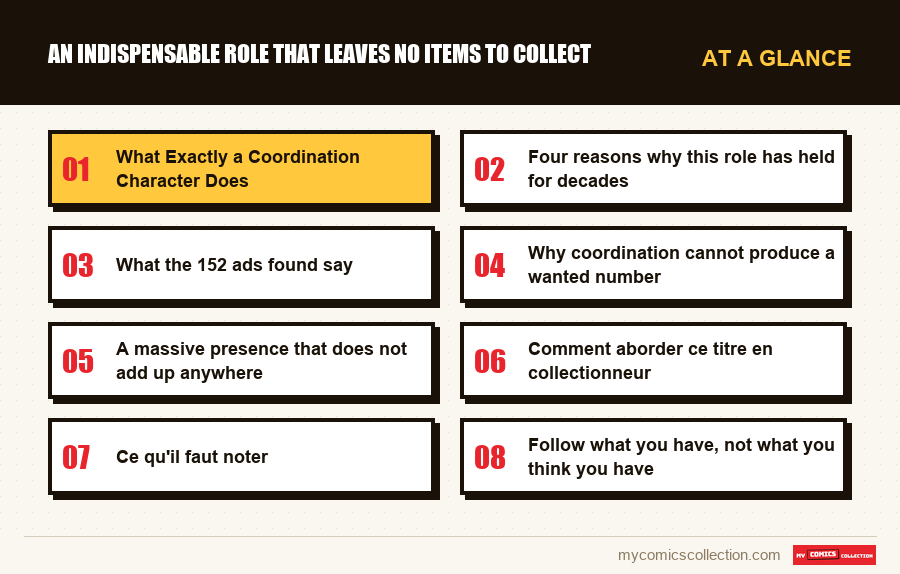
What Exactly a Coordination Character Does
The role is broken down into three recurring gestures. The first is intelligence: gathering scattered information, cross-checking it, transmitting it to those who have immediate use of it. The second is planning: breaking an operation into sequences, assigning each sequence to the right person, planning the break points. The third, and it is the rarest in fiction, is connection: bringing about a meeting between characters who would have no reason to cross paths, then maintaining this relationship over time. Barbara Gordon does all three, constantly, with a technical skill that belongs to no other character around her.
This skill is rare because it is difficult to write. A character who knows everything constantly threatens the tension of the story: if he can answer all the questions, there is no more investigation. The authors solved this problem by constraining it materially: it depends on what others will look for in the field, its information arrives late, incomplete, sometimes false. Coordination then becomes an exercise under constraint, and that’s what makes it relatable. But this writing solution has a decisive side effect: it disperses the character's contribution across the length of the arc. Nothing is focused.
Four reasons why this role has held for decades
A function that no other character fulfills
In a universe saturated with fighters, the coordinator's place is almost empty. Field heroes can't occupy it: they're on the ground. Mentors are too distant, civilian allies too poorly informed. Barbara Gordon fills a slot that no one else could fill, and this exclusivity has guaranteed her continued presence.
A skill transferable between titles
A field character remains attached to his city and his enemies. An intelligence character can appear anywhere, since his working tool is information, and information circulates. This is what explains the dissemination: it occurs in series which have no connection with each other, without its presence appearing forced.
A presence without leading competition
Because she never takes the spotlight, she does not come into conflict with any headliner. A screenwriter can introduce it into his title without having to negotiate the internal hierarchy of his casting. This functional neutrality explains why it has been used so often and for so long.
A continuity that the regular reader rewards
The reader who follows several titles recognizes its presence as a signal of coherence: he understands that the series belong to the same set. This reward is reserved for those who read widely. It is completely invisible to the person who opens a number taken at random: that is to say, to the second-hand buyer.
These four forces all work in the same direction: they display the character's contribution. None concentrates it in one point. And it is precisely the concentration at one point that creates an object sought after on the second-hand market. The link is mechanical: the more diffuse a role is, the less it leaves a salable trace. A successful coordination character is, by construction, a character without an iconic number.
An important methodological clarification: all the amounts cited here come from a count of advertisements published on eBay as of August 29, 2026. These are sums claimed by sellers, not concluded transactions. A seller can ask for whatever he wants; there is no guarantee that anyone will pay.
Second clarification, just as important: this reading was taken only once, at a single time. A single measurement describes a state, never a trajectory. Nothing in this data allows us to say that these amounts are rising, falling or stagnating: it would take at least two readings spaced over time to claim anything of this kind. No trend will therefore be asserted in this article.
What the 152 ads found say
The team series where Barbara Gordon fully exercises this coordination role (the one where she recruits, briefs and manages from the back) presented, as of August 29, 2026, one hundred and fifty-two announcements of uncertified copies. The range is $1.00 to $40.00, the median is $9.32. Next to it, only two ads were for verified copies, asking between $80.00 and $159.99.
A cap of $40.00
Out of one hundred and fifty-two proposals, the highest asks for $40.00. This is the tightest market encountered in this figure. On such a large volume, the total absence of high value is not a random sampling: it is the very shape of this market.
Peak-free distribution
A structured market almost always presents a few announcements far above the others, corresponding to episodes that the readership identifies as important. Nothing like that here. The distribution is flat: the ceiling is only a few multiples of the median, which is extremely low.
Lots at $1.00 each
Several consecutive issues of this series are offered at one dollar each by the same seller. A seller lining up a continuing sequel at the floor price has not identified any episodes worth extracting from the lot. It flows at number because nothing comes off.
Two copies checked out of 152
Having a copy certified costs money and time. This expense is only justified if there is a price difference to be captured between the raw state and the guaranteed state. Here, this gap does not exist: only two sellers out of one hundred and fifty-two considered the operation profitable.
High volume, low value
One hundred and fifty-two ads is a lot. The offer is abundant and easily accessible. This abundance, combined with a median of less than ten dollars, describes a series that is effortless to find and that no one really searches for.
Use value, not investment
A complete set at this price point is a great deal for anyone who wants to read. It is an object of reading, not an object of conservation. The distinction is structuring and should guide any purchasing decision on this title.
Why coordination cannot produce a wanted number
Let's look at the mechanism in detail, because it is more interesting than the simple observation. A number becomes sought-after when it contains something that does not exist anywhere else and is immediately recognizable: a first appearance, a costume change, a death, an identifiable confrontation. These are one-off, datable events that can be located in a specific example. The market knows how to name them, so it knows how to buy them.
Coordination has none of these properties. It has no founding moment that can be identified in a booklet: it takes hold gradually, through an accumulation of appearances, none of which is decisive. It does not produce a strong image: a character in front of screens, transmitting information, does not provide memorable coverage. And above all, her contribution is measured by difference: what the editorial line would have become without her. Now we do not buy a counterfactual difference; we buy an object.
We must measure what this implies. A reader who followed three series over four years has a very clear perception of the importance of the character: he saw the threads come together, he understood who held it together. This reader cannot, however, point to any number where this importance manifests itself. He therefore cannot ask anything from a seller. And a seller who is not asked anything specific sets a shelf price, not a piece price.
This is exactly the opposite of what happens for the character's field periods. Where it acts physically, there are tipping points, and these tipping points have left commercial traces. The cross-reading of key numbers around Batgirl shows this asymmetry: the action phases produce benchmarks, the coordination phase produces none. It is not a question of a hierarchy of quality, the coordination phase is often the best written, but of a difference in nature between two ways of existing in a story.
Collecting this series?
Track what you own, what you are missing and what your collection is worth. 7 day trial.
Start my trial →A massive presence that does not add up anywhere
The dissemination of the character in dozens of titles is, in itself, a remarkable phenomenon. Few secondary figures reach this degree of diffusion. But this distribution works against it on a commercial level, for a simple arithmetic reason: each appearance is diluted in a title which belongs to someone else. The issue is bought for its star, not for the guest who appears on three spreads. Its presence adds nothing to the price because it is not the reason for the purchase.
There is no mechanism for totalizing these appearances. There is no object that capitalizes on fifty interventions distributed in fifteen series. The catalog lists them one by one, which is perfect for documentation and useless for promotion. A value does not aggregate in this way: it crystallizes on an example or it does not exist.
The paradox deserves to be posed frankly. The more the character is present, the cheaper it is. Its very presence is what prevents scarcity: a reader who wants to find it has no difficulty in doing so, since it is everywhere. Difficulty of access, the usual driving force behind price, never plays a role in his case. To organize these scattered readings, a ordre de lecture construit is much more useful than a list of numbers to search for.
Comment aborder ce titre en collectionneur
The practical conclusions flow directly from the form of the market noted. With a median below ten dollars and a ceiling of forty, there is no selective acquisition strategy to pursue in this series. There is nothing to select: the differences between numbers are too small to make a decision. The only real tradeoff is material condition and shipping costs, which can represent a significant portion of the total cost at this price point.
The consequence is liberating rather than disappointing. A security without an internal hierarchy of value is a security that can be bought in blocks, without fear of making a mistake. The existence of continuous suites offered at the lowest price by the same seller also constitutes the most rational entry route: a coherent batch, a single shipment, a single contact. This is the least expensive way to access a dense narrative set.
Certification has no justification here. Two verified advertisements out of one hundred and fifty-two do not draw any market: they note that the operation interests almost no one. Paying to guarantee the condition of a copy only makes sense if this guarantee translates into an additional price on resale. On this title, this supplement does not exist in a documented manner, and two measurement points would not be enough to establish it in any case.
Ce qu'il faut noter
The coordinating role is a writing achievement, not an asset. It allowed a character deprived of his mode of action to remain central for decades, which is remarkable. But he leaves behind no example that the market knows how to designate, and this absence is not an accident: it arises from the very nature of the role.
Coordination is measured on the scale of an editorial line, never of an issue. This is the heart of the problem. A reader perceives the character's contribution after several dozen issues read in several titles. A buyer decides on a copy. The two scales do not meet, and it is the buyer's scale which sets the prices.
The cap at $40.00 on 152 ads is the most telling fact of the statement. It's not just a low level: it's the complete absence of upward dispersion. On a sample of this size, such a flat distribution means that no episode is identified as superior to the others by the selling readership.
The suites sold at a dollar each confirm the diagnosis from the other end. A seller who owns a complete series spontaneously seeks to isolate his best pieces. That on the contrary he aligns consecutive numbers at the floor price means that he has found nothing to isolate. The seller's behavior validates what the price distribution indicated.
Two verified copies out of one hundred and fifty-two close the file. Certification is a voluntary expense, incurred for gain. When almost no one hires it, it’s because no one anticipates any gain. In this series, the gap between gross and guaranteed is not wide enough to finance the operation, and the statement of August 29, 2026 shows this by simple counting.
Yes, and it's even one of the clearest cases of successful reinvention of a character. He occupies a place that no other figure could hold, he justifies his presence in unrelated series, and he gives the regular reader a thread of continuity. His literary success is not in question here. It's his commercial translation that sucks, and for reasons that have nothing to do with the quality of the writing.
Because each of these appearances is diluted into an issue purchased for another reason. The reader who buys a title does so for its star; the intervention of a secondary character on a few boards does not change what he is willing to pay. And nothing allows these appearances to be totalized into a single object: the value crystallizes on one copy or it does not exist.
As of August 29, 2026, counting eBay listings yielded one hundred and fifty-two uncertified listings ranging between $1.00 and $40.00, with a median at $9.32, and two listings of verified copies between $80.00 and $159.99. These are amounts requested by sellers, not closed sales, and they describe a single moment without saying anything about an evolution.
No. Certification has a cost and a delay, which are only justified if a measurable price difference separates the raw copy from the guaranteed copy. The report shows only two verified listings out of one hundred and fifty-two, indicating that almost no seller anticipates such a discrepancy. In this series, the expense has no documented counterpart.
In blocks rather than piecemeal. Since no numbers stand out, there is nothing to select and the only real trade-off concerns material condition and shipping costs, which weigh heavily at this price point. Continuous suites offered at the lowest price by the same seller offer the best ratio between total cost and reading consistency.
Follow what you have, not what you think you have
A series that is purchased in blocks is also a series where one unknowingly buys back numbers that have already been stored. Maintaining an up-to-date inventory, issue by issue, costs a few minutes and avoids exactly this kind of duplication. My Comics Collection gives you the real status of your series, on computer and on the phone.