Here is the Immortal Hulk reading order: read the series in publication order, from Immortal Hulk #1 (June 2018) to #50 (October 2021), by Al Ewing and Joe Bennett. The run is fifty monthly issues plus a #0 published in September 2020, and it breaks into seven stages of five to ten issues. The related one-shots are optional: this page places each tie-in at its release date, between the stages it touches.
Few recent Marvel series read as well in order. Each stage below matches a cycle of the story, with its issues, its years and the side stories that slot in next to it. We kept publication order rather than internal chronology, because the series does not play games with time jumps.
As always in this guide, we only state verified information (creators, issue numbers, dates); the analysis is our own, with no reproduction of panels or protected dialogue.
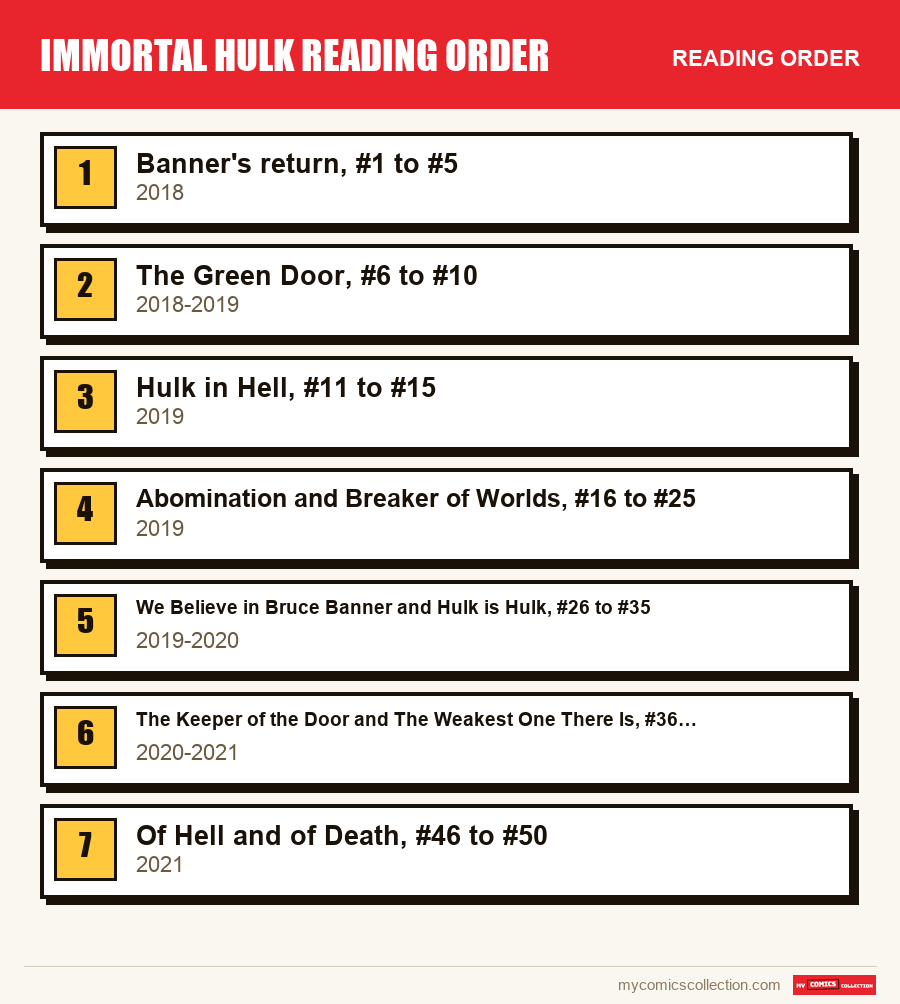
Stage 1: Banner's return, #1 to #5 (2018)
The series opens with Immortal Hulk #1, in June 2018. Al Ewing writes, Joe Bennett draws, and Alex Ross provides the main cover. The first collected edition, Or Is He Both?, gathers the first five issues, plus a piece from the Avengers series (issue 684 of volume 7), which is not essential to understanding the story.
The premise these five issues set up is simple: Bruce Banner dies, and comes back. Every night, the green creature takes over again, and the day belongs to Banner. Ewing chooses to treat Hulk as a horror story rather than a superhero series, and he does so first by entrusting part of the investigation to a journalist, Jackie McGee, a character who follows the trail of the phenomenon. Our entry on Immortal Hulk #1 details the contents of the first issue and why collectors hunt for it.
How do you read this stage? Straight through, from #1 to #5. It is also the best time to decide whether the tone suits you: if body horror and the slow pace of the story put you off, the next forty-five issues will not win you over to the series.
Stage 2: The Green Door, #6 to #10 (2018-2019)
The second collected edition is titled The Green Door and covers Immortal Hulk #6 to #10. It was released as a volume in February 2019. This stage widens the scope: after introducing the resurrection mechanism, the team begins to show where it comes from, and why it does not concern Banner alone.
This is where the series' own mythology appears, with its places and its rules. Ewing adds a mystical dimension to the gamma franchise without betraying the character's scientific origin. The tension of each issue rests on one very simple thing: the other characters cannot decide whether what they see is a man, a monster or a punishment.
In December 2018 came a one-shot with art by Simone Di Meo, The Best Defense #1, with Al Ewing writing. It accompanies an event tied to the Defenders series. You can read it right after #10 without losing anything from the monthly series, or skip it on a first read.
Stage 3: Hulk in Hell, #11 to #15 (2019)
The third collected edition, Hulk in Hell, gathers Immortal Hulk #11 to #15 and came out in May 2019. The title announces the turn: the series leaves the American roads for an infernal setting, and asks about the nature of the afterlife in the Marvel universe. It is the first cycle where Ewing accepts that his Hulk is no longer just an urban myth.
This stage is useful for two reasons. First, it shows that the series can change its setting without losing its logic: the rhythm of the chapters stays that of an investigation story, but the space changes. Second, it sets the tone for the following stages, where the border between the living and the dead is storytelling material rather than a backdrop.
For reading: stay on the monthly thread. No side story is needed in this range of issues; the series forms one continuous block, and that is its main strength.
Stage 4: Abomination and Breaker of Worlds, #16 to #25 (2019)
This stage brings together two collected editions: Abomination (Immortal Hulk #16 to #20, September 2019) and Breaker of Worlds (#21 to #25, November 2019). The first puts one of the character's historic enemies, the Abomination, back in play, in the series' own register: more intimate and more unsettling than the clash of brute force of previous decades. The second changes scale, and introduces stakes that go beyond Banner himself.
This range also matches the moment when the series caught on with readers. These are the issues you run into most often when completing the run one issue at a time. We come back to them in our study of modern Hulk key issues.
One one-shot attaches to this stage: Absolute Carnage: Immortal Hulk #1, published in October 2019, written by Filipe Andrade with Chris O'Halloran on colors. It is a story tied to the Absolute Carnage event, optional for anyone reading the series for its own sake.
Stage 5: We Believe in Bruce Banner and Hulk is Hulk, #26 to #35 (2019-2020)
Two more collected editions: We Believe in Bruce Banner (Immortal Hulk #26 to #30, March 2020) and Hulk is Hulk (#31 to #35, September 2020). The first title states the intent: after establishing the monster, the series turns to the man, and to those who keep believing in him despite everything.
This is the stage with the most side material, and the reading order calls for some method. Here is what comes out during these ten issues, by date:
- Immortal Hulk: Great Power #1, February 2020, written by Tom Taylor;
- Immortal Hulk #0, September 2020, written by Al Ewing and drawn by Mattia de Iulis, a framing story that retells the character's origin;
- Empyre: The Immortal She-Hulk #1, September 2020, by Al Ewing and Jon Davis-Hunt;
- Immortal Hulk: The Threshing Place #1, September 2020, written by Jeff Lemire and drawn by Mike del Mundo.
The #0 deserves a note. Its number suggests you should read it first, but it came out more than two years after #1, and it builds on what the reader already knows. We recommend reading it at its release date, or after #50 if you want to preserve the surprise of the early issues. The other three are detours, which you can ignore without any gap in the main thread.
Do you collect this series?
Track what you own, what you are missing and what your collection is worth. 7-day trial.
Start my trial →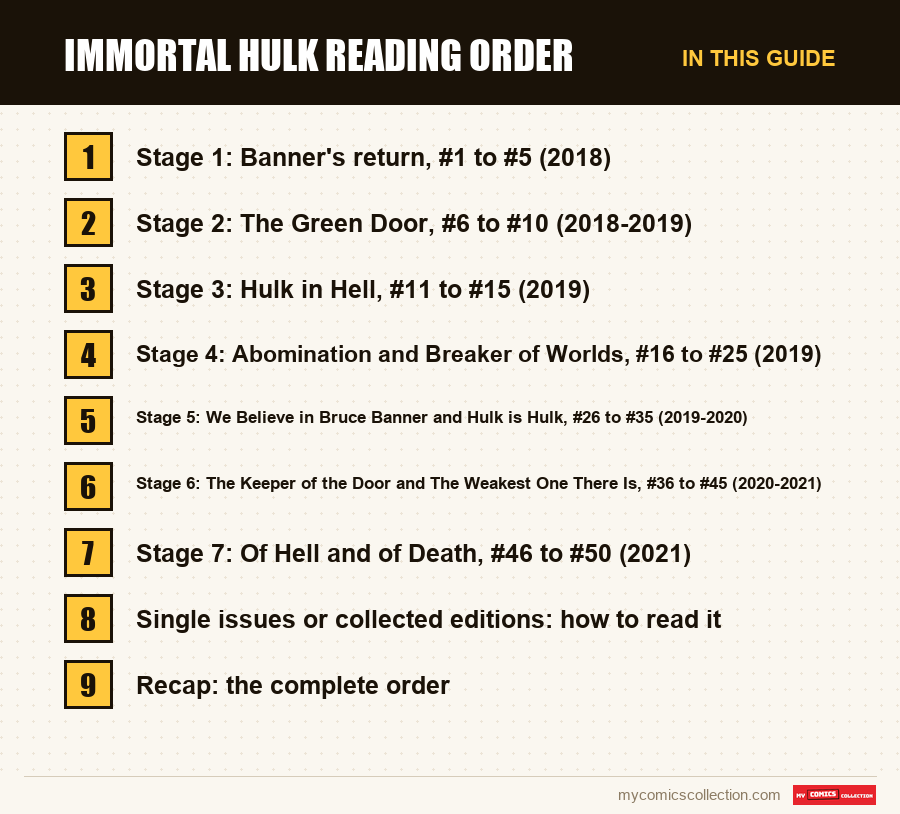
Stage 6: The Keeper of the Door and The Weakest One There Is, #36 to #45 (2020-2021)
Collected editions eight and nine cover this range: The Keeper of the Door (Immortal Hulk #36 to #40, January 2021) then The Weakest One There Is (#41 to #45, June 2021). The series enters its convergence phase: the threads laid since 2018 tighten, and the reader who followed the earlier stages recognizes what each recurring character stands for.
The word "tie-in" takes on its full meaning here, because three side stories slip in between these issues:
- King in Black: Immortal Hulk #1, December 2020, by Al Ewing and Aaron Kuder, attached to the King in Black event;
- Immortal Hulk: Flatline #1, February 2021, written by Declan Shalvey;
- Immortal Hulk: Time of Monsters #1, May 2021, by Alex Paknadel and Al Ewing, drawn by Juan Ferreyra.
Of these three, Ewing's is the closest to the main series. The other two read as variations on the theme, useful for completing but not for understanding. The important thing is not to interrupt your reading in the middle of a five-issue cycle: insert the side stories between two collected editions, not in the middle of one.
Stage 7: Of Hell and of Death, #46 to #50 (2021)
The tenth and last collected edition of the main series, Of Hell and of Death, gathers Immortal Hulk #46 to #50 and was released in December 2021. The final issue is dated October 2021. After fifty issues, the series closes the loop it opened in 2018: what began as a gas station mystery becomes the conclusion of a cycle of life and death.
If you read in publication order, you finish here, with the satisfaction of a complete story. The series leaves no major thread hanging, which is rare for a Marvel run of this length.
Two follow-ups exist, both optional. Gamma Flight #1 to #5 follows the team of gamma characters after #47 of the parent series, and the collected edition Defenders: There Are No Rules reprints Defenders (volume 6) #1 to #5 to show what becomes of one of the characters after #48. They extend the universe without being the direct sequel.
Single issues or collected editions: how to read it
Ten numbered collected editions follow exactly the stage breakdown above: each contains five issues, except the first, which adds a piece from Avengers, and the last, which is thicker. This regularity makes reading in volumes easy. An eleventh collected edition, Apocrypha, published in January 2022, gathers the one-shots written by Al Ewing along with part of Time of Monsters. Another, Great Power, collects the one-shots handed to other writers.
In single issues, the series is easy to complete: all fifty issues came out in a little over three years, with a large number of variant covers. If you are completing the run one issue at a time, start by fixing Alex Ross's main cover as your reference, then treat the variants as a second goal. Different printings of the same issue complicate comparisons, as we explain in our guide to Hulk annuals and specials.
Our advice: read in collected editions for the story, and keep the single issues for the collection. #1 is the only issue that justifies a separate purchase, because the series it opens has become a reference. If you are starting out collecting Hulk, the beginner collector's guide places this series within the character's overall history.
Recap: the complete order
- Immortal Hulk #1 to #5 (2018)
- Immortal Hulk #6 to #10, then The Best Defense #1 (December 2018, optional)
- Immortal Hulk #11 to #15 (2019)
- Immortal Hulk #16 to #25 (2019), with Absolute Carnage: Immortal Hulk #1 (October 2019, optional)
- Immortal Hulk: Great Power #1 (February 2020, optional)
- Immortal Hulk #26 to #35 (2019-2020)
- Immortal Hulk #0 (September 2020), Empyre: The Immortal She-Hulk #1 and The Threshing Place #1 (September 2020, optional)
- King in Black: Immortal Hulk #1 (December 2020, optional)
- Immortal Hulk #36 to #45 (2020-2021), with Flatline #1 (February 2021) and Time of Monsters #1 (May 2021, optional)
- Immortal Hulk #46 to #50 (2021)
- Optional: Gamma Flight #1 to #5 and Defenders (volume 6) #1 to #5
Frequently asked questions
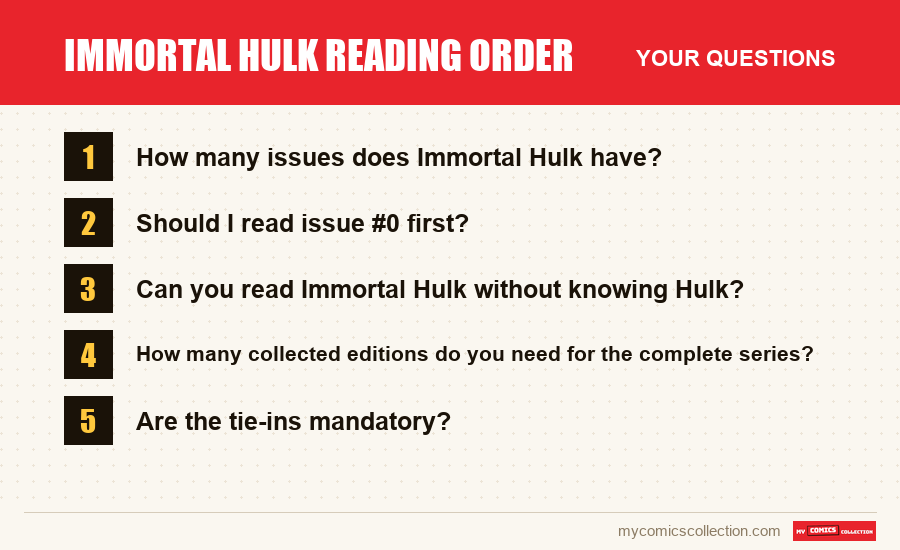
The main series has fifty issues, from Immortal Hulk #1 (June 2018) to #50 (October 2021), plus a #0 released in September 2020. About a dozen one-shots tied to events or by other writers come on top of that, but none is needed to follow the main story.
No. Immortal Hulk #0 came out in September 2020, more than two years after #1, written by Al Ewing and drawn by Mattia de Iulis. It retells the character's origin as a framing story. Read it at its release date or after #50, but not before #1.
Yes. The 2018 #1 is designed as an entry point: it sets up Bruce Banner, his death and his return without requiring any prior reading. References to older history enrich the read but do not condition it, including the callbacks to the Abomination in #16 to #20.
Ten collected editions cover the main series: from Or Is He Both? (#1 to #5) to Of Hell and of Death (#46 to #50). An eleventh, Apocrypha (January 2022), gathers Al Ewing's one-shots. The collected edition Great Power collects those handed to other writers.
No. One-shots like The Best Defense (December 2018) or King in Black: Immortal Hulk (December 2020) are optional: the story told in the fifty issues stands on its own. Read them between two collected editions if you want to be complete, never in the middle of a cycle.
Are you completing all fifty issues of Immortal Hulk and unsure about the value of a first printing? Have your copy appraised.
Estimate my comic