
A complete Hulk collection covers 5 main series: Incredible Hulk #1-6 (1962-63), Tales to Astonish #60-101 (1964-68), Incredible Hulk #102-474 (1968-99), Hulk vol.2 #1-112 (1999-2008) and Incredible Hulk vol.3/Incredible Hulks (2009-2011), plus modern relaunches: either approximately 700+ regular numbers excluding annuals and mini-series.
Collecting Hulk in its entirety is an ambitious project that spans more than 60 years of continuous publication under varying titles, numberings and creative directions. From Jack Kirby's first #1 in 1962 to the modern incarnations of Immortal Hulk, the franchise offers exceptional narrative diversity: horror, science fiction, road movie, cosmic epic and psychological drama.
This guide maps the entire Hulk series, establishes a realistic roadmap by budgetary levels and identifies the essential runs to build a coherent collection, whether your goal is absolute completeness or a reasoned selection of highlights.
The original series: Incredible Hulk #1-6 (1962-1963)
The first Hulk series by Stan Lee and Jack Kirby only lasted 6 issues before being canceled due to lack of sufficient sales. These 6 issues constitute the Holy Grail of any Hulk collection. #1 (first appearance, Gray Hulk) is a several hundred thousand dollar comic in high condition. #2-6 are more accessible: $2,000-15,000 depending on rank and number.
For most collectors, these issues represent an end goal rather than a starting point. Examples in acceptable condition (2.0-4.0) of #2-6 can be found between $2,000 and $5,000 each. #1 remains out of reach for modest budgets even in low condition ($15,000-30,000 in CGC 1.0-2.0).
Realistic strategy: Start with #2-6 in average condition, targeting one number per year. Reserve #1 for later or accept an incomplete/restored copy as a placeholder. Some collectors opt for a “qualified” CGC 0.5 (missing pages) from #1 at $8,000-12,000 to complete the set.
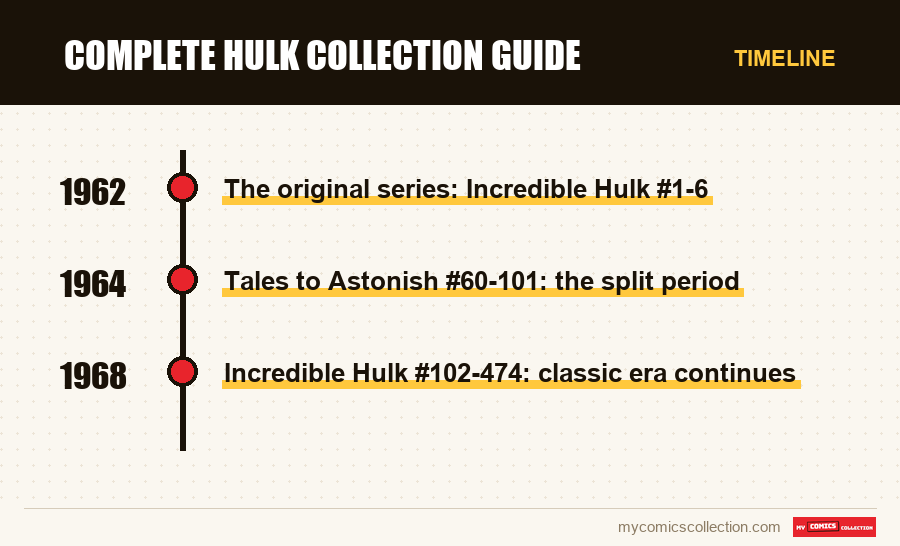
Tales to Astonish #60-101 (1964-1968): the split period
After his series was canceled, Hulk shared the Tales to Astonish title with Giant-Man and then Sub-Mariner. #60 marks the return of Hulk as a regular feature. Key issues include #62 (first Leader), #69-76 (Hulk vs. Hercules arc), #90 (Abomination first appearance in a split-book format), and #101 (last issue before the move to Incredible Hulk #102).
This run of 42 numbers is relatively affordable: most non-key numbers can be found between $30 and $80 in good condition (4.0-6.0). The complete run #60-101 in mid-grade represents an investment of $3,000-5,000. This is a great segment for Silver Age collectors who want vintage authenticity without the prohibitive prices of #1-6.
Incredible Hulk #102-474 (1968-1999): classic era continues
The character's longest continuous run, spanning 372 issues and over 30 years of publication. Narrative highlights and essential key issues: #102 (first issue of the renamed series), #141 (first Doc Samson), #162 (first Wendigo in Hulk), #180-181 (first Wolverine appearance: the most expensive in the run), #271 (first Rocket Raccoon), #340 (Hulk vs. Wolverine by McFarlane).
Recommended budget breakdown:
Issues #102-200 (Silver/Bronze Age): $50-200 per issue in mid-grade for non-keys, with #180-181 as major investments ($1,500-8,000 depending on grade). Numbers #201-400 are the most accessible segment: $5-30 per number excluding keys, with complete runs of 50 numbers found in batches for $200-400. #401-474 (90s) remain very affordable at $3-10 per issue.
Peter David's run (#328-467, 1987-1998) represents 140 issues of continued creative excellence. It's the most critically respected Hulk run and a satisfying collector's project in its own right. In reading condition (VF/NM), count on $800-1,500 for the set.
The modern era: from Hulk vol.2 to Immortal Hulk (1999-2021)
Hulk vol.2 #1-112 (1999-2008): Series relaunched with Bruce Jones then Greg Pak. Includes the Planet Hulk run (#92-105) which became one of the most famous Hulk arcs. #92 (start of Planet Hulk) in CGC 9.8: $80-150. World War Hulk #1-5 (2007) completes the arc with a devastating mini-event.
Incredible Hulk vol.3 and Incredible Hulks (2009-2011): Transition period with Red Hulk (Thunderbolt Ross) and the extended Hulk family. Short series but contains first appearances of characters used in She-Hulk (Disney+). Budget for the complete run in NM: $200-400.
Immortal Hulk #1-50 (2018-2021): Al Ewing and Joe Bennett's modern masterpiece. Complete, self-contained run that reinvents Hulk as a psychological horror comic. The #1 in CGC 9.8: $100-180. This series is considered one of the best Marvel runs of the decade and is gradually gaining value. An absolute must for any Hulk collection.
Mini-series, annuals and essential supplements
Annuals: The Incredible Hulk Annuals #1-20 (1968-1994) contain often significant stories. Annual #1 is worth $200-500 at mid-grade. The following are affordable at $10-40 each. Annual #7 (crossover with Angel and Iceman) and #14 (Beta Ray Bill backup) are the most sought after after #1.
Key mini-series: Future Imperfect #1-2 (1992, first Maestro by Peter David and George Perez) is a modern grail at $50-100 in CGC 9.8 for #1. Hulk: Gray #1-6 (2003, Loeb/Sale) offers a rereading of the origins in exceptional artistic quality. World War Hulk: Gamma Corps and Warbound complete the Planet Hulk universe.
Estimated overall budget for a complete collection: Excluding Incredible Hulk #1, an exhaustive Hulk collection (all regular series, main annuals, major mini-series) represents $25,000-50,000 depending on the conditions targeted. An "essential" collection covering the 50 most important issues of each era is achievable for $8,000-15,000.
5-year acquisition plan
Year 1: Build the base with the Peter David run (#328-467) in reading condition and Immortal Hulk #1-50 in NM. Budget: $1,500-2,500. You will immediately have 190 numbers of exceptional quality.
Year 2: Add Planet Hulk/World War Hulk and the rest of volume 2 (#1-112). Start Tales to Astonish #60-101. Budget: $2,000-4,000.
Year 3: Complete Incredible Hulk #200-327 (70s-80s between classic eras). Add the annuals. Budget: $2,000-3,000.
Year 4: Attack segment #102-200 (Silver/Bronze Age keys). Target #180 and #181 if your budget allows. Budget: $3,000-10,000 depending on ambition.
Year 5: Fill in the gaps, target the original #1-6 if you can afford it, add the missing mini-series and one-shots. Budget: variable depending on objectives.
Do you own Hulk comics? Estimate the value of your collection for free to know their current rating.
Frequently Asked Questions
Five main series: Incredible Hulk #1-6 (1962-1963), Tales to Astonish #60-101 (1964-1968), Incredible Hulk #102-474 (1968-1999), Hulk vol.2 #1-112 (1999-2008) and Incredible Hulk vol.3 or Incredible Hulks (2009-2011). Add the modern relaunches, for roughly 700 regular issues excluding annuals and miniseries.
This first series by Stan Lee and Jack Kirby lasted only six issues, canceled for lack of sales. #1, the first appearance with the grey Hulk, remains out of reach for modest budgets. The realistic strategy is to start with #2-6 in mid-grade, one per year, and keep #1 for later.
#60 marks Hulk's return as a regular feature, shared with Giant-Man and then Sub-Mariner. Keys include #62 (first Leader), #69-76 (Hulk versus Hercules arc), #90 (first appearance of Abomination) and #101, the last issue before Incredible Hulk #102. It is an ideal segment for tasting vintage without the price of #1-6.
#102 opens the renamed series, #141 introduces Doc Samson, #162 the Wendigo in Hulk, #180-181 the first appearance of Wolverine and #271 the first Rocket Raccoon. #340 pits Hulk against Wolverine under McFarlane's pencil. #180-181 are the most expensive of the run.
Peter David's run (#328-467, 1987-1998) spans 140 issues of continuous creative excellence, and is the most respected. Issues #201-400 form the most accessible segment, and the 1990s #401-474 remain very affordable. Complete runs of about fifty issues can be found as lots.