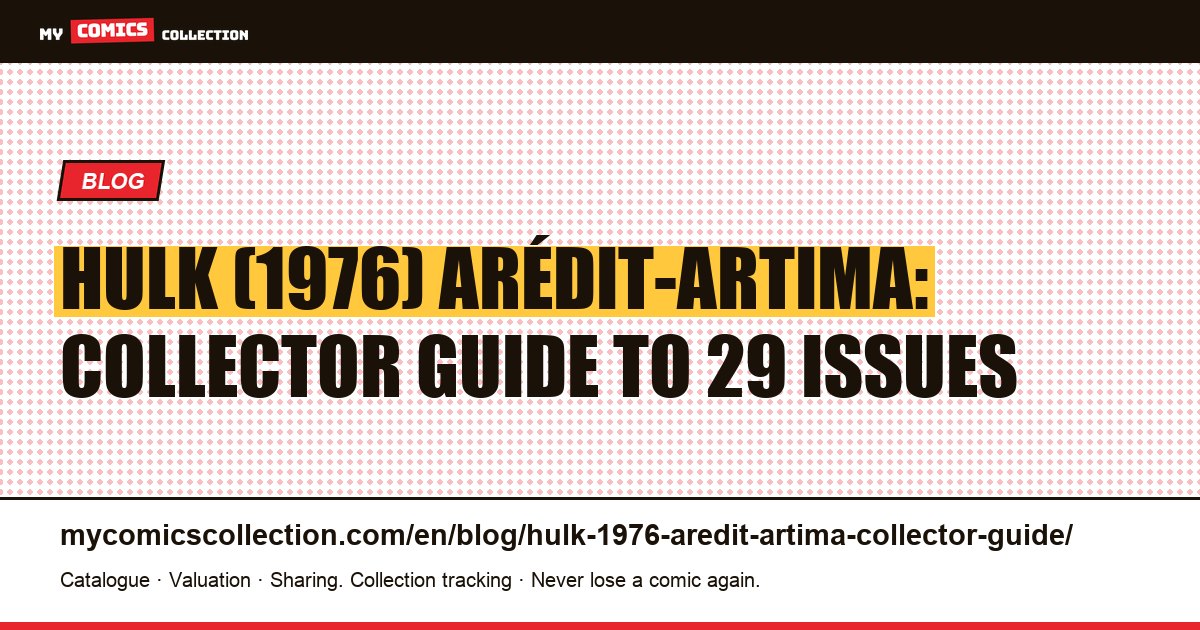
The Arédit-Artima magazine Hulk (the French magazine) runs to twenty-nine issues, from the first dated December 1976 to the last dated September 1983. Its numbering is complete, with no missing rank, but publication stops for thirty months in the middle. Watch out: a second magazine titled Hulk, published by Semic from 1992, covers exactly the same range of numbers. When you see a listing, the cover date decides, never the issue number alone.
A seller offers you a "Hulk number 12" and you do not know whether you are buying a 1978 issue or an album from the early nineties. That is not a small detail: between the two French magazines that carried this title, the format, the creative team and the content are entirely different. This guide covers the first one, launched at Arédit-Artima at the end of 1976, and gives you the method to never confuse the two.
As always on this guide, only verified information (creators, numbers, dates) is stated as fact. The analysis is ours, with no reproduction of panels or protected dialogue.
What the magazine published, and what its first contents page reveals
The most telling fact about this series lies in its opening. The first issue, dated December 1976, carries the catalogue title "Hercule". Not "Hulk". There is no error here: the label simply shows that the magazine's title announced its star, not the whole of its content, and that the story chosen for the contents could belong to a series other than the one featuring the cover hero.
The rest confirms it. The titles recorded across the whole series form a mixed catalogue: "Mogol", "Submariner", "Faucon Noir", "Miss Marvel", "Conan le Barbare", "L'origine de Blok". You even find "Le Pape Jean Paul II" and "Télé Junior", two titles that suggest no superhero story at all and look more like features inserted into the issue. In other words, you are buying an anthology, not a monographic collection.
Only one issue out of twenty-nine bears exactly the name of the magazine: number sixteen, titled "Hulk!". It is precisely the restart issue after the interruption we discuss below, as if the publisher wanted to put its star back up front when relaunching the title. Keep this marker in mind: if the main title announces Hulk, you are in the second period of the magazine.
Three publication rhythms, and a thirty-month interruption
The cover dates trace a curve that is anything but regular. The gap between the first issue and the next is only one month, then the rhythm stretches to one issue per quarter through 1977 before tightening again. For a collector, this means that a year printed on a cover does not let you guess the rank of the issue, nor the reverse.
In the second half of 1978, the rhythm becomes strictly monthly: six issues follow one another from July to December without skipping a month. This is the densest period of the series, and the one where you most easily find coherent lots, since these close-together issues were bought in a row by the same readers.
Then comes the break. Issue fifteen is dated December 1978, issue sixteen June 1981. Thirty months separate them, and not a single issue fills the gap. This is the structuring fact of the title: you are not looking for a continuous run but for two distinct sets joined under a single numbering. When publication resumes, it settles into one issue every two months, kept without fail until the last one, dated September 1983.
Two magazines, one single range of numbers
Here is the central trap, and it is a harsh one: the Hulk magazine launched by Semic in spring 1992 also has twenty-nine issues. The overlap in numbering between the two series is therefore not partial, it is total. Each rank designates two different objects, and not one of them settles the ambiguity by itself.
The setup is particularly treacherous, because it neutralises the collector's usual reflex. Faced with two homonymous series, one normally looks for the overlap zone in order to be wary of it. Here there is no safe zone: a "Hulk 3" cannot be identified, and neither can a "Hulk 27". Listings that give only the title and the number are structurally incomplete, and this also applies to the want lists you exchange between collectors.
The good news is that the two series never touch in time. The last Arédit issue carries an autumn 1983 date, the first Semic issue a spring 1992 date: nearly nine years apart, with not the slightest overlap of years. The cover date is therefore an absolute discriminant, for every rank, without exception.
Faced with a listing: how to tell which one you are buying
Always ask for a photo of the cover, and of the colophon if the seller agrees, then stop as soon as one criterion settles it. The cover date first. A year from late 1976 to autumn 1983 points to the series covered here; a year in the nineties points to the other one. The publisher's name next, legible on the cover or in the colophon: Arédit-Artima on one side, Semic on the other.
The credits, last, which helps when the cover is damaged. The nineties series is the work of a single writer, Peter David, credited throughout with one artist per period. The Arédit series systematically stacks several names per issue and changes team over the years. If the contents rest on a single writing credit, you are not looking at the 1976 series.
The creators, and what their dates reveal
One name dominates the series from end to end: Herb Trimpe, credited as penciller on twenty-two of the twenty-nine issues, from the very first to the very last. For a small anthology format, this thread is rare, and it is an argument for consistency if you present the series. Notably, he even appears once as writer, on issue twenty-two.
His presence is not uniform, however, and this is where reading becomes instructive. Trimpe signs the first fifteen issues without missing one, then disappears completely from the six issues that follow the 1981 restart, before reappearing from issue twenty-two to twenty-nine, except for issue twenty-eight. This gap matches exactly the restart phase, which suggests the publisher drew on another pool of material when relaunching the title.
On the writing side, the series divides into two clear eras. Roy Thomas is credited on thirteen issues, from the first to the sixteenth, and then disappears. Len Wein occupies nine strictly consecutive issues, from the sixteenth to the twenty-fourth: a remarkable continuity in a magazine that changes its contents with every delivery. The two names only cross on the restart issue, which makes it a true hinge. The final stretch goes to other hands, Marv Wolfman appearing on the last three issues and Ed Hannigan on two of them.
One detail deserves your attention: the catalogue also credits French names as writers on some issues, notably the twelfth and the fourteenth. The magazine's content was therefore not entirely of American origin, which reinforces the warning given above about correspondences.
The issues that matter in this series
The first issue naturally concentrates demand, like any first number. It also has a distinctive feature that makes a good story: its contents page does not bear the name of the magazine's hero. This kind of quirk means a copy sells faster than its neighbours, in comparable condition.
The sixteenth is the other strategic piece, for a reason few buyers appreciate. It is at once the restart issue after the interruption, the only one whose contents page carries the magazine's name, the turning point between the two writing teams and the start of the bimonthly rhythm. Four breaks in a single issue: it is the number to secure first if you are building the series piece by piece.
The six issues of the monthly period of 1978 form a block of their own. Published back to back, they often circulate grouped and are easier to find in a lot than singly; buying them together is generally a better deal, provided the condition is consistent. The last issue, for its part, is a closing number: the ends of series were printed lower, for lack of remaining readers, and it is often this one that blocks a complete collection for months.
Do you collect this series?
Track what you own, what you are missing and what your collection is worth. 7-day trial.
Start my trial →
Recognising the edition and judging the copy
Always begin with the colophon, the legal-notice box printed in small type on one of the first or last pages. You will find the publisher, the legal deposit and the date there, exactly the elements that settle the ambiguity between the two homonymous magazines. A listing that refuses to show that page deserves your suspicion.
On paper, these small formats age in recognisable ways: browning of the page edges, a fragile spine, corners rounded by handling, reading creases down the centre of the cover. This is the norm rather than the exception. A copy that is perfectly flat and white for its age should, on the contrary, make you look twice, either because it is an exceptional piece kept flat in a box, or because the photo was taken under flattering light.
Buying traps
The main trap is now clear, and it comes with a second one that concerns lots. A set advertised as "Hulk, issues 1 to 10" may well mix issues from both series without the seller being aware of it, especially if he inherited a collection and copied the numbers without looking at the dates. Ask for a photo of the whole set spread out, not a stack seen from above.
Another trap comes from the publication break. A buyer who does not know about it will believe that numbers are missing from a series that is in fact complete, or will let himself be persuaded that a run stopping at issue fifteen is "complete as published". It is not: the magazine did resume, and the full collection counts twenty-nine issues.
Completing the series, issue by issue
The strategy follows from the structure established above. Treat your hunt as two separate campaigns: the set before 1979 on one side, the set after 1981 on the other. The two do not circulate in the same lots, because they were not bought by the same readers at the same time, and because two and a half years of absence are enough to lose part of the readership along the way.
Pay attention to condition consistency. A set in which all copies show comparable ageing resells better than the same set where two flawless issues sit next to a very worn lot. Think also about physical markets: these small formats remain plentiful at flea markets and in second-hand bookshops, where they are shelved by title rather than by publisher. This is exactly where the confusion between the two magazines works in your favour, since you will know how to sort them by date when nobody else does. Our publishing features extend this method to other titles.
Today's value, and how to follow the collection
Do not look for a price in this article, and that is deliberate: the value of a small format depends on its condition, its completeness and the demand of the moment, three variables that only observing the market can tell you. What can be given, however, are ratios. A first issue in good condition sits clearly above the average of the common issues, and the gap widens as the condition improves.
To follow this without making mistakes, the only discipline that works is to write the publisher and the cover date next to each rank in your inventory. A line that contains only "Hulk 12" is unusable as soon as two magazines carry that title, and the problem will surface at the worst moment, on the day you sell or insure the collection.
What to remember
An anthology of twenty-nine issues spread over nearly seven years, interrupted in the middle and drawn by one and the same hand from start to finish: each of these traits is a tool for recognition, not an anecdote.
And above all, this magazine shares its title and its entire range of numbers with a second magazine published in the nineties. Get into the habit of never citing an issue of this series without its date: that is the reflex that keeps you safe for good, when buying as when selling. The Hulk and She-Hulk hubs extend this reading on the character side.
Frequently asked questions
The series runs to twenty-nine issues, from the first dated December 1976 to the last dated September 1983. The numbering is complete: no rank is missing. However, publication stops for thirty months between the fifteenth and the sixteenth issue. A complete collection therefore does comprise twenty-nine issues, spread over two clearly separated periods.
Because the magazine was an anthology: the title announced its star, not the whole of its content. The catalogue records only one piece per issue, and on the opening number that piece is not the one featuring the title character. The actual contents should be checked on the copy itself, contents page and colophon included, because a single title does not tell you everything about a small format.
By the cover date, which always decides: the Arédit series runs from late 1976 to autumn 1983, the other starts in spring 1992. The two date ranges never overlap. The publisher's name in the colophon confirms it, and so do the credits: the nineties magazine rests on a single writer, while the Arédit one stacks several names per issue.
The sixteenth, dated June 1981. It combines four breaks: restart after the interruption, the only contents page bearing the magazine's name, change of writing team, and start of the bimonthly rhythm. The first issue comes next, then the last, often the hardest to find because the closing issues sold less and were less often kept.
Not from catalogue records alone, which keep only one title per issue even though the magazine contained several. French names do appear in the credits of some issues, a sign that the content was not entirely imported. Any correspondence must be established with the copy in hand, by comparing the stories page by page, and never deduced from a translated title.