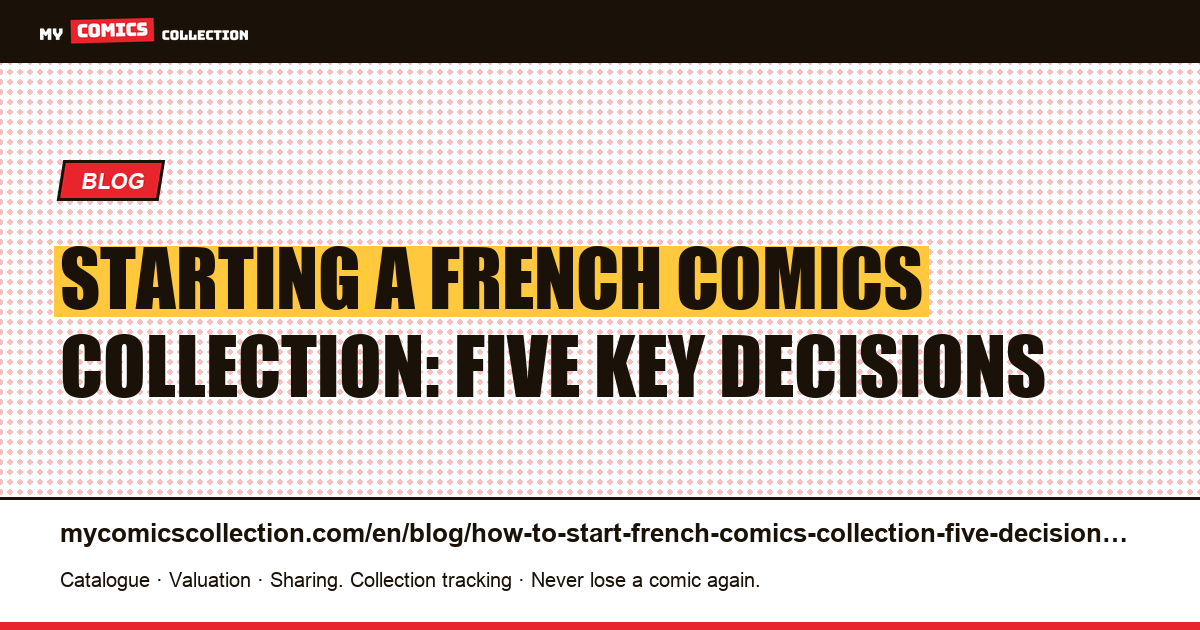
Five decisions govern a French-language comics collection, and they must be made before the first purchase: aim at a title or a character, a short series or a long run, a fine condition or accepted wear, lots or issues chosen one by one, an inventory kept from the start or postponed. Each one commits you to several years of searching and closes doors that cannot be reopened without starting over.
A French collector who is just starting does not run first into a shortage of copies, but into the absence of boundaries. The field of newsstand magazines is vast: our catalog of French-language series covers sixty-seven titles and more than three thousand three hundred issues, published between the mid-1950s and the late 1990s. Faced with such a mass, buying at random amounts to building a stock, not a collection. The five decisions that follow do not tell you what to buy: they tell you what each choice commits you to searching for over the following years.
As always on this guide, only verified information (creators, issue numbers, dates) is stated as fact; the analysis is our own, with no reproduction of panels or protected dialogue.
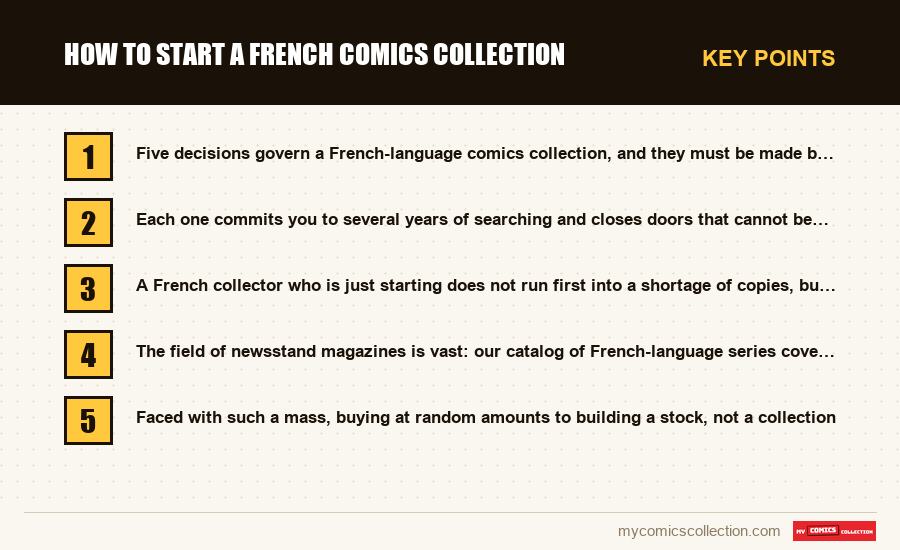
Why these decisions are made before the first purchase
A collection is not the sum of what you own; it is the definition of what you are missing. As long as the scope has not been set, no gap exists, so no progress can be measured. This is why the starting decisions matter more than the first finds: they create the list.
These decisions are not reversible at the same cost. Changing your mind about the condition you accept forces you to rebuy what you already have. Changing your mind about the scope, by contrast, leaves you with copies that remain valid, simply off-topic. Before deciding, it is therefore worth knowing which of your decisions will be the most expensive to undo.
One last point before going into detail: none of these five decisions depends on your means. They depend on the time you can give to it, the space you have, and your tolerance for the unfinished. A hurried collector and a patient collector do not make the same decisions, even with the same budget.
Decision 1: collecting a title or a character
Collecting a title means accepting a closed list written by a publisher. Collecting a character means accepting an open list that nobody has ever closed. The difference is not theoretical: Spider-Man runs through several successive newsstand magazines, from the monthly series bearing his name to the later collections, in addition to the episodes published in anthology magazines. Whoever targets the character ends up hunting across a dozen distinct series, from several publishers, over more than twenty years.
The trap is that the character list never really closes. Our series records retain only one story title per issue, whereas a French anthology magazine often published three or four. It is therefore impossible, from a catalog alone, to know whether a given issue contains an episode of your character: the check is made with the contents page in hand. Whoever collects a character accepts in advance to work from an incomplete list and to correct it copy by copy.
Collecting a title has the opposite merit: the list is known, numbered, and it has an end. It has a symmetrical flaw, and it is a real one: you will buy issues that do not interest you, because they are part of the series. Many advanced collectors end up holding both, a complete title for the satisfaction of finishing, and a followed character for the pleasure of searching. But starting with both at once rarely goes far.
Decision 2: a short series or a long run
The length of a series reads as a commitment in time, not as a number of issues. In our catalog, the median sits around thirty-three issues per series, and eighteen titles do not exceed twenty-five issues. A series of this size is a collection you can finish in a few years without devoting your life to it, and whose end you will see.
At the other extreme, Ombrax counts two hundred and forty-two issues spread over some twenty years. That is no longer a goal, it is a program. The last missing issues of a series this long take a long time to arrive not because they are rare, but because the probability of crossing them at the right moment becomes low when only a few remain to be found. The end of a long series costs more effort than its beginning, and this asymmetry surprises nearly every beginner.
Long runs hold a second surprise: they change hands along the way. Strange appears under a single numbering running from the first issue to the three hundred and thirty-fifth, but it was carried by two successive publishers, the second having picked up the numbering where the first left it. Deciding to collect Strange therefore does not tell you where your collection stops: you must also choose whether you follow the title to its last issue or stop at the change of publisher, and that choice has to be made at the start, not once the shelves are full.
Decision 3: demanding fine condition or accepting wear
This is the decision most costly to revisit, and yet the one most often made without thinking. A collector who first buys whatever is offered, then decides two years later to own only fresh copies, ends up rebuying most of what he owns. The reverse never happens: nobody replaces a fine copy with a tired one.
French newsstand magazines pose this question more bluntly than other collectibles, because they were made to be read and then thrown away. Ordinary paper, central staples, covers laminated unevenly depending on the period: a 1970s issue that looks brand new is the exception, not the expected norm. Systematically demanding near-mint condition on a long series amounts to reducing the number of copies available for each issue, and therefore lengthening the search.
The tenable position, for a first collection, is to set a threshold rather than an ideal: describe in writing what you refuse (a detached cover, a respined spine, a missing page) and accept everything that stays above that. The written threshold protects you from impulse buying and from the opposite drift, that of the collector who ends up buying nothing because no copy meets his standard. You can raise the threshold later on a few chosen issues; you cannot raise it across an entire series without redoing everything.
Do you collect this series?
Track what you own, what you are missing and what your collection is worth. 7-day trial.
Start my trial →
Decision 4: buying in lots or issue by issue
The lot is the fast route. It brings in a stretch of a series at once, often consecutive issues from a single former owner, and therefore a uniform condition. It also brings duplicates and titles that do not concern you, and this is where the decision is made: a lot is not just an entry, it is a stock whose fate you will have to decide.
Buying issue by issue is the precise route. You take only what is missing, in the condition you have set, and your collection remains exactly what you defined. In return, the pace is slow and every copy calls for its own search. On a series of thirty or forty issues, this method holds up. On a series of more than a hundred, it becomes a discipline you have to enjoy for its own sake.
The question to settle at the start is therefore not “lots or single issues” but “what do I do with the surplus.” A collector who buys in lots without an answer to that question accumulates piles he will never look at again, and he loses the benefit of the lot. Whoever decides from the outset to sell, trade or give away his duplicates turns the lot into an engine: each grouped purchase finances or feeds the next. This decision is reversible, but revisiting it late leaves a sorting backlog that discourages you.
Decision 5: keeping an inventory from the start or later
This is the easiest decision to make and the one most often postponed. As long as your collection fits on one shelf, your memory is enough. The switch comes sooner than you think, usually when you start buying away from home and need to know, standing in front of a crate of magazines, whether the issue in your hand is missing or not.
A technical reason argues for an early inventory: the publishing data of French magazines are not uniform. In our series records, some issues are dated to the exact day, others to the quarter only, others to the year, and a few carry no usable date at all. If you note your acquisitions in your own way, without fixed fields, you produce an inventory you will no longer be able to sort or compare. Deciding from the very first copy what form the inventory line takes spares you a complete redo later.
An early inventory imposes a rigor you do not think of: record the object, not the story. An anthology issue contains several episodes whose details you will only learn by opening it, and the creators credited in a catalog cover only part of the contents. The reliable unit is the physical issue, with its series title, its number, its publisher and the condition you assign to it. Everything else is a comment you will add when you have time.
If you prefer a structured form to an improvised spreadsheet, our application keeps this list for you and distinguishes what you own from what you are looking for. The important point is not the tool: it is to start before you have three piles to catch up on.
The trap that undoes a well-made decision: namesake titles
Ten series names in our catalog designate two different magazines. Thor, Hulk, Nova, Titans or Spécial Strange each exist in two distinct versions, separated by years and sometimes by a publisher. Announcing “I collect Thor” therefore defines nothing at all, and a seller acting in good faith may offer you the other series without any malice.
The defense is simple and must be put in place as early as Decision 1: identify your series by its title and its launch year, and note the publisher. These three elements together leave no ambiguity, whereas the title alone leaves a great deal. If you buy at a distance, ask for the number and the date printed on the cover rather than just the name of the magazine.
An order of work for the first months
These five decisions are not made simultaneously. The natural order starts with the scope, because it determines the list, then with the length, because it determines the duration. Condition comes next, since it only makes sense applied to a known list. The last two, the buying method and the inventory, are decisions of method: they are made at the time of the first purchase, not after.
A cautious way to start is to choose a short series as a testing ground, to carry it through to the end, and only then to launch into a long series or a character. You will learn what condition, lots and inventory mean in practice on an attainable goal, and you will reach the long series with rules already tested rather than with intentions.
Finally, write your five decisions down somewhere. Not out of formalism, but because a collection is built over years during which your taste changes: rereading what you had decided, and deciding deliberately to change it, is better than drifting without noticing and discovering after five years that you own three unfinished collections instead of one completed.
Frequently asked questions
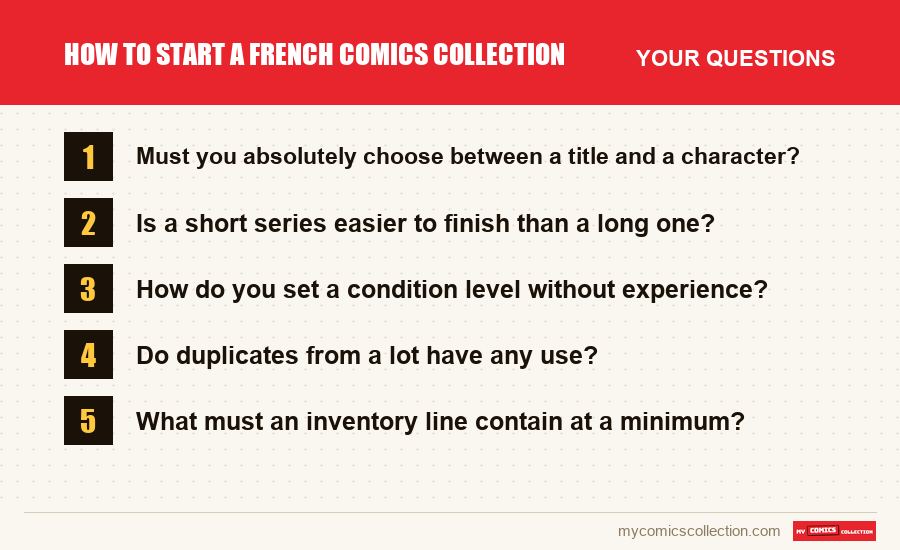
Not permanently, but you must choose which of the two drives your purchases in the first year. Pursuing both at once produces two equally incomplete collections, because searching by character requires going through entire magazines that a title search does not demand. Start with the one that gives you a finite list, and open the other afterward.
Shorter does not mean easier, but it does mean more predictable. A series of about twenty issues can be surveyed mentally all at once, and the remaining gaps stay identifiable at all times. On a series of several hundred issues, the difficulty is not the volume: it is the scarcity of chances to cross the few issues you still need.
Write down first what you refuse, which is easier than describing what you accept. Detached cover, torn staples, missing page, active damp stain: your list of refusals becomes your threshold. Handle a few common copies before hardening it, because yellowed newsstand paper is not a defect, it is its normal age.
Yes, provided you have planned a way out for them. A duplicate in better condition than your copy replaces it, and the old one goes into a trade. An identical duplicate serves as currency with other collectors, often more effectively than a purchase. Without a decision made in advance, the duplicate simply becomes a pile taking up space where the issues you are looking for should be.
The series title, its launch year, the publisher, the issue number and the condition you assign to it. The launch year and the publisher are not a luxury: several French titles designate two different magazines, and without these two fields your list becomes ambiguous as soon as it grows. The rest, contents and creators, can be added later.