There is no single counter for how many X-Men comics there are: we count twelve main series since September 1963, from The X-Men #1 to the 2024 relaunches. The longest, The X-Men, which became Uncanny X-Men, runs from #1 to #544 in 2011, and its historical counter even reached #600 in 2015. The answer depends on what you include: reprints, legacy numbers, off-sequence issues and spin-off series.
With the X-Men, the same name serves several series running in parallel. An X-Men series and an Uncanny X-Men series have coexisted since 1991, then relaunched in turn, and that back and forth is what makes the count hard for a collector who does not have the list in front of them.
As always in this guide, we only state verified facts (creators, issue numbers, dates); the analysis is our own, with no reproduction of protected art or dialogue.
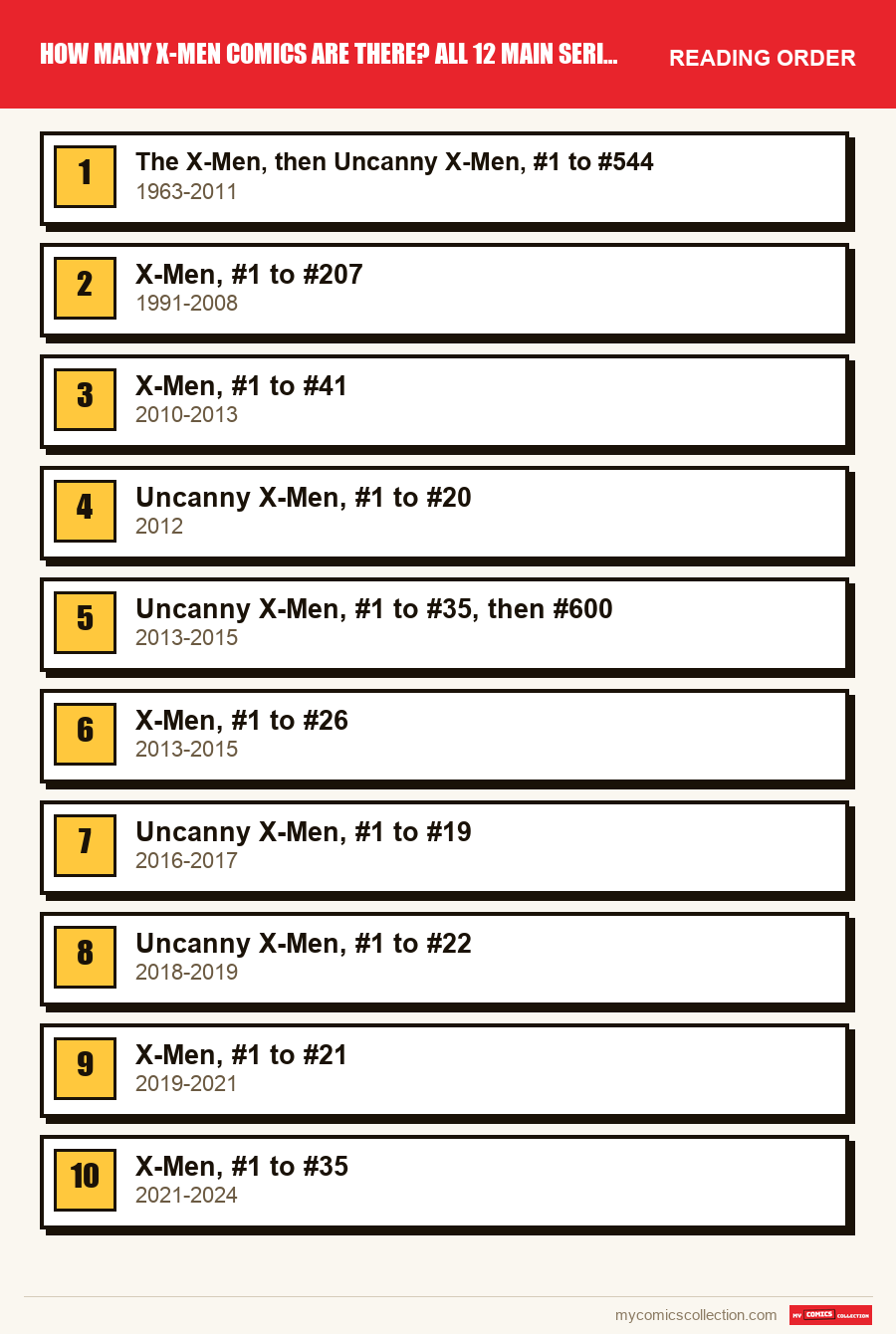
Series 1: The X-Men, then Uncanny X-Men, #1 to #544 (1963-2011)
The X-Men #1 is dated September 1963 and signed by Stan Lee and Jack Kirby. Lee handles the script for issues 1 to 19; after that the series runs out of steam: issues 67 to 93, from December 1970 to April 1975, contain only reprints. In this first volume, the word Uncanny appears on the cover from #114, in 1978: the series becomes The Uncanny X-Men.
The restart goes through Giant-Size X-Men #1, released in May 1975: Len Wein and Dave Cockrum assemble a team from around the world there. Chris Claremont takes the title over at #94 in August 1975 and writes it until #279 in 1991, then returns for issues 381 to 389 and 444 to 473. Dave Cockrum draws #94 and the issues that follow up to #105; John Byrne draws notably issues 111 to 143, from 1977 to 1981; Marc Silvestri draws many issues from 1987 to 1990, starting at #218; Jim Lee draws #248, issues 256 to 258 and 267 to 277, from 1989 to 1991. The series ends at #544 in December 2011. For the milestones of this period, see our page on Giant-Size X-Men #1.
Series 2: X-Men, #1 to #207 (1991-2008)
In October 1991, a second series titled X-Men starts with a #1 launched by Chris Claremont and Jim Lee, while Uncanny X-Men continues in parallel. A collector who only checks the title risks mixing up the two series, especially since the two titles sit side by side on the same shelves.
From #114, in July 2001, the title becomes New X-Men with Grant Morrison on script, then #157, in 2004, restores the name X-Men. The series reaches #207 before becoming X-Men: Legacy at #208, in 2008, under the pen of Mike Carey, who has been writing the series since #188. This lineage will still reach #300 in March 2014, by a detour we detail below.
For an inventory, this series raises a simple rule: the 2001 #114 belongs to New X-Men on the cover but remains issue #114 of the X-Men series in the numbering. Write both titles in your table, otherwise you risk looking for the same issue twice. The Grant Morrison issues, from #114 to #154, form a separate block in that table.
Series 3: X-Men, #1 to #41 (2010-2013)
In September 2010, a third X-Men series starts again at #1. Victor Gischler writes the first twenty-nine issues, from 2010 to 2012, with Paco Medina on art at the start; Brian Wood writes issues 30 to 37, then Seth Peck writes issues 38 to 41. The series has forty-one issues and a Giant-Size, and ends in February 2013.
It is a short series, therefore easy to complete, but it often gets lost in lists because it overlaps with the 2012 Uncanny X-Men series.
This period has a quirk: three major series carry almost the same name, the 2010 X-Men, the 2012 Uncanny X-Men and, a few months later, the 2013 X-Men. Only the start year and the writer let you tell them apart for certain.
Series 4: Uncanny X-Men, #1 to #20 (2012)
After #544, Marvel relaunches Uncanny X-Men from zero in 2012. Kieron Gillen writes it, and the series has twenty issues, from #1 in January to #20 in December 2012. It therefore lasts only one calendar year.
This small volume is a link that many collectors forget when they reconstruct the path from #544 to #600: yet it counts in the addition that leads to that anniversary issue.
Series 5: Uncanny X-Men, #1 to #35, then #600 (2013-2015)
Brian Michael Bendis writes a third volume of Uncanny X-Men starting in April 2013, which runs until September 2015. The issues go from #1 to #35, and the last single issue resumes the historical numbering: it is Uncanny X-Men #600, which brings the series to thirty-six issues.
This switch is the moment when the historical numbering reappears: 544 issues of the first volume, twenty of the second and thirty-six of the third add up to exactly 600.
Series 6: X-Men, #1 to #26 (2013-2015)
In May 2013, Marvel NOW! launches a fourth X-Men series, written by Brian Wood, with Olivier Coipel on art at the start. It rests on an all-female cast and has twenty-six issues, until May 2015.
It shares its years with Bendis's Uncanny X-Men: two series in parallel, two separate counters.
Series 7: Uncanny X-Men, #1 to #19 (2016-2017)
After the events of 2015, a fourth volume of Uncanny X-Men starts in 2016, written by Cullen Bunn. It runs nineteen issues, until March 2017.
Like the other short volumes, it is easy to find; it rarely appears in lists that stop at #600.
To keep your place in this string of small volumes, remember one landmark: each new volume of Uncanny X-Men restarted at #1 after the end of the previous one, except the last single issue of the third, which went back to issue 600.
Series 8: Uncanny X-Men, #1 to #22 (2018-2019)
A fifth volume of Uncanny X-Men begins on November 14, 2018, with the X-Men: Disassembled arc. It has twenty-two issues and an annual, and ends in 2019. This series goes right after the Cullen Bunn volume in your inventory.
Do you collect this series?
Track what you own, what you are missing and what your collection is worth. 7-day trial.
Start my trial →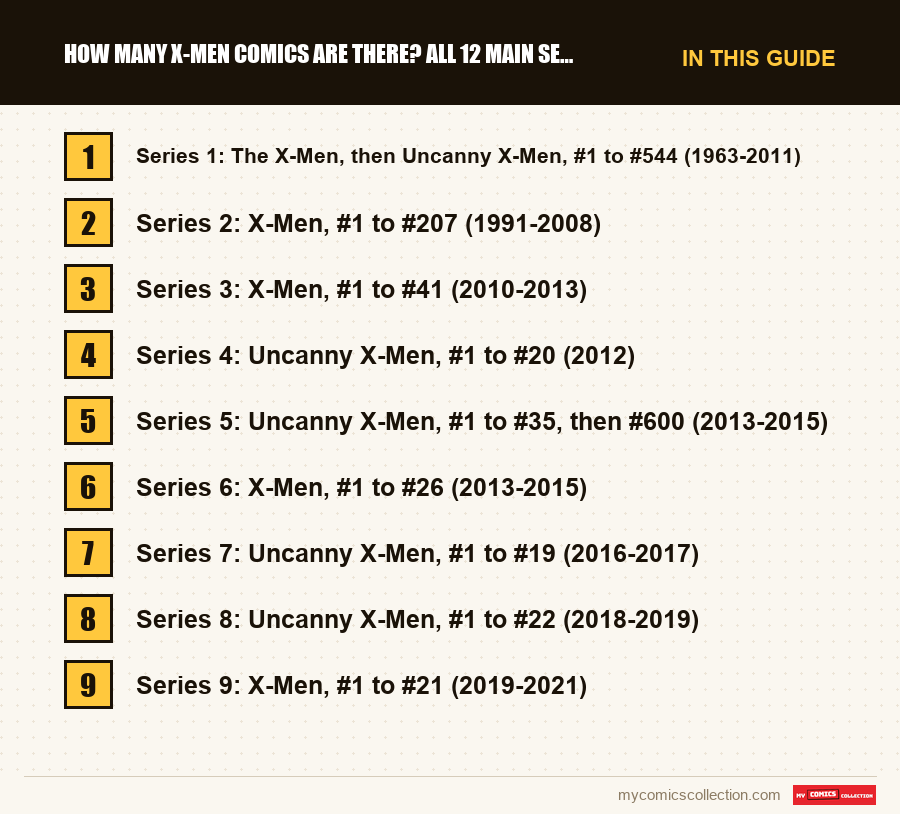
Series 9: X-Men, #1 to #21 (2019-2021)
Jonathan Hickman relaunches the franchise in October 2019, with Leinil Francis Yu on art at the start. The series has twenty-one issues and ends in 2021.
The #1 of this volume serves as the entry point for collectors of the Hickman era, set up in 2019 by the two miniseries House of X and Powers of X. Our page on the X-Men reading order puts this volume back into the flow of recent years.
Series 10: X-Men, #1 to #35 (2021-2024)
Gerry Duggan writes the volume launched in July 2021 and closed in June 2024 after thirty-five issues. Pepe Larraz and Javier Pina draw the series at first; Joshua Cassara and C.F. Villa then take over the art.
Its count is simple: thirty-five issues, which you complete as a block.
Series 11: X-Men, since #1 (2024)
The X-Men series restarts in July 2024 with Jed MacKay on script and Ryan Stegman on art. We write no end date, because the series is ongoing.
Series 12: Uncanny X-Men, since #1 (2024)
A sixth volume of Uncanny X-Men arrives in August 2024, written by Gail Simone, with David Marquez on art. It runs in parallel with Jed MacKay's X-Men series: the pattern of two titles run side by side therefore continues today.
Legacy numbering: the arithmetic of the total
For Uncanny X-Men, the addition is exact: 544 issues of the first volume, 20 of the second (2012) and 36 of the third, whose last single issue carries #600, so 544 + 20 + 36 = 600. The later volumes, from 2016, 2018 and 2024, start again at #1 without extending this counter.
The 1991 X-Men lineage follows a different logic. It reaches #207, becomes X-Men: Legacy at #208 in 2008 and stops at #275 in October 2012: the title changes, but the counter keeps going. A new X-Men: Legacy series, written by Simon Spurrier, then restarts at #1, and its twenty-fifth issue, in March 2014, carries #300: 275 + 25 = 300, the last issue of the lineage.
What we do not do: a grand total "all series combined." Such a figure would require deciding between reprints, annuals, Giant-Size issues and spin-off series, and each choice would give a different answer. Pick a scope, then count within that scope.
Annuals and spin-off series
Annuals and Giant-Size issues have their own numbering, separate from the series. Several volumes have them: an annual for the 2018 volume, one for Bendis's 2013 volume, a Giant-Size for the 2010 series. We make no claim to completeness.
Six spin-off titles stay outside our count: New Mutants, X-Factor, Excalibur, X-Force, Cable and Wolverine. Each keeps its own counter and has its own relaunches, which would be enough to double the list. To understand how they fit together, our pages on X-Men crossovers show the events that link them.
If you are looking for one particular X-Men series rather than a lineage, always check two things before buying: the volume's start year and the writer's name. These are the only two landmarks that do not vary from one edition to another and that keep you from mixing up, for example, the Victor Gischler volume and the Brian Wood one.
Completing the run: where to start
Start by deciding what you want to gather. If you want the Uncanny X-Men lineage, aim for the first volume, from #1 to #544, then the small 2012 and 2013 volumes up to #600. If you want the X-Men lineage, start from the 1991 #1 and follow it through to X-Men: Legacy.
A table per series will spare you duplicates: one row per volume, with the exact title, the start year, the end year and the number of issues. Add a column for annuals and off-sequence issues, so you do not mix them in with the main run.
Issues from the Claremont period turn up in blocks and cost more the further back you go toward 1975. For the early run, the September 1963 #1 and the Stan Lee issues make up the longest block to assemble; for recent volumes, the short series come together faster. Our free estimate lets you place an issue before writing it on your list.
Frequently asked questions
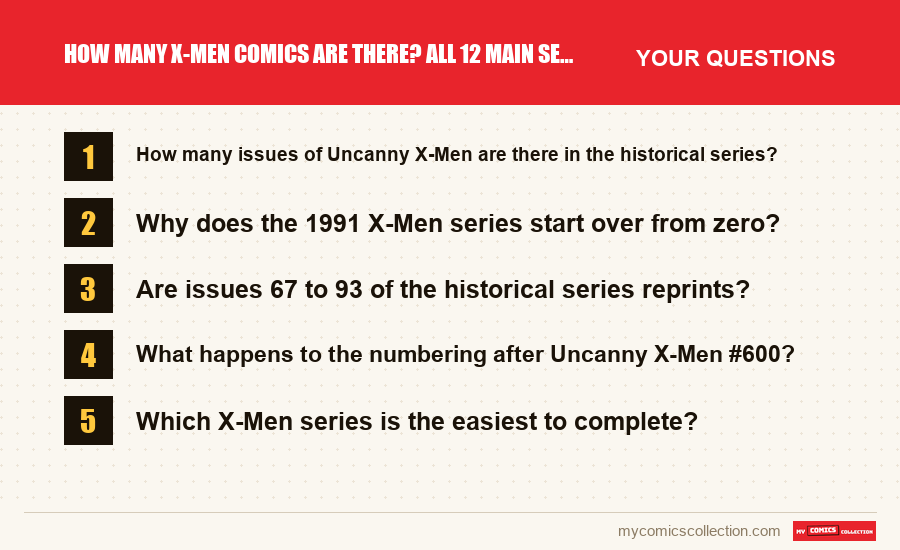
The first volume runs from #1 in 1963 to #544 in December 2011. Counting the twenty issues of 2012 and the thirty-six of the Brian Michael Bendis volume, whose last single issue carries #600, the historical numbering reaches 600.
Because in October 1991 Marvel launches a second series, titled X-Men, with Chris Claremont and Jim Lee, which runs in parallel with Uncanny X-Men. It reaches #207 before becoming X-Men: Legacy at #208, in 2008.
Yes. From #67 in December 1970 to #93 in April 1975, the series publishes only reprints of old stories. Two dates frame the end of the reprint run: May 1975 for Giant-Size X-Men #1, then August 1975 for #94 written by Chris Claremont, where the new team takes the place of the old one.
It is not extended: the later volumes restart at #1, in 2016, in 2018 and then in 2024. There is therefore no current legacy numbering for this series, only a historical addition that stopped at #600 in 2015.
The short ones: the 2012 Uncanny X-Men, with twenty issues, the 2016 Uncanny X-Men, with nineteen, or the 2019 X-Men, with twenty-one. Each can be put together quickly, which makes them good starting points for a collection.
Do you own an issue of Uncanny X-Men from the Claremont era? Get an estimate before deciding whether to shelve it or build on it.
Estimate my comic