
How many Wolverine comics are there? Across all volumes, Wolverine has carried eight main series since the four-issue miniseries of 1982. The longest is the 1988 series at 189 issues, followed by the 2003 volume at 90. Legacy numbering links those two to the 2010 series: after #20 of that volume, the count picks up at #300 and runs to #317. The total varies depending on whether you count fill-ins, annuals and spinoffs.
With Wolverine, the question of how many issues exist touches both a hero who keeps coming back and a publisher that likes to reopen a counter. Between 1982 and today, one title has served for separate series, for relaunches that start over at #1 and for a return to the cumulative number, so the bounds have to be read with method.
As always in this guide, we only state verified information (creators, issue numbers, dates); the analysis is our own, with no reproduction of protected art or dialogue.
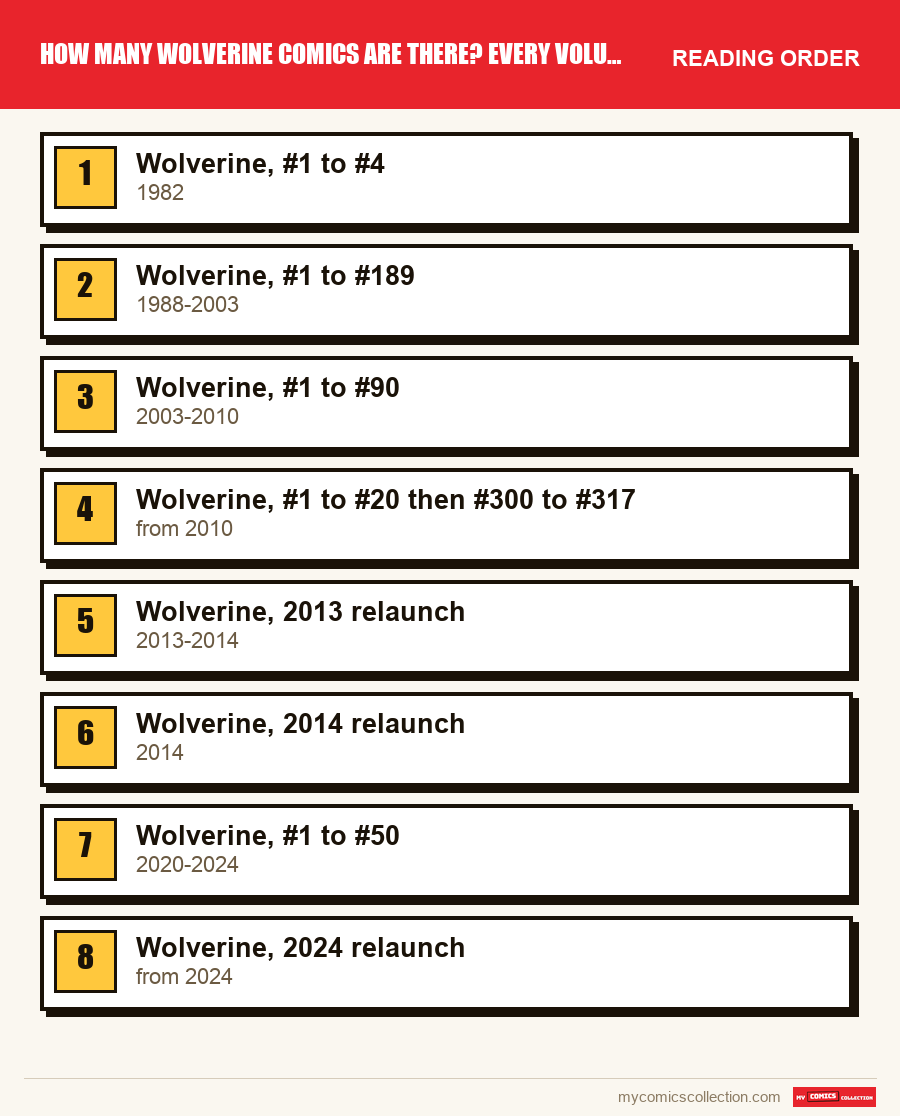
Series 1: Wolverine, #1 to #4 (1982)
This miniseries runs from September to December 1982, in four issues. Chris Claremont writes, Frank Miller draws, and Joe Rubinstein inks. It is a closed block, with no direct sequel in the counter of the later series: each regular series will start its own #1 later on.
Collectors shelve it separately, ahead of any regular series. The pages on Frank Miller place the art within the whole of his body of work.
Series 2: Wolverine, #1 to #189 (1988-2003)
The regular series starts in November 1988 and ends in June 2003 at #189. Chris Claremont writes the early run, with John Buscema on art. For the details of the launch, see issue #1 of the 1988 regular series.
Marc Silvestri draws the series from 1990 to 1992. Larry Hama writes most of the 1990s, with Adam Kubert on art from 1993 to 1996 and then Leinil Francis Yu from 1997 to 1999; the pages on Larry Hama trace that long stretch. Sean Chen then draws the series from 2001 to 2003.
Toward the end, Frank Tieri writes #159 to #176 and then #181 to #186, and Daniel Way closes the series with #187 to #189. The series also includes several annuals, a #1/2 issue and a #-1 issue, off-sequence issues that are not part of the 189.
Series 3: Wolverine, #1 to #90 (2003-2010)
Volume 3 restarts the counter in July 2003. Greg Rucka writes #1 to #19, with Darick Robertson on the first issues; Mark Millar takes #20 to #32 with John Romita Jr. on #20 to #31, then returns for #66 to #72 with Steve McNiven on art.
In between come Daniel Way (#33 to #40, with Javier Saltares), Marc Guggenheim (#42 to #48, with Humberto Ramos), Jeph Loeb (#50 to #55, with Simone Bianchi) and Jason Aaron, present on #56 and #62 to #65. Howard Chaykin draws #56 to #61.
Issues #75 to #90 are published under the title Dark Wolverine, written by Daniel Way, with Marjorie Liu among the writers. They are part of the same series and the same counter, which brings the volume to 90 issues, and it is on that figure that the jump to #300 rests.
During this period Wolverine: Origins, written by Daniel Way, Wolverine: First Class (21 issues) and Wolverine: Weapon X (16 issues, for the Jason Aaron run) are also published. These titles are separate series.
This period shows why the total for the 2003 volume is open to debate: a series that changes its title at #75 without changing its counter gets filed under two names in databases and shops. If your list stops at #74, it does not cover the whole volume; if it goes to #90, it includes Dark Wolverine. Note the choice you made in your file, because it shifts the legacy total by sixteen issues.
Series 4: Wolverine, #1 to #20 then #300 to #317 (from 2010)
Jason Aaron launches a new volume with a #1 in 2010. It runs to #20, then the numbering flips: the next issue is called #300, and the series continues through #317. The publisher thus reconnects with the cumulative counter of the earlier series.
A fill-in #5.1 exists in this volume; it does not count in the run. The pages on Jason Aaron show the scale of his work on the character, which goes well beyond this series, with Wolverine and the X-Men and Wolverine: Weapon X.
Series 5: Wolverine, 2013 relaunch (2013-2014)
After #317, a new series starts in March 2013 with Paul Cornell on script and Alan Davis on art. It runs thirteen issues and ends in 2014. The counter starts again at #1: the return to the cumulative number was therefore short-lived.
This series sets up the Death of Wolverine event, to which it connects through the following volume. Its brevity makes it easy to complete, but it gets mixed up in listings with the character's other #1 issues.
Series 6: Wolverine, 2014 relaunch (2014)
The next series, written by Paul Cornell and drawn by Ryan Stegman, appears the same year as Death of Wolverine. It runs twelve issues and an annual, gathered around the 12 Months to Die arc, and its #1 is once again a starting point.
For your list, keep the twelve regular issues of 2014 and file the annual separately, as with the other volumes. A chronological path through these volumes appears in the Wolverine reading guide.
Do you collect this series?
Track what you own, what you are missing and what your collection is worth. 7-day trial.
Start my trial →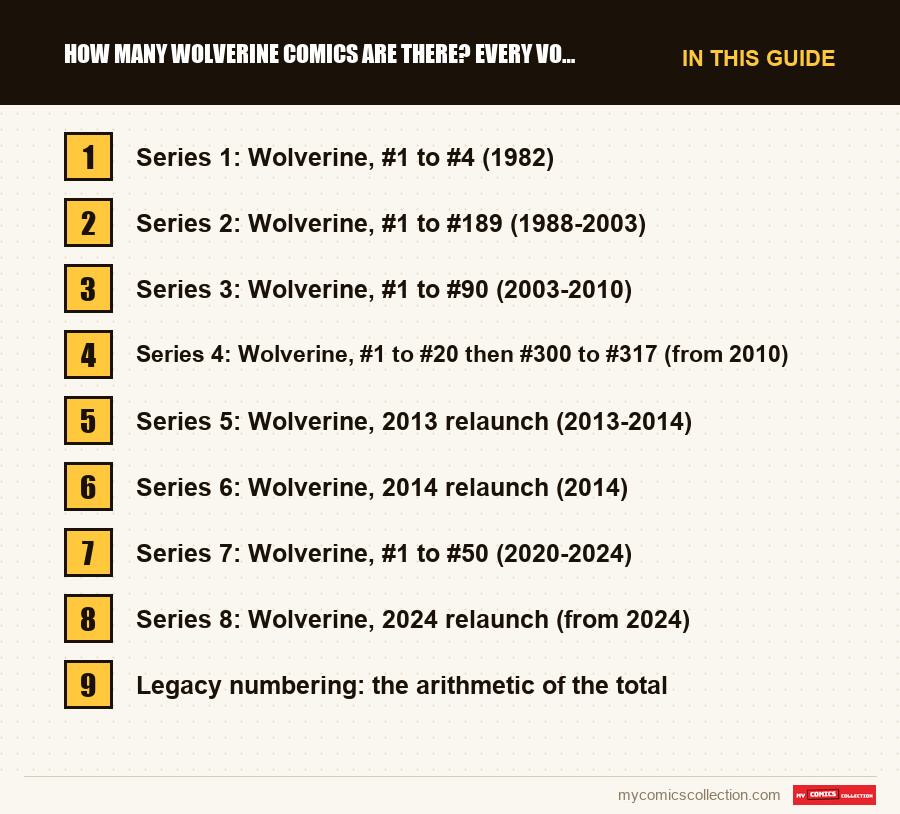
Series 7: Wolverine, #1 to #50 (2020-2024)
In 2020, Benjamin Percy launches a new volume in the Dawn of X line, with Adam Kubert on art and several other artists, including Viktor Bogdanovic. Gerry Duggan co-writes #7. The series reaches #50 in 2024.
Issues #8 to #19 tie into the Hellfire Gala, and #41 to #50 form the Sabretooth War arc. This volume is the longest since the 2003 volume and does not pick up the old numbering: it starts over at #1.
Keep the sequence for the recent period in mind: the 2020 volume runs from #1 to #50; the 2024 relaunch follows under a new #1. Neither picks up the cumulative counter. In a listing, a "Wolverine #1" can therefore mean a single issue from 1988, 2003, 2010, 2013, 2014, 2020 or 2024, and only the cover year settles it.
Series 8: Wolverine, 2024 relaunch (from 2024)
The X-Men: From the Ashes relaunch opens a new volume of Wolverine in 2024, with a #1. We list this series without end bounds, because it is ongoing. Its counter grows every month.
To place these volumes within the mutant's history, the history of Wolverine in comics offers a general overview.
Legacy numbering: the arithmetic of the total
The return to #300 is explained by an addition. The 1988 series has 189 issues, the 2003 volume has 90 including Dark Wolverine, and the 2010 volume has 20 before the jump: 189 plus 90 plus 20 makes 299, so the next issue is #300. Issue #21 of the 2010 volume thus becomes #300 of the legacy line.
Through #317, this running tally spans three series that share the same title. It excludes the 1982 miniseries, as well as the fill-ins, the #1/2 and #-1 issues, and the annuals. The figure of 317 therefore refers to the legacy run, not to the total number of single issues published.
If you include series 5 to 8, which start over at #1, you get a higher number, but we do not put a figure on it: some of their bounds are not settled here. And if you remove Dark Wolverine from the 2003 volume, the legacy total changes in turn. Specify your scope when you set two inventories side by side.
This arithmetic has a practical consequence. A collector who owns #250 of the legacy line cannot tell, without other information, whether it is an issue of the 2003 volume or a cumulative position: that number does not appear on a cover before #300. The 2003 single issues carry their own number from 1 to 90, and the cumulative position is only printed starting at #300.
To inventory a collection, you therefore keep two columns: the cover number and, if needed, the position in the legacy line. The second is calculated by adding 189 to the numbers of the 2003 volume, then 279 to those of the 2010 volume. For the 1988 series, the cumulative position is the issue number itself.
Annuals and spinoff series
The character's catalog extends beyond the main series. Wolverine: Origins is written by Daniel Way, Wolverine: First Class runs 21 issues, Wolverine: Weapon X runs 16, and Wolverine and the X-Men starts in 2011 under Jason Aaron's pen and accompanies the main series of those years.
Savage Wolverine begins in 2013 and sends the character to the Savage Land with Shanna the She-Devil. This list makes no claim to be exhaustive: the character's miniseries and one-shots are too numerous to list here. For their value, the guide to Wolverine's limited series goes through them.
In sales listings, spinoffs often slip in under the same name as the main series. So check the cover subtitle before ticking a box: Origins, First Class, Weapon X or Dark Wolverine are different products.
Annuals exist mainly for the 1988 series and for the 2003 volume, which has two, plus two Giant-Size issues. These issues are hunted separately from the regular series.
Completing the run: where to start
First decide whether you are following the legacy line or the series one by one. The legacy line goes from #1 of 1988 to #317, across three series, and is shelved in publication order; the 2013, 2014, 2020 and 2024 relaunches are filed afterward, volume by volume.
Then proceed block by block: the 1988 series is the longest and the most spread out, the 2003 series is completed faster, and the 2010 volume is limited to twenty issues before the jump. Keep a column for the title at the time, especially for #75 to #90 of 2003, which carry Dark Wolverine on the cover.
Plan last for a binder for the fill-ins, the #1/2, the #-1, the annuals and the miniseries. They are often bought after the regular series. The key Wolverine issues guide helps you spot the ones worth the effort.
Frequently asked questions
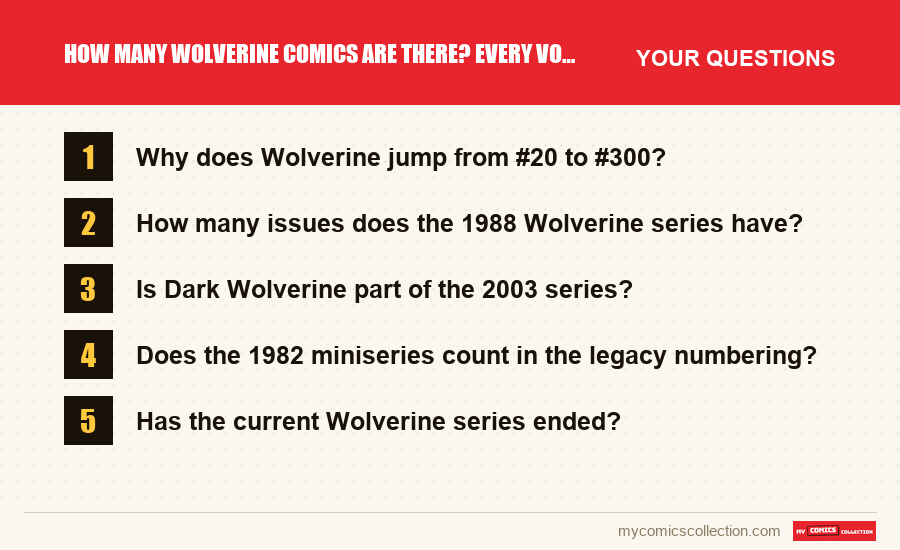
The 2010 volume stops at #20, then the publisher picks up the cumulative counter of the earlier series. 189 issues in 1988, 90 in 2003 and 20 in 2010 make 299, so the next issue carries the number 300. The run continues through #317.
It has 189 issues, from November 1988 to June 2003. Alongside them are annuals, a #1/2 issue and a #-1 issue, which are off-sequence. It is the character's longest series, ahead of the 2003 volume, which has 90 issues.
Yes: #75 to #90 of the 2003 volume are published under the title Dark Wolverine, with Daniel Way on script. They count toward the volume's 90 issues. Removing them would drop the volume to 74 issues and break the addition that leads to #300.
No. The miniseries by Chris Claremont and Frank Miller has four issues and remains a closed block. The tally that leads to #300 adds up only the 1988 series, the 2003 volume and the 2010 volume, without fill-ins or annuals.
No. The volume launched in 2024 with the X-Men: From the Ashes relaunch is ongoing, and its total grows every month. A final total is therefore impossible. The previous volume, from 2020, reached #50 in 2024.
Own part of the Wolverine line from 1988 to 2010? Get your issues appraised before you fill in the gaps.
Estimate my comic