How many Deadpool comics are there? Deadpool has twelve main series since the two miniseries of 1993 and 1994, and the longest is the 1997 volume with 69 issues. The runs detailed below add up to 335 issues, not counting annuals, #0, #-1 and .1 issues, and not counting spinoff titles. Legacy numbering, for its part, reaches #250 in 2015, #300 with Despicable Deadpool and #350 with the 2024 volume.
Few characters have gone through so many relaunches in so few years. Created by Rob Liefeld and Fabian Nicieza in The New Mutants #98, cover-dated February 1991, Deadpool goes from supporting appearance to star of several successive monthly series, each restarting at #1. To know how many comics exist, you therefore have to count by volume, then understand why cover numbers sometimes lie.
As always in this guide, only verified information (creators, issue numbers, dates) is stated as fact; the analysis is our own, with no reproduction of protected art or dialogue.
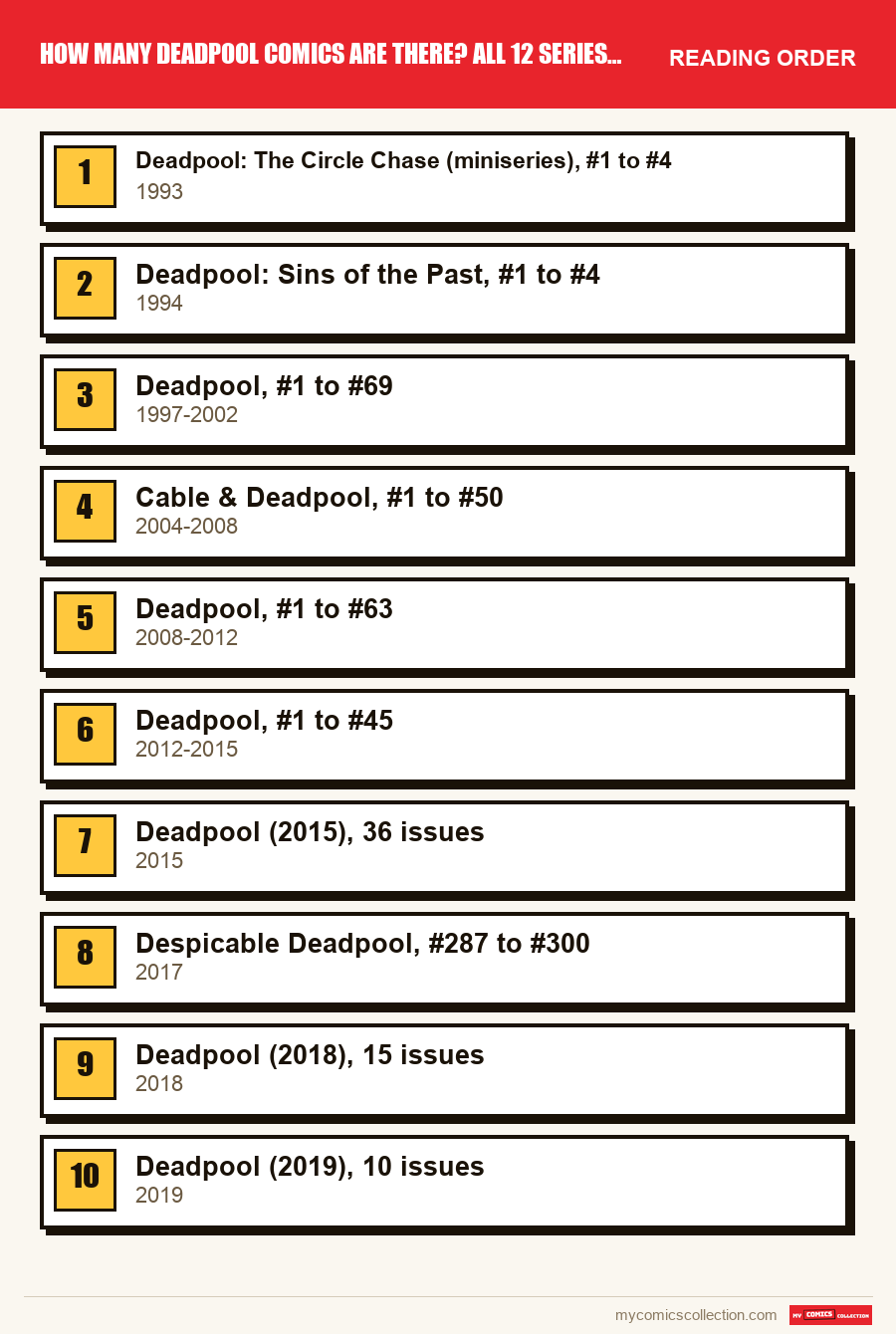
Series 1: Deadpool: The Circle Chase (miniseries), #1 to #4 (1993)
The 1993 miniseries runs four issues. Fabian Nicieza writes it, and Joe Madureira draws the pencils. It gives Deadpool a first solo starring role, two years after his appearance in The New Mutants #98, and sets the tone for the series that follow: a talkative mercenary in the middle of more serious characters.
For a count, this miniseries belongs to the character's solo beginnings: Joe Madureira's name on the art makes it sought after by fans of the artist as much as by those of the character. It is part of no legacy numbering and is confused with no later volume, which makes it simple to shelve.
Series 2: Deadpool: Sins of the Past, #1 to #4 (1994)
The second installment comes out in 1994, also in four issues. Mark Waid writes it and Ian Churchill draws it. The two miniseries share an identical format, but not the creative team: Nicieza and Madureira on one side, Waid and Churchill on the other.
Together, they total eight issues and form the foundation of what a collector sometimes calls the miniseries era, before the launch of an ongoing series.
Series 3: Deadpool, #1 to #69 (1997-2002)
The ongoing series starts in 1997 under the direction of Joe Kelly, with Ed McGuinness among the early artists. It runs 69 issues. Joe Kelly writes a large share of them, including #-1, #0, issues 1 to 33 and the 1997-1998 annual; Christopher Priest succeeds him, in 1999, on issues 34 to 45; Gail Simone takes the series over from #65, before Marvel replaces it with Agent X, also written by Simone.
It is a monthly series numbered without interruption, but do not conclude that it marks the character's entry into solo books: the two miniseries of 1993 and 1994 came first. The issues written by Joe Kelly, from #-1 to #33, form the block that fans hunt first, because they set the tone and the backdrop for the following years. The handoff to Christopher Priest, on issues 34 to 45, then Gail Simone's arrival at #65, mark three writing periods that you can collect separately. Our page on this 1997 series goes deeper into the analysis.
Series 4: Cable & Deadpool, #1 to #50 (2004-2008)
From May 2004 to April 2008, Cable & Deadpool runs fifty issues. Fabian Nicieza writes issues 1 to 48 and supplies the script for the last two, signed with Reilly Brown. Mark Brooks draws issues 1 and 2, Patrick Zircher issues 3 to 24, and Lan Medina issues 25 to 27.
The series pairs two characters in a single publication. For inventory purposes, it counts in Deadpool's total, but it also counts in Cable's: check it off in both lists if you collect both. With Reilly Brown, artist on several issues between #28 and #50 and then co-writer of the last two, the series ends on a signature that stayed with it for a long time, and Ron Lim as well as Staz Johnson appear as artists on isolated issues.
Series 5: Deadpool, #1 to #63 (2008-2012)
The second volume runs from September 2008 to October 2012: 63 issues, one annual and two .1 issues, #33.1 and #49.1. Daniel Way writes the series and Paco Medina draws it. The .1 issues do not count in the main numbering, but they very much exist: plan for them if you are aiming for a run with no gaps. For anyone who likes cohesive sets, it lends itself well to buying by the block, with a clear list of sixty-three issues and three side issues to track down separately.
Series 6: Deadpool, #1 to #45 (2012-2015)
As part of Marvel NOW!, Deadpool is relaunched by Brian Posehn and Gerry Duggan, with Tony Moore on art, and the opening arc is titled "Dead Presidents." The volume runs 45 issues, from 2012 to 2015. Its last issue nonetheless carries the number 250: that is the starting point of legacy numbering. Gerry Duggan also writes what follows, which ties the 2012, 2015 and 2017 volumes together under one signature, even though the covers do not always show the same numbering. Tony Moore draws the opening of the volume; that is a useful detail for spotting it, because its #1 is that of a highly visible relaunch.
Series 7: Deadpool (2015), 36 issues
A new volume starts in 2015 from the pen of Gerry Duggan and runs 36 issues. It should not be confused with the 2012 one, which ended on the number 250. In your inventory, always write the volume's year next to the issue number, otherwise two single issues from the same era cannot be told apart.
Series 8: Despicable Deadpool, #287 to #300 (2017)
Launched in 2017, Despicable Deadpool runs fourteen issues, including #300. Gerry Duggan still writes this series. Counting back, #300 makes this volume start at #287: the count works out with the previous 36 issues, since 250 plus 36 gives 286.
Do you collect this series?
Track what you own, what you are missing and what your collection is worth. 7-day trial.
Start my trial →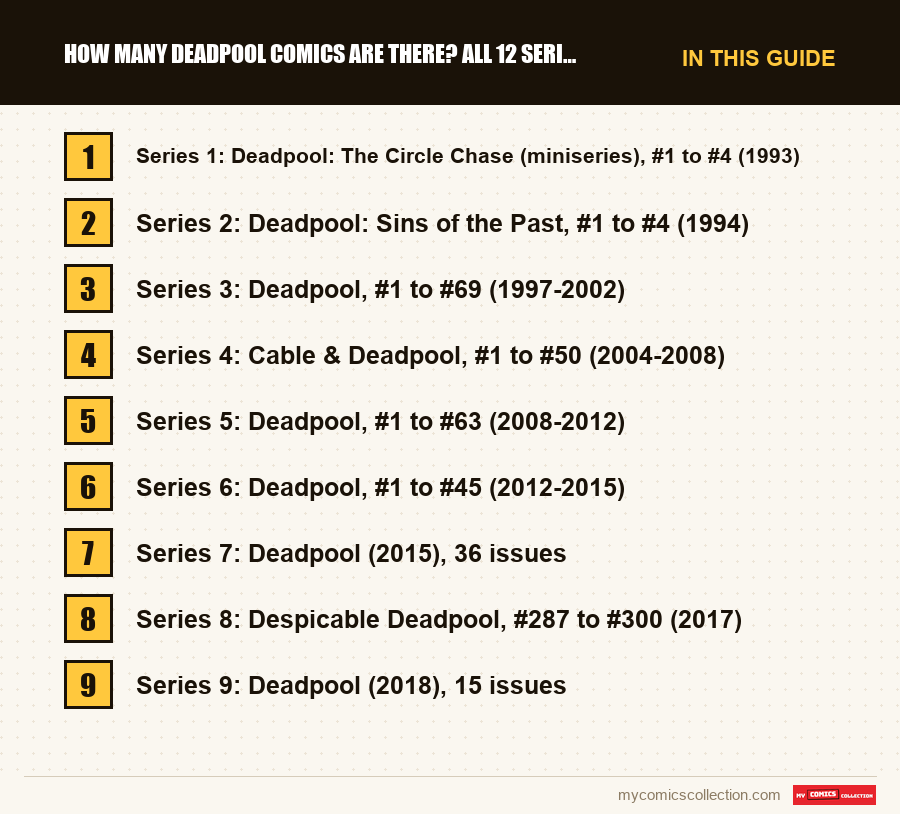
Series 9: Deadpool (2018), 15 issues
Skottie Young writes the 2018 volume, which runs fifteen issues. This volume does not continue the previous series: it rests on its own fifteen issues, whose inventory record should mention the year 2018 so it does not get mixed in with the other volumes.
Series 10: Deadpool (2019), 10 issues
Kelly Thompson writes this ten-issue volume, launched in November 2019 with Chris Bachalo on art. A short series, treated as a volume in its own right. The writer has her own page.
Series 11: Deadpool (2022), 10 issues
In 2022, Alyssa Wong writes a new ten-issue volume. Like the two before it, it restarts at #1 and falls in the column of modern series. With Alyssa Wong, the list of the character's writers widens again, from Fabian Nicieza to Cody Ziglar by way of Joe Kelly, Christopher Priest, Gail Simone, Daniel Way, Brian Posehn, Gerry Duggan, Skottie Young and Kelly Thompson: a table by volume, with the writer's name, will help you avoid mixing up the periods.
Series 12: Deadpool (2024), 15 issues
Cody Ziglar writes the volume launched in 2024, which runs fifteen issues and one of which carries the number 350. Here again, that number is a cumulative one, not a count of single issues published under this volume. Keep this principle in mind for every round number: the 2024 volume has fifteen real issues, while the cover number depends on the history of the numbering, and it is the real count that answers the question asked.
Legacy numbering: the arithmetic of the total
Here is the addition of the runs written above: 4 + 4 + 69 + 50 + 63 + 45 + 36 + 14 + 15 + 10 + 10 + 15 = 335 issues. The 2012 volume's #250 does not result from the volumes titled Deadpool alone: 69 + 63 + 45 give only 177. It corresponds exactly to the character's solo series taken together: the two miniseries (4 + 4), the 1997 volume (69), the fifteen issues of Agent X, Cable & Deadpool (50), then the 2008 (63) and 2012 (45) volumes, for 250.
This arithmetic has a practical consequence. If you are looking for a specific issue, mention the volume and the year every time, for example the 2012 volume and its #45, rather than the number 250 alone. A listing that cites only the number leaves doubt about which volume is meant, and the question is worth asking the seller before you buy.
The rest is easier to follow: 250 plus the 36 issues of the 2015 volume gives 286, and Despicable Deadpool takes over at #287 to end at #300. The 2024 volume then includes #350; adding the issues of the 2018, 2019, 2022 and 2024 volumes to #300 (15 + 10 + 10 + 15) gives that same number, by the way.
Annuals and spinoff series
Annuals and the #-1, #0 and .1 issues are set apart: the 1997-1998 annual, the #33.1 and #49.1 of 2008-2012, the #-1 and the #0 of the 1997 volume. Direct successor to the 1997 volume, Agent X and its fifteen single issues weigh in on the #250 without appearing among our twelve series. Spinoff series are numerous and we make no claim to be exhaustive: Deadpool Team-Up in 2009, from the pen of Fred Van Lente, Deadpool Corps in 2010, written by Victor Gischler, Deadpool MAX written by David Lapham, and Deadpool Kills the Marvel Universe. None of them enters our total. For annuals, our dedicated page details the most sought after.
Completing the run: where to start
To compare your priorities, lean on the best Deadpool arcs and on the character's major artists: these two pages show which volumes deserve a particular effort and which can wait.
Fix your scope before you buy. Do you want the 1997 volume, with its 69 issues, or all twelve series? In the second case, open a table per volume, with its runs, and note the #0, #-1 and .1 issues separately.
An example of method: for the 2008 volume, draw up a list from 1 to 63, add a line for the annual, one for #33.1, one for #49.1, then check items off as you go. Do the same for Cable & Deadpool from 1 to 50, and for each volume on the list. After twelve tables, you have a complete map of what you still need to find, volume by volume, with the writer's name at the head of each column so you can quickly find the periods you prefer.
Start with the modern series, which turn up without difficulty, then go after the 1997 volume, whose issues written by Joe Kelly are the most in demand. Leave the 1993 and 1994 miniseries for last. With each purchase, check the volume and the year, never just the number: legacy numbering has a #250 and a #1 coexisting on covers from the same period. Our collecting guide details the series to prioritize.
Frequently asked questions
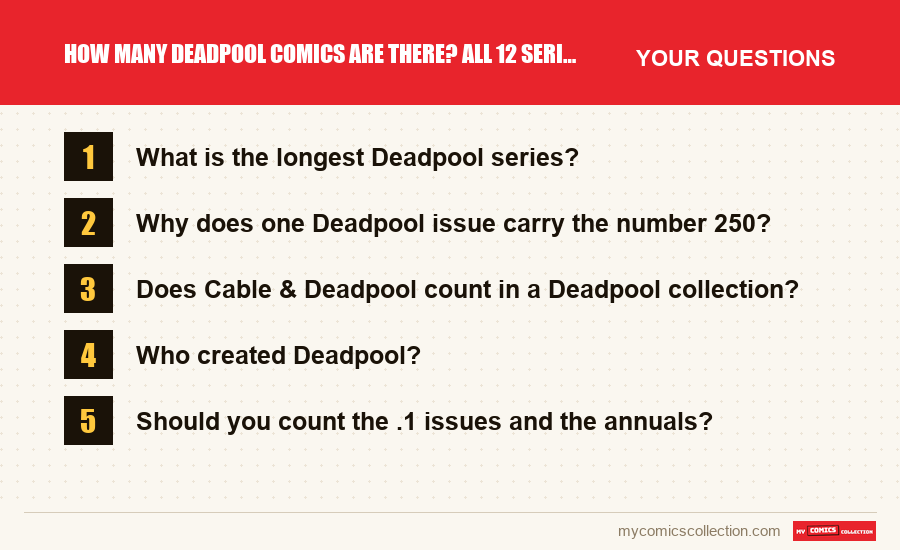
Among the twelve series we count, the longest is the 1997 volume with 69 issues, written first by Joe Kelly, then by Christopher Priest and Gail Simone. The 2008 volume has 63, Cable & Deadpool fifty.
Because the last issue of the volume launched in 2012, which runs 45 issues, carries the number 250: that is legacy numbering. The number adds up the character's solo series: the two miniseries, the 1997 volume, Agent X, Cable & Deadpool and the 2008 and 2012 volumes. A new volume then restarts at #1 in 2015.
Yes, this fifty-issue series, published from May 2004 to April 2008, stars Deadpool alongside Cable. Fabian Nicieza writes almost every issue. It shelves in both collections; count it in one as in the other.
It was in The New Mutants #98, dated February 1991, that artist Rob Liefeld and writer Fabian Nicieza brought the character to life. The character then becomes the star of two miniseries, in 1993 and 1994, before his 1997 ongoing series.
It depends on your goal. Our 335 issues exclude them: the 2008 volume has one annual, a #33.1 and a #49.1, the 1997 one has an annual, a #-1 and a #0. An exhaustive inventory should note them separately, with their own column.
Your Deadpool comics, from the 1993 miniseries to the 1997 volume, are worth a precise estimate before any purchase or resale.
Estimate my comic