To discover Deadpool, start with run by Joe Kelly (Deadpool #1-33, 1997-1999) who defined the character, then continue with Uncanny X-Force by Rick Remender (2010-2012) for a darker version, and finish with the run by Gerry Duggan (2012-2018) for the modern era.
With over 30 years in publication, dozens of miniseries, and crossovers across nearly every Marvel franchise, Deadpool has an intimidating catalog for new readers. Unlike Spider-Man or Batman, there is no single consensus on the ideal reading order, as the character has been reinvented several times by different authors.
This guide offers a structured reading order, from absolute beginner to keen completist, distinguishing essential reading from optional supplements. Each arc is contextualized so you know exactly what you're going to discover.
Phase 1: origins (1991-1996)
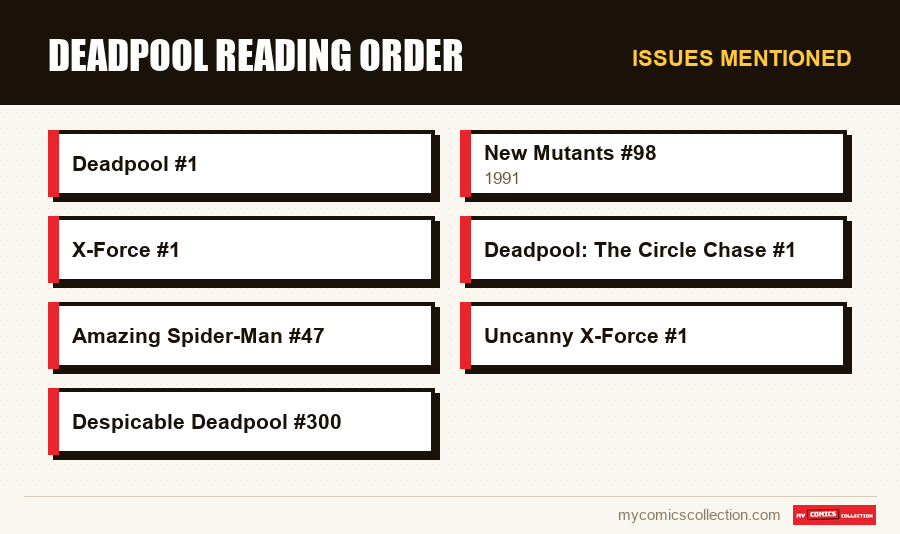
New Mutants #98 (1991): the very first appearance. Deadpool is a simple mercenary antagonist sent by Tolliver. The character doesn't yet have his signature humor but his visual design is already in place.
X-Force #1-15 (1991-1992): recurring appearances of Deadpool as Cable and X-Force villain. These issues show the character's evolution from simple antagonist to complex anti-hero. Optional reading but useful for understanding the Cable/Deadpool dynamic.
Deadpool: The Circle Chase #1-4 (1993): first solo mini-series. Fabian Nicieza writes, Joe Madureira draws. The humor begins to take hold but the tone remains that of a classic 90s action comic.
Deadpool #1-4 (1994 miniseries): second mini-series, by Mark Waid and Ian Churchill. Introduction of concepts that will be taken up later, notably the relationship between Deadpool and Death. Recommended reading.
Phase 2: the Joe Kelly golden era (1997-1999)
Deadpool #1-33 (1997-1999): it’s THE founding run. Joe Kelly transforms Deadpool from a generic mercenary into a deeply original character, blending absurdist humor, fourth-wall breaking, and heartfelt emotion. Key numbers include:
#11: Full introduction to Blind Al and twisted domestic dynamics. #14: The famous episode where Deadpool travels back in time and inserts himself into Amazing Spider-Man #47 (art by Pete Woods recreating Romita style). #25: resolution of the T-Ray arc and revelations about the identity of Wade Wilson.
This run is unanimously considered the best Deadpool ever written. If you only have to read one thing, this is it.
Phase 3: the pre-film era (2004-2012)
Cable & Deadpool #1-50 (2004-2008): the buddy-cop series between Cable and Deadpool, written by Fabian Nicieza. The chemistry between the two characters is excellent and this series directly inspired the Cable angle of the Deadpool 2 movie. Highly recommended reading, especially arcs #1-12 and #36-50.
Deadpool #1-63 (2008-2012, Daniel Way): the most divided run among fans. Daniel Way pushes the humor towards pure slapstick and interior voices (the famous yellow and white bubbles). Some love it, others find it reduces the character to a simple buffoon. Optional reading: arcs #1-12 are enough to get an idea.
Uncanny X-Force #1-35 (2010-2012, Rick Remender): although this is an X-Force series and not a solo Deadpool, it's one of the best uses of the character in comics history. Remender writes a Deadpool that oscillates between humor and deep tragedy, particularly in the “Dark Angel Saga” arc. Essential reading.
Collecting this series?
Track what you own, what you are missing and what your collection is worth. 7 day trial.
Start my trial →Phase 4: the cinematic era (2012-2026)
Deadpool #1-45 + Deadpool #1-36 (2012-2018, Gerry Duggan): the longest and most consistent run in the character's history. Duggan develops Deadpool in depth: marriage with Shiklah, fatherhood, alliance then betrayal with SHIELD, and confrontation with the identity of a hero in Secret Empire. The key issues are #27 (marriage), #250 (end of part one), and Despicable Deadpool #300 (conclusion).
Deadpool (2018-2019, Skottie Young): short but entertaining run with a stripped-down Deadpool. The Fresh Start arc is a good entry point for readers who want modern Deadpool without 200 issues of context.
Deadpool (2024, Kelly Thompson): the current series, with a new status quo. Thompson brings a different sensibility to the character while respecting his humorous DNA. Run in progress, to be continued.
Thematic additional readings
For pure humor: Deadpool Kills the Marvel Universe (2012, Cullen Bunn), Deadpool's Secret Secret Wars (2015), Deadpool vs. Old Man Logan (2017). These standalone mini-series require no context and play the meta-humor card to the fullest.
For the drama: Deadpool: Dracula's Gauntlet (2014), which develops the Shiklah romance, and Deadpool vs. Gambit (2016) for a darker angle.
For team-ups: Spider-Man/Deadpool #1-50 (2016-2019) is an entire series dedicated to the Spidey/Deadpool duo with arcs of varying quality but an excellent start (Joe Kelly at the helm of the first 12 issues).
Do you own Deadpool comics? Estimate the value of your collection for free to know their current rating.
Frequently asked questions
Joe Kelly's run (Deadpool #1 to #33, 1997-1999), regarded as the founding run and unanimously as the best Deadpool ever written. Joe Kelly turns a generic mercenary into an original character, blending absurd humor, fourth-wall breaks and sincere emotion. If you only read one thing, make it this.
In New Mutants #98 (1991), where he is a simple antagonist mercenary sent by Tolliver. He does not yet have his signature humor, but his visual design is already in place. He then reappears as a villain of Cable and X-Force in X-Force #1 to #15.
Yes, although it is an X-Force series rather than a Deadpool solo (#1 to #35, 2010-2012, Rick Remender). It is one of the best uses of the character, who swings between humor and deep tragedy, notably in the "Dark Angel Saga". It offers a darker version of the character.
Cable & Deadpool (#1 to #50, 2004-2008, Fabian Nicieza), especially arcs #1 to #12 and #36 to #50, then Gerry Duggan's run (2012-2018), the longest and most coherent. Daniel Way's run (2008-2012) divides fans: arcs #1 to #12 are enough to get a sense of it.
Skottie Young's run (2018-2019), short and entertaining, with a Deadpool stripped of everything: the Fresh Start arc is a good entry point. Kelly Thompson's current series (2024) also brings a new status quo. For pure humor, Deadpool Kills the Marvel Universe (2012) needs no context.