
How many Daredevil comics are there? The character has nine numbered volumes since April 1964, plus a 2009 return to the original numbering from #500 to #512. Volume 1 is still the longest: Daredevil #1 to #380, plus a #-1 issue. Volume 2 runs 119 issues, which brings you to #499 when you add them up. After #512 the title restarts at #1 in 2011, so the final total depends on your counting rules.
The Man Without Fear has had as many publishing rebirths as narrative falls: canceled and then resurrected in the same year, 1998, under a different banner, then relaunched several times by a succession of writers who each set their own tone. For the collector, that comes down to one concrete question: where does a "complete run of Daredevil" begin and end?
As always in this guide, we only state verified information (creators, issue numbers, dates); the analysis is our own, with no reproduction of protected artwork or dialogue.
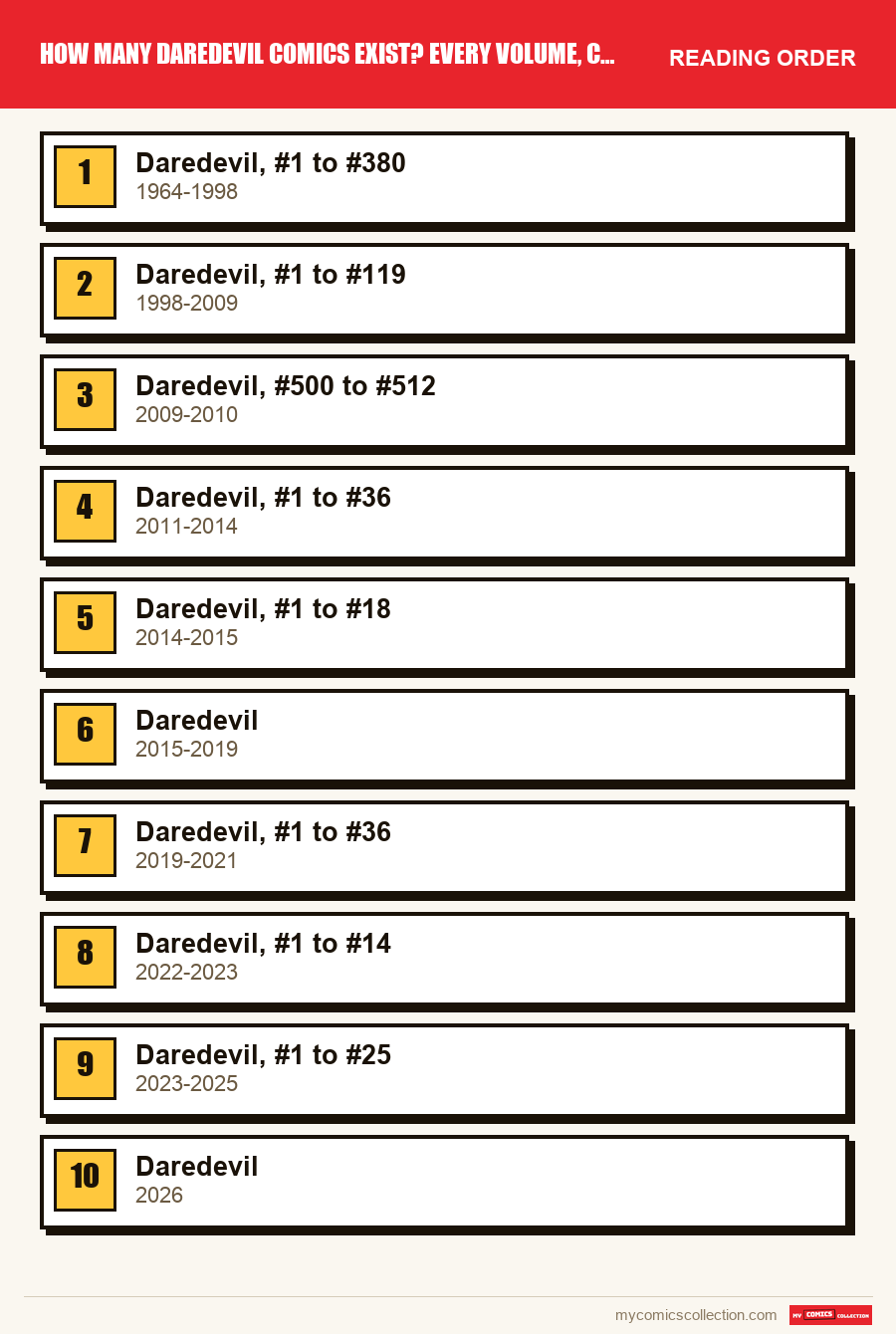
Series 1: Daredevil, #1 to #380 (1964-1998)
It all starts with Daredevil #1, cover-dated April 1964, with Stan Lee writing and Bill Everett on pencils. The run then goes on for thirty-four years: the volume totals 381 issues, that is #1 to #380 plus a #-1 issue, along with ten annuals. It is the longest of them all, and the one with the most creative team changes.
After Stan Lee came Roy Thomas, Gerry Conway, Steve Gerber, Marv Wolfman, Roger McKenzie and Dennis O'Neil on writing; Gene Colan, John Romita Sr. and Wally Wood were among the artists of the early years. Frank Miller arrives on pencils with #158 (May 1979), writes the series starting with #168 and leaves after #191. He comes back for Born Again, #227 to #233, drawn by David Mazzucchelli. Ann Nocenti then has a long stretch that runs through #291, and D.G. Chichester writes after her from #292 through #332.
The end of the volume goes through J.M. DeMatteis (#344 to #350), Karl Kesel (#353 to #364), Joe Kelly, who also writes the #-1 issue and #365 to #375, then Scott Lobdell (#376 to #379); D.G. Chichester returns for #380, the last issue of the volume, after which Marvel cancels the title. To go deeper into the key issues of this era, our page on the 1964 to 1998 Daredevil series breaks down the market issue by issue.
Series 2: Daredevil, #1 to #119 (1998-2009)
In 1998, the very year of the cancellation, Daredevil comes back under the Marvel Knights banner, with a new #1. Kevin Smith writes the first issues and Joe Quesada draws them; their arc opens a volume that will reach 119 issues, plus a #1/2. Our page on the 1998 #1 describes its publishing context.
David Mack then takes over stretches of the volume, notably #9 to #11 and #13 to #15, then #51 to #55. Brian Michael Bendis first co-writes the #16 to #19 arc with David Mack, then, teamed with Alex Maleev, writes #26 to #50 and #56 to #81; Ed Brubaker succeeds him from #82 to #119 with Michael Lark. This is the volume where the writing on Daredevil permanently shifts register, toward a darker crime story.
Series 3: Daredevil, #500 to #512 (2009-2010)
In 2009, Marvel drops the volume 2 numbering and picks up volume 1's: #119 is followed by #500. Andy Diggle writes this period, with Roberto De la Torre and Marco Checchetto among the artists. It runs thirteen issues, #500 to #512.
It is a series apart for the collector: these thirteen issues belong in volume 1's continuity, since they pick up its counter, but they follow a volume 2 that had its own #1. When you count volume by volume, they are easy to forget.
Series 4: Daredevil, #1 to #36 (2011-2014)
In July 2011, Marvel relaunches the title with a #1 written by Mark Waid. Paolo Rivera, Marcos Martín and Chris Samnee share the art. The volume has 36 issues plus a #10.1 and an annual.
The #10.1 is a stopgap issue that fits into no arithmetic sequence: depending on whether you count it or not, the volume totals 37 or 36 single issues. This volume ends in February 2014.
Series 5: Daredevil, #1 to #18 (2014-2015)
Mark Waid relaunches the series in March 2014 for a new volume, drawn by Chris Samnee. This volume has 18 regular issues; side issues (#0.1, #1.50 and a #15.1) bring the total to 21 if you add them up, and it wraps up in September 2015.
The side issues are hard to shelve: their numbers do not look like the rest of the volume's sequence, and an omission of this kind goes unnoticed until you reread your list.
Series 6: Daredevil (2015-2019)
Charles Soule writes this volume, whose first two issues come out in December 2015; it is on his watch that the Kingpin becomes mayor of New York. Ron Garney handles most of the art. The volume has 28 issues and an annual, and spans a little over three years.
Series 7: Daredevil, #1 to #36 (2019-2021)
Chip Zdarsky writes this volume launched in February 2019, with Marco Checchetto on most of the art. It has 36 issues plus an annual, and ends in November 2021 with #36; the follow-up runs through the Devil's Reign crossover.
This volume fits in thirty-six issues with clean boundaries: once you have #1 and #36 in hand, all that remains is to check every issue in between.
Do you collect this series?
Track what you own, what you are missing and what your collection is worth. 7-day trial.
Start my trial →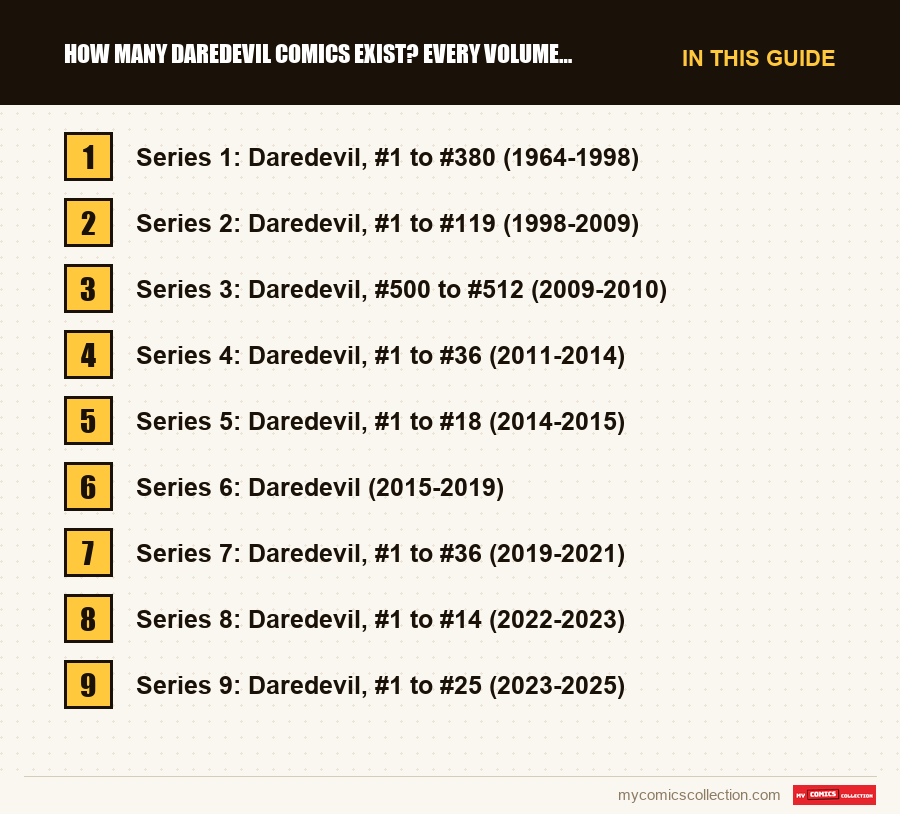
Series 8: Daredevil, #1 to #14 (2022-2023)
Chip Zdarsky also writes this volume, launched in July 2022. It ends in August 2023 with #14, that is fourteen single issues: the count takes a few minutes, and that is exactly why it is easy to overlook when you shelve by volume.
Series 9: Daredevil, #1 to #25 (2023-2025)
Saladin Ahmed writes this volume, launched in September 2023 with Aaron Kuder on art. It runs twenty-five issues and ends in 2025: a mid-sized block, shorter than the Waid or Zdarsky volumes, that fits easily on a single page of your list.
Series 10: Daredevil (2026)
The ninth numbered volume starts in spring 2026. Stephanie Phillips writes it and Lee Garbett draws it. It is the current volume as we write, and its final count is still open.
To place these volumes in a continuous reading, a reading guide orders them by storyline rather than by publication date, which does not always match the order of the issue numbers.
Legacy numbering: the arithmetic of the total
What we call legacy is numbering that continues the original count instead of restarting at #1. For Daredevil, the arithmetic proof is simple: volume 1 stops at #380, volume 2 has 119 issues, 380 plus 119 makes 499, and the next issue is called #500. The 2009 return is therefore consistent with what Marvel actually published.
But this continuity breaks off after #512: the volume launched in 2011 restarts at #1, just like the 2014 one. To say "how many Daredevil issues exist," you therefore have to distinguish several counts:
- 380 regular issues of volume 1, or 381 if you add the #-1 issue;
- 119 issues of volume 2, which gives 499 in total for the first two volumes;
- 13 issues of the return, #500 to #512, for 512 in total on the historical line;
- the later volumes, numbered from #1, with their .1 or 0.1 issues that you count or not depending on your method.
Our tally stops at #512, the last issue of the historical line: beyond that, each volume is counted on its own, and the 2026 volume is still running.
Annuals and spin-off series
Volume 1 has ten annuals, and the 2011, 2015 and 2019 volumes one annual each: they are not included in the issue counts above. The annuals and specials that matter deserve a page of their own, linked above. Our list of specials makes no claim to being exhaustive: other Daredevil one-shots exist.
Some famous Matt Murdock stories sit outside the regular series. Daredevil: The Man Without Fear, written by Frank Miller, exists as a standalone story; Shadowland and Reborn belong to events or miniseries. The crossovers are summarized in our page on Daredevil crossovers, and a chronological path through these events keeps you from reading out of order.
A word on method: an annual, a #10.1 or a Devil's Reign tie-in weighs differently from an ordinary #14, and your tally should say so.
The best stories do not all fall in the regular series, which is a second reason not to rely on the issue number alone: the most cited arcs belong to different volumes, from the Miller era to Waid's, so a ranking by arc does not line up with a count by volume.
Completing the run: where to start
Do not try to complete "Daredevil" in one go. Break the hunt into periods: #1 to #50 for the Stan Lee era, #158 to #191 for Frank Miller's first stint, #227 to #233 for Born Again, then Kevin Smith's volume 2 through Ed Brubaker. Each period has its own scarcity profile and its own audience.
Next, draw up a want list by volume and note the condition of each copy, with one column for the printing year and another for any mention of a later printing. Side issues (-1, 10.1, 0.1) and annuals are handled separately, on a separate sheet, so they do not skew the count of regular issues. Read our pages on the key issues of Daredevil to prioritize the ones that weigh the most.
For the Bendis and Brubaker era, work by writing segments rather than by isolated issue: Bendis writes #26 to #50 then #56 to #81, with David Mack in charge in between, and Brubaker takes #82 to #119. With those boundaries written on your list, a gap stands out immediately.
Finally, check every copy before you buy: issue number, volume, printing year. A 2009 #500 and an issue from the 2011 volume are told apart by their number and date, not by the look of the cover. Before selling a Daredevil lot you have already assembled, compare your volume 1 copies with their recent equivalents.
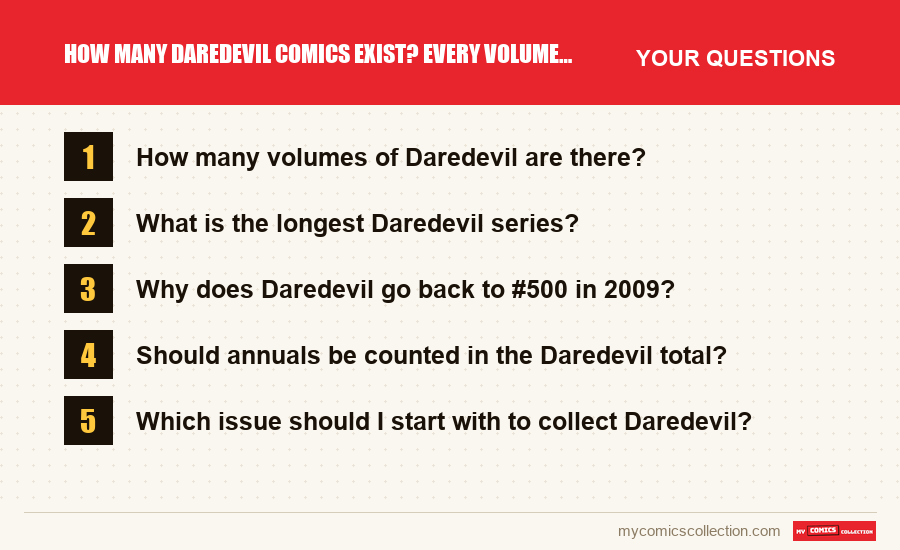
Frequently asked questions
Nine numbered volumes since 1964, plus the 2009 return from #500 to #512. The latest started in 2026. The count changes depending on whether you treat the return as a separate volume or as the continuation of volume 1, which is what its numbering indicates.
Volume 1, from #1 to #380 between 1964 and 1998, which is 381 issues with the #-1 issue. It is also the one that brings together the most creative teams: Stan Lee, Frank Miller, Ann Nocenti, D.G. Chichester among others. No later volume comes close in number of single issues.
Because Marvel picked up volume 1's numbering. Volume 1 stops at #380 and volume 2 has 119 issues: 380 plus 119 makes 499, so the next one is called #500. The series then restarts at #1 in 2011.
Not for a count of regular issues: each annual runs on its own sequence. Volume 1 has ten, other volumes just one. A collector can shelve them apart, on a separate list, and only add them in if they say so clearly.
It depends on your goal. For continuity, start with volume 1; for a continuous read, the Mark Waid or Chip Zdarsky volumes can be picked up as a block. Issues #158 to #191 and Born Again are the most sought-after stretches of volume 1.
A long Daredevil run mixes several volumes: get your copies appraised before you shelve them.
Estimate my comic