
How many Captain America comics are there? There is no single count: we identify fourteen successive series, from Captain America Comics #1 in March 1941 to the volume Chip Zdarsky launched in July 2025. The longest is the 1968 volume, #100 to #454, or 355 issues. Legacy numbering reaches #600 in 2009 and #640 in 2012, then resurfaces at #695 in 2017.
Asking a specialist comic shop owner this question is really asking them to pick an era. The shield has changed publishers, titles and numbering with every generation: an anthology magazine that hosts him part of the time, issues that continue another title, volumes that restart at #1, and some spectacular rewinds. This guide puts the series back in order and tells you what each endpoint lets you say with confidence.
As always in this guide, only verified information (creators, issue numbers, dates) is stated as fact; the analysis is ours, with no reproduction of protected artwork or dialogue.
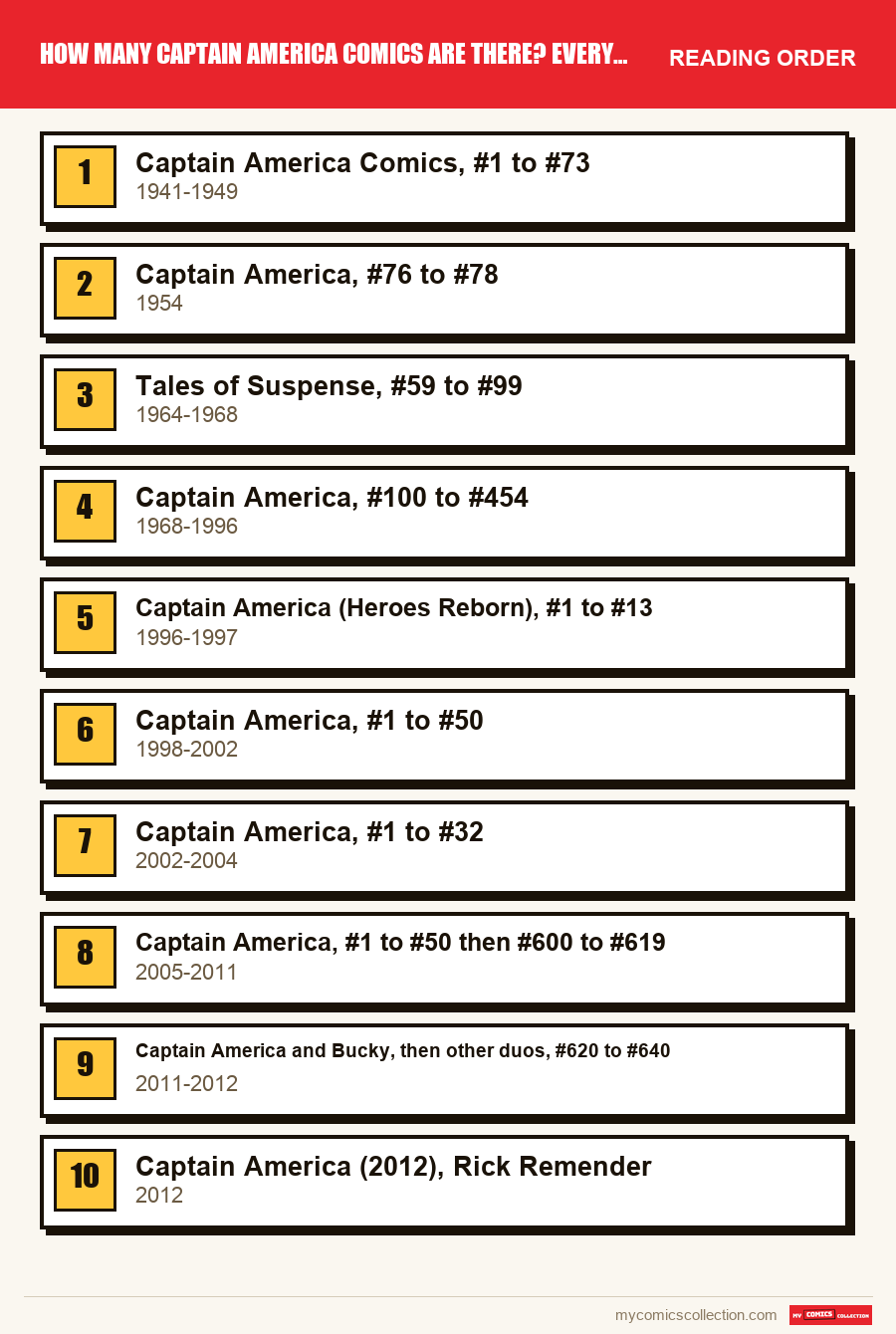
Series 1: Captain America Comics, #1 to #73 (1941-1949)
The cover says March 1941; on newsstands it was out as early as December 20, 1940, before the United States was at war. Joe Simon and Jack Kirby created the character at Timely, the company that would become Marvel. The original title runs through issue 73, dated July 1949. The numbering then continues under another name, Captain America's Weird Tales, for issues 74 and 75, from October 1949 to February 1950; the last of these is a horror and suspense anthology with no superheroes.
For the collector, that means two numbers: 73 issues under the title Captain America Comics, and 75 if you follow the numbering to the very end with the two Weird Tales issues. Decide before you start whether those are two boxes to check or two curiosities to store in a separate box.
The creation story is covered on our page about the character's first appearance, which will keep you from mistaking issue #1 for its many reprints.
Series 2: Captain America, #76 to #78 (1954)
After a gap of several years, the character returns in May 1954 under the Atlas banner, with three issues that extend the numbering of the previous series, #76 to #78, the last dated September 1954. The experiment ends at #78 and Steve Rogers leaves the newsstands once more.
These three single issues, which continue the numbering after the two Weird Tales, are often forgotten in quick tallies. If you are building a complete run, they form a short parenthesis that has its place between the character's two major periods.
Series 3: Tales of Suspense, #59 to #99 (1964-1968)
Steve Rogers's return in Avengers #4 sets up another appointment: in November 1964 he gets his own feature in Tales of Suspense #59, a magazine he shares with Iron Man. Stan Lee retells the character's origin starting at #63, in March 1965, and the period stories then continue through #71, in November 1965. Jack Kirby draws every story except two, which Gil Kane and John Romita Sr. complete.
This series is not counted like the others: only one section of each issue involves Captain America, and the magazine existed before him. Remember the range #59 to #99, or 41 issues that contain the hero's story.
Kirby plays a double role in this collection: he creates the character in 1941, then redraws him here. His Jack Kirby page brings together the work tied to him.
Series 4: Captain America, #100 to #454 (1968-1996)
At issue 100, dated April 1968, Tales of Suspense splits: the title becomes Captain America and keeps the ongoing numbering. Iron Man, for his part, goes through Iron Man and Sub-Mariner #1 and then gets his own title. The series runs to #454, in August 1996, for 355 issues, the longest run of the character.
Starting with #134, in February 1971, the cover adds the Falcon to the title, which becomes Captain America and the Falcon through #222, in June 1978. That makes 89 issues with the double title. The Falcon first appeared in #117: our page on Captain America #117 tells the story of that debut.
Three landmarks structure these 355 issues: a short stint by Jim Steranko, the collaboration of Steve Englehart (writing) and Sal Buscema (art) from 1972 to 1975, and then Jack Kirby, who writes and pencils #193 to #214. Our selection of key issues places them in context and compares them.
Between those milestones, long stretches are less contested. That is where the patience of the back-issue hunter pays off: a run of 355 issues contains more ordinary single issues than key issues, which also makes it a realistic project for anyone who does not need perfect copies.
Series 5: Captain America (Heroes Reborn), #1 to #13 (1996-1997)
In the fall of 1996, Steve Rogers leaves the usual continuity for the world of Heroes Reborn, where he starts his story over from scratch. The title runs thirteen issues there, from November 1996 to November 1997.
These single issues count toward the legacy numbering, which comes as a surprise: they do not tell the main continuity's story, but Marvel added them up when it rebuilt the overall counter. We come back to this below.
Series 6: Captain America, #1 to #50 (1998-2002)
January 1998: the heroes return to their original universe, and the title restarts at #1. Mark Waid comes back as writer, first with Ron Garney on art, then with Andy Kubert. The series runs fifty issues and ends in February 2002.
It is a transitional series: it rebuilds the character after the Heroes Reborn episode, before the next one changes the tone. It is also a good entry point for anyone who wants to read the shield without wading through decades of accumulated continuity.
Series 7: Captain America, #1 to #32 (2002-2004)
A fresh start in June 2002, under the Marvel Knights label, with John Ney Rieber writing and John Cassaday on art for the opening. The series runs thirty-two issues and wraps in December 2004. It counts fully in the legacy numbering calculation, as we show below.
Series 8: Captain America, #1 to #50 then #600 to #619 (2005-2011)
Ed Brubaker and Steve Epting launch a new volume in January 2005: this is the period that turns the character on its head. Issue 25, in March 2007, contains the death of Steve Rogers; Bucky Barnes wears the costume starting with #34, in March 2008. The volume runs fifty issues before Marvel resumes the historical numbering in August 2009, at #600, and carries it through #619.
That makes 70 issues in total under this volume: the fifty from the start and the twenty from the restored numbering. Readers who skim these lists too fast forget the jump to #600 and assume the series stopped at #50. For the style and impact of this period, see the Ed Brubaker page.
Series 9: Captain America and Bucky, then other duos, #620 to #640 (2011-2012)
The new volume announced in May 2011, with Ed Brubaker writing and Steve McNiven on art, restarts at #1 and gives the shield back to Steve Rogers. The historical numbering, though, does not die out: it goes from #619 to #620 and runs through #640, or 21 issues, under titles that change with the hero's partner: Captain America and Bucky (#620 to #628), Captain America and Hawkeye (#629 to #632), Captain America and Iron Man (#633 to #635) and Captain America and Black Widow (#636 to #640), with a #635.1 interlude, Captain America and Namor.
The presence of a .1 issue in an otherwise continuous series shows the counting problem well: depending on whether you include the interludes or not, you get 21 or 22 single issues for this volume.
Do you collect this series?
Track what you own, what you are missing and what your collection is worth. 7-day trial.
Start my trial →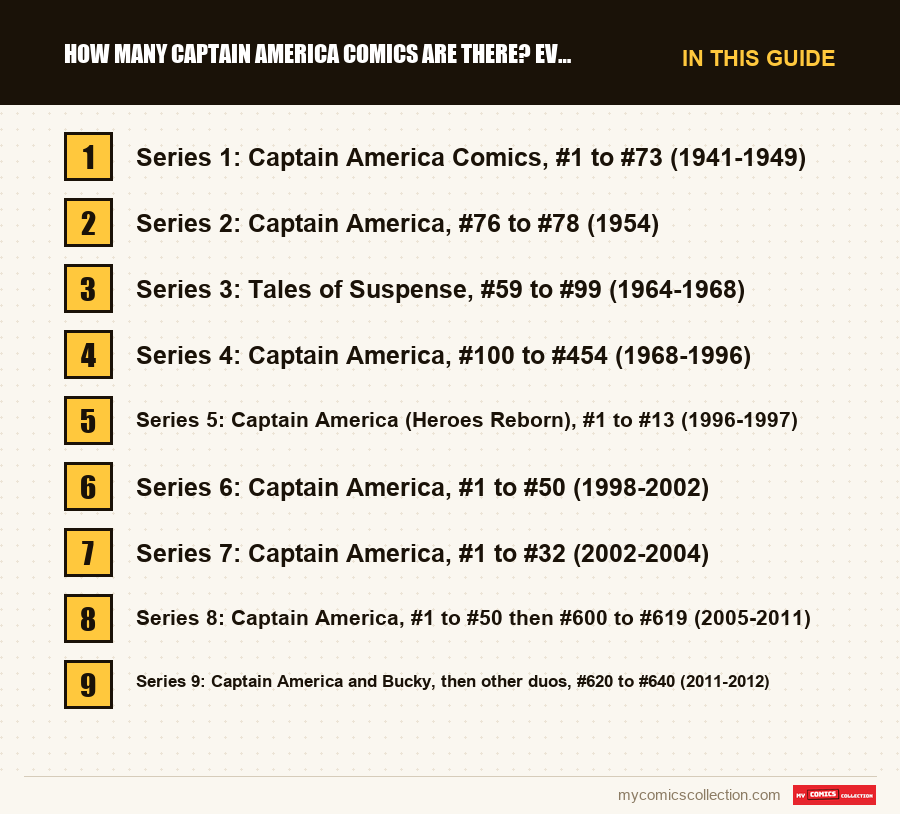
Series 10: Captain America (2012), Rick Remender
When Brubaker's run ends in 2012, the Marvel NOW! campaign relaunches the title at #1 with Rick Remender writing. Sam Wilson takes over the role of Captain America in 2014, during this publication period. The Rick Remender hub presents his other work at Marvel.
Series 11: Captain America (Marvel Legacy), #695 to #704 (2017-2018)
In the fall of 2017, the Marvel Legacy relaunch restores the historical numbering with Captain America #695. Mark Waid writes and Chris Samnee draws these ten issues, which carry the historical line through #704, passing through #700.
Series 12: Captain America (Fresh Start), Ta-Nehisi Coates (2018-2021)
In 2018, the Fresh Start campaign resets the numbering: Ta-Nehisi Coates writes and Leinil Francis Yu draws. This series continues until 2021. Just keep the publication markers in mind: one writer, one main artist, three years of publication.
Series 13: Captain America (2023), J. Michael Straczynski (2023-2024)
The volume written by J. Michael Straczynski runs from September 2023 to December 2024. It restarts at #1 and stays outside the legacy line: a short volume, to be shelved as an independent block.
Series 14: Captain America (2025), Chip Zdarsky
The most recent series was announced in February 2025 with Chip Zdarsky writing and Valerio Schiti as main artist; the first issue came out in July 2025. It is too recent to give a final issue count: the counter is still open.
Legacy Numbering: The Arithmetic of the Total
Marvel has rebuilt its numbering several times, and the sum comes out right when you follow the company's own logic. The 1968 volume stops at #454. Add the thirteen issues of Heroes Reborn, the fifty of the 1998 volume and the thirty-two of the 2002 volume: 454 + 13 + 50 + 32 = 549. The fifty issues of the 2005 volume lead to 599, hence the #600 of August 2009. What follows through #619, then #620 to #640, extends the same line.
Everything therefore depends on which list you decide to follow. Adding the 41 issues of Tales of Suspense devoted to the character extends the line upstream; the #1 to #73 of Captain America Comics, the two Weird Tales and the three issues of 1954 form another line, with no arithmetic link to this one. The #695 of 2017 and the #700 that follows belong to a different numbering operation, introduced by Marvel Legacy. We do not give a grand total, because it would change depending on these choices.
Annuals and Spinoff Series
Around the main series, several titles have existed: Captain America and the Falcon, a 2004 title; Nick Spencer's series, Sam Wilson: Captain America and Captain America: Steve Rogers, which explore different bearers of the shield; Captain America: Sentinel of Liberty and Captain America: Symbol of Truth; and miniseries such as Captain America: White, by Jeph Loeb and Tim Sale. The annuals follow a separate counter, distinct from that of the volumes. This list is not exhaustive.
We keep them outside the fourteen series: they have their own numbering. To gather everything that carries the shield's name, open a second list, separate from the first. Our page on annuals and specials details part of it.
Completing the Run: Where to Start
First choose your scope. A run centered on the 1968 volume, from #100 to #454, is the most coherent for a start: one single line, 355 issues, plenty of ordinary single issues, and a few landmarks spotted in advance. Then add the modern legacy line up to #640, and the more recent volumes as the mood takes you.
For the earlier period, move in blocks rather than issue by issue: the 41 issues of Tales of Suspense form a separate project, as do #1 to #75 of the first series, Weird Tales included. In your list, note the condition, any reprint stamp, and the edition (newsstand or direct market), because two copies of the same issue are not always equal.
Use the guide to completing a Captain America collection to prioritize your purchases, and check the reading guide if you want to go in story order rather than issue order.
Frequently Asked Questions
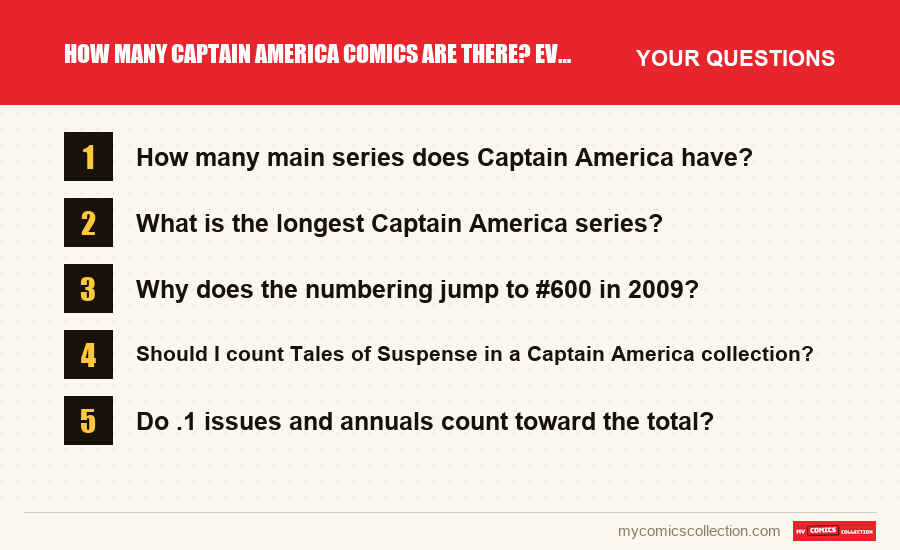
We identify fourteen, from Captain America Comics in 1941 to Chip Zdarsky's relaunch in 2025. The number varies depending on how you treat Tales of Suspense, which hosts the hero without carrying his name, and on whether or not you set apart the three issues of 1954.
The 1968 volume, which continues the numbering of Tales of Suspense from #100 and ends at #454 in August 1996, for 355 issues. Within it, the title becomes Captain America and the Falcon from #134 to #222.
Marvel restored its historical counter by adding up the previous volumes: 454 issues for the 1968 volume, 13 for Heroes Reborn, 50 for 1998 and 32 for 2002, then the 50 of the 2005 volume. The total reaches 599, so the next issue carries the number 600.
It depends on your goal. The hero has a feature there from #59 to #99, with Jack Kirby drawing almost every story, but the magazine also contains Iron Man. If you are following the character, hunt them down; if you are completing entire titles, put them off until later.
They stay outside the series counter. An interlude like the #635.1 devoted to Namor is added to the volume around it, and annuals have their own numbering. So write down two totals: the number of single issues in the regular line, then the number of extras you are willing to accept.
Do you own single issues of Tales of Suspense or of the 1968 volume and want to know what they are worth today?
Estimate my comic