Some French publications do not bear a number: they are designated by their month of publication. On a reading carried out on August 30, 2026 on the French market, in euros, and not in dollars like most of the measurements published on this site -, two announcements from the same magazine are entitled "August 2016" and "March 2016", without the slightest order figure. A third has a number zero, which comes before the number one. Practical consequence: your inventory must accept a date as a sort key in the same way as an integer, otherwise an entire collection becomes impossible to order.
The comic book collector reasons by default in a sequence of numbers. We have 4, 5, 7; the 6 is missing. This elementary arithmetic carries the essence of the action: putting away in the boxes, spotting the holes, knowing what to buy the following month, measuring the progress of a series. However, it supposes something that we never question, because it is true almost everywhere: that each object bears a number, and that these numbers form a continuous sequence starting at one. The French statement of August 30, 2026 shows that this assumption falls as soon as we leave the standard American booklet.
The survey concerns the query “Superman Urban Comics” and brings back 163 advertisements. These are amounts claimed by sellers on a single date, not completed transactions: no one has demonstrated that a buyer had paid these amounts. The minimum is €2.00, the median is €10.29, the maximum is €300.00. This isolated maximum expresses the hope of a seller and nothing else; a single measurement taken on a single day says absolutely nothing about an increase or a decrease, and I will not draw any trend from it. None of the 163 announcements concerns a copy passed by an independent verification body.
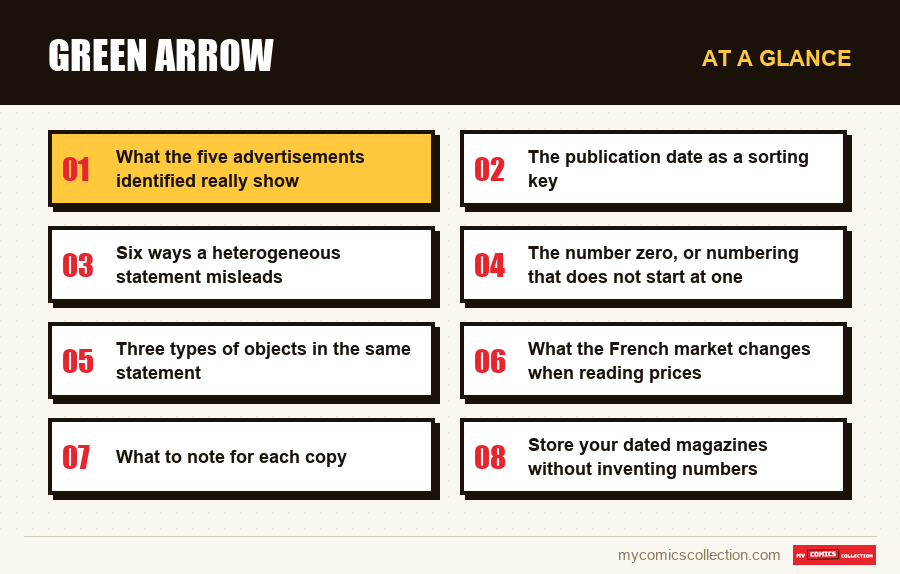
What the five advertisements identified really show
The five advertisements included in the statement are, in order of the amounts claimed: « DC Saga H.S. #1 juin 2013 [...] Urban Comics » at €2.00, « Para BD, Guide Superman, L'essentiel De L'homme D'acier: Urban Comics » at €2.00, « Urban Comics Superman Univers août 2016 » at €2.50, « Urban Comics Superman univers mars 2016 » at €2.50, and « Urban Comics DC JUSTICE LEAGUE of AMERICA N° 0 » at €2.80. Five lines, five different ways of naming an object. It is this diversity of naming, much more than the amounts, which constitutes useful information.
The first announcement combines the two systems: a special issue carries both a serial number and a month of publication. The next two only have the date. The last one only has one digit, and that digit is zero. As for the reference work, it has neither: it is a book about the character, not a story featuring the character. The same search keyword has therefore just picked up four categories of objects which are not arranged, cannot be counted and are not evaluated in the same way.
The publication date as a sorting key
A date can be ordered
“March 2016” comes before “August 2016” as surely as 3 comes before 8. Nothing is lost in terms of order: a dated monthly publication aligns in time without ambiguity, provided that the tool that arranges it knows how to read a month-year pair as an orderable value and not as a string of characters.
A date does not indicate rank
A number immediately tells you how many objects precede it. A date, no: between March 2016 and August 2016, there are five months, but there is no guarantee that there were five publications. A skipped month, a double summer issue, an interruption, and the account is wrong.
Le tri alphabétique trahit
Arranged as text, “August” comes before “March” and “December” opens the year. A dated collection sorted without prior conversion comes out in an order that makes no chronological sense, and the gaps become invisible because the neighbors are no longer neighbors.
The seller writes as he wants
The two advertisements in the same magazine bear “August 2016” and “March 2016” with different capital letters on the word “universe”. A case-sensitive or accent-sensitive search separates them. Any comparison of dates must go through normalization, otherwise two entries from the same month become two distinct objects.
The central lesson is modest and reassuring: a publication without a number remains perfectly manageable. The calendar performs exactly the function that the sequence of integers did, namely giving each object a unique place in an order. What is broken is not the collection, it is the tool which refuses to admit anything other than a number in the field provided to identify an item. An inventory that requires a mandatory integer forces the collector to invent a number, and an invented number is false data that will survive all rereadings.
Beware of the trap of the reconstructed order number. Deciding that “March 2016” will be number 3 and “August 2016” will be number 8 seems convenient, but fabricates information that the publisher has never published. The day you come across an additional publication, or a year when the magazine did not appear every month, the in-house numbering contradicts itself.
The only reliable data is that which appears on the object. If the item has a month on it, record a month. If the object has a number, record a number. If the object has both, like the special issue dated June 2013, record the two in two separate fields, and not concatenated in the same label, which will become impossible to sort again later.
Six ways a heterogeneous statement misleads
The query does not delimit anything
A publisher name combined with a character name sweeps anything with one or the other. The 163 advertisements do not form a series or even a coherent range: it is a bag in which we have only verified that each object contains the right words.
Two dates, one review
The August 2016 and March 2016 announcements refer to the same publication at two times. A naive count would see two different titles, or on the contrary a duplicate to be deleted. These are two distinct copies of the same continuous series.
The median describes no one
€10.29 is the midpoint of a set that mixes booklets, special issues and reference works. None of these types of objects have any reason to cost this amount: the statistic is accurate and irrelevant, because the population it summarizes does not exist as a category.
The format is not in the title
Nothing in the labels noted systematically says whether it is a soft booklet, a collection or a bound volume. However, the thickness, the number of stories contained and the method of storage depend entirely on it.
Zero distorts the counts
The €2.80 ad has a number zero. A numerical sort places it correctly, before the number one. But any sentence of the type « j'ai douze numéros sur quinze » becomes false as soon as the series starts at zero, since there is one more object than the largest number.
A guide is not a story
The reference work on the character at €2.00 does not belong to the same family of objects as the others. It is not part of any sequel, does not complete any series, and putting it with the booklets is like counting a road map among the novels.
The number zero, or numbering that does not start at one
The case of the number zero deserves to be treated for its own sake, because it illustrates something counterintuitive: it is not the absence of a number that poses the most problems, it is a number that exists but does not respect the expected convention. A dated review immediately warns: there is no figure, we will have to do otherwise. A number zero does not warn of anything. It looks like a regular number, sorts like a regular number, and silently breaks any math that relies on the idea that the first published object has the number one.
Sorting, in fact, works. Zero precedes one in any numerical ranking, and the object is placed exactly where it should be, at the top. The problem is elsewhere: in the counting. The collector's mental formula (“I have N numbers, the last one is the twentieth, so I'm missing twenty minus N”) presupposes that the rank of the last object equals the total number of objects published. With a leading zero, there is always one more object than the largest number suggests. Apparent completeness is systematically overestimated by one unit.
This shift of one unit seems insignificant. It is not when it concerns the only question that matters to a collector: am I finished, or am I missing something? A series that we believe to be complete and which is not is no longer the subject of any research. The missing object goes off the radar, not because it cannot be found, but because no one is looking for it anymore. This is the most costly form of inventory error: the one that self-perpetuates by eliminating the action that would have corrected it.
The parade is simple and involves a single habit: recording, for each series followed, the rank of your first object at the same time as that of the last. This data cannot be invented, it can be read on the oldest object you own or in the catalog. Once noted, it is enough to make any count accurate, whatever the starting point chosen by the publisher.
Collecting this series?
Track what you own, what you are missing and what your collection is worth. 7 day trial.
Start my trial →Three types of objects in the same statement
The statement contains at least three distinct natures of objects, and this distinction governs everything else. The periodical issue, first: the dated monthly review, which appears regularly and is collected over time. The special issue, then: the €2.00 ad carries both a number and a month, which betrays a publication outside the normal rhythm, counted separately by the publisher himself since it has its own numbering. The reference work, finally, which talks about the character without depicting it.
These three natures do not have the same logic of completeness. A periodic review is completed month after month and we always know what is missing. A special issue appears when the publisher decides: there is no sequel to fill, only an open list of which the final length is unknown. A reference work does not complete itself at all: it is a unique object, and its presence or absence in a library has no relation to the progress of a collection.
Mixing these three natures in the same meter produces a number that does not answer any questions. “I have forty objects” says nothing if these forty objects fall under three different regimes. The best practice is to separate the counters upon recording, not for the beauty of the ranking, but because the question "what am I missing?" » only makes sense within the same nature of object. To explore this question of the relevant collection unit further, see the miniseries as a unit, which deals with a related case where the whole takes precedence over the isolated number.
What the French market changes when reading prices
We must reiterate the obvious: this statement relates to the French market and the amounts are expressed in euros. Most of the measurements published on this site relate to the American market and are denominated in dollars. The two are not directly comparable, and not just because of the exchange rate. These are two different populations of objects, with different print runs, different resale circuits and different description habits.
The most striking difference is third-party verification. Out of 163 advertisements noted, none concerns a copy passed by an independent verification body. This is not a statistical detail: it means that none of the information contained in the advertisements (neither the date of publication, nor membership of a particular editorial line, nor the material condition) is attested other than by the seller himself. In this market, the seller's declaration is the only source, and the buyer has no recourse other than the photograph and his own knowledge of the subject.
This makes the question of naming all the more critical. When a third party attests to the identity of an object, an approximate designation is corrected. When no one attests to anything, the title of the ad is the identity of the object. A magazine designated « août 2016 » has no other name than that, and if the seller gets the month wrong, nothing in the chain will make up for the error. The rigor of your own recording becomes the only barrier against confusion: a point that also develops the title that changes during the series.
A final word on amounts. The minimum of €2.00 and the median of €10.29 describe a heterogeneous whole and on a single date. They do not allow us to say that a dated magazine is “worth” ten euros, nor to say that anything has gone up or down. A measurement taken on a single day shows no movement, by construction: it would take at least two measurements spaced over time, on comparable populations, to pronounce the word “evolution”. This is not the case here, and I will therefore refrain from saying it.
What to note for each copy
The publication date, when the number is missing. Record the month and year as they appear on the subject, in a dedicated field, and not blended into the title. “August 2016” and “March 2016” are two values of the same nature which must be able to be compared and ordered between them. Separating the month from the year also avoids the unpleasant surprises of alphabetical sorting, where December would open the year and August would precede March.
The type of object, on at least three values. Periodic story, special issue, reference work: these three categories are enough to cover everything contained in the statement, and they condition the way in which the object is counted. The special issue dated June 2013 falls under the second; the €2.00 character guide falls under the third and should never be included in the countdown of a series.
The starting point of the numbering, when there is one. The zero-number ad reminds us that not all series start at one. Note the rank of the first object appeared at the same time as the rank of the last; without this data, no sentence like “I'm missing three” is verifiable. This is information to be collected only once per series, and it provides lasting protection from the illusion of completeness.
L'éditeur, systématiquement. All listings found have the same publisher name, making this field seemingly useless: precisely the mistake to avoid. The same character is published in France by successive houses, in unrelated formats and numbering. Without the editor in plain text on each line, two distinct sets end up mixing into a single counter that no longer means anything.
The price paid, shipping included. The statement amounts are claimed, not cashed: they do not say what an item really costs. On ads priced at €2.00, €2.50 or €2.80, shipping often weighs more than the item itself. Recording the total actually debited is the only way to know what your collection cost you: see also acheter au meilleur prix.
Not intrinsically. The publication date fulfills exactly the function of order that an issue would fulfill: March 2016 precedes August 2016 without any ambiguity. The difficulty is purely instrumental and arises when the inventory refuses to accept anything other than an integer. The only point really lost is the immediate reading of the rank: a number says how many objects precede it, a date does not.
No. A reconstructed issue is data that the publisher has never published, and it contradicts itself as soon as an additional publication or a skipped month appears. Record the date as it appears on the item. If an official numbering exists elsewhere, it is noted in a separate field: never instead of the date.
Because it summarizes a set that mixes different types of objects: periodicals, special issues and at least one reference work on the character. The value is arithmetically correct, but it does not describe any of the categories it covers. A median only makes sense when applied to a homogeneous population.
That no information contained in these announcements is attested by an independent third party: neither the date, nor the line of publication, nor the material condition. The seller is the only source. This doesn't make the listings suspicious, but it shifts the burden of verification entirely onto the buyer, who only has the photographs and their own knowledge of the subject.
No, and for a methodological reason, no caution: a measurement taken on a single date does not contain any information on the movement. It would take two surveys spaced over time, covering comparable populations, to speak of evolution. The maximum of €300.00 is also the ambition of an isolated seller and in no way constitutes an observed price level.
Store your dated magazines without inventing numbers
Publication date, type of object, publisher, starting point of numbering, price paid including shipping: My Comics Collection accepts these five pieces of information for each copy and sorts your series in real order, whether they are numbered, dated, or start from zero.