August 30, 2026, a search for “Green Arrow Urban Comics” on the market French returns 21 listings, the lowest of which asks €9.48, the middle of the pack asks €13.90, and the highest asks €150.00. All these amounts are denominated in euros, unlike the American statements usually published here. The same day, in the United States, a single issue from 1958, the one where the character appears for the first time, fetched between $25.00 and $40.00. In other words: a French hardcover album for around ten euros delivers an entire story, an American booklet for twenty-five dollars delivers a fragment. These are not two prices of the same object, they are two different objects, and they do not register in the same way.
You have to start by saying what these amounts are, otherwise everything else is distorted. These are sums réclamées by sellers on the morning of August 30, 2026, no completed transactions. Nobody signed. An ad is a request, and a request can stay online for months without ever meeting a buyer. Of the twenty-one announcements noted, none concerned a copy passed through the hands of an independent verification body: counting certified copies gives zero, and this category is kept separate from the rest of the calculation rather than mixed with it.
We must also say what this statement cannot say. It was taken only once, on a single date. A single point does not draw a curve: no rise, no fall, no trend can be extracted from it, and anyone claiming the opposite would be adding a conclusion that the measurement does not bear. In the same way, the upper limit of €150.00 measures nothing other than the hope of the person who wrote it. She is fifteen times higher than the lower limit and lives alone at the top of the list, with nothing around to support her. The middle value, €13.90, is infinitely more telling: it indicates where the current offer really stands, approximately four euros above the floor.
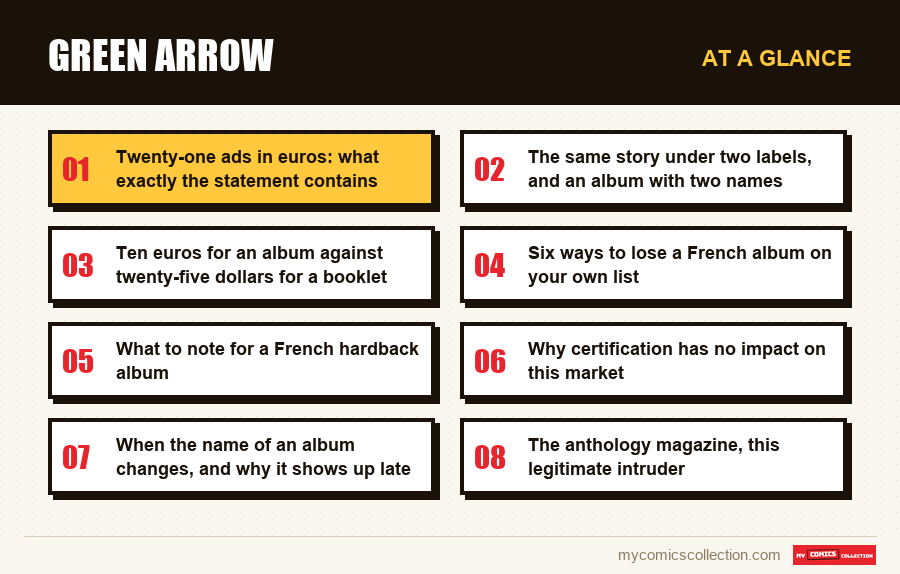
Twenty-one ads in euros: what exactly the statement contains
Twenty-one announcements are not many. It's not nothing either (beyond ten, we can at least place an order of magnitude without making any fuss) but it's a number which prohibits any finesse. We can say “around thirteen or fourteen euros”; we cannot say “the price has moved by two euros”, nor can we distinguish one album from another by its rating. The survey is used to frame a market, not to evaluate a specific item.
Five announcements have been noted in detail, and they are enough to show where the problem lies. The first, “Comic - Green Arrow - Year One: Urban Comics”, costs €9.48. The second, “Comic, Green Arrow, No 1 - Killing Machine: Urban Comics”, is asking for exactly the same price. The third, “GREEN ARROW VOLUME 1 CARDBOARD ALBUM URBAN COMICS”, goes for €9.99. The fourth, “JUSTICE LEAGUE UNIVERSE 12 BATMAN SUPERMAN FLASH GREEN ARROW URBAN DC COMICS”, also costs €9.99. The fifth, “Comics URBAN DC hardcover, Green Arrow, Year one: Diggle / Jock”, is priced at €10.00.
Rows side by side, these five lines fit in a pocket square: from €9.48 to €10.00, or fifty-two cents difference. A buyer who only looks at the price column would conclude that he is looking at the same thing five times. This is false. He has before him at least three distinct objects: a story published under two different labels, a numbered album also bearing a story title, and a magazine which does not belong to any particular series, and the price will never tell him that. It's the titles that say it, provided you read them line by line.
The same story under two labels, and an album with two names
A capital letter that cuts a series in two
“Year One” and “Year One” refer to the same story. To the human eye, the difference is invisible. For alphabetical sorting or strict searching, these are two separate entries, and one of them disappears from the results. A collection stored on the title as written by the seller mechanically inherits this cut.
A numbered volume which also bears a title
“No 1: Killing machine” combines the two identifiers: a rank in a collection and a proper name of the story. Noting only “volume 1” does not say which story we have; Note only "Killing Machine" doesn't say where the album fits in the series. You need both, in the same recording.
Only one in five announcements names the authors
Only one line mentions Diggle and Jock. However, it is the most robust mention of the lot: the title is translated, the numbering is redone, the model changes, but the authors remain the same from one country to another. The most useful information is the one that four out of five sellers leave out.
An anthology magazine in the results
“Justice League Universe 12” brings together several series under one cover. It comes up in the search because Green Arrow is there, but it doesn't belong to any of these series. Putting it under one of them makes it impossible to find for the others.
These four defects become only one, seen from four angles: in this market, the ad title is not an identifier. It is written on the keyboard by an individual who describes what he has in front of him, with the words that come to him, in the case that comes to him. Two honest sellers describing the same album will produce two different strings. No naming rules constrain them, and there is no one to harmonize them after the fact.
Direct consequence for those who keep a collection: copying the title of the ad in their list as is is importing the seller's mess into their home. Six months later, the same series appears in three spellings and we buy an album that we already own.
The solution costs nothing: when entering, we retain a standardized form of the title, we add the volume number when it exists, and we note the authors separately. These three fields overlap; one catches up with what the other lets slip away.
Ten euros for an album against twenty-five dollars for a booklet
The comparison measured on the same day is brutal in its simplicity. On the one hand, a French hardback album costs around ten euros. On the other, an American booklet from 1958, that of the character's first appearance, fetched between $25.00 and $40.00. The booklet costs more, and it contains many fewer pages. This seems absurd as long as we think we are buying the same merchandise.
We don't buy the same merchandise. The hardcover album is a reading medium: it brings together a complete story, from start to finish, in a mass-produced object that can always be reprinted. Its value comes from what it reads, and this value is capped by the fact that a publisher can reprint it. The 1958 issue is a dated object. Its quantity has been fixed for sixty-eight years, its production will never be repeated, and what is paid for by taking it is not the narrative content but the copy itself, with its age and its condition.
The two logics do not contradict each other, they simply do not meet. We may want to read a story and want to own an ancient object; these are two expenses that respond to two desires, and it is perfectly coherent to do both. What doesn't work is to compare the two prices as if they were for the same good and conclude that one is a good deal and the other a scam.
This asymmetry has a concrete translation in a collection. A hardcover album is described by its title, its authors and its publisher: what it contains is enough to identify it, its condition does not matter as long as it is readable. An old booklet is described by its series, its number and its condition: what it contains is almost secondary, since the same story is available elsewhere for ten euros. The same “state” field therefore does not weigh at all the same weight depending on the line where it is filled. The principle of coherent block cutting is the same as that described in the mini-series considered as a unit: what counts is the whole which forms a whole, not the isolated fragment.
Six ways to lose a French album on your own list
Search does not find what you own
You entered “Year One” with a capital letter, you are looking for “Year One”. Zero results. The album is there, but your request doesn't touch it, and you conclude that you miss it.
The date of the album is not that of the story
A French album appears years after the booklets it covers. Recording the French publication date as the date of the story confuses any chronological classification of the series.
The French publisher is not noted
Without it, two different editions of the same story become indistinguishable in the list, even though they have neither the same pagination, nor the same editorial apparatus, nor the same resale value.
Shipping is not included in the price paid
A hardcover album is heavy. On a ten euro item, shipping weighs a very visible fraction of the total. Writing down €9.48 instead of the amount actually debited distorts any subsequent addition.
The volume and the title are entered in the same field
“No 1: Killing Machine” written in one block cannot be sorted by number or title. Separated, the two find each other in their own way.
The anthology is grouped under a single series
A magazine bringing together several heroes arbitrarily classified under one of them becomes invisible from the others. It needs its own entry, described for what it is.
None of these six pitfalls is spectacular. They do not cause a visible error on the day of entry: the list looks correct, each line seems filled. The cost comes later, when you have to find, count or resell, and by then, it's too late to remember what exactly you had in your hands.
What to note for a French hardback album
The title of the story AND the volume number, in two separate fields. The statement proves it: the same album can carry both, like this ad for €9.48 which displays “No 1” and “Machine to Kill” on the same line. Writing only the number leaves a collection of anonymous tomes; writing only the title leaves a floating story, impossible to place in the order of the series. The two together control each other, and a standardized form of the title, capitalization fixed once and for all, avoids the duplication “Year One” / “Year One”.
The authors, systematically, even when the seller does not give them. Only one of the five detailed ads mentions Diggle and Jock. However, this is the only information in the lot that survives the passage from one country to another: a title is translated, a volume number is renumbered by the French publisher, but a screenwriter and an artist remain identical throughout. When four out of five ads omit this data, it's up to you to find it and enter it: it's what will one day allow you to recognize a foreign album as being one you already have.
American numbers included in the album, when indicated. A hardback album combines several issues. If the cover page or ad specifies which ones, note the interval. This is the only way to know, later, if another album you want covers the same content or extends it. Without this information, two albums can contain exactly the same pages without anything in your list indicating this.
The French publisher, in full. The five advertisements noted carry it, in varying forms: "Urban Comics" alone, or attached to "DC" and the mention "hardcover". It is this name which distinguishes one edition from another for a story which may have been published several times in French. Without it, two lines in your list may refer to the same story in two different objects, and you will only know this by physically putting them side by side.
The price actually paid, including shipping, with the date of purchase. The amounts in this statement are requests made on August 30, 2026, not sales. The only certain number you can enter is the one you debited yourself, shipping costs included. On a ten-euro hardcover album, shipping is not a detail. And the date attached to the amount is what will give, in a year or five, an honest point of comparison: a single isolated statement never shows any movement.
Collecting this series?
Track what you own, what you are missing and what your collection is worth. 7 day trial.
Start my trial →Why certification has no impact on this market
Zero copies checked out of twenty-one advertisements. The figure is clear, and there is nothing accidental about it. Verification organizations work on specifications: they seal a copy in a shell, give it a condition rating and transform it into an object whose condition is guaranteed by a third party. This operation makes economic sense when the value of the property depends massively on its condition and this value greatly exceeds the cost of the appraisal.
A ten-euro reprintable hardback album does not meet either of these two conditions. Having an object certified for which you can buy a new copy for the price of a meal has no logic: the service would cost several times the good. And an album sealed in a cover can no longer be read, which directly contradicts its raison d'être. The French album market has therefore naturally ruled out a device designed for another type of object.
This observation has a practical consequence: in this segment, no third party vouches for the state. The buyer is alone when faced with the seller's description, and this description is written freely, without an imposed grid. The same words (“good condition”, “like new”) cover very different realities from one seller to another. The only protection consists of describing the object received yourself, in your own terms and on your own scale, upon arrival. This requirement to count what we actually have on hand rather than what we believe to have joined what is exposed the count of eleven announcements.
It should be added that the absence of certification is not a defect in the French market. This is a sign that it functions according to another logic: that of reading, where the object is a means and not an end. On the American side of old fascicles, where the object is the end, certification has its place. The two markets coexist without resembling each other, and a collector who frequents them both must have two ways of describing what he owns.
When the name of an album changes, and why it shows up late
The statement shows a story appearing under two spellings. This is only the benign version of a larger phenomenon: between the original American edition and the French edition, almost no element of identification remains intact. The title is translated, therefore replaced. The numbering is redone according to the division chosen by the French publisher, therefore shifted. The cover is sometimes changed. The format changes from the stapled booklet to the hardback album, so the object itself no longer has the same shape.
What crosses this border without being distorted comes down to two things: the authors, and the material of the story. This is why the mention “Diggle / Jock” spotted on a single advert is, from an identification point of view, more valuable than the four titles combined. It allows us to say with certainty that two objects with very different appearances tell the same story: something that no translated title will ever allow to affirm alone.
The difficulty repeats itself within the same market when a title evolves over the course of publication. A series can change its name, be relaunched, be renumbered without the content marking a break, and a list organized around the single title then splits into two blocks with no apparent link. The mechanism is detailed in the title that changes during the series, and it applies word for word to the France-United States crossing.
The remedy is always the same, and it is modest: never base the identity of an object on a single field. Standardized title, volume number, authors, publisher, original numbers when known. Five fields which, taken in isolation, are all fallible; taken together, they are enough to recognize any of the albums noted, including when a seller writes the name differently than you do.
The anthology magazine, this legitimate intruder
“Justice League Universe 12” deserves attention, because it illustrates a case that most lists handle poorly. This magazine brings together Batman, Superman, Flash and Green Arrow under one cover. It appears in a search for Green Arrow because the name appears there, and this appearance is perfectly legitimate: the character is there. But the object does not belong to any individual series.
Two bad solutions present themselves spontaneously. The first is to put it under Green Arrow, which makes it untraceable for anyone looking for Flash. The second is not to register it at all, on the grounds that it does not fit in any box, and we then end up with an object owned but absent from the list, which is the worst possible configuration.
The right solution is to give it its own entry, described for what it is: a numbered magazine, with its own publication title, its own number, and mention of the series it contains. It then ceases to be an intruder in a series to become an object in its own right, rediscoverable from any of the names that appear there.
This question of connection arises in exactly the same terms for adaptations and derivative products, which constantly come up in research without belonging to the bibliography of the character: this is the subject of the television series versus the comics. The rule that emerges applies everywhere: when an object does not fit into any series, it is not the object that must be twisted, it is the list that must be expanded.
Frequently asked questions
Because the statement dated August 30, 2026 was taken on the French market, where hardback albums in the French language circulate. The twenty-one advertisements are denominated in euros: minimum €9.48, median value €13.90, maximum €150.00. The only dollar figure cited here is the American comparison measured on the same day on the 1958 fascicle, between $25.00 and $40.00. The two currencies are never added or converted into each other: they are two distinct markets, observed separately.
The question has no answer, because it compares two different goods. The hardback contains a complete story and is reprinted; we pay for what we read. The 1958 booklet contains a fragment of history in an object whose quantity has been frozen for decades; we pay for the copy, its age and its condition. Depending on whether we seek to read or to possess, one or the other is relevant, and nothing prevents us from wanting both for different reasons.
Save both, in two separate fields. The case presents itself in the statement with an advertisement for €9.48 which bears “No 1” and “Killing machine”. The number alone gives a position in the series without saying which story it is; the title alone gives the story without saying where it is placed. Written together as a single block in the same field, they are not sorted by one nor the other. Separated, each remains usable for what it brings.
No. This is an amount claimed by a seller on August 30, 2026, not a concluded sale, and it is isolated at the very top of a list whose midpoint is €13.90. A solitary maximum measures the hope of the person who displays it, nothing more. With only twenty-one advertisements, the number is too small to establish a precise price level: we can place an order of magnitude, not decide the value of a specific copy.
No, it is consistent with the nature of the objects concerned. Verification by an independent body applies to fascicles whose value strongly depends on the condition and exceeds the cost of the expertise. A reprintable album for ten euros meets neither of these conditions, and sealing it in a cover would prevent it from being read. On the other hand, as no third party guarantees the condition in this segment, you must describe the item received yourself upon arrival, in your own words.
Two formats, one list
Hardcover albums in euros on one side, American issues in dollars on the other: as long as both live in the same file without suitable fields, each new acquisition adds ambiguity. A collection kept with the standardized title, the volume, the authors, the publisher and the price actually paid including shipping can be reread effortlessly years later, and never buy the same story twice under two different labels.