
A graphic novel is a standalone bound book, typically 100 to 600 pages, that differs from monthly comic issues and European bande dessinée albums through its monolithic, self-contained nature: Watchmen , Maus , Persepolis , Asterios Polyp , Building Stories , Sandman Omnibus. Managing them in a dedicated app means using a graphic-novel tag, applying a valuation logic that's less volatile than issues (stable editions, regular reprints), and storing them like books (vertical on a shelf, spines visible).
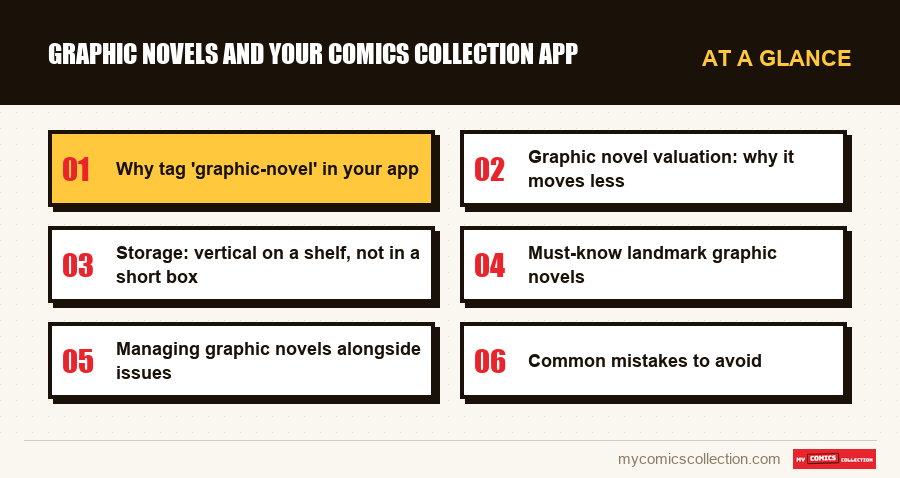
Any comics collector who adds Watchmen , Maus , or Persepolis to their database quickly runs into a classification problem. These books don't have issue numbers, no monthly cover date, and sometimes no clearly identifiable American publisher in the Marvel/DC sense. Yet they're often worth more than a single issue: a Watchmen Absolute Edition hardcover goes for $85-$165, a Maus two-volume Pantheon Books slipcase for $38-$65, and a Building Stories by Chris Ware in its original box can top $220 on the secondary market. This cluster guide explains how to cleanly integrate graphic novels into a comics collection management app, what metadata to track, how to assess their value, and how to store them properly. Seven sections cover the definition, tagging, valuation, storage, landmark titles, and a practical FAQ.
What exactly is a graphic novel?
The term graphic novel has been used loosely for over thirty years. Will Eisner popularized it in 1978 with A Contract with God, which was presented as a bound book aimed at general bookstores rather than newsstands. The strict modern definition requires three cumulative criteria: a standalone work (a complete story in a single volume, with no required continuation), a bound book format, either hardcover or trade paperback, and a substantial page count (100 to 600 pages, sometimes more). This definition excludes trade paperbacks that are merely collections of monthly issues (for example, Saga Vol. 1 , which compiles Saga #1-6), even though the line remains blurry in practice.
The practical difference from a comic issue shows up in the barcode. A modern comic carries an EAN-13 tied to a specific issue in a series (Amazing Spider-Man, Batman, X-Men). A graphic novel carries an ISBN-13 book code managed by library distribution networks (Electre, BookData), not by comics-specific databases like catalog or League of Comic Geeks. The practical implication: your collection management app needs to know how to switch between two different metadata sources. The cataloguing comics methods guide covers this dual-database logic in detail.
Three subcategories matter in practice. The original graphic novel (OGN) is conceived from the start as a book, never published as floppies: Maus by Spiegelman, Persepolis by Satrapi, Blankets by Craig Thompson, Asterios Polyp by David Mazzucchelli. The collected graphic novel compiles a complete mini-series later published as a single book: Watchmen (12 DC issues), Batman: The Dark Knight Returns (4 issues), V for Vendetta (10 issues). The omnibus or complete edition gathers a long finished series into one massive volume: the Sandman Omnibus by Neil Gaiman, Bone One Volume Edition by Jeff Smith, Locke & Key Master Edition. See strips, trade paperbacks, and omnibuses for the full breakdown.
Why tag 'graphic-novel' in your app
The dedicated tag isn't just a cataloging nicety: it serves four concrete purposes. First, it visually separates your book collection from your issue collection in list views and stats. A collector with 800 Marvel floppies and 40 graphic novels will see those 40 items buried in the noise without a filter. With a graphic-novel tag, the counter shows both subsets distinctly: 800 issues + 40 GNs, with separate valuations and separate physical shelving.
Second, the tag drives valuation logic. A graphic novel has a less volatile value than a key issue. Amazing Spider-Man #300 in CGC 9.8 can swing from $1,300 to $2,200 over six months depending on MCU news. A current-edition Watchmen hardcover stays stable around $27-$38 because it gets reprinted every 18 to 24 months. That stability makes sense: the publisher restocks when demand picks up. Only out-of-print or collector editions (Absolute, first-printing Deluxe HC, signed) genuinely appreciate. Your app should therefore apply a different pricing logic: less real-time eBay scraping, more publisher catalog reference.
Third, the tag guides storage decisions. A modern floppy goes into a short box horizontally, sleeved in a polypropylene bag with a backer board. A graphic novel stands vertically, spine out, on a bookshelf: just like any quality bound book. The protection needs differ: no individual bag required (the hardcover is its own protection), but watch out for humidity (which warps pages), direct light (which fades coated paper dust jackets), and stacking pressure (which creases the spines of 500+ page volumes). More detail in protecting and preserving your comics.
Fourth, the tag simplifies insurance export. An insurer covering a $33,000 collection will ask for a detailed inventory. Separating 700 floppies at ~$11 each from 50 graphic novels at ~$65 each makes the math clean. The comics collection app exports these two categories as separate sections in the PDF inventory report.
graphic-novel: ogn (original), collected, omnibus, indie (Drawn & Quarterly, Fantagraphics, Pantheon Books). These sub-tags let you filter by publishing channel. Asterios Polyp would be tagged graphic-novel + ogn + indie. The Sandman Omnibus gets graphic-novel + omnibus + DC Vertigo.
Graphic novel valuation: why it moves less
A GN's value follows book market logic, not back-issue comics market logic. Three factors dominate. The first is edition status: current (in stock at the publisher), out of print, or collector (Absolute Edition, first-printing Deluxe HC, signed/numbered). A current-edition Watchmen from DC can be found new for around $20-$25 at any bookstore. The same story in Absolute Watchmen (slipcase, glossy paper, 22 x 33 cm format, 464 pages, released 2005, long out of print) trades for $220-$385 on eBay or ComicConnect. See ComicConnect, Heritage, and eBay.
Second factor: the first printing. For books that became classics after the fact, the first hardcover printing (1st printing HC) commands a premium. Maus I: My Father Bleeds History in its 1986 Pantheon Books hardcover first edition with intact dust jacket goes for $220-$440, while the current trade paperback reprint retails for $20. For Persepolis in its original French four-volume L'Association edition (2000-2003), expect $88-$165 for a complete set in good condition, versus $38 for the current one-volume reprint.
Third factor: signatures. A GN signed by the author on the bookplate is reliably worth 2 to 4 times more: provided there's provenance (a photo of the signing, a COA, or documented convention context). French conventions like Angoulême or Comic Con Paris draw Frank Miller, Mike Mignola, Brian K. Vaughan, and their signatures on hardcovers are traceable. See comics conventions 2026 calendar.
For your app, this means storing not just the title and author, but also the exact publisher, printing year, edition number (1st, 2nd, 3rd printing), HC/SC designation, whether a dust jacket is present, precise condition (Near Fine, Very Good, Fine per bookseller grading vocabulary), and signed or unsigned status. Without this metadata, your Watchmen is a vague entry that could be worth $25 or $385 depending on the actual edition. The free valuation tool builds this multi-edition logic in.
Storage: vertical on a shelf, not in a short box
A graphic novel should be stored like a quality bound book, not like a comic. Four technical rules apply. First rule: store vertically, spines visible. Books ranging from 200 to 600 pages weigh 1.3 to 4 lbs. Stack them horizontally and the ones on the bottom deform under the weight above. An IKEA Billy bookcase with supports every 30 inches holds 60 to 80 GNs per shelf across four levels without issue. Go with deeper shelves (at least 11 inches) for oversized formats like Absolute Editions (22 x 33 cm) or Building Stories (42 x 30 cm box).
Second rule: humidity control. Above 65% relative humidity, pages warp within months and dust jackets brown within years. Target 45 to 55% humidity, monitored with a $15-$20 hygrometer. Avoid unheated exterior rooms in winter (high humidity) and attics in summer (extreme heat). A bookcase in a climate-controlled living room at a stable 68-72°F is the practical ideal.
Third rule: light protection. The coated paper dust jackets on modern editions (Vertigo, Image Deluxe HC) fade fast under direct UV. Six months of full southern exposure can strip 30% of the chromatic saturation from a Sandman Deluxe Vol. 1 spine's orange and red tones. Avoid direct sunlight or install a UV-blocking window film (99% UV film runs about $4-$5 per square foot).
Fourth rule: sleeves for rare pieces. For an Absolute Edition worth $275 or a first-printing Maus, a mylar protective sleeve (BCW Modern Comic Mylar or equivalent in book format) provides a barrier against handling, dust, and fingerprints. Budget $9-$13 per quality mylar sleeve in hardcover size.
Must-know landmark graphic novels
About a dozen titles define the global graphic novel canon. Knowing them helps you spot the pieces in your catalog that deserve special attention.
Watchmen by Alan Moore and Dave Gibbons (DC, 1986-1987). Originally published as 12 issues, later collected in hardcover and then as an Absolute Edition. Winner of the 1988 Hugo Award, the only comic listed among Time Magazine's 100 greatest novels. First DC hardcover edition 1987: $88-$165 in good condition. Absolute Watchmen 2005: $220-$385. Current DC reprint edition: $20-$28.
Maus by Art Spiegelman (Pantheon Books, 1986 and 1991). The first graphic novel to win the Pulitzer Prize (1992). First Vol. 1 hardcover 1986 with original dust jacket: $220-$440. Two-volume Pantheon slipcase 1996: $38-$65. Current complete edition: $22 new.
Persepolis by Marjane Satrapi (L'Association, 2000-2003). Four original French volumes, then a one-volume complete edition. Original L'Association first edition in black and white softcover: $33-$55 per volume, or $132-$220 for the complete set. Current complete edition: $22.
Asterios Polyp by David Mazzucchelli (Pantheon, 2009). 344-page hardcover, five-time Eisner Award winner. First hardcover edition: $44-$77.
Building Stories by Chris Ware (Pantheon, 2012). A 42 x 30 cm box containing 14 independent printed pieces (books, newspapers, foldouts, pamphlets). Complete first edition in intact box: $165-$275. Technically challenging to catalog: your app needs to support a boxed set, 14 pieces notation.
Sandman Omnibus by Neil Gaiman (DC, 2013-2014). Two hardcover volumes of 1,040 and 1,088 pages collecting all 75 issues plus tie-ins. Complete new set: $275-$385 for both volumes. See Sandman comics history.
The Dark Knight Returns by Frank Miller (DC, 1986). Absolute Edition 2006 (out of print): $220-$440 signed. Current Deluxe HC reprint: $38.
Blankets by Craig Thompson (Top Shelf, 2003). 592 pages in black and white, widely considered a high-water mark in autobiographical comics. First Top Shelf edition: $66-$110. Drawn & Quarterly reprint: $33.
indie consistently in your app.
Managing graphic novels alongside issues
The real challenge begins when your collection mixes monthly floppies, trade paperback runs, original graphic novels, and omnibuses. Keeping the catalog coherent requires four clear conventions. First convention: standardized naming. For an OGN, use the format Title (Publisher, Year) : Watchmen (DC, 1987) , Maus I (Pantheon, 1986). For a reprint, add the edition: Watchmen Absolute Edition (DC, 2005). This naming convention enables partial searches and alphabetical sorting.
Second convention: ISBN as a required field. A GN without an ISBN in the database is unmanageable. Every book published after 1972 carries an ISBN-10 or ISBN-13. Scan it or type it in manually. Your app then queries OpenLibrary, WorldCat, or the Library of Congress to pull in the complete bibliographic record.
Third convention: physical separation. A dedicated vertical shelf for GNs and omnibuses; short boxes for floppies; D-ring binders for compact softcover trade paperbacks (standard Marvel TPB format at 17 x 26 cm). This physical separation makes cross-referencing easy: a comic missing from its box but present in its collected edition takes seconds to locate.
Fourth convention: separate counters on the dashboard. Configure your app to display three counts: number of floppies, number of TPBs/trades, number of GNs/omnibuses. Three lines, three distinct valuations. The mixed comics/BD/manga collection guide applies the same principle across comics and European albums.
Catalog your graphic novels in minutes
The My Comics Collection app accepts book ISBN scans alongside standard comic barcodes. The graphic-novel tag is pre-configured, valuation is kept separate from issue pricing, and the PDF inventory export automatically splits the two sub-collections for insurance purposes.
Common mistakes to avoid
Four recurring pitfalls undermine a clean catalog. First mistake: tagging a trade paperback as an OGN . Saga Vol. 1 is not an original graphic novel: it's a collection of issues #1-6 published separately before being compiled. If you tag it ogn, you skew your stats. Reserve ogn for works conceived from the start as standalone books (Maus , Persepolis , Blankets , Asterios Polyp).
Second mistake: omitting the edition . A Watchmen entry with no further details could be worth anywhere from $20 to $385 depending on the actual edition. Always specify: current edition, first printing, Absolute, Deluxe HC, Companion Edition. The same rigor applies to key issues like Amazing Spider-Man , Walking Dead , and X-Men: see ASM key issues, Walking Dead key issues, and X-Men key issues.
Third mistake: valuing at new retail price. The resale value of a current-edition GN that's been read is typically 40 to 60% of its cover price. There's no point inflating your catalog with 50 GNs at $25 each when they'll actually resell for $10-$15 apiece. Be realistic about current editions.
Fourth mistake: ignoring the dust jacket. On hardcovers, the dust jacket (DJ) accounts for 30 to 50% of the collectible value. A first-edition Maus without its dust jacket is worth $66-$110 instead of $220-$440 with it. Always note in the condition field: HC with DJ or HC without DJ.
FAQ: Graphic novels and collection management apps
Does a trade paperback count as a graphic novel?
Technically, no. A trade paperback (TPB) is a collection of multiple monthly issues that were published separately before being compiled. An original graphic novel (OGN) is conceived from the start as a standalone book. The distinction matters for valuation and archiving. In your app, create two separate tags: tpb and graphic-novel. See strips, trade paperbacks, and omnibuses for the full breakdown.
How do I scan a book ISBN with a comics app?
Serious comics apps accept EAN-13 book barcodes in addition to comic UPC codes. The scanner detects the format, then automatically queries a bibliographic database (OpenLibrary, WorldCat, Library of Congress) instead of a comics database (catalog, League of Comic Geeks). The metadata injected includes: title, author, publisher, ISBN, publication date, page count, and format.
Why is an Absolute Edition worth so much?
Absolute Editions (DC Comics), Treasury Editions (Marvel), and Companion Editions are large-format hardcovers on glossy paper, printed in limited runs, typically with a slipcase and bonus material. A typical print run is 5,000 to 15,000 copies, never reprinted once sold out. The physical scarcity combined with the premium production quality explains the 5-to-10x premium over the standard edition.
Does a graphic novel need a sleeve or not?
For current editions (worth $16-$38), no: the hardcover is its own protection and a sleeve adds little. For rare pieces (first printings, Absolute Editions, signed copies), yes: a mylar book sleeve like the BCW Mylar Book Bag at $9-$13 each. This protection keeps the dust jacket free from fingerprints and dust without preventing occasional reading.
How do I value an out-of-print graphic novel?
Three reliable sources: closed eBay sales (use the "Sold" filter over 90 days), ComicConnect/Heritage for premium pieces, and AbeBooks for out-of-print non-comics editions. Avoid active listings: they tend to be aspirational. The free valuation tool aggregates these sources for classic comics. For pure OGNs, AbeBooks remains the most realistic pricing reference.
Should omnibuses be tagged as graphic novels?
Yes, for practical consistency. An omnibus like the Sandman Omnibus , Bone One Volume Edition , or Locke & Key Master Edition is physically a massive bound book stored the same way as a graphic novel. Tag it graphic-novel + omnibus. Storage, valuation, and inventory all follow book logic, not comics logic.
How many graphic novels before you need to structure a catalog?
Past 20 GNs, memory alone isn't enough. At 50, you can't remember whether you own Volume 1 or Volume 2 of Persepolis , or whether your Watchmen is the standard edition or the Deluxe HC. At 100 GNs without an app, you'll accidentally buy 2 or 3 duplicates a year. An app pays for itself starting around 30-50 GNs.
Does a signed graphic novel really gain value?
Yes: as long as the signature is traceable. An anonymous signature with no context is worth little. A signature with a photo, a convention COA, or documented video of the signing event multiplies value by 2 to 4. A Maus signed by Spiegelman at a documented festival could fetch $660-$1,320 versus $220-$440 unsigned. Same goes for a Watchmen signed by Dave Gibbons at Angoulême.