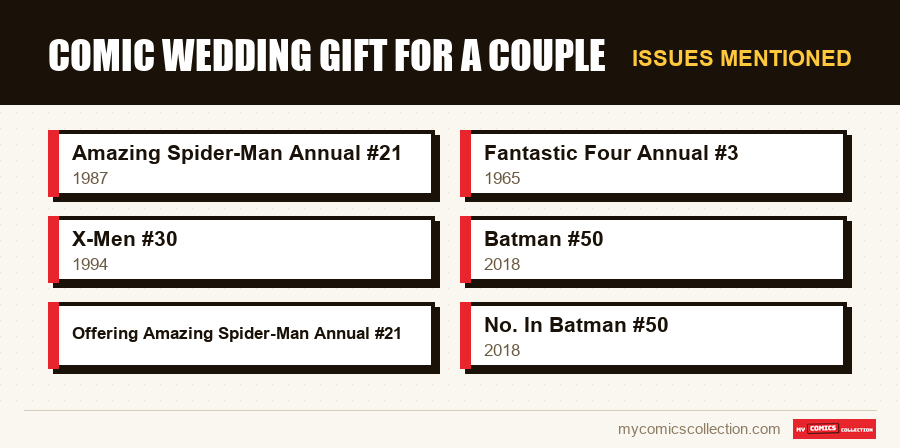
For an original and meaningful wedding gift, superhero wedding comics are a formidable choice: Amazing Spider-Man Annual #21 (1987, Peter Parker & Mary Jane), Fantastic Four Annual #3 (1965, Reed Richards & Sue Storm), Superman: The Wedding Album (1996, Clark Kent & Lois Lane), X-Men #30 (1994, Cyclops & Jean Grey) or even Batman #50 (2018, Bruce Wayne & Selina Kyle) each tell a truly significant couple story in American publishing history. The right choice depends on the personality of the bride and groom, the budget and the condition sought: a period copy in good condition, a more accessible facsimile reissue, or a certified piece for lovers of fine collections.
Finding a wedding gift that stands out from the crowd is never easy. Between the classic list (linens, household appliances, gift certificates) and more personal options, many loved ones are looking for something that tells a story, and that lasts. For a couple who love pop culture, superhero cinema or are simply nostalgic for their childhood readings, a comic book dedicated to the wedding of an iconic character ticks all the boxes: it is a physical, collectible object, loaded with a real narrative, and which often has a cultural resonance well beyond the simple geek gadget.
What makes these issues particularly relevant for a wedding is that they are not simple derivative products: they are episodes that marked the history of their respective series, with leading creative teams, identifiable vintage prints, and for some a media resonance that went beyond the circle of comic book readers at the time of their release. Offering Amazing Spider-Man Annual #21 or Superman: The Wedding Album is not offering a wedding-themed gimmick: it's offering an authentic fragment of American pop culture, published on the day two fictional characters said yes to each other, with all the editorial mechanics (crossovers, promotional events, press coverage) that that entailed at the time.
This guide details the main wedding numbers to know, their creation context, what makes them sought after, and how to choose the right copy according to the profile of the couple, the available budget and the level of collection already started (or not) by the bride and groom.
Marriage, an editorial rite of passage for major comic studios
Since the 1960s, major American publishers have understood that the marriage of a main character constitutes an editorial event in its own right: it brings together readers of several series around the same issue, it justifies a special cover, an annual or one-shot format, and often a communication operation that goes beyond the simple readership of comics. This is exactly what happened with Fantastic Four Annual #3 in October 1965. Stan Lee and Jack Kirby organized the wedding of Reed Richards and Susan Storm, but transformed the episode into a gigantic crossover: almost the entire catalog of Marvel heroes of the time was summoned to protect the ceremony, while Doctor Doom orchestrated an attack by all the major villains of the moment. The issue closes with a wink that remains famous: Stan Lee and Jack Kirby themselves, depicted being refused entry to the wedding party for lack of an invitation.
This model, marriage plus crossover plus meta nod, was subsequently taken up and refined. Marvel took it even further in 1987 with the marriage of Peter Parker and Mary Jane Watson in Amazing Spider-Man Annual #21, written by David Michelinie and drawn by Paul Ryan, with a cover by John Romita Sr. The operation did not stop at the printed page: Marvel orchestrated a promotional ceremony at Shea Stadium in New York, where comedians reenacted the vows of Peter and MJ in front of tens of thousands of spectators who came to attend a game of the Mets, all supervised by Stan Lee. This is one of the rare cases where a comic book wedding had mainstream media coverage at the very moment of its release, which explains why this issue remains an almost obligatory reference when we talk about wedding gifts on the theme of comic books.
On the DC Comics side, the wait was longer but just as editorially structured. The marriage of Clark Kent and Lois Lane, announced for decades in Superman mythology, was only made official in 1996 with the one-shot Superman: The Wedding Album, released the week of October 6, 1996 with a cover date of December 1996. DC brought together the five writers who then took turns on the Superman series (Dan Jurgens, Karl Kesel, David Michelinie, Louise Simonson and Roger Stern) as well as an impressive lineup of historical cartoonists of the character, including John Byrne, Curt Swan, Gil Kane, Jon Bogdanove and Tom Grummett. The release was timed to coincide with the wedding episode of the television series Lois & Clark: The New Adventures of Superman, a timing that illustrates the extent to which these issues were intended as true transmedia events, almost thirty years before the term became commonplace.
Peter Parker and Mary Jane Watson: the alliance that has become an icon
If a single wedding issue had to sum up the genre, it would probably be Amazing Spider-Man Annual #21. What makes it a particularly meaningful gift for a couple is the trajectory of the character: Peter Parker is by far the Marvel hero whose sentimental story has been the most followed over time, with ups and downs made famous by subsequent cinematographic adaptations. The 1987 marriage marks the culmination of more than twenty years of a whirlwind relationship between Peter and Mary Jane, initiated from the beginning of the series in the 1960s.
The issue has since enjoyed a second editorial life: Marvel has published a reissue in a facsimile edition of the marriage story, allowing readers and collectors to access a faithful version of the original content (cover, period advertisements included) at a price that is much more accessible than an original copy from 1987. This is an option to be aware of if the budget takes precedence over the rarity of a period print: the narrative background is identical, only the provenance of the print changes.
Reed Richards and Susan Storm: the first major crossover marriage in the Marvel universe
For a couple who loves the team aspect of marriage (the collective dimension, the extended family, the friends from everywhere) Fantastic Four Annual #3 tells a particularly fitting story. The issue isn't just the wedding of two characters: it's a declaration of a shared universe, where virtually every Marvel hero published at the time makes an appearance, whether protecting the ceremony or attending it. It is also historically one of the very first examples of "mega-crossover" in the history of American comic books, a format which would become a trademark of the industry decades later.
For fans of author comics in the classic sense, this issue has an additional interest: it is about Stan Lee / Jack Kirby, the founding creative duo of the Fantastic Four, at the height of their collaboration on the title. This is a strong argument if the receiving couple is as interested in the history of the medium as in the plot itself.
Clark Kent and Lois Lane: sixty years of waiting before “yes”
Few fictional couples have waited this long before officially marrying in editorial continuity. Since the creation of Superman in 1938, the relationship between Clark Kent, Superman and Lois Lane went through decades of twists and turns before culminating in 1996's Superman: The Wedding Album. The editorial choice to have this one-shot written by five hands, by the regular writers of the different Superman series of the time, underlines the extent to which the event was perceived as belonging to the entire editorial “family” of the character rather than to a single title.
It is a particularly appropriate gift for a couple who appreciate the “classic” and intergenerational dimension of the superhero genre: Superman remains, in the collective imagination, the founding archetype of the American superhero, and this issue captures a moment when editorial history joined popular culture in the broad sense, driven by synchronization with the television series of the time.
Scott Summers and Jean Grey: the long-awaited mutant wedding
For a couple more attached to the X-Men universe, X-Men #30, published in March 1994, remains the reference. Written by Fabian Nicieza with art by Andy Kubert, the episode titled "The Ties That Bind" features the marriage of Cyclops and Jean Gray after years of an up-and-down relationship marked by the death and resurrection of Jean Grey's character in her Phoenix form. The ceremony remained in the memory of readers for several scenes that have become cult: Jean Gray using her telekinetic powers to allow Professor Xavier to dance with her despite her wheelchair, or the Rogue/Gambit duo fighting over the bouquet and the garter.
It's a fitting choice for brides and grooms who grew up with the 1990s X-Men animated series or the franchise's films: the issue captures a pivotal moment in mutant mythology, at a time when the Nicieza/Kubert creative team dominated the title.
Collecting this series?
Track what you own, what you are missing and what your collection is worth. 7 day trial.
Start my trial →Bruce Wayne and Selina Kyle: the marriage that (almost) never happened
Batman #50, released on July 4, 2018 under the pen of Tom King and the pencil of Mikel Janin, deserves a separate place in this list: for a reason precisely the opposite of the other issues cited. The story is constructed as the culmination of two years of storytelling around the relationship between Batman and Catwoman, with impressive cover art from guest artists (Joëlle Jones, David Finch, Neal Adams, Frank Miller, Andy Kubert, among others) depicting flashbacks throughout the issue's 48 pages. But when it was time to say her vows, Selina Kyle turned around and left Bruce Wayne at the altar, in a twist that caused a lot of ink to flow upon its release.
This twist makes it a double-reading gift: to be taken at face value for a couple who appreciates dark humor, or to be avoided if you are looking for an unequivocal symbol of a successful marriage. The full story, including the episodes leading up to this non-ceremony, has since been collected into the deluxe edition Batman/Catwoman: The Wedding Album, a convenient option for offering the full story arc rather than just a single issue.
Archie, Betty and Veronica: the marriage that explores the two possible outcomes
In a completely different register, the Archie series offered in 2009 an original variation on the theme of marriage. Under the leadership of screenwriter Michael Uslan (also executive producer of the Batman film franchise since 1989) and historical series artist Stan Goldberg, Archie issues #600 to #602 imagine a future where Archie Andrews marries Veronica Lodge, while issues #603 to #605 unfold the opposite hypothesis: a marriage to Betty Cooper. This diptych structure, which explores the two possible outcomes of the most famous love triangle in American comics, makes it a fun and light gift, particularly suited to a couple who favors the humor and nostalgia of American popular culture rather than the superheroic universe.
The impact of adaptations on interest around these numbers
The popularity of these characters in film and television has a measurable effect on the interest in their respective wedding numbers, even decades after their original publication. The regular return of Peter Parker and Mary Jane in Marvel productions, just like the continued presence of Superman and Lois Lane in the DC adaptations, maintains constant attention for these founding episodes among new audiences who discover the characters on screen before returning to the original comics. This is a classic mechanism of the collectible comics market: each new cinematic release or television series dedicated to a character tends to revive interest in the historical episodes which defined his mythology, marriage included.
For Batman and Catwoman, the relationship depicted in Batman #50 has also received increased visibility with the duo's recent film adaptations, which continue to explore their ambiguous romantic dynamic. This type of cultural resonance does not guarantee a particular market value (this depends above all on the state of conservation, the circulation and the real demand observed on the resale market) but it explains why these issues remain gift choices that speak to a wide audience, well beyond the circle of regular collectors.
How to choose the right number according to the couple
Choosing the ideal number depends above all on what the bride and groom are already reading or watching. A couple who grew up with the Spider-Man movies would naturally find themselves in the Parker/Watson marriage. Fans of team series and broader mythology will appreciate the collective dimension of Fantastic Four Annual #3 or X-Men #30. For a couple more attached to the classic heritage of the American superhero, Superman: The Wedding Album remains a safe bet, while a duo with a strong sense of humor can have fun with the twist of Batman #50 or the double comic hypothesis of Archie.
The available budget then directs towards three families of choice: a period copy in fair to good condition, a facsimile edition or a collection (trade paperback / deluxe edition) containing the complete story, or a certified copy for couples who wish to keep the piece as a lasting collector's item rather than simply for reading.
Buying guide
- Check the condition of the comic before purchasing. For an original issue (1965, 1987, 1994, 1996 or 2018 depending on the title chosen), the state of conservation (corners, spine, colors, presence of folds or discoloration) directly influences the appearance of the gift and its potential resale value. An encapsulated copy graded by a certification service (CGC or equivalent) eliminates any uncertainty on this point, but generally costs more than a raw copy.
- Favor a facsimile reissue if the budget is tight. Marvel and DC have reissued several of these historic issues in facsimile format, faithfully reproducing the period cover and advertisements. It is an honest and transparent alternative to an original print, as long as the seller clearly specifies that it is a reissue and not a copy from 1965 or 1987.
- Consider complete collections for multi-part stories. The marriage of Batman and Catwoman, for example, is best understood in its entirety via the deluxe edition Batman/Catwoman: The Wedding Album, which includes the narrative context leading up to Batman #50 rather than just the final issue.
- Never neglect the authenticity of the seller and the description of the item. Systematically ask for real photos of the copy (front, back, edge), particularly for a second-hand purchase, and check that the number and year announced correspond to the original edition sought.
- Associate the gift with a sustainable method of presentation. A rigid comic protector, an acid-free conservation sleeve or a suitable frame transform a simple issue into an object to display, which makes sense for a wedding gift intended to be kept for the long term rather than joining a reading pile.
- Consider monitoring the collection if the couple is already a collector. For couples who already own several comics or wish to start a joint collection from this gift, the application application-collection-comics/allows you to catalog each issue, track its status and estimate its value over time.
- Estimate the rating before setting a purchasing budget. Before negotiating a vintage example, it is useful to check a realistic price range based on current eBay listings rather than on an isolated ad, particularly via the free-estimate/of the site, which is based on eBay current eBay listings.