French magazines renamed most Marvel characters, and those names shifted from issue to issue. In Strange, the same foe of the Fantastic Four is called "Fatum" in #16 and then "Fatalis" in #34. The practical consequence: a listing written with the old name does not show up in your searches, and a key issue slips past you. The answer is not to memorize the history of the translations, but to search for each character under all of its names.
You are looking for the issue where a specific adversary appears. You type his name, the one you know, the one from the films or from recent editions. Zero results, or nearly so. The issue does exist, and it is for sale, sometimes a short drive from you: it is simply described with the name the character carried at the time, and you did not type that name. This is not a problem of scholarship, it is a problem of search query.
As always on this guide, only verified information (creators, issue numbers, dates) is stated as fact. The analysis is ours, with no reproduction of panels or protected dialogue.
The case that proves the problem: Fatum, then Fatalis
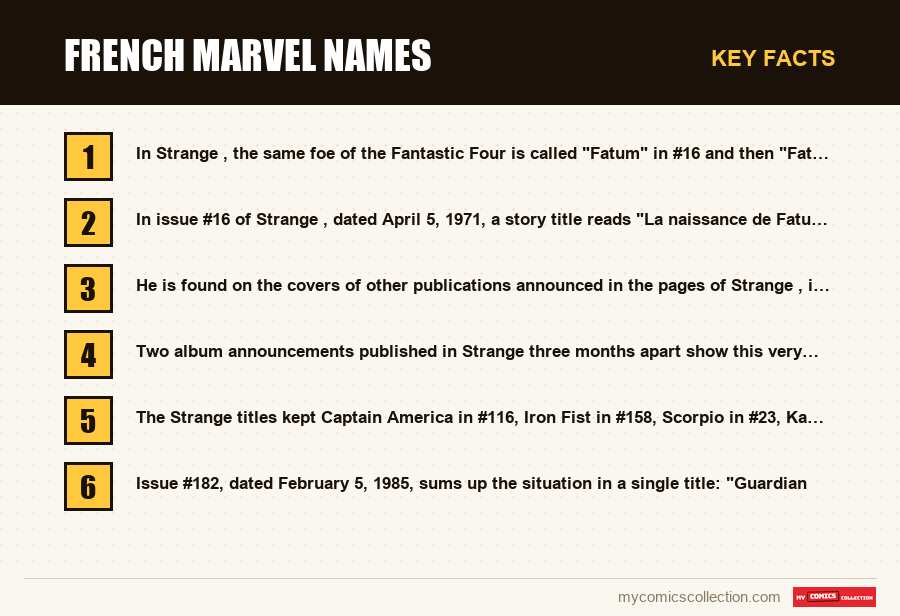
Let us take the clearest example, and the only one the catalog lets us demonstrate without assuming anything. In issue #16 of Strange, dated April 5, 1971, a story title reads "La naissance de Fatum." In issue #34, dated November 5, 1972, another title announces "Le retour de Fatalis!" Same character, the masked enemy of the Fantastic Four, two French names nineteen months apart.
What matters to you is not the anecdote but the direction of the change: Fatalis settles in and never leaves. He is found on the covers of other publications announced in the pages of Strange, including an album of the Fantastic Four in #85, and again in #166 in a title that pits him against Rom. Fatum, by contrast, never comes back. So you have an early name that was dropped and a lasting one, and that is exactly the most dangerous configuration: the rare name will never come to mind, even though it is the one that describes the earliest issues, the ones that are hardest to find.
Be careful not to over-interpret. The catalog gives story titles, not a publisher's memo. It shows that usage switched between these two issues; it does not say who decided, why, or whether there was a written instruction. On the exact date of an official change, sources disagree, and we will assert nothing beyond what the titles bear.
The second layer of the trap: abbreviations
A stabilized name does not protect you, because the title it appears in varies. Two album announcements published in Strange three months apart show this very well: in issue #55, dated July 5, 1974, the wording is "Une Aventure des Fantastiques n°4 : Docteur Fatalis," and in issue #58, dated October 5, 1974, it is "Album les Fantastiques numéro 4 : Dr. Fatalis."
The character is the same, the album is the same, and yet four things changed in the character string: the collection's title, "n°" became "numéro," "Docteur" was abbreviated to "Dr.," and the period after it. A search for "Docteur Fatalis" misses the second announcement. A search for "Dr Fatalis" without the period can miss both. That is why you search by part of a name, "Fatalis" alone, and never by a full phrase.
Names left in English, and what they do to your searches
Not everything was translated, and the arbitrariness of that sorting is good news for anyone who knows it. The Strange titles kept Captain America in #116, Iron Fist in #158, Scorpio in #23, Ka-Zar in several announcements, Mephisto in #11, Thanos in #219, and Slyde in #206. Alongside them, the Silver Surfer, the Scarabée, the Vautour, the Penseur Fou, the Rôdeur and the Chasseur de Minuit appear in French.
Issue #182, dated February 5, 1985, sums up the situation in a single title: "Guardian... futur chef de la Division Alpha..." The hero keeps his English name, while his team is translated. So there is no rule to learn, only a habit to form: for each character you search for, ask yourself the question in both directions, and test both.
One character, three names: the most confusing chain
Some name changes come not from the translator but from the story, and they stack on top of the first ones. Issue #146, dated February 5, 1982, carries a title that exposes them all at once: "De l'Homme Fourmi à Goliath et à Pourpoint Jaune." Three successive identities, the same man under the mask, and two of the three names are French translations that current editions no longer use.
For a collector, this means a single character can require four or five different queries depending on the era of the issue you are after. It is also proof that searching by character name is structurally fragile, and that it must be paired with something else. We get to that. The hubs devoted to Ant-Man and the Wasp help untangle who wore which costume at what point.
When the translation shortens itself
The same character can also drift between a long form and a short form, with neither replacing the other. The masked foe of the Spider-Man appears as "Le Bouffon et les gangsters" in #21, then "Ramenez-moi le Bouffon Vert" in #26, and #37 plays outright with the wording in "Qu'il était vert mon Bouffon !" Much later, issue #192, dated December 5, 1985, asks "Qui est le Super Bouffon ?", which refers to a different wearer of the costume.
Three practical lessons follow. First, "Bouffon" on its own is the right query, because it catches all three forms. Second, a seller who copied the cover title will write what they read, not the canonical name. Third, the short form and the long form do not necessarily designate the same man, so an honest listing can still mislead you without any bad faith.
Do you collect this series?
Track what you own, what you are missing and what your collection is worth. 7-day trial.
Start my trial →
Wolverine and Serval: what can be said, what cannot
The most famous case is also the one where you must be most careful. Serval is the name French readers of the time knew for the character now called Wolverine, and the switch from one name to the other happened later, with other publishers and other collections.
But this file of contents does not prove it. The Strange story titles we have in front of us contain neither one. What they do contain is an announcement in #65, dated May 5, 1975, "Une aventure des X-men !", which attests to the team's presence under its English name on that date, and nothing more. On the precise moment when Serval gave way to Wolverine in French publications, sources disagree, and we will not settle it with data that do not address the question.
This caution is not an evasion, it is the core of the method. If even a well-informed collector cannot date the change, then none of your searches should rest on the assumption that a name was valid from a given year onward. Search for both, always, and let the results tell you which one was in use. The Wolverine hub gives you the reference points on the American series side.
Why a table of contents is never enough to conclude
There is a limit you must know before buying on the strength of a title. A magazine such as Strange published several episodes per issue, whereas the catalog keeps only one title. When you read "Le Surfer et l'Araignée !.." in #9, dated September 5, 1970, you know that one episode carries that title; you do not know what the other pages contain.
This holds in both directions, and it is the trap that costs the most. An issue may contain the episode you are looking for without its known title mentioning it. So the absence of a name from a table of contents proves nothing at all: it only tells you that you need to check the copy, table of contents in hand, before paying the price of a key issue.
The method: search by cluster, not by name
Here is the approach that solves the problem instead of working around it. It comes down to five steps, and it applies to a flea market as much as to an online marketplace.
- List the names before you search. For each character, write the English name, the old French name, and the title variants (abbreviated, without accents, in the plural). You will search for each one separately.
- Truncate. Type "Fatalis," not "Docteur Fatalis." Type "Bouffon," not "Bouffon Vert." The shortest root catches the most listings.
- Pair it with the issue number. Once you have identified the issue, search for it as "Strange 34" or "Strange n°34": the magazine's issue number is a piece of data nobody translates, and it is your most robust query.
- Tolerate typos. The titles themselves contain them: #66 announces "Spécial Srange 1," with the S and the t transposed. A hurried seller copies what they see, and a misspelled listing often sells for less because nobody finds it.
- Save your alerts in duplicate. If the platform allows saved searches, create one per name, not one per character. It is the only setting that works for you while you sleep.
Building your own table of equivalences
After a few months, you will have accumulated correspondences that you will not find anywhere in list form. Note them, in a notebook or in your online collection, each time with the issue where you saw the name. That last detail is what separates a useful note from an impression: "Fatum, Strange #16" can be verified, "Fatum, early 1970s" cannot.
This work has a second effect, less obvious. By dating your equivalences, you learn to place a copy without looking at its date, which is valuable on later printings where the publication information is discreet. A title that says Fatum places you very early in the series; a title that says Pourpoint Jaune places you in the 1980s. Vocabulary becomes an era marker, just like a logo or a format.
And if you inherit an entire stack without knowing where to start, the reflex is the same: record the names used before you record the numbers. Hubs such as Apocalypse or Thanos will quickly tell you whether a title refers to the character or only to a common word, a real doubt when you read "L'Homme de l'Apocalypse" in #8, dated August 5, 1970.
Frequently asked questions
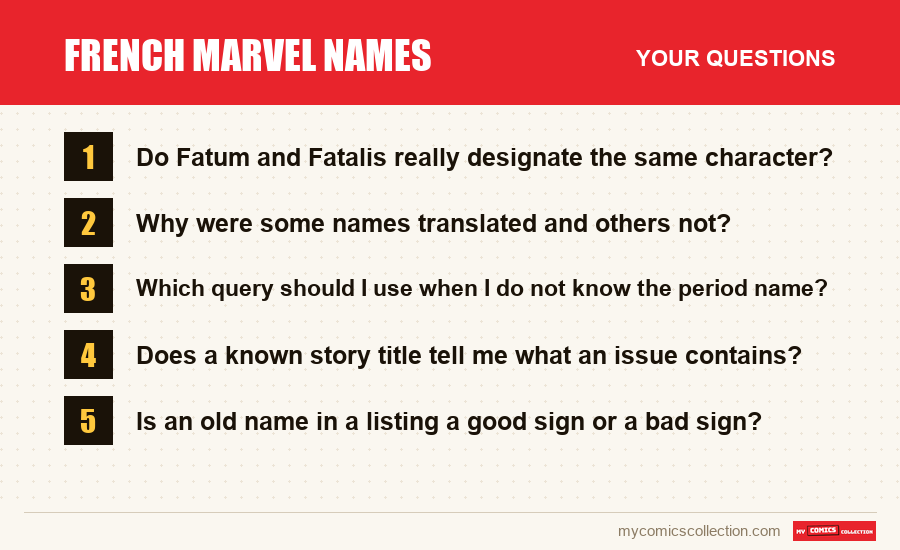
Yes, the masked enemy of the Fantastic Four. The catalog shows him under the name Fatum in the title of Strange #16, then under the name Fatalis from #34 onward. Fatalis then becomes the lasting form, used in album announcements in the following years. The reasons for the change, however, do not appear in the data.
There is no readable rule in the titles. Captain America, Iron Fist, Scorpio or Ka-Zar stay in English, while the Silver Surfer, the Scarabée or the Penseur Fou were given French names. A single title, in #182, keeps Guardian in English and translates Division Alpha. The reasons behind this sorting are a matter on which sources disagree.
Go through the magazine's issue number, which is not translated. Search for "Strange 34" rather than the character's name, and check the table of contents in the listing photos. It is also the right method when the seller describes a lot by ranges of issue numbers without detailing the contents of each.
No, and that matters. A magazine of this type published several episodes per issue, whereas the catalog keeps only one title. The title proves the presence of one episode, never the absence of the others. Before paying the price of a sought-after issue, ask for a photo of the printed table of contents.
More of a good sign for the buyer. A seller who copies "Fatum" or "Pourpoint Jaune" is describing what is in front of them, which is reassuring about the lot's authenticity, and their listing stays invisible to most searchers. That is exactly the kind of lot that sells below its value.