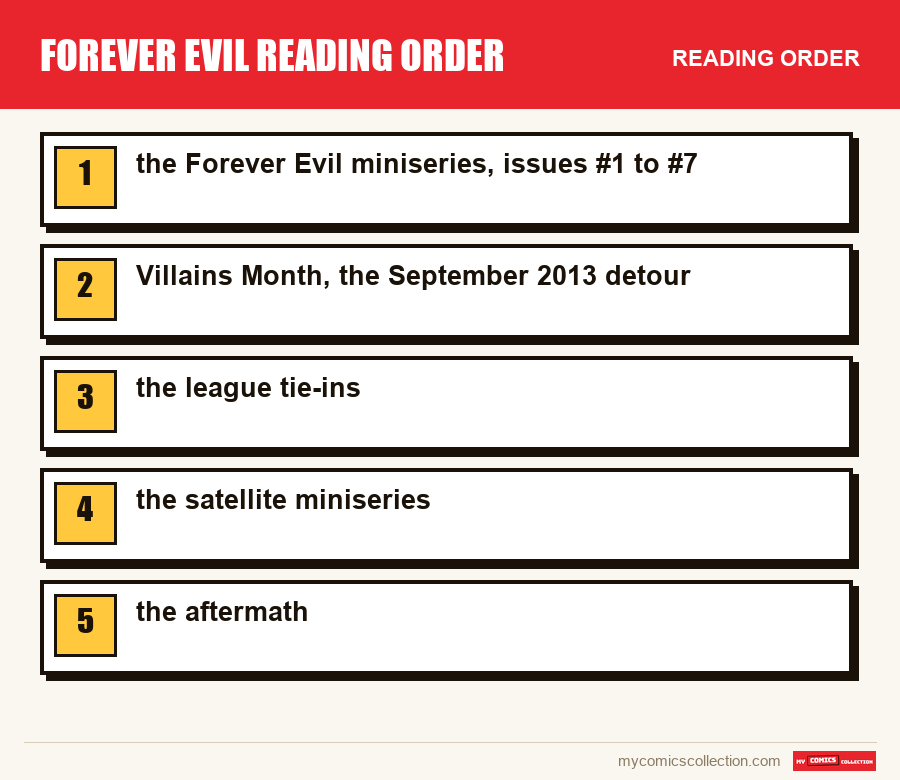
The Forever Evil reading order covers DC's seven-issue villain event, published between September 2013 and May 2014 and written by Geoff Johns with art by David Finch and other artists. Start with the Trinity War arc (Justice League #22-23, Justice League of America #6-7, Justice League Dark #22-23), continue with the seven issues of the main series, then pick your tie-ins: three league series and four satellite miniseries. The prelude is enough to follow the miniseries on its own.
In the New 52 universe, Forever Evil flips the usual point of view: the villains take center stage while the heroes of the League are out of the picture. The road runs from Trinity War to the series that wrapped up in spring 2014, with the essentials on one side and the optional reading on the other.
As always in this guide, we only state verified information (creators, issue numbers, dates); the analysis is ours, with no reproduction of protected panels or dialogue.
What to read before
The starting point of Forever Evil is another event, Trinity War, published in July and August 2013. Its final issue ends with the arrival of the Crime Syndicate, who declare the Earth theirs and go after the weakened League teams. Without that scene, the first issue of the miniseries loses its footing, because it picks up directly from what has just happened.
The prelude has two levels. The first, optional but enlightening, gathers Justice League #19-20 (Geoff Johns, with Ivan Reis and other artists) and Trinity of Sin: Pandora #1 (Ray Fawkes, with Zander Cannon and Daniel Sampere). The second, essential, is the main arc spread across three series, whose reading order does not follow the issue numbers:
- Justice League #22 (part 1, Geoff Johns and Ivan Reis)
- Justice League of America #6 (part 2, Geoff Johns and Jeff Lemire, art by Doug Mahnke)
- Justice League Dark #22 (part 3, Jeff Lemire and Mikel Janin)
- Justice League of America #7 (part 4)
- Justice League Dark #23 (part 5)
- Justice League #23 (part 6)
Three tie-ins go along with the arc: Trinity of Sin: Pandora #2-3 (Ray Fawkes, Daniel Sampere), Constantine #5 (Ray Fawkes, Renato Guedes) and Trinity of Sin: The Phantom Stranger #11 (J. M. DeMatteis, Fernando Blanco). That last issue lays the groundwork for a thread that becomes Forever Evil: Blight. If you want to read it all in one sitting, the collected edition Justice League: Trinity War, released in March 2014, gathers the six parts, Trinity of Sin: Pandora #1-3 and the other tie-ins of the arc, but not Justice League #19-20.
A tip on method: put the six main parts in a stack, in the order above, and don't trust the series numbering. The back and forth between the three titles is intentional, and reading series by series breaks the rhythm of the story.
Phase 1: the Forever Evil miniseries, issues #1 to #7
The Forever Evil miniseries has seven issues. It was supposed to end in March 2014; the final issue slipped to April, then to May, because Geoff Johns needed extra pages to wrap things up. The schedule ran longer than planned, and the league tie-ins were partly published before the conclusion.
On the art side, David Finch carries the series, backed by a large team: Richard Friend, Scot Eaton, Neil Edwards, Manuel Garcia, Scott Hepburn, Mick Gray, Jay Leisten, Jaime Mendoza, Jason Paz, Javier Pina, Norm Rapmund, Philip Tan and Patrick Zircher are among the credits of the event. Brian Buccellato, Sterling Gates and Peter J. Tomasi appear, for their part, in the writing credits of the story as a whole, through their miniseries. There is no need to memorize these names: just remember that the main series is written by Geoff Johns and that the art is a team effort.
We suggest splitting your reading into three stretches:
- Issues #1 to #3: the setup of a world without a League, seen by the villains. This is the moment when it is best to read the tie-ins in short batches, because the satellite miniseries line up with this period.
- Issues #4 and #5: the heart of the story, where alliances take shape. Read these two issues back to back.
- Issues #6 and #7: the conclusion. Set aside a quiet moment for the last issue, the one whose release was pushed back twice.
This split is a reading suggestion, not an editorial one: the series is not officially divided into acts.
Phase 2: Villains Month, the September 2013 detour
In September 2013, about a third of DC's ongoing series published special issues devoted to villains, with three-dimensional lenticular covers, also released in a flat version. These issues carry decimal numbers: Action Comics #23.1 to #23.4, Batman #23.1 to #23.4, Detective Comics #23.1 to #23.4, Justice League #23.1 to #23.4, Superman #23.1 to #23.4, Green Lantern #23.1 to #23.4, The Flash #23.1 to #23.3, and others. Regular numbering resumed in October 2013.
They accompany the launch of the event, published the same month, and spotlight the side of the villains that the miniseries puts front and center. But they are not a required stop: you can read Forever Evil without opening a single one. For a collector, these issues are more of a separate subject, with their specific covers and their two versions.
Phase 3: the league tie-ins
Three regular series serve as official tie-ins, each running six issues, on the side of the heroes who stayed or came back on the field:
- Justice League #24 to #29: Geoff Johns, with Ivan Reis and Joe Prado. This is the tie-in closest to the writer of the main series.
- Justice League of America #8 to #13: Matt Kindt, with Doug Mahnke, Christian Alamy, Eddy Barrows and Eber Ferreira.
- Suicide Squad #24 to #29: Matt Kindt, with Patrick Zircher.
Two other issues call for a clarification. Teen Titans #24-25 had been announced as tie-ins but are not: they follow the Titans in the timeline after the second issue of the main series, and you can leave them aside for this event. Also, Justice League #30 and Suicide Squad #30 are not part of the event, even though they directly follow the last tie-ins in their series.
For the precise order between the main series issues and the tie-in issues, the simplest rule is release date: take one issue of the miniseries, then the issues of the regular series that came out the same month. A collected edition does this work for you, which is one more reason to prefer the trade paperbacks over single issues for this event.
Phase 4: the satellite miniseries
Four miniseries tie into the event. Three of them run six issues each, with their own creative team.
- Forever Evil: A.R.G.U.S. #1-6: Sterling Gates, with Philip Tan, Neil Edwards, Javier Pina, Jason Paz and Jay Leisten. It follows Steve Trevor and the agents of the agency.
- Forever Evil: Arkham War #1-6: Peter J. Tomasi, with Scot Eaton and Jaime Mendoza. It focuses on Batman's enemies. It concludes with an April 2014 one-shot, Forever Evil Aftermath: Batman vs. Bane (Tomasi, Eaton, Mendoza, Scott Hana).
- Forever Evil: Rogues Rebellion #1-6: Brian Buccellato, with Patrick Zircher and Scott Hepburn. It follows the Rogues, Flash's enemies.
- Forever Evil: Blight: the supernatural thread set up by Trinity of Sin: The Phantom Stranger #11 and launched in #14 of that series. It runs notably through Justice League Dark #24-29 and Constantine #9-12, with issues of Pandora and The Phantom Stranger, and brings together John Constantine, Swamp Thing, Nightmare Nurse, Pandora and the Phantom Stranger, who try to defeat Blight and find the missing members of the League.
If you can only pick one, the choice depends on your characters: Rogues Rebellion for Flash fans, Arkham War for Batman fans, A.R.G.U.S. for anyone who likes DC's espionage stories. Each of these three miniseries has a dedicated collected edition.
Do you collect this series?
Track what you own, what you are missing and what your collection is worth. 7-day trial.
Start my trial →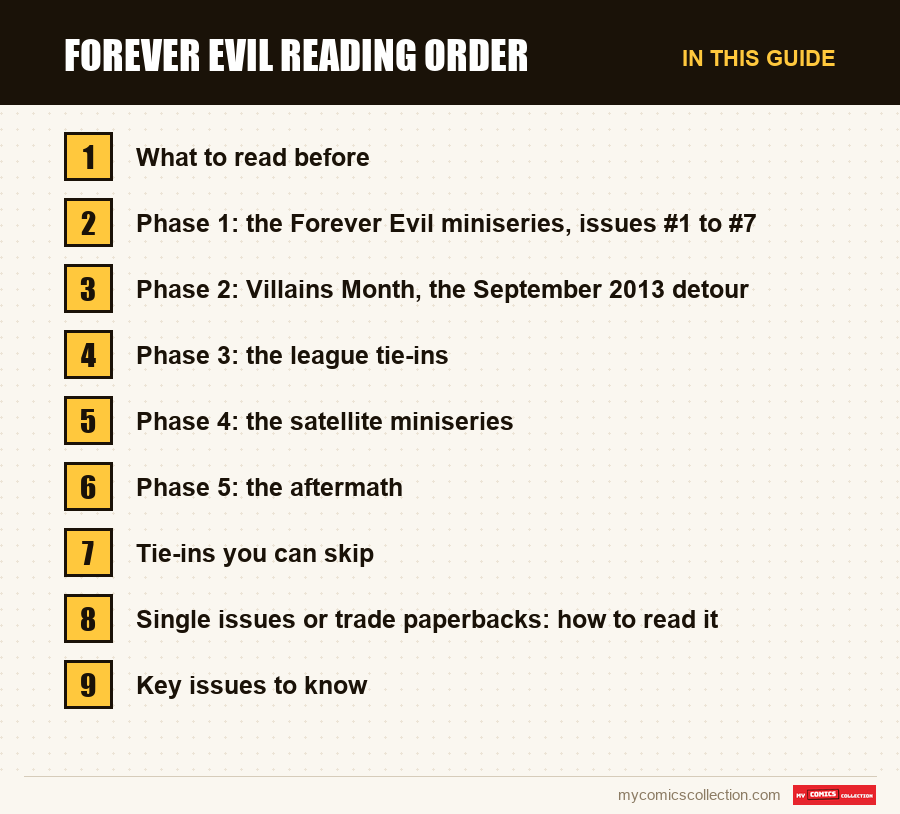
Phase 5: the aftermath
After the main series ends, several titles change shape. Justice League of America had first been announced under the name Justice League Canada, with a Cree hero; in January 2014, the series was ultimately canceled and then relaunched under the title Justice League United. The cancellation of Nightwing, Suicide Squad and Teen Titans was decided in April 2014, and the final issues of Justice League of America, Nightwing and Suicide Squad were pushed back to May 2014.
To keep going, the volume Justice League of America Vol. 2: Survivors of Evil collects issues #8 to #14 of the series, that is, the tie-ins and the final May 2014 issue. For the rest, let your usual series guide you: after an event of this size, each regular title absorbs the changes at its own pace.
Tie-ins you can skip
An event of this scale multiplies satellites, and not all of them are essential. You can skip without regret Teen Titans #24-25 (they are not tie-ins, as noted above), the decimal issues of Villains Month if you only want the main plot, and Forever Evil: Blight if the supernatural register doesn't appeal to you. The main series does not depend on any of these to be understood.
This is not a value judgment: these titles are optional because they tell the same moment from another angle, without changing the course of the main series. They suit readers who already follow a specific character perfectly well.
Single issues or trade paperbacks: how to read it
The first decision is to choose between single issues and trade paperbacks. Single issues follow the release order, but series numbering alone doesn't tell you what order to read in: for Trinity War, for example, the order of the parts alternates between three titles. Trades, for their part, arrange the chapters in reading order.
For the prelude, a collected edition exists: Justice League: Trinity War, which gathers the six parts, Trinity of Sin: Pandora #1-3, Constantine #5 and Trinity of Sin: The Phantom Stranger #11. For the event itself, collected editions exist for the main series, as well as for A.R.G.U.S., Arkham War and Rogues Rebellion. Issues #8 to #14 of Justice League of America are collected in a volume titled Survivors of Evil, and the decimal issues of Villains Month have their omnibus.
Our method: read the prelude trade, then the main series trade, then one or two satellite trades, in whatever order interests you. In single issues, build one stack per release month and read it in order, starting each month with the main series. In both cases, check the exact contents of the edition before buying: the tables of contents vary from one edition to another.
Key issues to know
For an event like this, the sought-after issues are spotted by their role in the story rather than by a first appearance. Four landmarks are useful.
- Justice League #23: the last issue of Trinity War, which introduces the arrival of the Crime Syndicate and serves as a direct bridge to the miniseries.
- Forever Evil #1: the start of the event, in September 2013.
- Forever Evil #7: the finale, published in May 2014 after two schedule delays.
- The decimal issues of Villains Month, notable for their lenticular covers and their double version, in 3D and in 2D.
How do you evaluate a copy? For the Villains Month issues, first examine the lenticular cover, the part most exposed to scratches, and make sure you have the version you want, 3D or 2D. Our page on key issues of events and crossovers goes deeper into the evaluation process.
Recap: the complete order
- Optional prelude: Justice League #19-20 and Trinity of Sin: Pandora #1
- Trinity War: Justice League #22, Justice League of America #6, Justice League Dark #22, Justice League of America #7, Justice League Dark #23, Justice League #23
- Trinity War tie-ins: Trinity of Sin: Pandora #2-3, Constantine #5, Trinity of Sin: The Phantom Stranger #11
- Villains Month (optional): decimal issues from September 2013
- Forever Evil #1 to #3, with the tie-ins released in the same months
- Forever Evil #4 and #5
- Forever Evil #6 and #7
- Justice League #24-29, Justice League of America #8-13, Suicide Squad #24-29
- Miniseries: A.R.G.U.S. #1-6, Arkham War #1-6 and Batman vs. Bane, Rogues Rebellion #1-6, Blight
- Next: Justice League of America #14, the last issue of the series before Justice League United
Frequently asked questions
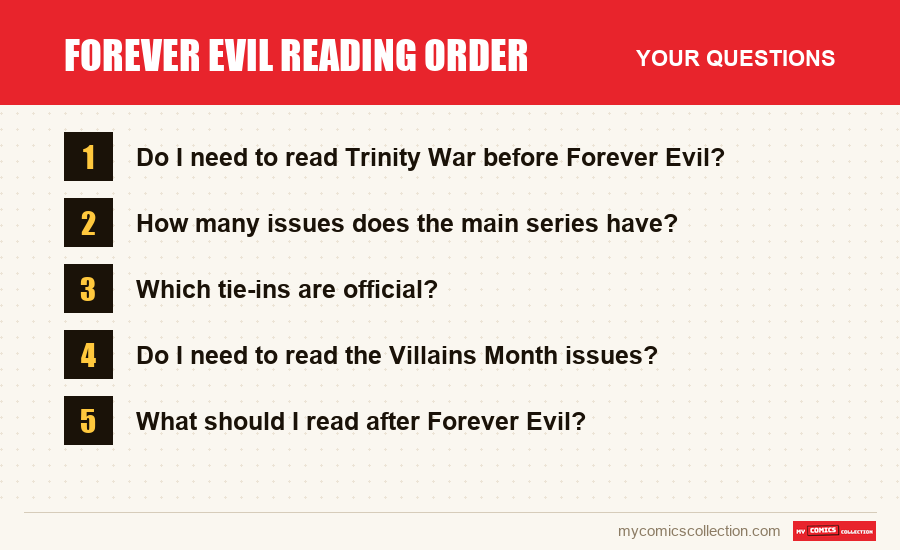
Yes, it is the direct prelude. The last issue of Trinity War, Justice League #23, ends with the arrival of the Crime Syndicate, and the miniseries picks up at that moment. Read the six parts in chapter order, not issue-number order: Justice League #22, Justice League of America #6, Justice League Dark #22, Justice League of America #7, Justice League Dark #23, then Justice League #23.
Seven issues, written by Geoff Johns and drawn by David Finch with other artists, from September 2013 to May 2014. The end was planned for March 2014, but the final issue was pushed back to April, then to May, because the writer needed extra pages to conclude his story.
Three regular series are official tie-ins: Justice League #24-29, Justice League of America #8-13 and Suicide Squad #24-29. Added to these are the miniseries A.R.G.U.S., Arkham War and Rogues Rebellion (six issues each) and Blight. Teen Titans #24-25 had been announced as tie-ins but ultimately are not.
No, they are optional. In September 2013, a third of DC's series published decimal issues (like Batman #23.1 to #23.4) centered on their villains. They came out the same month as Forever Evil #1, but the main series can be understood without them. They mostly interest collectors, for their lenticular covers.
Finish Justice League of America with #14, collected with the tie-ins in Survivors of Evil, then follow your usual series. The series was canceled and then relaunched under the title Justice League United in 2014, and the cancellation of Nightwing, Suicide Squad and Teen Titans was decided in April 2014.
Did you track down issues of Forever Evil or its tie-ins? Get your copy appraised.
Appraise my comic