In a search for the 1966 issue that introduced Galactus, a $5.27 offering came up as "first printing." The object is dated 2002: it is the first edition of a reprint, not the original issue. The formula is true and means nothing, because it omits the only information that matters: first draw of what. Statement from August 29, 2026: 51 unverified listings from $4.27 to $8,500.00, median $635.00; 137 verified listings from $29.99 to $35,000.00, median $1,449.00. These are amounts claimed by sellers on a given date, not completed transactions, and a single measurement does not show any trend.
An ad does not have to lie to mislead. It is enough for her to use a term whose scope depends on a referent which she does not name. “First printing” belongs to this family: the mention designates the first passage in press of a given edition, and nothing more. It becomes information as soon as we know which edition we are talking about; without this addition, it describes both a booklet published in 1966 and a notebook reprinted thirty-six years later. The salesman who writes it is not necessarily building a trap. It uses a label that the vocabulary of the sector has made prestigious, forgetting that it only conveys this prestige when stuck on the right object.
The case noted on August 29, 2026 is instructive because it is clean. The asking price, $5.27, is consistent with what the item actually is. The date, 2002, appears in the ad. Nothing is hidden: the two elements which make it possible to decide are there, before the eyes of the buyer. What is missing is the habit of bringing them together. A reader scanning a list of results first sees a familiar title, a familiar number, and a flattering mention; he only sees the contradiction between “first printing” and “2002” if he looks for it. The rest of this article consists of installing this reflex, then examining a second object, offered at $5.95, which still escapes the original/reprint dichotomy.
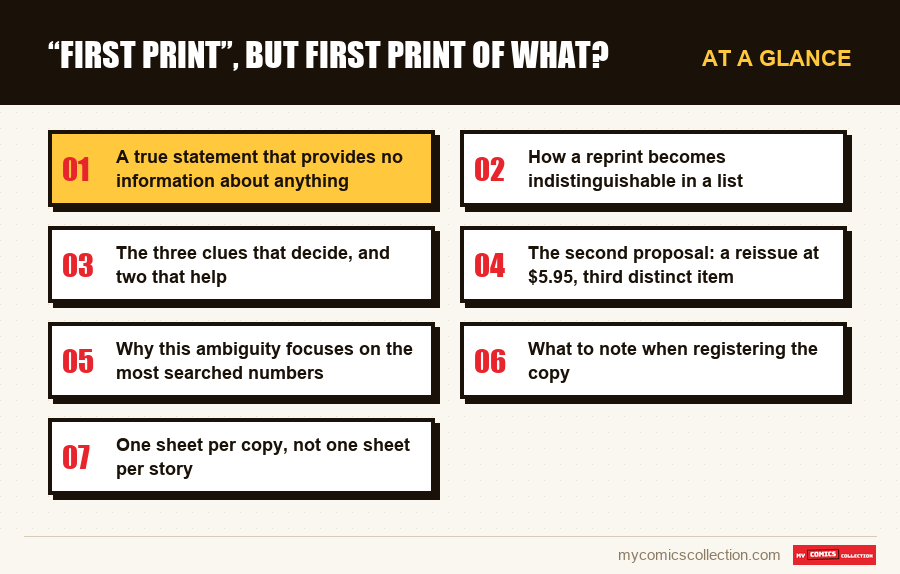
A true statement that provides no information about anything
We must start from the mechanics of the word. Every printed edition has a first printing: this is the initial batch coming off the presses before any additional demand triggers a second one. The property is structural, not uncommon. A 1966 booklet had a first printing; a 2002 reprint also had a first printing, and if it sold well it was able to have a second printing. The mention therefore does not separate old objects from recent objects. It separates, within any edition, the inaugural lot from the following lots. Used alone, without naming the edition, it produces a grammatically impeccable and informatively empty sentence.
This emptiness takes on a commercial value because the reader's ear has been trained elsewhere. In common industry language, « premier tirage » almost always implies « premier tirage de la parution originale », that is to say the object that existed first, physically, when the story first appeared. The shortcut works as long as the context supports it. It stops working as soon as a sales catalog lines up objects from different generations bearing the same title and number side by side. At this precise moment, the implication becomes a bridge: the word retains its prestige while designating something else.
How a reprint becomes indistinguishable in a list
Title and number are shared
A reprint reproduces the story and, very often, the title and numbering of the publication it reproduces. In a list of results reduced to these two fields, the object of 2002 and the object of 1966 occupy the same logical line. Nothing in the title distinguishes them, because the title was never designed to distinguish them: it designates content, not a copy.
The cover is taken
A faithful reprint reuses the original cover image. The thumbnail displayed in the results is therefore the one the buyer expects to see. The visual clue, which works very well to rule out an unrelated booklet, is neutralized here: it confirms the story without saying anything about the object.
Sorting by ascending price groups the intruders
A buyer who opens a search and sorts from least expensive to most expensive first sees what costs little. However, what costs little, in this segment, are precisely the objects which are not the targeted issue: reprints, reissues, and issues foreign to the research. The most natural gesture places the buyer in contact with ambiguous cases.
Print date is not a search field
The filters proposed concern the title, the publisher, the declared state, sometimes the certification. The actual year of printing of the copy, when it appears, lives in the free text of the advertisement. It therefore escapes sorting and only enters the field of vision when the buyer opens the complete file.
The result is not a deception but a collision of formats. A results list is a compressed object: it retains what allows you to find content and abandons what allows you to identify an item. But the value here lies entirely in the copy. As long as the buyer thinks at the level of content, “this is the story I’m looking for”, he has no reason to suspect anything. The switch only happens when he changes the question from asking “what is it?” » but “when was this object made?” ".
Of the 51 unverified advertisements noted on August 29, 2026, several do not relate to the issue in question: an unrelated issue at $4.27, a reprint dated 2002 announced as "first printing" at $5.27, a reissue at a call price at $5.95, two unrelated issues at $9.99. The median of $635.00 calculated on this set therefore does not describe any specific object: it locates the middle of a heterogeneous list, not the middle of a market.
It is the composition of the segment that must be read, not its central point. The verified side, with 137 listings from $29.99 to $35,000.00 and a median of $1,449.00, relies on copies whose identities have been verified by a third party; the difference between the two medians first measures this difference in composition. In both cases, these are amounts claimed by sellers on a single date, never completed transactions, and an isolated maximum expresses the hope of the person who displays it.
The three clues that decide, and two that help
The year printed on the object
This is the decisive clue, because it is carried by the copy itself and not by the seller's speech. A printing date several decades later than the publication of the story closes the debate: whatever the notice displayed, the object is a reprint. In the case noted, 2002 versus 1966 is enough to decide without knowing anything else.
Le prix de couverture
The amount printed on the front corresponds to the price charged at the time of manufacture. It cannot be modified after the fact and follows the evolution of the kiosk prices. A visibly contemporary cover price on an old story signals recent fabrication, regardless of anything else the ad says.
The edition notice
The information given in the legal notices (edition number, year of deposit, formula indicating a reprint) designate the edition to which the copy belongs. This is exactly the referent that the “first print” formula leaves in the shadows. Reading it means completing the sentence in the ad.
Paper and finishing
A recent medium does not age like an old medium: whiteness, flexibility, ink rendering differ. The index is not decisive alone, because it depends on the conservation, but it guides the verification and serves as a first filter when the photographs are correct.
The asking price itself
An amount that massively deviates from the rest of the segment is a question, not an answer. It may indicate a reprint, a title error, a very degraded state or an incomplete object. It justifies opening the file, never concluding on its own.
Pagination and additional content
A cover version does not always restore all of what originally accompanied the story: sections, mail, period advertisements. A summary that does not correspond to that expected indicates that we are dealing with a recovery, even when the coverage is identical.
Collecting this series?
Track what you own, what you are missing and what your collection is worth. 7 day trial.
Start my trial →The second proposal: a reissue at $5.95, third distinct item
The same search reveals, at $5.95, an object that would be wrong to place in one or other of the two previous categories. This is neither the 1966 issue nor a faithful reproduction of this issue, but a reissue from a collection of reprints at a premium price: a range designed to put sought-after stories back into circulation at an affordable price, under a collection title of its own. The story is the same; the editorial envelope is different.
This difference in title completely changes the nature of the problem. Faced with the 2002 reprint, the buyer must detect a date ambiguity within an identical title. Faced with the reissue, the title itself does not correspond: it bears the name of the collection, not that of the original publication. A reader attentive to the title immediately dismisses it. A reader who searches through the story (because he wants to read the episode, which is a perfectly legitimate intention) on the contrary willingly retains it, and he is right to do so as long as he knows what he is buying.
The trap only closes when the two intentions mix. An object bought to read, then placed in a collection without its nature being recorded, becomes after a few years an object of which no one knows whether it corresponds to the original publication. The title of the collection fades from memory, the story remains, and the copy begins to occupy the place of an object in the inventory that it is not. It is there, much more than at the time of purchase, that confusion costs something.
There are therefore at least three objects to distinguish around the same story: the original publication, the faithful resumption under the same title, and the reissue under the title of collection. Each has its legitimacy and its use. None are fakes. What is not legitimate is to let a laudatory mention be used for identification, and to postpone the question of the referent until later.
Why this ambiguity focuses on the most searched numbers
The phenomenon is not randomly distributed in the catalog. A reprint costs to produce; it only exists if a publisher anticipates sufficient demand to absorb it. Ordinary issues, those which do not carry a notable event, almost never cross this threshold: they appeared once and never appeared again. There is therefore, for them, only one possible object, and the mention “first print” is redundant but harmless.
The numbers that concentrate demand follow the opposite trajectory. Because they are sought, they are recaptured; because they are repeated several times and in several forms, they generate a population of neighboring objects which share the title, number and cover. The ambiguity of the vocabulary resides exactly where the financial stakes are highest: not out of malice, but as an arithmetic consequence of what triggers a reprint.
This produces a useful rule of attention. The more coveted a number is, the greater the probability that a low-price ad concerning it is about something else, and the more the mention “first draw” loses its ability to discriminate. Conversely, on a number without a known repeat, the same mention becomes innocuous again. The word therefore does not have a fixed value: its informative value varies depending on the position of the number in the request.
This is also what explains the shape of the August 29, 2026 reading. The five titles observed at the bottom of the range: $4.27, $5.27, $5.95 and twice $9.99: are not opportunities missed by the rest of the market. These are objects of another nature, aggregated into the same set by a textual search. Their presence pulls the median downward without anyone having proposed the fascicle targeted at these amounts. Any reading that takes this median as a reference price is wrong about the subject even before getting the wrong figure.
What to note when registering the copy
Record the year printed on the item, not the year of the story. These are two different fields and they diverge for any recovery. A copy registered under “1966” because the story dates from 1966, while the object was printed in 2002, produces a false record that nothing will correct later. The date of manufacture is the first thing to note, and the only thing that survives forgetting.
Copy the edition statement as it appears, without interpreting it. The formulas used in legal notices vary from one publisher and from one era to another. Translating them into “original” or “reprint” at the time of entry amounts to freezing a conclusion and losing the data that produced it. Recorded word for word, it remains verifiable; summarized, it becomes an opinion.
Note the cover price as a feature of the copy. It is of no use for estimation, but it constitutes a period imprint that nothing can modify after manufacture. Two copies of the same story bearing different cover prices are, without doubt, two objects of distinct editions, and this information is no longer found once the object is put away.
Distinguish the reissue under collection title by its actual title. The copy priced at $5.95 belongs to a range bearing its own name. Registering it under the title of the original publication under the pretext that it contains the same story creates precisely the duplicate which will make the inventory unreadable. The story is noted in the content, not in the identity of the object.
Keep track of what the ad said, including its questionable wording. A “first printing” notation preserved next to a printing date of 2002 documents the contradiction and explains, years later, why the copy was classified as it was. Erasing the seller's speech amounts to erasing the reasoning which made it possible to correct it.
Not necessarily. The statement is literally accurate: the reprint did indeed have a first printing. What is missing is the referent, that is to say the edition concerned. In the case noted, the date 2002 appears in the ad, which gives the buyer the means to understand. The responsibility for ambiguity lies with the vocabulary of the sector as much as with the seller.
No. It is calculated on 51 advertisements, several of which relate to objects which are not the specification in question. A median extracted from a heterogeneous set locates the middle of a list, not the value of an object. We must first look at the composition of the segment, weed out the intruders, then reason about what remains: keeping in mind that these are amounts requested on August 29, 2026, not closed sales.
Because the two sets do not contain the same objects. Passage by a verification body assumes that the identity of the copy has been verified, which mechanically excludes covers and unrelated issues present in the other set. The difference between $635.00 and $1,449.00 therefore firstly measures a difference in composition, before any consideration of condition.
It has obvious use value: it gives access to the story without committing a large sum. It also constitutes an editorial object in its own right, with its own date and edition. What doesn't make sense, however, is to treat it as a substitute for the original publication in an inventory: they are two different objects, which must occupy two different lines.
By starting from the object rather than the memory of the purchase. The year of printing, the cover price and the legal notices are carried by the copy itself and are sufficient, in the vast majority of cases, to identify the edition. If these three elements are consistent with recent manufacture, the question is resolved, regardless of the manner in which the object was presented at the time of sale.
One sheet per copy, not one sheet per story
As long as the year of printing, the cover price and the edition note are not recorded, two very different objects occupy the same line in your collection. My Comics Collection allows you to describe each copy for what it is (original, faithful reproduction or reissue under a collector's title) and to find this distinction years later, when the memory of the purchase has faded.