The first wearer of the suit is the least read and most expensive of the three. As of August 29, 2026, its numbers from the 1960s show $40.00 gross median out of 135 ads and $249.99 certified median out of 45 announcements: significantly more than the next two carriers combined. The explanation has nothing to do with quality: these issues come from a small publisher, with a modest circulation, on paper that has aged poorly.
This is the most poorly known segment of this character and the one where the wrong object is most easily mistaken.
Here's what this carrier brought, what the statement shows, the identification pitfalls specific to this period, and what you need to know before buying.
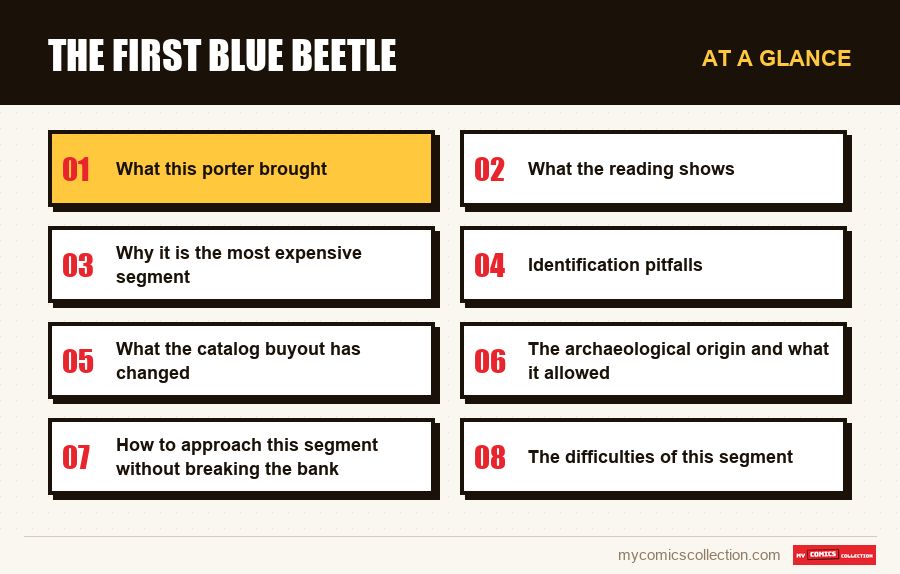
What this porter brought
It must be placed, because it precedes everything the audience knows about the character.
An archaeological origin. It is with him that the beetle becomes an object found in a grave, and not an invention or technology. This origin conditions everything that follows.
An adventure series registry. The tone is that of stories of exploration and mystery, closer to the soap opera than to the superhero as it was then practiced elsewhere.
An adult and competent figure. Without doubt or anxiety, he acts because it is the right thing to do: a position that has not aged well but was the norm.
This carrier is therefore the source of the object and not the character as we understand it today. What survived of him was the beetle; what's gone is pretty much everything else.
What the reading shows
Issues from the 1960s
Raw : 135 ads, of $6.36 to $430.00 requested, median $40.00. Certified: 45 ads, median $249.99.
A four-digit certified isolated maximum, with no neighbors.
Lowest entries
Numbers to $7.19 and $7.99 requested, described in weak condition. These are the only accessible copies from this period.
The following carrier, for comparison
Its series are much cheaper, with a much thinner certified side despite greater notoriety.
Polluted research
The query returns unrelated collections. Sorting is necessary before reading the numbers.
Method: statement from August 29, 2026 on fixed price announcements, with a separate statement of raw and certified. These are amounts displayed by sellers.
Why it is the most expensive segment
Three causes combine, and none of them are related to demand.
A small publisher. These numbers come from a house with modest means, whose circulations have never reached those of large structures. The rarity is original.
Poor quality paper. The supports used yellow and break, and sixty years of conservation have resulted in severe sorting. Copies in good condition are really few in number.
No conservation at the time. Nobody kept these numbers. They were read, lent, thrown away: normal behavior for a 1960s newsstand item.
These three causes produce a rarity which owes nothing to popularity. It is the most stable form of scarcity there is, and she explains that this segment remains expensive despite a character that few readers know in this form.
The certified side deserves careful reading here. Forty-five certified ads per hundred and thirty-five gross is a high ratio, and it can be explained by the same mechanism observed in other old segments.
Beyond a certain price, certification costs a fraction of the value and secures the transaction. The examples in good condition therefore mostly end up under shell, and what remains in rough leans towards weak conditions: which is confirmed by the entries at $7.19 explicitly described as such.
Identification pitfalls
This period has more of them than others, and they are expensive.
Several successive publishers. The character existed in more than one house before and during this period, with distinct numberings. The title alone means nothing.
Numberings that resume. The same company has relaunched the numbering, so that several numbers have the same figure years apart.
Later covers. These stories were republished, notably after the catalog was bought by a major house. The content is the same, the subject is not.
Overvalued states. On paper that is yellowing, the gap between two condition assessments is wider than elsewhere, and the photographs reflect it poorly.
The rule is therefore the same as in all the old segments of this campaign: publisher and year before issue, and an actual photograph rather than a stock image.
Should we target this segment?
A frank answer is necessary, because these issues are often presented as the culmination of a collection on this character.
To read, no. These stories have been republished and can be read for a few dollars in other forms. The register has also aged considerably, and few readers will find what they need there today.
To understand the character, partially. The origin of the beetle is stated there, and it is the only really useful information: it fits into a few pages.
To own the original item, yes, provided you name it as such. This is an old part purchase, not a necessary link.
The classic disappointment is spending several hundred dollars and then finding that the stories don't interest you. In this segment more than elsewhere, you have to want the object and not the content.
What the catalog buyout has changed
An editorial event weighs on this entire segment and it must be raised, because it explains the coexistence of very different objects.
The catalog of the little house was bought by a large structure, which integrated its characters into its own universe. The original stories were then republished, adapted, sometimes rewritten.
This creates three families of objects for the same content: the original issues of the small publisher, the reissues of the buyer, and the new versions produced after integration. Their prices have no relation to each other.
The narrative content is similar in the first two cases and different in the third, where the character was retouched to fit into a continuity that was not his.
To a buyer, this editorial history is not visible anywhere on the items. However, it explains most of the price differences and confusion that we encounter in this segment, and knowing it is better than any odds grid.
The archaeological origin and what it allowed
A design choice is worth developing because it is the reason for the longevity of the concept.
Making the beetle a found object rather than an invention changes everything. Equipment designed by its wearer belongs to him and disappears with him; a found object can be found by someone else.
This decision, taken in the 1960s without its impact being measured, made the two subsequent successions possible. It installs a logic of transmission where the genre practiced personal property.
She also explains that the nature of the scarab could have changed several times (magical, technological, extraterrestrial) without the concept collapsing. A found object does not need to be stably explained; its nature can be revised by each generation of authors.
This is a rare flexibility and it comes at a cost: the character never has a canonical version, which makes him difficult to present. His strength for survival is exactly what keeps him from having a fixed identity.
Collecting this series?
Track what you own, what you are missing and what your collection is worth. 7 day trial.
Start my trial →How to approach this segment without breaking the bank
Three approaches, from the cheapest to the most engaging.
By reissues. The original stories have been republished several times and can be found for a few dollars. This is the only reasonable path if the goal is to read.
By an original number in weak condition. The prices raised at $7.19 and $7.99 allow you to own an object from this period without spending a significant amount of money: provided you accept yellowed and fragile paper.
By a certified copy, for a precise reference. It's a three-digit project, to be reserved for the numbers you really want.
These three approaches meet distinct needs and do not combine well. Deciding which one to follow before starting avoids accumulating mediocre copies while waiting for better, which is the most common outcome on old segments.
The difficulties of this segment
A paper that has aged badly
Yellowing and breakage at the fold are the norm. A truly good copy is rare and has to be paid for.
Several successive editors
The character has changed houses, with distinct numberings that the title does not allow to separate.
Later covers
The same stories were republished after a catalog buyout. Same content, different subject.
Stock images
Frequent in this segment, they do not provide information on the condition or the edition.
What this case says about the character
An overall observation is worth making, because it sheds light on the three bearers.
This character is one of the rare ones whose item matters more than the wearer. The scarab goes through three generations, changes its nature depending on the era, and remains the only constant element: the men who carry it are interchangeable from the point of view of continuity.
It's an unusual setup and explains the longevity of the concept. A character whose identity is based on a person dies with them; a character whose identity is based on an object can be repeated indefinitely.
The first carrier is the demonstration: he was replaced without the concept suffering, and his replacement was in turn.
This is also what explains the structure of the market. The value is distributed between three distinct segments instead of focusing on just one, which is rare and makes this character more approachable than it seems.
What to record
In an old segment with multiple publishers, the fact sheet must carry what the cover does not decide.
The publisher, the year and the numbering rank, noted in the title rather than on the front. Three houses and several numbering raises coexist on this character, and a number identified by its single digit can designate four objects whose prices range from seven to four hundred dollars.
It is the information that makes resale possible, and it is lost as soon as the copy is put away.
A description of the condition of the paper written by you, upon receipt: on a support that is yellowing, a seller's assessment and yours often diverge, and writing down yours when you have it in front of you avoids depending later on an assessment that you did not make.
These two mentions address the difficulty specific to old kiosk objects, ambiguous identity and unstable state, which recent segments do not pose.
Frequently asked questions
Three cumulative causes, none linked to demand: a small publisher with modest print runs, paper that yellows and breaks, and the total lack of conservation at the time: these issues were read, loaned, thrown away. It is the most stable form of scarcity there is.
Few readers will find what they are looking for: the register has aged a lot, and the stories have been republished, so can be read for a few dollars in other forms. The only really useful information, the archaeological origin of the beetle, is contained in a few pages.
Forty-five certified ads to one hundred and thirty-five raw, which is a high ratio. Beyond a certain price, certification costs a fraction of the value and secures the transaction: the correct examples therefore mostly end up under shell, and the rough leans towards weak states.
By requiring the publisher and the year before the issue. The character has existed in more than one house, with distinct numberings and revivals, so much so that the same number can designate four objects whose prices range from seven to four hundred dollars. Also ask for an actual photograph rather than a stock image.
The object matters more than the wearer. The scarab goes through three generations and remains the only constant element, allowing the wearer to be replaced indefinitely. A character whose identity is based on a person dies with them; this one doesn't, and its value is spread across three segments instead of concentrated in just one.
Which publisher, what year, what numbering?
The same number can designate four objects whose prices range from seven to four hundred dollars.