The Emperor Joker reading order covers the 2000 Superman crossover that runs through all four monthly Superman titles: Superman (second series) #160-161, Adventures of Superman #582-583, Action Comics #769-770 and Superman: The Man of Steel #104-105, plus the one-shot Superman: Emperor Joker, co-written by Jeph Loeb and Joe Kelly. Ed McGuinness draws both issues of Superman. Read the nine single issues by cover date, and add nothing else.
Few crossovers rest on an idea so simple to state and so uncomfortable to read: the Joker gets hold of Mister Mxyzptlk's power and remakes the universe in his own image. For Superman, it is a starting point; for Batman, it is the heart of the story. This article gives you the shortest path to reading the whole thing in order, with the place of each issue, the optional extras and how to approach buying copies.
As always in this guide, we only state verified facts (creators, issue numbers, dates); the analysis is our own, with no reproduction of protected artwork or dialogue.
What to read before
Good news for anyone coming to the event cold: there is no required prelude. Emperor Joker makes sense from its own pages, because its engine fits in one sentence: the Joker has taken nearly all of Mister Mxyzptlk's power, when the imp from the fifth dimension had only meant to hand over a tiny fraction. The story re-explains everything you need to know.
Two reference points do enrich the read, though. The first is Mister Mxyzptlk himself: his first comic book appearance is in Superman #30, in 1944, under the original spelling of his name, written by Jerry Siegel and drawn by Ira Yarborough, and he is a being able to rewrite reality at will. Knowing that gives the 2000 stakes their weight: here, that power changes hands.
The second is the relationship between the Joker and Batman. The Joker's role in this story rests on his obsession with Batman, in the line of Batman #1, in 1940, where the Joker first appears. If you want to place that obsession over time, skim the Joker reading guide before you start, or keep it open next to you. For how Superman is written around 2000, the Superman reading guide puts the monthly series in perspective.
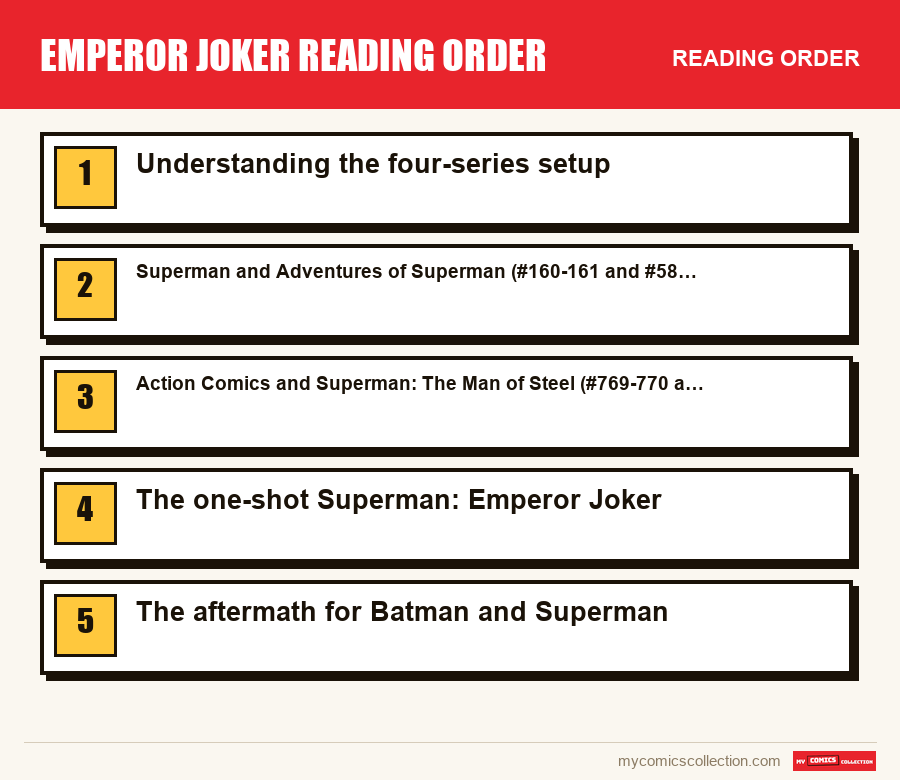
Phase 1: Understanding the four-series setup
What sets Emperor Joker apart from most events with a central miniseries is that it has no separate backbone. The plot moves from one series to the next: each monthly Superman title carries two issues, and the one-shot Superman: Emperor Joker rounds out the set. So there is no "main series" to read first and tie-ins to read afterward: the nine issues are the story.
The setup rests on four series whose numbering is worth noting before you go hunting for copies: Superman is then in its second series, hence issues #160-161; Adventures of Superman is at #582-583, an already high numbering; Action Comics reaches #769-770; and Superman: The Man of Steel is at #104-105. When you search a comic shop, these numbers tell the crossover issues apart from all the others without ambiguity.
The most reliable way to read is chronological: note the cover date printed on each of the nine single issues and sort them in that order. The four series came out in parallel, each with its own team, and the story passes from one to another as the issues were released. Reading one series all the way through before moving on to the next is possible, but you will lose the rhythm the whole was built around.
Chapter titles give a useful marker. In the Jeph Loeb and Ed McGuinness run, the Superman #160 chapter is titled "Arkham, Part One," while #161 opens "Emperor Joker, Part One." So the story moves in two laps through the four titles, and the teams behind each series carry different tones from issue to issue, from broad slapstick to Batman's drama.
Phase 2: Superman and Adventures of Superman (#160-161 and #582-583)
These two series make up the first block of a series-by-series read: Superman #160-161 and Adventures of Superman #582-583. If you sort the issues by cover date, you will find them interleaved with those of the other two titles. What they tell, in broad strokes, is the tipping into a universe where everything obeys the Joker's whims, with a Superman locked up in Arkham Asylum and brought back every day into the same loop by Bizarro.
Read these issues with one question in mind: what does Superman perceive of the transformation, and what escapes him? The event plays on the gap between a hero whose bearings are coming apart and a reader who figures out very quickly who is pulling the strings. Each series keeps its team during the event, and you will feel that handoff in the shifts of tone from one issue to the next, from broad slapstick to unease.
For a collector, Adventures of Superman #582-583 deserves a close look: in a listing, the title alone is not enough, you need the issue number and the cover year, 2000, to be sure you have the right single issue.
Phase 3: Action Comics and Superman: The Man of Steel (#769-770 and #104-105)
The second series-by-series block brings together Action Comics #769-770 and Superman: The Man of Steel #104-105. Action Comics is Superman's historic title, and seeing it drawn into a crossover of this scale is a reminder that the monthly line of the era works like one big story with four voices. The Man of Steel completes the machinery with issues #104-105.
This stretch of the read is where the story's point of view shifts to what really matters: the focus on Batman and on the relationship between the Joker and him. Spoiler warning: in the reality he has remade, the Joker tortures and kills Batman every day before bringing him back, and that motif gives the event its emotional weight. The principle that lets Superman win in the end rests on that obsession: the Joker cannot erase Batman, since his very existence is defined by that fight, which is why the ending is so often cited.
As for keeping track, do not leave a hole in the stack: if one of the four issues is missing, find it before moving on, because each series contributes two single issues to the whole.
Phase 4: The one-shot Superman: Emperor Joker
The one-shot Superman: Emperor Joker, co-written by Jeph Loeb and Joe Kelly with several artists, is the ninth issue of the event: it does not replace any of the eight monthly issues, it completes the picture. A crossover one-shot always has a particular function: it serves as an entry point for readers who do not follow the monthly series, or as a collectible for those who want a simple witness to the event.
Our reading advice: treat it as a full issue in its own right and place it by cover date, like the other eight. If you are building the collection for the pleasure of reading, do not separate it from the rest; if you want a single issue to represent the event on a shelf, it is the one that carries its title.
It is also worth flagging that it is easy to confuse with the collected edition that has almost the same title. The one-shot is a single issue; the collection is a bound volume. When you buy, check the format, the page count and the cover year.
Do you collect this series?
Track what you own, what you are missing and what your collection is worth. 7-day trial.
Start my trial →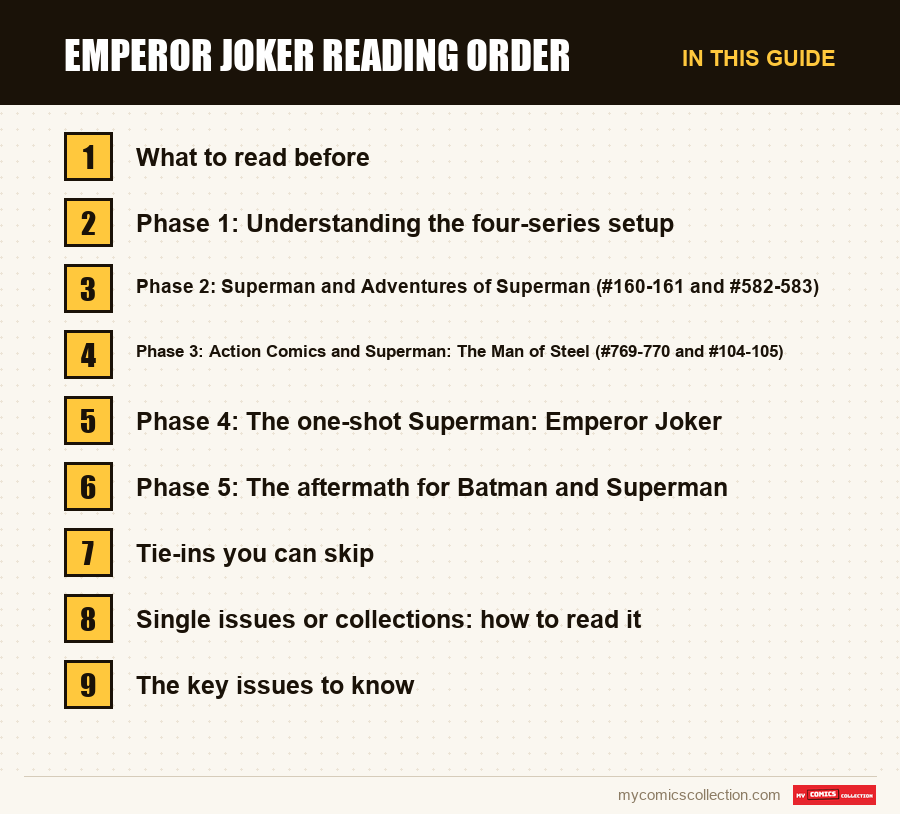
Phase 5: The aftermath for Batman and Superman
Spoiler warning: after the Joker's defeat, the Spectre transfers to Superman the death experiences Batman had suffered, so that Batman can heal mentally. It is the most cited consequence of the event, and it explains why it is readily ranked among the darkest Superman crossovers, despite its often clownish tone.
To continue on the Joker side, the best follow-up is not a specific series but a logic: reread the Joker in his encounters with Batman, for example with the Death of the Family reading order, where the obsession with Batman is front and center. On the Superman side, move on to the character's other crossovers listed in the guide to major Superman crossovers.
Tie-ins you can skip
Emperor Joker is read with its nine issues, the ones gathered in the event's collected edition. Other DC titles published around the same time, notably on the Batman side, are not needed to follow the story: they are not part of the collected set, and you can save them for later.
This restraint takes nothing away from the event. On the contrary, it makes it one of the easiest crossovers to assemble: a short list, precise issue numbers, no risk of missing an essential piece because it is hidden in a side series. If you see a longer list go by on a forum or in a sale listing, check it against the nine references in this article before buying.
A tip on method: when a seller presents a "complete" lot of the event, count nine single issues, not one more or one fewer, and check that they carry the numbers #160-161, #582-583, #769-770, #104-105, plus the one-shot.
Single issues or collections: how to read it
Two paths are open to you. The first is single issues: nine numbers to track down, with the advantage of reading the story at its original pace. It takes organization, because those issues are spread over four series and the cover date has to serve as your thread.
The second path is the Superman: Emperor Joker collection, published by DC Comics as a trade paperback in 2007 (256 pages), then as a hardcover in 2024: it gathers the eight issues of the monthly series and the one-shot. It is the simplest way to read the whole thing in one sitting, since it puts all nine parts in a single volume.
To decide, ask yourself how you will use it. If you just want to read: get the collection. If you want to own the single issues, for the cover, the period ads or the completeness of a Superman run: look for the nine numbers. The two approaches are not mutually exclusive, and many collectors read the volume while keeping the single issues safely stored. Our Superman collecting guide details this approach for the series of the era.
The key issues to know
The event does not introduce a new character to chase: it features established figures, the Joker, Mister Mxyzptlk, Batman and Superman. The value of a copy therefore comes down to other criteria, listed here in the order we would examine them.
First, the one-shot Superman: Emperor Joker, which carries the event's title: it is the single issue buyers spot at a glance. Next, the completeness of the four-title set: a copy of Superman #160, Adventures of Superman #582, Action Comics #769 or The Man of Steel #104 makes sense within a stack of nine. Finally, any variants and graded copies, to be examined issue by issue.
To put a value on any of the nine single issues, first pin down its exact issue number, then check it against completed sales, and examine the corners and the spine. If the issue is presented in a slab, note the full grading label, the issue number and the year. For a serious valuation, use the free estimate.
Recap: the complete order
Sort the nine single issues below by cover date; the list groups them by series to make searching easier.
- Superman (second series) #160-161
- Adventures of Superman #582-583
- Action Comics #769-770
- Superman: The Man of Steel #104-105
- Superman: Emperor Joker (one-shot)
- Aftermath: back to your monthly Superman series, then to the Joker reading guide for what follows on the Batman side
Frequently asked questions
You need eight issues from the monthly series, two per series: Superman #160-161, Adventures of Superman #582-583, Action Comics #769-770 and The Man of Steel #104-105. Add the one-shot Superman: Emperor Joker, for nine single issues in total across the whole 2000 event.
It is not essential, since the story stands on its own, but the relationship between the Joker and Batman is at the heart of the narrative. If you do not know that duo, the Joker reading guide on our blog gives you the bearings you need before you open the first issue of the event.
Each monthly series keeps its usual team. Jeph Loeb writes Superman #160-161, drawn by Ed McGuinness, and co-writes with Joe Kelly the one-shot Superman: Emperor Joker, illustrated by several artists. That split gives the whole 2000 event a plurality of styles.
For reading, the collection is enough: the volume published by DC Comics in 2007, then reissued as a hardcover in 2024, gathers the eight issues of the four monthly series and the one-shot. Single issues are for those who want to own the original copies, with their covers and their period ad pages.
Note the cover date printed on each of the nine single issues and start with the oldest. Since the four series came out in parallel, the cover date is the best thread for moving from one to another without breaking the rhythm the 2000 crossover's teams intended.
You have tracked down the nine Emperor Joker issues or just the one-shot: get your copy valued before you sell or insure it.
Value my comic