
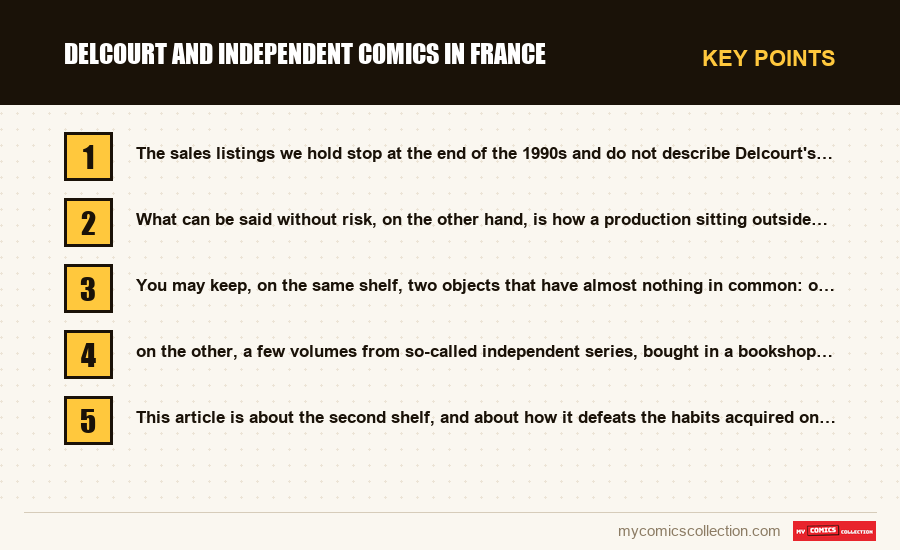
The sales listings we hold stop at the end of the 1990s and do not describe Delcourt's catalogue, so we will not state anything precise about its collections. What can be said without risk, on the other hand, is how a production sitting outside the two major American catalogues is collected differently: in closed volumes rather than in series to be completed, with availability set by print runs rather than by numbering.
You may keep, on the same shelf, two objects that have almost nothing in common: on one side, stacks of newsstand magazines, numbered, interchangeable at first glance, of which three issues are always missing; on the other, a few volumes from so-called independent series, bought in a bookshop, complete in themselves, and which do not tell you what to buy next. This article is about the second shelf, and about how it defeats the habits acquired on the first.
As always on this guide, only verified information (creators, issue numbers, dates) is stated as fact; the analysis is our own, with no reproduction of panels or protected dialogue.
Why this article begins with what it does not know
Our French listings of contents cover a period that closes at the end of the 1990s: the most recent publication we can cite without hesitation is a collection launched in 1997. Everything after that lies outside what we have measured. For a contemporary publisher, this means one simple thing, and it is better to say it plainly: we hold no issue-by-issue listing, no verified release date, and no collection name that we can guarantee.
We will therefore not recite a catalogue from memory. The lists found online for recent houses are often incomplete or copied from one another, and on several points sources disagree: the exact launch date of a collection, the number of volumes actually published before it stopped, the status of a collected edition presented as a complete run. A publisher's page asserting all of this with confidence would do you a disservice, because you would buy or pass up a copy on the strength of a false detail.
This limit is not an admission of helplessness, it is the subject itself. It points exactly to where the French collector finds himself alone: facing a recent production, abundant and poorly documented, whose reference list nobody has yet established, as was eventually done for the major newsstand magazines. The right question is therefore not "what does the catalogue contain", but "how do you work when the catalogue does not yet exist".
What the word "independent" says, and what it does not
In French, the word is used for convenience to designate anything that belongs to neither of the two major American superhero catalogues. It is a definition by subtraction, and it lumps together very different things: author-driven series published by small outfits, titles carried by a fairly sizeable American house, genre stories without costumes, works signed by artists who came from European comics. The boundaries shift depending on who is speaking, and here too sources disagree on what goes where.
For collecting, this label is nonetheless not empty of meaning. It predicts one thing: the absence of a continuous, supervised editorial thread. In our newsstand listing, the major magazines advanced by one issue a month for years, and that regularity gave the collector a backbone, landmarks, and an obvious list of gaps. A production outside those catalogues almost never has that continuous ribbon: it advances by objects, each decided separately, sometimes interrupted without warning.
From the anthology contents to the closed volume
The listing we went through shows how much the logic of the newsstand was that of the anthology. A magazine such as Ombrax passed two hundred issues by piling up stories of diverse origins, and our data keep only one episode title per issue although the booklet often contained several. The actual contents had to be opened to be known, and that is still true today when you buy a lot: the exact contents of an issue are checked on the copy, not on a card.
A volume from an independent series works the other way round. It announces its contents on its back cover, it gathers a whole story arc, and it closes. You know what you are buying before you open it, which removes in one stroke the main uncertainty of the newsstand. In exchange, you lose the pleasure and the usefulness of discovery: no more letters page, no more secondary story that makes you try a character, no more editorial pages that date and situate the object. The object is clearer, and it says less about its era.
Collecting without a series to complete
The engine of magazine collecting is the gap. You have two thirds of a set, you know the list of what is missing, you hunt. The 1989 switch on Strange illustrates well what this work looks like: the Lyon publisher stops at issue 228, the next one picks up at 229 without resetting the counter, and the collector must understand this continuity so as not to believe that a whole series is missing from him. It is all a matter of ranks and boundaries.
A modern series in volumes does not offer you this engine. There is no rank to line up until exhaustion, and when the set stops because the authors have finished, it is finished: your shelf is complete and it will stay that way. Many collectors who came from the newsstand find this emptiness hard to live with, then find it restful. In practice, it shifts the effort: you no longer hunt an issue, you choose sets, and the only decision that really matters becomes the scope you set for yourself.
Availability depends on the print run, not the number
On the newsstand, rarity follows readable rules: the first issues of a magazine were printed when nobody knew whether it would sell, the last ones when sales were falling, and it is these two ends that go missing from lots. The very shape of the series indicates where to look for difficulty.
For a recent production in volumes, the indicator is no longer the rank but the industrial history of the object: how many copies were printed, and above all whether it has been reprinted. A volume reprinted several times remains available for a long time and has no reason to become hard to find. A volume printed only once, from a series that stopped early, can disappear from circulation within a few seasons without anything, neither its place in the series nor its appearance, having signalled it. This is an invisible rarity, and it makes watching more useful than hunting.
The direct consequence for the method: when a volume interests you and is in stock, the question is not whether it will be worth anything, but whether you will find it again. Most of the time, for a series in progress from an active publisher, the answer is yes. For a discreet title you never hear about anywhere, nobody can guarantee it.
Do you collect this series?
Track what you own, what you are missing and what your collection is worth. 7-day trial.
Start my trial →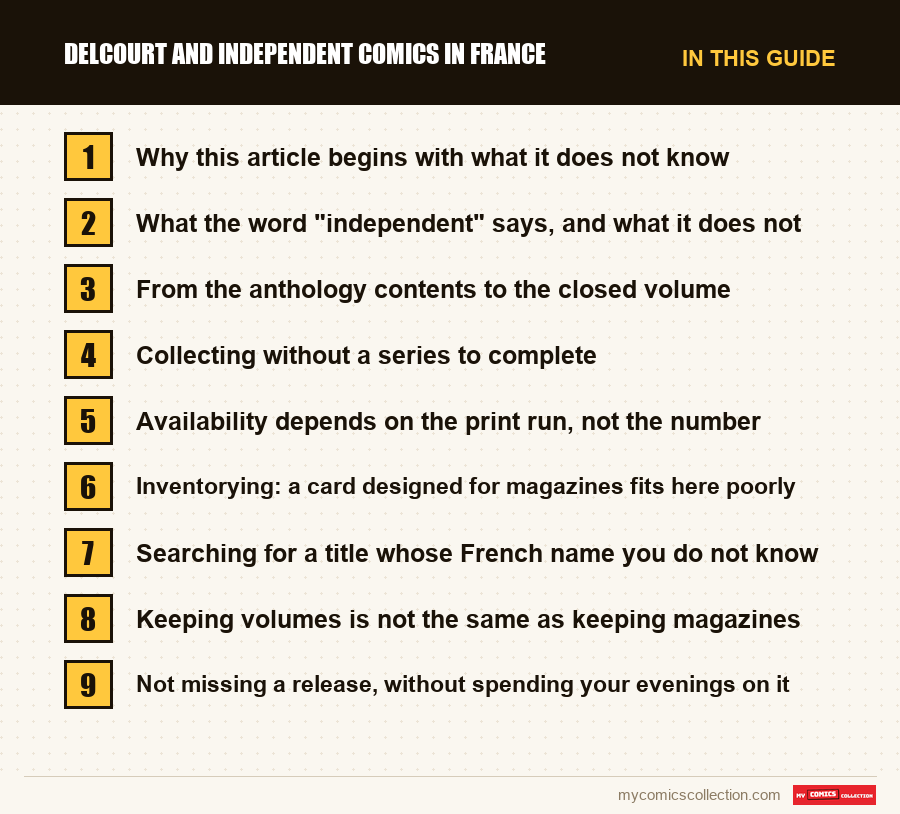
Inventorying: a card designed for magazines fits here poorly
The fields used to describe a newsstand booklet are the magazine title, the issue number, the month of release, and the publisher. This set of four is enough to identify nearly all of our listing without ambiguity, and it fills in quickly when you have a stack in front of you.
For an independent volume, two of these four fields become fragile. The number is no longer a rank in a long series but a volume in a French division that may not follow the original one, so you must note the division itself, that is, what the volume contains. The release date matters less than the edition or reprint indication, often printed in small type on an inside page, and which is the only thing distinguishing two otherwise identical copies. A serious inventory therefore adds one line for the contents and one line for the edition, failing which you will end up with a catalogue that is useless on the day you want to sell or insure.
Searching for a title whose French name you do not know
The newsstand listing is full of titles that exist only in French, invented by publishers for their public, and full of homonyms that trap the search: a magazine named Hulk appeared at one house in the seventies, another of the same name at a different house fifteen years later. The reflex to adopt is the same today as it was then: a name alone identifies nothing, you must add the publisher and the year.
For recent series, the difficulty is different and more treacherous. The French title may be a translation, an adaptation, or the original title kept as it is, and habits vary from one house to another, even from one collection to another within the same house. We will refrain from stating which rule applies where, because our listings do not record it. In practice, search by author names rather than by title: the writer and artist pairing stays stable from one country to another, and it is what will lead you to the right series when the title escapes you.
Keeping volumes is not the same as keeping magazines
What we have measured of the newsstand, the short format, the cheap paper and the two staples, dictates a storage that collectors know well: flat, out of the light, in low stacks, accepting that the paper will yellow anyway. The enemy is the fold and the rust of the staples.
A bound or paperback volume ages differently. It stands upright, so it is shelved upright, and that is where the spine comes under strain: left lying under others for too long, a binding deforms; standing but poorly packed, it warps. Surfaces printed in dark solid colours show the slightest rubbing, which makes handling damage more visible than on a magazine cover printed in line work. Finally, the thick, coated paper of these editions does not yellow the way newsprint does, but it keeps a permanent mark wherever it has taken on moisture. For a mixed shelf, the practical conclusion is this: do not store the two sets in the same way, and do not stack one on top of the other.
Not missing a release, without spending your evenings on it
The newsstand solved this problem by itself: the magazine came back every month to the same spot, and the only risk was arriving too late in the month. Our listings show, moreover, series interrupted around the twentieth or thirtieth booklet, and for those the collector of the time did not know he was holding the last ones.
Today, the risk has changed shape: it is no longer the number that slips away, it is the very existence of the series. A discreet release, with no screen adaptation to carry it, can come out and stop without ever crossing your field of view. Three habits reduce this risk without excessive effort. Follow the authors you like rather than the characters, because it is the name in the credits that will alert you. Look, once a quarter, at the announcements of the publisher whose several volumes you already own, because a house has a taste and that taste repeats itself. And note in your inventory the series in progress with the volume reached, so that a set left unfinished at home announces itself.
If your shelf already mixes newsstand magazines and recent volumes, it is worth sorting it out once and for all: separate the two sets, describe them with different fields, and stop applying the same valuation grid to both.
Frequently asked questions
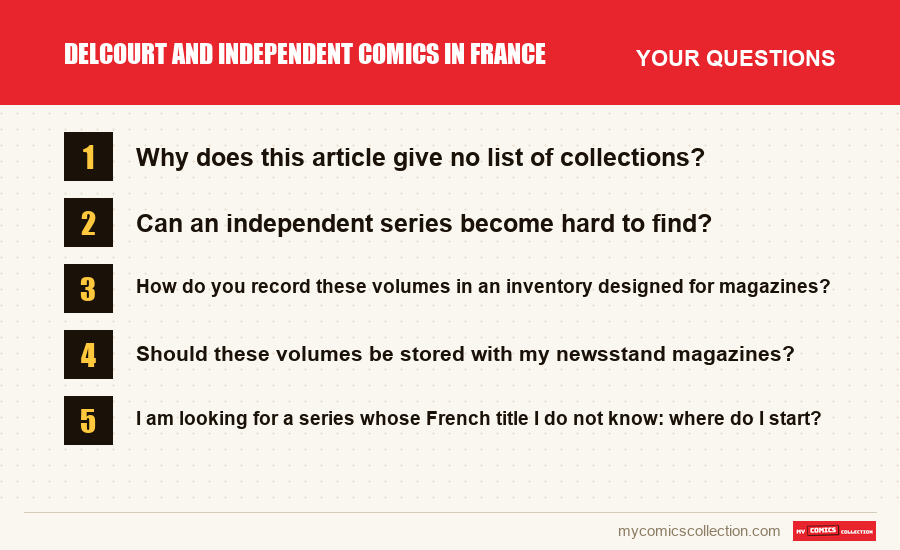
Because our contents listings stop at the end of the 1990s and do not cover contemporary publishers. We could copy a list found elsewhere, but we could not verify it, and on several points sources disagree. A sound method is better than an approximate inventory on which you would base a purchase.
Yes, but not by the rules of the newsstand. What matters is not the rank of the volume but the print run and whether or not it has been reprinted. A discreet title, stopped early and printed only once, leaves circulation without warning. A volume reprinted several times stays accessible for a long time, whatever its place in the series.
Add two columns. The first describes what the volume contains, since the French division does not necessarily follow the original one. The second notes the edition or reprint indication printed inside, which is often the only element distinguishing two copies that look alike. Without these two lines, your file will not serve you on the day of resale.
No, and certainly not stacked together. Stapled booklets are kept lying flat, in low stacks, their weak points being the fold and the staples. Bound volumes are kept upright and packed tightly, otherwise the spine deforms or warps. Their coated paper does not yellow like newsprint, but it keeps the trace of any moisture.
With the authors. The writer and artist pairing does not change from one country to another, whereas the title may be translated, adapted or kept in English depending on the habits of the house. Search for the artist's name, then check on the copy itself what it contains before buying, as you would for a magazine's contents page.