The pocket format with a glued spine and the large stapled comic-book format differ not only in their dimensions: they impose a different page layout, age through opposite weak points, the spine for one and the staples and corners for the other, and do not sit on the same shelf. Listings describe them with two distinct vocabularies, and an inventory that ignores the format produces wrong searches.
Two stacks are in front of you. On the left, thick issues, almost square, that you hold in one hand and whose spine carries a title readable in profile. On the right, larger, thinner booklets that slump as soon as you stand them up. Both are comics magazines in French, and yet everything you will do with them differs: the space they take up, the way you describe them to a buyer, the time lost finding them again in your list. The format is not a descriptive detail, it is a management variable.
As always on this guide, only verified information (creators, issue numbers, dates) is stated as fact; the analysis is our own, with no reproduction of artwork or protected dialogue.
Two objects filed under the same word
In French, the word "fascicule" covers two families of objects that had no obligation to look alike. The first is the pocket format, which carried most of American comics in France for thirty years: a compact, fairly thick block whose pages are held by a glued spine. The second is the booklet in large comic-book format, closer to the original format of American magazines, thin, held by two staples at the central fold.
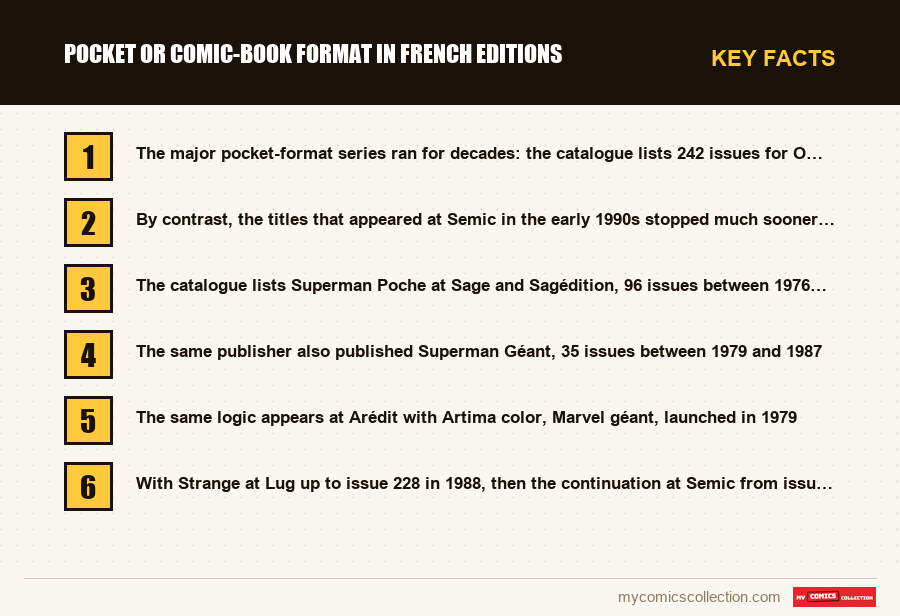
The catalogue makes it possible to place the two periods without guessing. The major pocket-format series ran for decades: the catalogue lists 242 issues for Ombrax between 1966 and 1986, and 228 issues for Strange at Lug between 1970 and 1988. By contrast, the titles that appeared at Semic in the early 1990s stopped much sooner: 23 issues for Spider-Man launched in 1991, 25 for X-Men launched in 1992, 26 for X-Force the same year. This is not a comparison of quality, it is a comparison of scale: a pocket-format collection counts in hundreds of uniform pieces, a large-format collection in dozens, often scattered across several short-lived titles.
The format decides how the page is laid out
Reducing a format is not a simple change of scale. A page designed for a wide page contains panels whose width carries the rhythm: a panorama that fills the full width, a strip of three panels read in a single movement of the eye. Reduced to a narrower page that is proportionally taller, the same page has to be reworked. In the French pocket formats, depending on the case, one finds a reframing, a strip split into two levels, a displacement of the speech balloons, and sometimes a complete reorganisation of the page.
For reading, this changes two things. The first is the number of pages needed for the same story: a pocket-format magazine is thick because it needs more leaves to say the same thing. The second is the loss of the surface effect. A spectacular full page in a large booklet occupies the field of vision; in a pocket block it remains an image, but it no longer dominates anything. Readers who say they prefer one format to the other are not only talking about comfort, they are talking about a page layout.
The glued spine and the staples fail in different places
A glued spine is a structure: it holds the block, it carries the title, and it is the first thing a buyer looks at in profile. Its weaknesses are its own. Opened too wide, it develops a white crease that never disappears. Handled often, it shows the beginnings of detachment at the first and last leaves, where the glue holds least. Stored tightly, it keeps the trace of its neighbours and takes on a slight bow.
A saddle-stitch at the central fold has the opposite geometry. It has no spine to damage, but it has two localised points of support that concentrate all the stress. The large booklet opens flat without harm, which is comfortable, but it warps as soon as it is placed badly supported, and its outer corners are exposed because nothing protects them. A stapled issue stored badly curls; a pocket issue stored badly warps at the spine. These are two defects that cannot be corrected in the same way, and they are not described with the same words.
The title itself sometimes announces the format
A useful and often overlooked point: some publishers wrote the format into the name of the publication. The catalogue lists Superman Poche at Sage and Sagédition, 96 issues between 1976 and 1987, and Batman Poche at the same publisher, 52 issues between 1976 and 1984. The word is in the title, and it works as a declaration: the publisher was selling a small object, and the reader knew it before opening it.
The same publisher also published Superman Géant, 35 issues between 1979 and 1987. Here again the adjective is not decorative, it commercially distinguishes one range from another. The same logic appears at Arédit with Artima color, Marvel géant, launched in 1979. When the format appears in the title, your inventory has reliable information without measuring anything; when it does not, and that is the case for most series, you have to measure it yourself once and note it.
What a shelf accepts and what it refuses
This is where a mixed collection becomes a concrete problem. A shelf of pocket formats is dense and stable: the thick blocks support one another, the title reads in profile, and you find an issue without taking anything out. A shelf of large booklets does not work that way. Thin and without a spine, they do not stand on their own, they slide against one another, and no title can be read from the outside.
The two families therefore call for two systems. Pocket formats live well upright, on a shelf whose depth is just enough, provided they are not packed too tightly. Large booklets live better flat, or upright in a rigid container that holds their corners, with regular dividers to avoid a domino effect. Mixing the two on one shelf guarantees the worst of both worlds: the large ones slump against the small ones, and the small ones bow under the overhang.
This constraint has an effect that is underestimated: it breaks the reading order. A collector following a character across decades ideally wants a chronological shelf. With Strange at Lug up to issue 228 in 1988, then the continuation at Semic from issue 229, you already have a continuous numbering that invites you to line everything up; as soon as the format changes midway, the chronological shelf becomes physically impossible, and you have to choose between sorting by format and sorting by series. Most collections end up sorting by format and documenting the chronology elsewhere, in a list.
Do you collect this series?
Track what you own, what you are missing and what your collection is worth. 7-day trial.
Start my trial →
Two sellers' vocabularies, and only one object to buy
Listings reflect this split. For a pocket format, the seller talks about the spine: spine in good condition, spine rubbed, spine sunned, spine re-glued, sometimes spine with a missing piece. He mentions whether the cover is present, the condition of the corners, and the thickness of the block. The issue number and the magazine title are usually enough to identify the piece, because the major series were numbered continuously over many years.
For a large booklet, the vocabulary shifts. The seller describes flatness, the condition of the staples, the presence of rust at the fold, the sharpness of the corners, and the alignment of the central fold. He often specifies whether the booklet is complete, because detached pages at the centre are the typical defect of this binding. Identification, however, is more uncertain: the short titles of the 1990s look alike, and the same character name served several different publications.
The trap, then, is not that one vocabulary is better than the other. It is that a buyer used to one reads the other at a slant. A pocket-format listing that says nothing about the spine is silent on the main defect. A large-booklet listing that praises an immaculate spine describes an object that has no spine, which should alert you to the care taken over the description.
Disputes almost always arise from an implicit format
Most disagreements after a purchase concern not the condition but the object. A buyer thinks he is ordering a large booklet, receives a pocket format that does contain the story announced, and feels cheated. The seller, in good faith, described a title and a number. Both are right within their own frame of reference, and neither wrote down the format.
Three situations recur. The first: a character published under several imprints and in several formats, such as Hulk, listed in the catalogue at Arédit and Artima from 1976 and then at Semic in 1992 under the same series name. The issue number alone is no longer enough; the publisher and the year are needed. The second: series whose visible numbering does not match the number of issues actually published, because reprints and parallel ranges are mixed in; the catalogue gives an example with Artima color, Marvel géant, where the count of entries and the printed numbering do not line up. The third: titles taken over from one publisher to another, where the mention "Poche" or "Géant" may have disappeared or appeared from one range to the next.
The remedy is short: always require three items before paying, the exact title printed on the cover, the publisher, and the year. If the rarity justifies it, also ask for the height of the issue in centimetres.
Inventorying a mixed collection without sorting it by hand
A collection list that knows only the title and the number will leave you in ambiguity for good. The useful minimum is to add three fields: the publisher, the year of publication of the issue, and the format. The first two come from the catalogue and cost you nothing. The third is recorded once per series, not per issue, since a series almost never changes format midway.
With these three fields, tedious operations become immediate: listing what should join the large-booklet storage, counting what is missing from a pocket-format series, preparing a uniform lot to resell. Without them, each question means going back to the shelf. That is why the format deserves a field, and not a note in a comment.
Searching for an issue when the format is part of the question
When searching, the format works both as a filter and as a disambiguator. As a filter, it removes at a stroke the listings that do not interest you: if you are completing a pocket-format series, everything in large format is out of scope, even under the right character name. As a disambiguator, it settles between two homonymous publications where the date alone leaves doubt.
In practice, combine three criteria in your alerts: the printed title, the publisher, and a date range. For Spidey, for example, the catalogue covers 107 issues between 1979 and 1988 at Lug: an alert limited to that interval mechanically excludes the later publications carrying a similar name. For the Fantastic Four, of which several French series coexist in the catalogue, the date range does the same job and spares you rereading ten listings a week.
What I would do with a mixed stack today
If you inherit a mixed lot, the order of operations matters. First, physically separate the two families before even sorting by title: you immediately stop the deformations caused by proximity. Next, series by series, record the exact title on the cover, the publisher, and the year of the first and last issue you hold; this will be enough to resolve almost every homonym. Only then, finally, turn to condition, piece by piece.
This order is not arbitrary. Sorting by title first means handling each issue twice, and handling is what marks glued spines. Sorting by format first gives you two stable sets, each storable under its own rules, and leaves you all the time needed for the documentary part. In a mixed collection, the format is not the last characteristic to record: it is the first decision to make.
Frequently asked questions
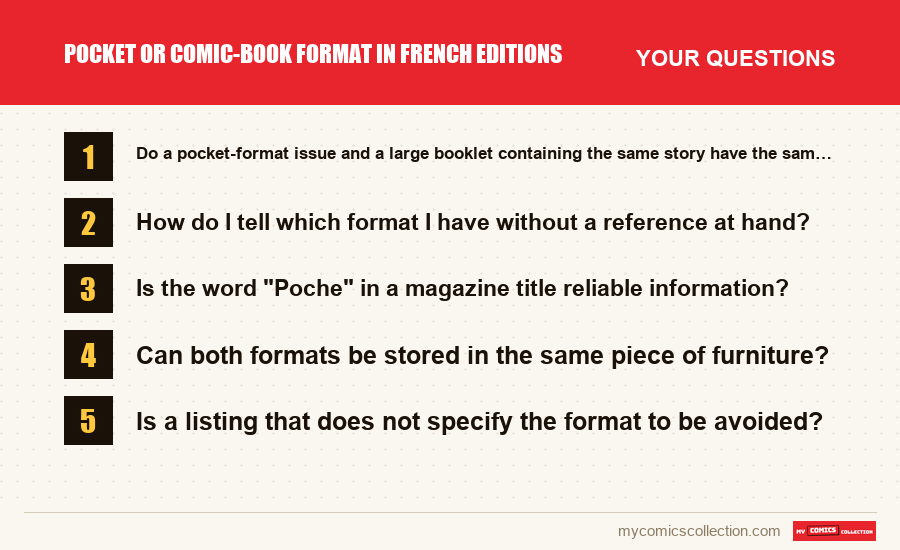
No, and not for a reason of quality. These are two markets with distinct demand: long pocket-format series interest collectors completing a numbered run, while large booklets attract buyers of individual episodes. Condition is also judged on different criteria, the spine for one, the staples and flatness for the other. Comparing the two directly makes no sense.
Look at the spine. If there is one, if it is flat and carries a title readable in profile, you have a glued-spine block. If the issue opens naturally flat and shows two staples at the central fold, it is a stapled booklet. This test takes two seconds, requires no measurement, and is enough to record the format series by series in an inventory.
Yes, for the range concerned. When the catalogue lists Superman Poche or Batman Poche at Sage and Sagédition in the years 1976 to 1987, the publisher was announcing the format itself. Be careful, however: the absence of the word means nothing, since the great majority of French pocket formats did not carry it in their title.
In the same piece of furniture, yes; on the same shelf, no. Give one shelf to the glued-spine blocks, which stand upright and support one another, and another to the large booklets, with dividers or a rigid container. Mixed together, the large ones slump against the small ones and the small ones bow, and both deformations are permanent.
Not to be avoided, but to be completed. Ask for the exact title printed on the cover, the publisher, the year of the issue, and a photo taken in profile. For a significant purchase, also ask for the height in centimetres. A serious seller answers without difficulty, and his silence on these points is itself a piece of information.