The Dark Nights: Metal reading order starts with a six-issue miniseries (2017-2018) written by Scott Snyder and drawn by Greg Capullo. Read the two preludes first, Dark Days: The Forge and Dark Days: The Casting, then the six main series issues, slipping in the fall 2017 "Dark Knights" one-shots, Batman: Lost between #3 and #4, Hawkman: Found between #4 and #5, and Dark Knights Rising: The Wild Hunt between #5 and #6. The tie-ins from the regular series are optional.
Metal is a two-speed event: a short spine, drawn almost entirely by the same artist, and a constellation of one-shots, interludes and regular-series issues that attach to it. Order matters mostly for the first group, and this article gives it to you title by title, with the creators of each piece.
As always on this guide, we only state verified facts (creators, issue numbers, dates); the analysis is ours, with no reproduction of protected art or dialogue.
What to read before
Two publications serve as a direct prelude, and they read quickly. Dark Days: The Forge #1 came out in June 2017: Scott Snyder and James Tynion IV write it, and three artists follow one another, Jim Lee, Andy Kubert and John Romita Jr., inked by Scott Williams, Klaus Janson and Danny Miki. Dark Days: The Casting #1 follows in July 2017 and brings the reader to the threshold of issue #1 of the main series.
These two one-shots require no prior knowledge of any specific run, but they carry more weight if you already know the Justice League lineup. Our Justice League reading guide brings the team and its members back into focus if you're coming from another corner of the reading universe.
If you like the duo's style, the Batman vol. 2 cycle that Scott Snyder and Greg Capullo wrote earlier is a natural companion read: it isn't needed to understand Metal, but it shows how the pair works with the myths of Gotham. Our Batman reading guide helps place it.
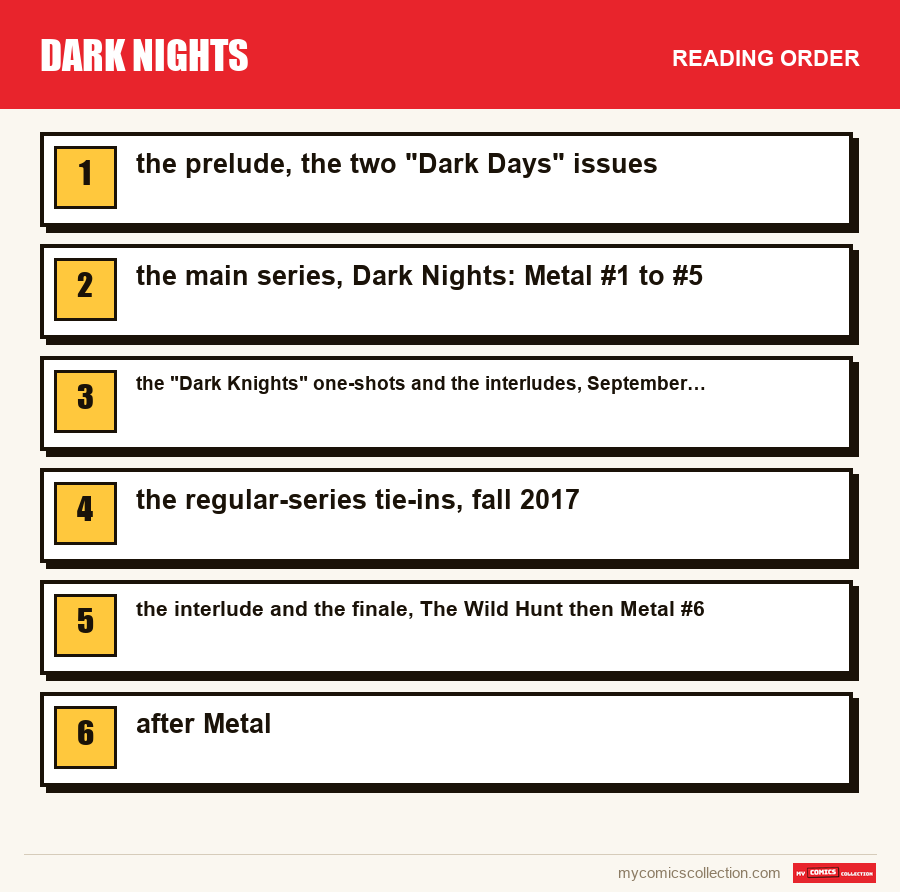
Phase 1: the prelude, the two "Dark Days" issues
Recommended order: Dark Days: The Forge #1, then Dark Days: The Casting #1. Both issues are full one-shots, published a month apart, and they take little time to read. Think of them as a threshold: they don't give you the whole plot, but they set the tone and the stakes that the main series will develop.
A collecting detail: Dark Days: The Forge brings together six pencilers and inkers in a single issue, which makes it a curiosity for art fans. The Casting is more discreet, but it's part of the reading chain, and a reader who skips it feels a bit looser going into #1.
Phase 2: the main series, Dark Nights: Metal #1 to #5
Six issues make up the main series: Snyder writing, Capullo drawing, Glapion inking, Plascencia coloring. It ran from August 2017 to March 2018. Issues #1 to #5 form a block in which you follow the threat's advance, at the pace of an adventure series more than a noir novel.
A reading tip: read the first five issues interleaved with the one-shots of the next phase, rather than all in a row. That way you avoid learning the main series' reveals before you've read the stories that set them up, and the reading keeps the rhythm the publishers intended at the time.
If you prefer the straight line, read #1 to #5 in one go: the main story remains understandable without the one-shots, which enrich the context without gating the thread.
Phase 3: the "Dark Knights" one-shots and the interludes, September to December 2017
The seven one-shots devoted to the evil versions of Batman form the core of the side material. Here is the list, with the creators of each issue, in their release order.
- Batman: The Red Death #1 (September 2017): Joshua Williamson writing, Carmine Di Giandomenico on art.
- Batman: The Murder Machine (September 2017): Frank Tieri and Riccardo Federici.
- Batman: The Dawnbreaker (October 2017): Sam Humphries and Ethan Van Sciver.
- Batman: The Drowned (October 2017): Dan Abnett, with Philip Tan and Tyler Kirkham on art.
- Batman: The Merciless (October 2017): Peter J. Tomasi and Francis Manapul.
- Batman: The Devastator (November 2017): Frank Tieri and James Tynion IV, art by Tony S. Daniel.
- The Batman Who Laughs (November 2017): James Tynion IV writing, Riley Rossmo on art.
These issues are read in their release order. Each is a short story centered on an alternate version of the hero, which makes them easy to sample. If you can only pick one, The Batman Who Laughs is the issue to read to discover that character under James Tynion IV's pen.
Two interludes then slot into the main series. Batman: Lost (November 2017), written by Scott Snyder, James Tynion IV and Joshua Williamson, is read between Dark Nights: Metal #3 and #4. Its follow-up, Hawkman: Found #1 (December 2017), written by Jeff Lemire and drawn by Bryan Hitch and Kevin Nowlan, sits between #4 and #5.
Phase 4: the regular-series tie-ins, fall 2017
In fall 2017, several of the publisher's regular series devote an issue to the event. Here is the verified list, in publication date order.
- Teen Titans vol. 6 #12 (September 2017), in the "Gotham Resistance" story.
- Nightwing vol. 4 #29 (September 2017).
- Suicide Squad vol. 5 #26 (September 2017).
- Green Arrow vol. 6 #32 (October 2017).
- The Flash vol. 5 #33 (October 2017), in the "Bats Out of Hell" story.
- Justice League vol. 3 #32 and #33 (November 2017).
- Hal Jordan and the Green Lantern Corps #32 (November 2017).
To interleave these issues with the main series, follow their dates: read them through the fall, between the "Dark Knights" one-shots of phase 3. If you subscribe to one of these series, you'll read its issue in its place; otherwise, nothing obliges you to hunt it down.
You'll find these characters in our hubs: Green Lantern, Flash or Nightwing, depending on which series appeals to you.
Phase 5: the interlude and the finale, The Wild Hunt then Metal #6
The interlude Dark Knights Rising: The Wild Hunt came out in February 2018, between issues #5 and #6 of the main series. It's written by Scott Snyder, Grant Morrison, James Tynion IV and Joshua Williamson, with Howard Porter, Jorge Jiménez, Doug Mahnke and Jaime Mendoza on art. Grant Morrison is among the writers: if you follow that author, the Grant Morrison page lists his other comics.
So read it after Dark Nights: Metal #5 and before #6, which concludes the story. That last issue is the most anticipated of the series; spoiler warning: we won't say anything about its content, which you need to discover by reading.
Do you collect this series?
Track what you own, what you are missing and what your collection is worth. 7-day trial.
Start my trial →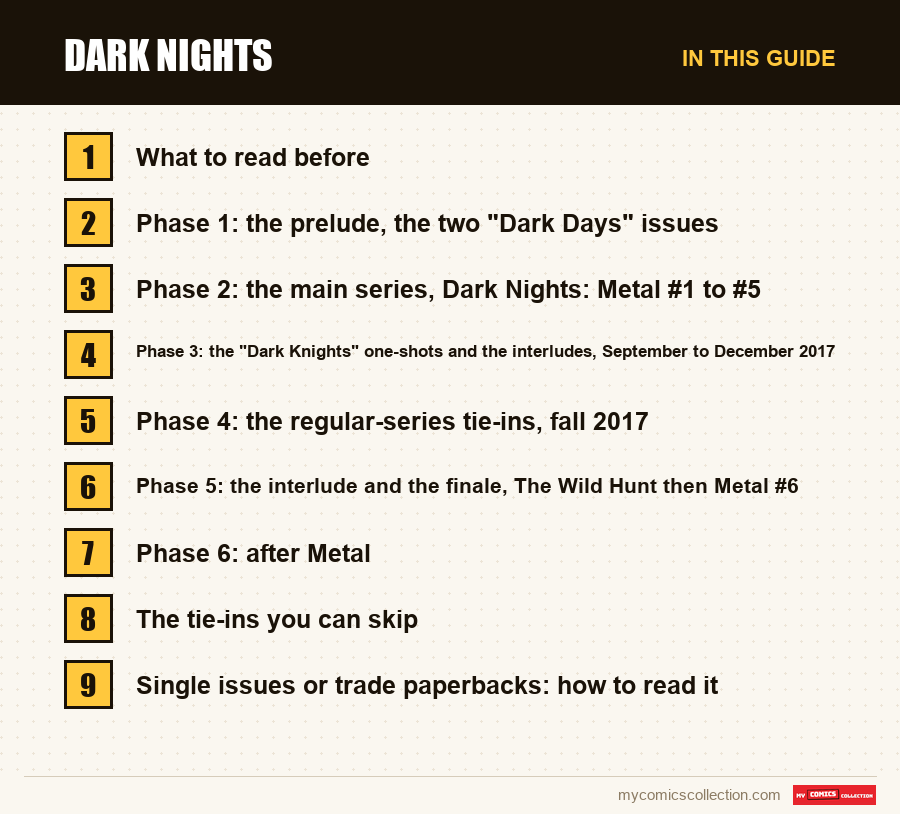
Phase 6: after Metal
In the immediate term, the end of Metal serves as the starting point for Justice League: No Justice, a four-issue miniseries published in May 2018, written by Scott Snyder, James Tynion IV and Joshua Williamson, with Francis Manapul on art. The event's direct sequel is called Dark Nights: Death Metal, written by Scott Snyder and drawn by Greg Capullo, and it came out in 2020. You can read it right after if you enjoyed the universe, but you don't need it to understand the 2017-2018 series.
The Batman Who Laughs returned in other publications after the event. For the rest of the Gotham universe, the Batman crossovers feature places the event among the hero's big stories.
The tie-ins you can skip
The six-issue main series tells the event from start to finish, and the two preludes are enough to put it in perspective. Everything else is optional.
The regular-series issues (Teen Titans, Nightwing, Suicide Squad, Green Arrow, The Flash, Justice League, Hal Jordan and the Green Lantern Corps) mostly address those series' readers: the event grafts onto ongoing plots there, and reading a single issue in isolation can leave an unfinished feeling. The Batman-focused one-shots, on the other hand, are standalone and easier to read separately.
Optional is not a quality judgment: a tie-in is there to explore the event from another angle, not to complete the plot. Choose based on your tastes as a reader or collector.
Single issues or trade paperbacks: how to read it
In single issues, follow publication order: preludes in June and July 2017, the main series from August, one-shots and tie-ins in the fall, The Wild Hunt between #5 and #6. It's the method most faithful to the original pace, but also the most tedious.
In trade paperbacks, several editions exist. Dark Nights: Metal: The Deluxe Edition came out in June 2018; a standard edition, Dark Nights: Metal, followed in January 2019; Absolute Dark Nights: Metal in November 2022; and an omnibus, Dark Nights: Metal Omnibus, in January 2023. The tie-ins are found in the collection Dark Nights: Metal: The Resistance (July 2018), which gathers the regular-series issues as well as Batman: Lost and Hawkman: Found #1.
Collector's method: before buying a collection, compare its contents to the list in this article. A volume can contain the preludes, or the tie-ins, or both, and that detail determines what you still have left to find in single issues.
The key issues to know
For a collector, four pieces stand out. Dark Days: The Forge #1 and Dark Days: The Casting #1 open the chain. Dark Nights: Metal #1 launches the main series. The Batman Who Laughs (November 2017) and Dark Knights Rising: The Wild Hunt (February 2018) are two useful landmarks: the first for its character, the second because it brings together four writers.
Among the one-shots, Batman: The Red Death #1 opens the one-shot series and serves as a natural entry point. As for cover variants, there are plenty on the issues of this event: always check the notation printed on the cover before buying.
When buying, compare completed sales against online listings and note the condition of each copy. The appraisal service lets you place your issues before selling or insuring a lot.
Recap: the complete order
- Dark Days: The Forge #1 (June 2017): Scott Snyder and James Tynion IV.
- Dark Days: The Casting #1 (July 2017).
- Dark Nights: Metal #1 to #3 (2017): Scott Snyder and Greg Capullo.
- Through fall 2017, the one-shots Batman: The Red Death, The Murder Machine, The Dawnbreaker, The Drowned, The Merciless, The Devastator and The Batman Who Laughs (September to November 2017).
- Tie-ins: Teen Titans #12, Nightwing #29, Suicide Squad #26, Green Arrow #32, The Flash #33, Justice League #32 and #33, Hal Jordan and the Green Lantern Corps #32.
- Batman: Lost (November 2017), then Dark Nights: Metal #4.
- Hawkman: Found #1 (December 2017), then Dark Nights: Metal #5.
- Dark Knights Rising: The Wild Hunt (February 2018).
- Dark Nights: Metal #6 (March 2018).
- Follow-up: Justice League: No Justice #1 to #4 (2018), then Dark Nights: Death Metal (2020).
Frequently asked questions
The main series has six issues, published between August 2017 and March 2018, written by Scott Snyder and drawn by Greg Capullo. It's preceded by two preludes, Dark Days: The Forge and Dark Days: The Casting, and accompanied by several optional one-shots and tie-ins.
It's recommended. Dark Days: The Forge #1 (June 2017) and Dark Days: The Casting #1 (July 2017) serve as a direct prelude. You can technically start at #1 of the main series, but you lose the context that the two one-shots set up.
Between Dark Nights: Metal #5 and #6. This February 2018 interlude is written by Scott Snyder, Grant Morrison, James Tynion IV and Joshua Williamson. Read it before closing the series with #6, to respect the order planned at publication.
No. The main series and the two preludes are enough to follow the story. The Nightwing, The Flash, Justice League and other series issues mostly address their regular readers, and you can skip them without losing the thread.
For the main series, Dark Nights: Metal (January 2019 edition) or the Deluxe Edition (June 2018). For the tie-ins, Dark Nights: Metal: The Resistance (July 2018). Always compare the volume's contents with the order described above before buying.
Do you own issues of Dark Nights: Metal or its one-shots: get your lot appraised before reselling it or completing it.
Appraise my comic