
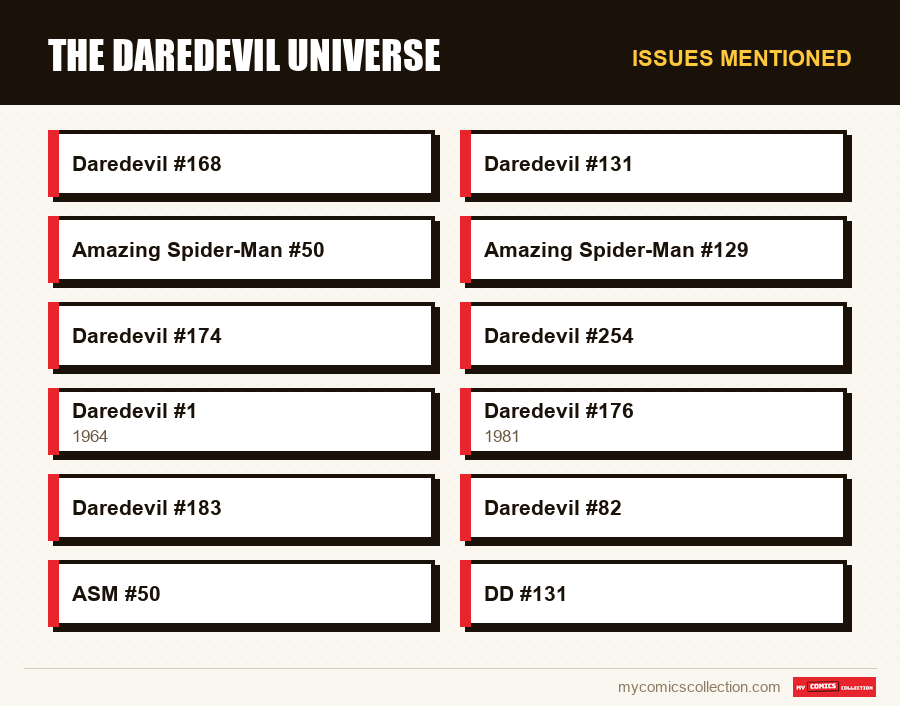
The Daredevil universe is a dark, interconnected ecosystem centered on Hell's Kitchen. Must-haves include Elektra (Daredevil #168, 1981), Bullseye (Daredevil #131, 1976), Kingpin (Amazing Spider-Man #50, 1967), and Punisher (Amazing Spider-Man #129, 1974). The series Elektra: Assassin , Punisher and the appearances of Karen Page form a compact but extremely valued universe.
Hell's Kitchen is the beating heart of a street-level Marvel universe where secondary characters often carry as much weight as the main hero. Since Frank Miller, the Daredevil universe has been constructed as a network of tragic destinies (Elektra, Bullseye, Karen Page, Foggy Nelson) each carrying major key numbers on the collectible market.
This guide lists essential first appearances, spin-offs and crossovers to build a complete collection of the Daredevil universe. For key numbers of the main title, see our Daredevil key numbers guide.
Major Villains: First Appearances
Kingpin (Wilson Fisk)
First appearance in Amazing Spider-Man #50 (July 1967). Although introduced as Spider-Man's villain, Kingpin became Daredevil's definitive nemesis under the pen of Frank Miller. This Silver Age issue is a major key book exceeding $10,000 in high condition.
Bulleye
First appearance in Daredevil #131 (March 1976). The psychopathic assassin is responsible for the deaths of Elektra (#181) and Karen Page (Guardian Devil). An essential Bronze Age key to the DD universe.
Elektra
First appearance in Daredevil #168 (January 1981). The creation of Frank Miller, Elektra is both antagonist and ally: her first appearance is one of the most iconic issues of the Bronze Age. Anti-heroine and star of multiple solo series.
The Hand and Typhoid Mary
The Hand (Daredevil #174, 1981) and Typhoid Mary (Daredevil #254, 1988) complete the rogues' gallery. Typhoid Mary is an underrated Ann Nocenti number that is gaining recognition.
Supporting Cast: Key Characters
Karen Page
First appearance in Daredevil #1 (April 1964). Karen's tragic trajectory: from secretary to porn actress to victim of Bullseye in Guardian Devil (DD vol. 2 #5, 1999): is one of Marvel's most poignant.
Foggy Nelson
First appearance in Daredevil #1 (April 1964). Matt Murdock's best friend and law partner has been the emotional anchor of the series since its beginning.
Stick
First appearance in Daredevil #176 (November 1981). Matt's blind mentor is a foundational Miller creation, expanded in Elektra: Assassin and Netflix series.
Derivative series and spin-offs
Essential satellite titles: Elektra: Assassin (1986, 8 issues: Miller/Sienkiewicz, masterpiece), Elektra (solo series 1996-1998, 19 issues), Daredevil/Punisher: Seventh Circle (2016), Daredevil: Woman Without Fear (2022, Elektra as Daredevil) and Man Without Fear (miniseries 1993, Miller/Romita Jr.).
Punisher Crossovers
The Daredevil-Punisher relationship is fundamental. Key crossovers: Daredevil #183-184 (1982, Miller: Punisher guest), Daredevil vs. Punisher (2005, Lapham), Punisher in DD vol. 2 #4 (Bendis) and the bow Daredevil #82-87 (Brubaker: Matt in prison with Punisher). Each encounter creates a moment of narrative tension valued by collectors.
Collecting Strategy for the Expanded Universe
The three pillars are ASM #50 (Kingpin), DD #131 (Bullseye) and DD #168 (Elektra): major but fundamental investments. Complete with Elektra: Assassin complete, the Miller run (DD #158-191) and the Bendis run (#26-81 vol. 2). Nocenti numbers (#236-291) are still undervalued and offer upside potential. For the full story, see our Daredevil story guide.
Map your Hell's Kitchen collection with our management application: follow every key issue in the Daredevil universe and its ramifications.
Where to start when exploring the Daredevil universe
The Daredevil universe is dense, and it is easy to get lost. Here is a four-stage route that follows the logic of the story rather than the order of publication.
1. The foundations of Hell's Kitchen
Begin with Daredevil #1 (April 1964), which introduces Karen Page and Foggy Nelson, the two pillars of Matt Murdock's daily life. Foggy is his best friend and legal partner, and has been the emotional anchor of the series since its beginnings. This issue lays the base on which everything else is grafted.
2. The Frank Miller turning point
Frank Miller's run (Daredevil #158-191) holds most of the major arrivals: The Hand (#174, 1981), Elektra (#168, January 1981) and Stick (#176, November 1981). This is where Wilson Fisk, introduced earlier as a Spider-Man villain in Amazing Spider-Man #50 (July 1967), becomes Daredevil's true nemesis. Bullseye, who debuted in Daredevil #131 (March 1976), then comes into his own.
3. The satellite series
Once you have read the Miller run, branch out with Elektra: Assassin (1986, 8 issues, Miller and Sienkiewicz), then the solo series Elektra (1996-1998, 19 issues) and Man Without Fear (1993, Miller and Romita Jr.). For more recent stories, Daredevil: Woman Without Fear (2022) puts Elektra in the Daredevil costume.
4. The Punisher encounters
The relationship between Daredevil and the Punisher forms a thread of its own: Daredevil #183-184 (1982, Miller), Daredevil vs. Punisher (2005, Lapham) and Brubaker's Daredevil #82-87 arc, where Matt ends up in prison with the Punisher.
Points to watch when collecting
- Do not mix up first appearances. Kingpin does not debut in Daredevil but in Amazing Spider-Man #50, and the Punisher in Amazing Spider-Man #129 (1974): always check the series before buying.
- Tell the series apart. Guardian Devil, which costs Karen Page her life, belongs to Daredevil vol. 2 #5 (1999): the volume matters as much as the issue number.
- Do not overlook Ann Nocenti's issues. Typhoid Mary (Daredevil #254, 1988) belongs to a Nocenti run (#236-291) that is still undervalued.
With these four stages, you follow a coherent path without buying at random.
Frequently asked questions
The three pillars are Amazing Spider-Man #50 (Kingpin), Daredevil #131 (Bullseye) and Daredevil #168 (Elektra). Complete them with the whole of Elektra: Assassin and Frank Miller's run (Daredevil #158-191).
In Daredevil #168 (January 1981), a creation of Frank Miller. She is both antagonist and ally there, and this appearance is one of the most emblematic of the Bronze Age.
No, he first appears in Amazing Spider-Man #50 (July 1967) as a Spider-Man villain. He later becomes Daredevil's definitive nemesis under Frank Miller's pen.
Elektra: Assassin (1986, 8 issues, Miller and Sienkiewicz) is presented as a masterpiece. You can add Elektra (1996-1998, 19 issues), Man Without Fear (1993), Daredevil/Punisher: Seventh Circle (2016) and Daredevil: Woman Without Fear (2022).
Ann Nocenti's issues (#236-291) offer upside potential, including Typhoid Mary in Daredevil #254 (1988). That issue is gaining recognition.