Around the booklet which introduced Daredevil's coldest adversary in 1976, a crown of advertisements was formed which bear his name without proposing the subject. On August 29, 2026, the five cheapest proposals in the segment without certification asked for 21.88 · 25.79 · 34.99 · 35.82 and 120.00 dollars: a decorative plaque, two Australian reissues from the 1980s, a completely foreign booklet whose title cites the number sought, and a single real copy, incomplete with a detachable element. None of these ads lie. It is their accumulation that makes the bottom of the range unreadable, and this is why sorting is done by reading, not by price.
The keyword is everyone's entry point. You type in the name of the character, add the title of the series and the year, sort by increasing price, and you think you get a queue of copies classified from the most affordable to the most expensive. This is false. What we get is a queue of objects that share a vocabulary, not a nature. The survey carried out on August 29, 2026 on the current announcements shows this unambiguously: of the twenty-four proposals published without certification, the five leading entries only describe the original fascicle in one case, and even then, in average condition and without a detachable element.
The amounts must be named for what they are. These are sums claimed by sellers on a given date, recorded on August 29, 2026, and not completed transactions. A seller who displays a price expresses an intention; nothing says a buyer followed him. In the non-certified segment, these requests ranged from $21.88 to $947.63, with a midpoint at $213.84. In the segment of third-party verified copies, counted separately, thirty-three listings asked for $299.00 to $10,000.00, midpoint at $689.99. These two sets are small, and the first is heterogeneous to the point that its midpoint does not designate any identifiable object. We will therefore look at what the segment contains, never at what it would be worth.
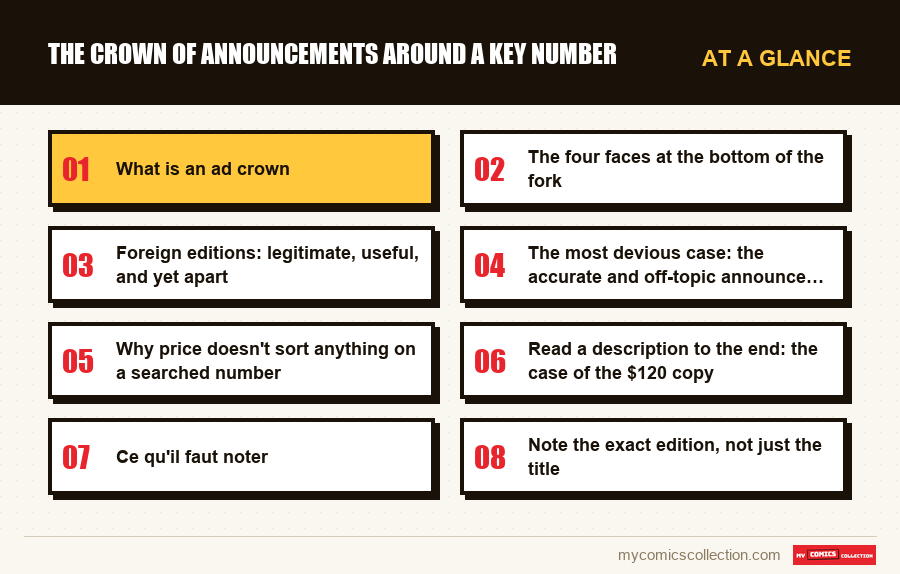
What is an ad crown
When a booklet becomes highly sought after, its entry ceases to be a simple catalog line and becomes a lexical magnet. Its title, its year, the name of the character it introduces and the formula which describes its importance begin to circulate elsewhere: on derivative objects which reproduce its cover, on foreign reissues which take up its content, in the descriptions of other fascicles which invoke it as a point of reference. Around the object a halo of propositions is thus formed which share its vocabulary without sharing its nature. It is this crown that we pass through first when sorting by increasing price, because it is, by construction, less expensive than the core.
There is nothing malicious about the mechanism. A decorative plaque seller describes his plaque; an Australian edition dealer describes his Australian edition; a dealer who lists a lot mentions the significant references it contains. Everyone writes an exact title for the object they hold. The problem arises from aggregation: one hundred exact titles, indexed on the same words, produce a list in which the object actually sought becomes a minority. It must be said clearly, because confusion is easy: no one here is deceiving anyone, and the accusation of deception would be both unfair and unnecessary. It is the cumulative effect that is the problem, not the individual intention.
This crown has an immediate statistical consequence. As soon as a segment mixes different natures of objects, the position indicators (the minimum, the midpoint, the gap between the extremes) cease to describe a homogeneous good. The midpoint of $213.84 recorded on August 29, 2026 on the twenty-four announcements without certification does not say “this booklet is trading around this amount”. He only says “half of the things which bear this name are demanded above this sum”. The nuance is not rhetorical: it is the difference between information and a mirage.
The four faces at the bottom of the fork
The derived object: $21.88
A decorative metal plate reproducing the cover of the booklet. The lowest price in the segment is therefore not a cheap booklet: it is a decorative object, sold as such, without the slightest ambiguity in the title. However, it occupies first place in sorting by increasing price and fixes, in the eye of the reader in a hurry, a completely false anchor point.
Foreign reissues: $25.79 and $35.82
Two proposals from an Australian edition from the 1980s which includes the content of the original issue under numbering specific to the local market. These are real booklets, printed and distributed legally, containing the episode sought. They are simply not the original edition, and an inventory that confuses them with it becomes false.
The Unrelated Booklet: $34.99
A completely different number, the title of which cites in passing the reference sought among other famous milestones. The ad is accurate: it describes what it is selling and just sets out benchmarks. This is the most devious case, because nothing is false and everything is off topic.
The actual copy: $120.00
The fifth proposition only is the booklet in question: described in average condition, and incomplete with a detachable element. In other words, you have to go down to the fifth rank of sorting by price to encounter the object, and the object encountered already carries two explicit reservations that the seller took care to register.
This sequence deserves to be reread slowly, because it contradicts the most widespread intuition. The reader who opens the list thinks he is viewing four affordable copies followed by a fifth, slightly more expensive. He actually consults a decorative object, two reissues from another market, a booklet unrelated to the subject, and finally a real copy whose description immediately indicates two limitations. Four out of five entries answer the query without meeting the need.
Précision de méthode. The amounts cited here are requests from sellers noted on August 29, 2026, never concluded sales. The segment without certification had twenty-four advertisements, that of verified copies thirty-three: two small numbers, the composition of which can be described but from which no trend can be drawn.
The highest amount in a segment deserves the same caution. An isolated maximum expresses the hope of a seller who is not in a hurry; he doesn't notice anything. It is only cited in this article to give the magnitude of the range, never to suggest a level.
Foreign editions: legitimate, useful, and yet apart
What exactly is it
An edition published for another national market, under license, repeating the original episode in local pagination and numbering. The narrative content is the same; the physical object, its date, its edition and its distribution channel are not.
Pourquoi elles existent
Distant markets received local reissues rather than the original printings, for reasons of transportation cost, scheduling, and rights. These editions introduced the series to readers who would never have seen the initial edition.
Why it's perfectly legitimate
Nothing unofficial about it: these are authorized publications, referenced in the catalog as entries in their own right. Selling them by saying so, as the two advertisements noted do, is an impeccable practice.
Who are they really for?
To the reader who wants the episode and not the object, to the one who collects editions from a given country, to the one who wants a manipulation copy to leave the original copy alone. These are three perfectly defensible uses.
Why don't they replace the original?
In an inventory, a line designates a specific edition, with its date and market. Placing a foreign reissue under the entry in the original booklet creates false data that nothing later will correct on its own.
How to save them properly
Like what they are: a separate entry, attached to the same episode but identified by its edition. The collection remains sincere, the search for the original booklet remains open, and we know exactly what we have.
The delicate point is not the legitimacy of these editions, it is complete. It is in the silent slippage that occurs at the moment of recording. A buyer satisfied with his Australian edition checks the entry for the original number, because that's the name he had in mind when searching. A year later, his collection claims he has a booklet he never had, and he no longer looks for it. The cost of the error is not financial: it is informational, and it is paid for long after.
The most devious case: the accurate and off-topic announcement
The $34.99 proposal deserves separate treatment, because it escapes all the usual defenses. It does not reproduce a cover, like the plate. It does not offer another edition of the same episode, like the Australian issues. It offers an entirely different booklet, and its title mentions the number sought among a series of famous references, as one would cite landmarks to locate an era or a group.
Nothing is inaccurate there. The words used describe objects that exist, and the object sold is also described. The seller who writes like this is not trying to trick: he aligns reference points because it is the common vocabulary of the field, and because these reference points help a reader to understand what is being discussed. The effect, on the other hand, is mechanical: the search engine indexes all the words in the title, without knowing which one designates the item sold and which ones only serve to locate.
This is why vigilance cannot be based on lie detection: there is none. It is based on a simpler and much more effective question, to be asked before each title: among all the names cited here, which designates the object that I will receive? A title that cites three significant references rarely sells three. As soon as a list of nouns appears, you have to look for which one is the grammatical subject of the sentence and which ones are complements.
This question has a decisive advantage over all pricing heuristics: it works just as well at $34.99 as it does at $947.63. It does not depend on any threshold, any average, or any number. It applies to each ad taken in isolation and gives a binary response. It is the only filter that remains reliable when the observed segment is small and heterogeneous, which is exactly the case here.
Collecting this series?
Track what you own, what you are missing and what your collection is worth. 7 day trial.
Start my trial →Why price doesn't sort anything on a searched number
Sorting by ascending price relies on an implicit assumption: that all the rows compared are the same object in different states. On an ordinary booklet, the hypothesis roughly holds, and the price becomes a rough proxy for the condition. On a highly sought-after number, it collapses, because the crown of advertisements populates precisely the bottom of the scale. Derivative items are less expensive than an old booklet. Foreign reissues are cheaper than the original edition. Unrelated booklets are cheaper because they are banal. Sorting by price therefore ranks at the top everything that is not the object.
The symmetry is instructive on the side of the examples verified by a third party. On August 29, 2026, these thirty-three announcements requested a minimum of $299.00, that is to say significantly more than the five proposals examined above. It's not that verification enriches the object: it's that a decorative derivative, a foreign reissue or an off-topic booklet does not pass through this door, because no one pays an expert to present them there. The verified segment is more expensive in part because it is more homogeneous. But thirty-three announcements remain thirty-three announcements: a workforce whose composition can be described, nothing more.
We must also resist reading into extremes. The difference between 21.88 and 947.63 dollars on the raw segment does not express an amplitude of value: it expresses an amplitude of natures of objects. The bottom is occupied by what is not the fascicle, the top by requests that nothing links to a transaction. Between the two, the midpoint of $213.84 floats without a referent. It would be more honest to say that this segment, as it presented itself that day, does not allow us to conclude on one level, and to stick to what it allows, namely to describe its composition.
This observation reverses the way of approaching research. On a searched number, the reading order should not be “from the least expensive to the most expensive” but “from the most precise title to the most vague”. An ad that names the edition, year, condition and defects is usable, whatever the price. An ad that stacks famous keywords is not, even if it is the cheapest on the page. The price only comes into play afterwards, between objects of the same nature.
Read a description to the end: the case of the $120 copy
The fifth proposition is finally the targeted fascicle, and it illustrates the second half of the method. Its title passes the first filter: it is indeed the object. Its description adds two reservations that the seller states bluntly: average condition, and the absence of a detachable element that the copy originally included. These two mentions are not advertising defects, they are advertising qualities. They say exactly what the buyer will receive.
However, these are precisely the mentions that automatic sorting does not see. A keyword filter retains the title and misses the sentence, within the descriptive paragraph, which indicates the missing element. A reader who looks at the sticker and the price sees a real copy at a modest price and concludes that it is a good deal, without knowing that the object is incomplete. The difference between these two readings is only about thirty seconds of careful reading.
This does not say anything against this announcement, on the contrary. An incomplete and honestly described example has its place in a collection: it allows you to own the object, to handle it, to hold its place in a series while waiting for something better. What it does not allow is to be saved as a complete copy. Here again, the error is not in purchasing: it is in placing the purchase under a description that is not its own.
The practical conclusion is simple. On a key number, the title is used to know if the ad is talking about the right item, and the description is used to know what condition it is in. Skipping the second step because the first has been completed is like buying half-informed. The two readings are inseparable, and neither is delegated to a filter.
Ce qu'il faut noter
Four of the five cheapest proposals are not the fascicle. On August 29, 2026, you had to go down to the fifth rank of sorting by increasing price to find the desired object. A decorative plaque, two Australian reissues and an unrelated booklet occupied the top four places. This is not an accident of reading, it is the normal structure of the bottom of the range on a searched number: neighboring objects are less expensive than the object, so they pass in front.
None of these ads are misleading. The plate is sold as a plate, the Australian editions as Australian editions, the off-topic booklet describes well what it offers. Looking for a culprit in this list would be a diagnostic error. The phenomenon is collective and purely mechanical: one hundred exact titles indexed on the same vocabulary produce a list where the object becomes a minority.
A foreign reissue is noted as a foreign reissue. It gives access to the episode, it is legitimate, it provides a service; it is not the original edition. Mixing it up in an inventory costs nothing on the day of purchase and costs a lot afterwards, because a collection that claims to own an issue stops looking for it. A separate entry, attached to the same episode, settles the question definitively.
The midpoint of this segment does not describe any object. Twenty-four advertisements, several of which are not the specification in question, produce a midpoint: $213.84 that day: which has no referent. It is cited here only to be discarded. As for verified copies, thirty-three announcements and a midpoint of $689.99 remain a low number: we can describe their composition, not draw a trend, and even less an evolution.
Sorting is done upon reading, and in this order. First the full title, to identify which of the names mentioned designates the item sold. Then the complete description, to note the condition and the gaps: this is where the mention of the missing detachable element appears, on the $120.00 copy. Price only comes into play in third position, once we only compare objects of the same nature.
Because the objects that revolve around a desired number cost structurally less than it. A decorative derivative, a reissue from another market or an ordinary booklet whose title cites the reference are all less expensive than an original copy, and sorting by increasing price therefore places them ahead. On August 29, 2026, the first four proposals in the non-certified segment fell into exactly these three categories.
It has its own collectible value, distinct from that of the original edition. It is an authorized publication, referenced in the catalog as a separate entry, sought after by collectors of local editions and useful to anyone who wants to read the episode without handling an old copy. The two proposals noted asked for $25.79 and $35.82 on August 29, 2026: claimed amounts, not sales.
By looking, in the title, which noun is the subject of the sentence and which are just references. An ad that aligns several notable references generally sells only one, sometimes none of them. The $34.99 proposal noted that day worked like this: exact title, object actually described, and yet completely foreign to the booklet sought.
Yes, if you know what you are buying and record it as such. The $120.00 proposal clearly announced average condition and the absence of a detachable element: it is a well-made ad. It is suitable for anyone who wants to own and read the object; it should simply never be noted as a complete copy in an inventory.
No, not on this statement. The segment without certification mixed different types of objects, which deprives its midpoint of any referent, and the two segments had twenty-four and thirty-three announcements respectively, numbers too small to draw any conclusions. These numbers describe the composition of a results page on a given day, nothing more, and they say nothing about an evolution.
Note the exact edition, not just the title
Original edition, foreign reissue, incomplete copy: three different lines for the same episode. My Comics Collection lets you record each copy with its edition, its condition and its shortages, so that your inventory tells the truth a year later.