This antagonist does not make his lieutenants: he takes them. The Cavaliers' device consists of seizing characters already established in the series, renaming them, redesigning them and turning them against their camp. For a screenwriter, the economy is obvious: he gets an adversary that the reader already knows, therefore immediately loaded with emotional stakes, without having to install a new figure over several issues. The cost comes later: the converted is almost always returned to its original state, the process wears out through repetition, and it ends up transforming beloved characters into interchangeable silhouettes. The statement of asking prices observed on August 29, 2026 confirms this indirectly: 172 gross advertisements peak at $39.95, the lowest amplitude encountered in this figure.
Most long-term antagonists build up a bodyguard by creating new characters. This one proceeds differently: it recruits, and it recruits from others. His subordinates don't come out of nowhere, they come from neighboring series, with a past, friendships and readers already acquired.
What follows describes this process as a writing tool: what it brings to the person who uses it, what it costs the story, why it always ends up being canceled, what it does to the characters who undergo it, and why such a device leaves so little trace in the commercial offering.
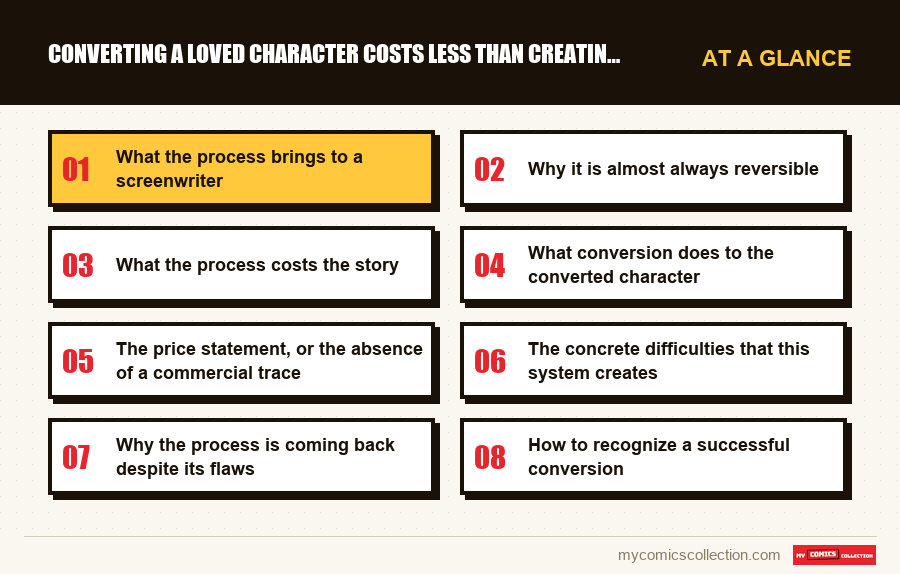
What the process brings to a screenwriter
Introducing a credible antagonist costs a lot of pages. You have to show him, explain where he comes from, give him a reason to act, make him win the first time to establish his dangerousness, then wait for the reader to start taking him seriously. This work easily takes up several issues, and it often fails: the majority of adversaries created in this way disappear without ever having existed in the eyes of the readership.
Conversion eliminates this expense all at once. The screenwriter presents nothing: he takes a figure that the reader has been following for years, he places her on the wrong side, and the stakes are immediately high because it is based on an already established attachment. No one needs to be convinced that this character matters: they've mattered for a long time.
The payoff is also emotional. An unknown adversary threatens characters; a converted ally threatens a relationship. The conflict ceases to be a matter of power and becomes a matter of loyalty, which is the most profitable material available to a serial story. The reader no longer wonders who will win, he wonders if the one he loves will come back.
Finally, there is a readability benefit. The conversion is accompanied by a change of name and a change of appearance, that is to say two signals visible in a single box. The reader who opens the booklet in the middle understands in an image that something serious has happened, without any line of dialogue being necessary.
An opponent already installed
The conversion provides an antagonist whose credibility is a foregone conclusion, without the set-up numbers that a new figure requires.
An immediate emotional issue
The reader does not fear the power of the convert, he fears losing him: the conflict becomes a question of loyalty.
An instant visual signal
New name, new appearance: the switch is read in one box, without exposition or explanatory dialogue.
An expanding threat
The device can be replayed at will on other figures, which allows the antagonist to be relaunched without inventing anything.
Why it is almost always reversible
A converted character is not destroyed, it is borrowed. This is precisely what makes the operation acceptable for everyone: the publisher who owns the figure, the screenwriter of the original series who will have to recover it, and the reader who accepts the shock because he guesses that it will be repaired.
Reversibility is even included in the logic of the device. Conversion is presented as an externally imposed constraint: a modification undergone, not a choice. However, a character who has not chosen his change has nothing to reproach himself for, and therefore nothing to atone for: he can return to his camp as soon as the constraint ceases, without his reputation suffering.
This mechanism is comfortable and that is its fault. A change of heart that costs nothing commits nothing. The story achieves the intensity of a betrayal without assuming the consequences, since in the end the former ally becomes an ally again, and the only trace of the episode is a painful memory from which no one will draw any lasting conclusion.
We must add a more prosaic reason. Figures that are sufficiently well known for their conversion to produce an effect are also those that other series need. Leaving them permanently on the opposing side would amount to removing them from circulation, which no editorial structure can afford for long. Restitution is therefore not a writing facility, it is an industrial constraint.
We can summarize the situation as follows: the more prestigious the convert, the stronger the effect and the more certain the restitution. The two quantities vary together, and this correlation condemns the process to never producing definitive change on the characters which really interest it.
The rule that governs the entire system: it produces a maximum of immediate effect for a minimum of lasting consequence.
This is a conscious transaction, and it is not illegitimate. A serial story needs regular shocks that its continuity must be able to absorb. Conversion provides just that: a spectacular, fully reversible event that does not force any neighboring series to change their plans. The price of this convenience is that nothing that happens there weighs afterwards.
What the process costs the story
The first cost is wear and tear. A device whose effect is based on surprise does not survive its repetition: the first conversion is a twist, the fifth is an expected box. The regular reader stops wondering what happens to the character and only wonders how long the episode will last before cancellation.
The second cost is standardization. A convert loses his name, his costume and, most often, his speech: he becomes a function in a group, designated by a role rather than by an identity. What the process promised, seeing a beloved character in a different light, backfires: instead of new lighting, we get a silhouette that could have been anyone.
The third cost affects the antagonist himself. A figure who is only defined by his ability to turn others around ends up only existing through them. His lieutenants attract attention, carry the action scenes and concentrate the emotion, while he remains in the background, reduced to the role of organizer. The device which was to make it formidable makes it accessory.
The fourth cost is narrative in the strict sense: the process creates dead ends. Once the convert is restored, the story must address what he did during his conversion-the damage, the injuries, the words spoken. As nothing must change permanently, this debt is generally erased by a quick explanation, which retrospectively damages the credibility of the entire episode.
The fifth cost is the hardest to repair. By dint of use, the device teaches the reader that the shifts are not serious. When a story then wants to really move someone, it comes up against a disbelief that it has installed itself.
What conversion does to the converted character
We must distinguish two very different situations, which the process nevertheless treats in the same way.
The conversion of a leading figure. It has the maximum effect because the reader knows the character intimately, but it is also the most surely undone. The story gets a jolt and returns the object intact; the episode becomes a parenthesis which the original series will practically not take into account.
The conversion of a secondary figure. It is sometimes lasting, for lack of stake in restoring it, but it produces almost no effect: the reader has no attachment to lose. The process therefore works exactly where it cannot change anything, and fails where it could last.
Between these two extremes, a third category deserves attention: characters who return from their conversion damaged. It is the only variant of the device which produces something new, because it refuses complete restitution. The character rendered is no longer quite the same, he carries the episode as an experience and not as an accident, and this becomes usable material for the sequel.
This variant remains in the minority, and for a mechanical reason: it forces the other series to take it into account. However, the main virtue of the process, from an editorial point of view, is precisely that it does not force anyone to do anything. What makes the device convenient is also what prevents it from producing its best results.
The price statement, or the absence of a commercial trace
The above is a matter of writing. But a narrative device sometimes leaves a legible trace in the commercial offer, and the absence of a trace is significant here.
Asking prices observed on August 29, 2026, raw and certified counted separately, never sales concluded: the raw segment counts 172 listings, $2.50 to $39.95, for a median of $9.99; the certified segment counts 22 listings, $35.00 to $579.99, for a median of $89.45. A statement for a single day describes the state of the supply on that date; it says nothing about an evolution and does not allow any assertion of a trend.
The notable fact is the amplitude. Maximum gross is $39.95 on 172 listings, while other statements relating to the same figure go up to $350. This is the flattest market encountered on this character: the offer is numerous and almost entirely contained in a narrow band, without the few very high advertisements which usually indicate a booklet that buyers know how to identify.
The cautious reading is as follows: a device that recycles existing characters does not produce a booklet that the market knows how to distinguish. A conversion does not introduce anything, it redesignates someone; there is therefore no single object to which the event can be linked, and the offer is spread over a mass of numbers that are equivalent to each other.
The gap between the two segments says something else again. The gross peaks at $39.95 when the certified reaches $579.99 on 22 advertisements only: the high value does not come from the narrative content but from the condition of the verified copies, which obeys a logic independent of what the booklet says. Again, two separate populations, two reasons to pay, and no conclusions to draw from one for the other.
Collecting this series?
Track what you own, what you are missing and what your collection is worth. 7 day trial.
Start my trial →The concrete difficulties that this system creates
For those who follow these stories or maintain a collection, serial conversion produces very practical complications.
Two names for one person
The convert is referred to by his name Cavalier, which is not linked to his original identity in an index.
Reassigned roles
The same title of lieutenant could have been worn successively by several characters, without any connection between them.
An exploded reading
The conversion takes place in one series, its consequences in another: the complete story spans several titles.
Tacit cancellations
The restitution of the character is not always told; he simply reappears as himself again elsewhere.
Competing groups
Several formations of lieutenants coexist depending on the era, which makes membership ambiguous.
Claimed beginnings
Each conversion provides an actionable “first appearance as” in a sales headline.
Why the process is coming back despite its flaws
A tool whose drawbacks have been known for a long time nevertheless continues to be used. It's not an oversight, it's a calculation.
The first reason is the immediate return. No other construction gives as much intensity for so many pages: the conversion produces a shock from the box where it is revealed, where the installation of a new antagonist does not yield anything for several issues and sometimes never.
The second reason is the absence of editorial risk. The device does not permanently damage any character, close any doors or force any neighboring series to change their course. It is therefore easy to get accepted, and easy to cancel if management changes its mind.
The third reason is the format. A story that needs to relaunch the same antagonist regularly without destroying him needs a cheap renewal of its menace. Changing the lieutenants costs infinitely less than changing the leader, and allows you to replay the same game with different pieces.
The fourth reason is aesthetic. The device provides designers with immediately usable material: take a known silhouette, redraw it in dark, and obtain a strong image that works on the cover. This argument is never formulated but it carries weight.
The last reason is more honest: the process pleases. Seeing a beloved character on the wrong side remains a pleasure to read, even when you know that it will be returned. The wear of the device is real, it has never been total, and that is why it comes out at regular intervals.
How to recognize a successful conversion
Not all of them are equal, and three criteria allow us to decide between them without having to judge the general quality of the story.
The conversion must reveal something about the character. A successful shift exploits an existing crack (an anger, an ambition, an already established doubt) rather than imposing a purely external change. The reader must recognize the convert by the new name, otherwise they are only looking at a costume.
The return must cost something. Free restitution retrospectively cancels the entire episode. A restitution that leaves a trace (a damaged relationship, a lasting distrust, a lost capacity) transforms the parenthesis into an event.
The convert must keep one vote. This is the most discriminating criterion. As long as he speaks, he remains a character; reduced to silence and function, it becomes an interchangeable obstacle, and the emotional benefit of the process disappears entirely.
These three criteria explain why certain conversions remain in memory decades after their publication, while others are forgotten the next episode. The difference lies neither in the character chosen nor in the magnitude of the event, but only in what the story agrees to pay.
What to note on a booklet involving a conversion
This system produces particularly ambiguous collection lines, and what must be recorded is specific to this case.
The convert's original identity, next to their Cavalier name. This is the decisive mention: without it, a line refers to a job title that has nothing to do with the real person, and the booklet becomes impossible to find as soon as you search by the name you know.
The moment in the story to which the booklet corresponds. Recruitment, period of service or restitution: these three stages do not have the same narrative status, and two issues which show the same character under the same name may belong to opposite phases.
The formation concerned, when several coexist. The groups of lieutenants follow one another and overlap according to the times; noting which one is on the scene avoids bringing together booklets that only have a title in common.
The series in which the consequence plays out. The shift is often told about something other than its effects. Recording this reference is the only way to later reconstruct an episode that crosses several titles without being marked as such.
The exact nature of the claim made by the ad.“First appearance as” denotes a change of name, not the entry of a character into the catalog: noting this distinction at the time of acquisition avoids confusing two objects of very different status later.
Because creation is expensive and pays off late. An invented subordinate has to be established for several issues before the reader takes it seriously, and most never get there. A converted figure arrives with his credibility already established and an attachment already formed: the effect is immediate, without any page of exposition.
Almost never, and it's structural. The more famous the convert, the stronger the effect, but the more other series need to pick it up. Conversion being presented as a constraint suffered, the character has nothing to atone for and can return to his camp intact. The restitution is as much an editorial constraint as a writing choice.
Three criteria. It must exploit a crack already present in the character rather than impose an external change; its cancellation must leave a lasting mark; and the convert must keep one vote. Reduced to silence and a function, it becomes an interchangeable obstacle and all the emotional benefit of the process disappears.
No, and that's the interesting observation. On the asking prices observed on August 29, 2026, the raw segment has 172 listings from $2.50 to $39.95, median $9.99: a very low amplitude, while other readings of the same character rise to $350. Carefully formulated, a device that recycles existing characters does not produce a booklet that the market knows how to distinguish.
No. A single-day statement describes the status of the offering on that date: what sellers are asking, not what buyers have paid. He says nothing about an evolution. The certified segment, 22 advertisements from $35.00 to $579.99 for a median of $89.45, also obeys a logic of the state of the verified copies, independent of the narrative content.
What name did you put it under?
A convert changes his name, costume and camp: without his original identity recorded, the line becomes untraceable.