
Black Canary occupies a rare place in comics: that of a character who belongs to both the first generation of superhero teams and those that followed it. This bridge function serves the editor enormously, who gains continuity embodied in a single costume, but it costs the character dearly, condemned to remain stable while everything around him is renewed. The market bears the trace: on August 29, 2026, the historic team title displayed 173 uncertified listings requested between $0.99 and $199.99, with a median of $7.98, and only five verified copies, claimed from $22.00 to $99.99 for a median of $69.00. No fascicle stands out: a liaison role does not create a summit.
There are two ways a publisher can tell the story of its own catalog. The first consists of publishing texts, chronologies, explanatory inserts which place each title in its time: no one reads them, and they age as quickly as the covers they comment on. The second is to entrust this job to a character. We make him appear in a team from the first wave, we make him reappear in those that follow, and the continuity ceases to be a notice to become a silhouette that the reader recognizes. Black Canary belongs to that handful of figures who have been charged with this role and who have held it, decade after decade, without ever having been designed for it in the first place.
This function is not anecdotal. It resolves a structural problem: a publishing house that has been publishing for a very long time mechanically produces layers of fiction that are incompatible with each other, founding teams that no one remembers anymore and recent training that is not based on anything. A character capable of existing in both sews the fabric together without the need to explain anything. In return, this character accepts constraints that his cell partners do not have to support. It cannot be dated, it cannot be revolutionized, it cannot disappear for long. This article describes this trade, what it brings in for the publisher, what it takes from the character, and why it does not result in any booklet whose asking price stands out from the crowd.
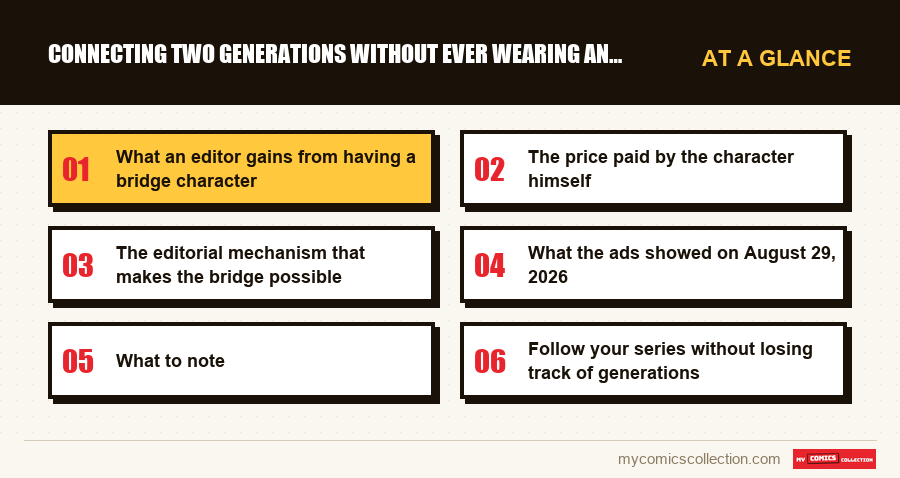
What an editor gains from having a bridge character
The first benefit is embodied continuity. A publishing house that has spanned several generations of readers finds itself with a stratified catalog: old bands, relaunches, groups created for an audience that was not born during the previous wave. Nothing spontaneously connects these layers, other than a logo. A character present in several of them provides the link at a low cost: he just has to be there. The second benefit is educational. The history of a catalog is illegible as long as it remains a list of titles; it becomes readable as soon as a face crosses it. The reader who opens a recent series and finds a figure he encountered in a reissue from an earlier era understands intuitively that there is a depth behind what he is reading, without having been exposed to it. The third benefit, the most commercially useful, is legitimation. A new team composed exclusively of recent creations resembles a product; the same team with, within it, a figure from historical training, looks like a legacy. Presence does the work of advertising, and it does it better, because it does not announce itself.
The price paid by the character himself
Staying consistent while everything changes
A bridge character cannot afford the profound transformations that are of interest to others. Its value for the publisher rests entirely on its recognizability: if the reader does not find it identical from one generation to the next, the bridge no longer connects anything. It is therefore fixed by its own usefulness, and the arcs which lastingly disrupt a figure are, in practice, refused to it.
Never be too marked by an era
Anything that dates a character prevents him from circulating. A costume that is too typical, a vocabulary that is too specific, a theme linked to current events: so many elements that would lock it into the layer where they were introduced. The bridge character is therefore kept in relative neutrality, which makes him crossable but rarely memorable.
Témoin plutôt qu'acteur
In a team, the liaison role falls to the one who knows the past. This position structurally pushes towards commentary: explaining, replacing, remembering. These are valuable narrative functions, but they are not the ones that produce the scenes we remember, much less the covers we search for years later.
Une visibilité diluée
Appearing in several formations and in several eras means not being at the center of any. Attention is spread across a large number of booklets instead of concentrating on a few. It is exactly the opposite of the profile which creates peaks in demand on the second-hand market.
These four constraints reinforce each other. A character kept constant produces few events; a non-eventful character is entrusted with the commentary; the commentary disperses its presence over numerous titles; dispersal prohibits the woodpecker. We get a long, regular, structurally useful career, and without a peak. It is the most difficult editorial profile to promote on the market, precisely because its main quality, continuity, is only visible over the course of several decades, while the market buys individual issues.
A point of method before discussing the figures: everything that follows comes from a count of advertisements carried out on August 29, 2026. An advertisement is an amount claimed by a seller, not a concluded transaction. None of the amounts cited prove that a copy changed hands at this price.
Additionally, this reading was taken on a single date. It says nothing about an increase or a decrease: describing a movement would require at least two comparable readings, and there is only one. The following describes a state, not a trajectory.
The editorial mechanism that makes the bridge possible
An obvious obstacle stands before any figure supposed to link two generations: time passes. A character introduced into an ancient formation should, if we follow logic, be out of age by the time the next wave arrives. Publishing houses have several ways of getting around this difficulty, and Black Canary illustrates one which consists of transmitting the name rather than prolonging the person indefinitely. Identity, costume, team membership are transmitted from one wearer to the next; the reader finds the same silhouette, but the story did not need to suspend the aging.
This process has an elegance that must be recognized: it transforms constraint into a story. Instead of denying time, he uses it. Continuity is no longer an artifice to be forgotten, it becomes the subject: the next generation inherits a name, assumes its weight, and the presence in the recent team justifies itself. The editor obtains everything he was looking for: the link between the layers, the legitimization of the newcomers, the legibility of his own past.
But this mechanism has a direct consequence on the market, and it is rarely formulated. Transmission distributes interest instead of concentrating it. Where a single character crossing the decades concentrates all the attention on his first appearances, a transmitted identity fragments: there are several possible entrances, several moments deemed important, several reception series. None of these moments brings together the entire request, and everyone finds themselves having to share it. The bridge works perfectly from a fiction perspective, and it dilutes from a booklet perspective.
Let's add a purely practical difficulty for anyone trying to find their way: the names used in the comics are not exclusive. The same title can designate a group, a regular title, a revival mini-series and a reissue, published at different periods. The catalog distinguishes these entities without difficulty; a commercial search bar, no. This is a point on which we must be vigilant before drawing the slightest conclusion from an ad count.
What the ads showed on August 29, 2026
Une recherche poreuse
The questioning of the historic team title does not bring back a clean series. She grabs booklets from several publications with similar titles, mixing different periods and formats. The total of 173 uncertified announcements must therefore be read as a volume of offer around a name, not as the exact inventory of a specific series.
A snapshot, not a curve
All these values were recorded on the same day, August 29, 2026. They describe what sellers were asking for at that time. They do not allow us to assert either progress or decline, due to the lack of a second reading with which to compare them.
A low and meaningful median
On the uncertified side, the median amount requested was $7.98, with a range of $0.99 to $199.99. Such a low distribution environment, with such a wide amplitude, describes an abundant and poorly hierarchical offer: the majority of proposals are located very far from the top of the range.
Consecutive batches of numbers
Several proposals displayed at $0.99 and $1.00 related to consecutive numbers, posted online by the same seller. It is the signature of a collection sold by number, without any episode being distinguished from the others by its owner. No one saw fit to extract one and sell it separately.
Five copies checked out of 173
The count found only five listings for verified copies, asking between $22.00 and $99.99, median $69.00. Having a booklet certified represents an expense that is only justified if it opens up a price gap to be captured. Five out of a hundred and seventy-three indicates that holders do not believe in this discrepancy here.
A maximum which only binds its seller
The upper limit of $199.99 observed on the non-certified side is isolated. An extreme point in a distribution does not measure what the market is willing to pay: it measures what a seller hopes to get. Bringing it closer to the median of $7.98 is enough to reduce its scope.
Collecting this series?
Track what you own, what you are missing and what your collection is worth. 7 day trial.
Start my trial →Why does the bridge function not produce any detached fascicles?
Let's look at the complete chain again, because it is consistent from start to finish. A character responsible for connecting two generations must remain recognizable; remaining recognizable prohibits ruptures; the absence of a break deprives the character of moments which, for others, become benchmarks for purchase. The value it provides is spread across its entire presence instead of being housed in a few fascicles. However, the second-hand market does not buy a career: it buys an object, an issue, a cover. A quality that does not reside anywhere in particular cannot be paid for anywhere in particular.
The count of August 29, 2026 is perfectly compatible with this analysis. A median of $7.98 on 173 uncertified proposals describes an available, current title that can be found without looking. Lots of consecutive issues for less than a dollar say the same thing in a different way: the seller selling his collection by number has not identified any episode worthy of separate treatment, whereas that is precisely what any holder who thinks he has a sought-after piece does. And the virtual absence of verified copies confirms the diagnosis from a third angle: certification is an investment, and no one invests without an expected gap.
What is striking is the convergence. Three indicators of a different nature (the distribution environment, the way in which sellers divide their stock, and the rate of use of certification) point in the same direction. None of them would be enough alone; together, they draw a title where no number plays the role of summit. The maximum of $199.99 contradicts nothing: it occupies the place that we expect of an isolated prospect in a wide distribution, and the gap with the median says it clearly.
We must be careful not to draw a judgment on the character. Abundant, cheap supply does not signal disinterest: it is a convenient and false shortcut. Here she signals something more precise: that the contribution of this figure is structural, that it is exerted on the scale of the catalog and not of the copy, and that the second-hand market has no instrument to measure this type of contribution. You can be essential to the coherence of a universe and find yourself at $7.98 median, without any contradiction.
What to note
The bridge function is exercised between the fascicles, never in one of them. An isolated number shows nothing of the connection between generations: it shows a team in action. The link only appears to those who have read both layers, which explains why it is not sold individually. If you are trying to understand this role, it is a whole that must be brought together, not a piece to be isolated.
Identity transmission fragments entry points. Where a single character focuses attention on a single beginning, a transmitted identity offers several. None brings together the entire request. Before you consider a number to be the starting point, check which carrier and layer it is: the continuity detail completely changes the nature of what you're holding, and the question of first appearances deserves to be treated for its own sake.
Five copies verified out of 173 is the most informative figure in the survey. The certification rate is a vote of the holders themselves: they incur an expense only when they anticipate a sufficient price difference to reimburse it. Here, the ratio of approximately one to thirty-five indicates that this discrepancy is not considered credible. Reasoning is better than any opinion, because it is backed by real money at stake.
The consecutive number packs at $0.99 and $1.00 are worth careful reading. They indicate that the same seller put a suite online without extracting anything from it. It is a signal of non-hierarchization coming from the field, more reliable than an opinion: the person who owns the entire series is in the best position to identify a piece worth isolating, and he has not done so.
Searching by title is misleading on this specific name. Several publications have similar titles, and a count of advertisements mixes them up without warning. The catalog allows you to decide, the search bar of a marketplace does not. Before allocating an amount to an issue, make sure that the line consulted corresponds to the publication you are targeting, and not to a homonym from another period. The subject is developed in identifying key numbers.
He is a figure present both in a generation of old teams and in those which succeed him. Its presence connects layers of fiction that, without it, would have no apparent connection. The publisher gains a continuity that the reader perceives without it being explained to him, and a way of making the history of his own catalog readable.
Because the value of the bridge is based on recognizability. If the figure changes to the point of no longer being identified from one layer to another, the link ceases to operate. The character is therefore maintained in relative constancy, and the lasting upheavals which are of interest to other figures are practically refused to him.
The historic team title had 173 proposals without certification, with claimed amounts ranging from $0.99 to $199.99 and a median of $7.98. Aside, five verified copies were offered between $22.00 and $99.99, median $69.00. These are amounts requested by sellers, not closed sales, and they describe a single day.
No. An isolated extreme point in a distribution reflects the hope of a seller, nothing more. Reported at a median of $7.98, it appears for what it is: a demand unrelated to the distribution environment. Only a set of concluded transactions would make it possible to speak of an observed price.
Impossible to say, and it would be dishonest to say so. The count was done on a single date. Describing an evolution requires at least two surveys carried out in the same way at different times; there is only one here. What we hold is a photograph, not a movement.
Follow your series without losing track of generations
A character who crosses several teams and several eras spreads his presence across a large number of titles. My Comics Collection lists your issues, reports gaps and allows you to reconstruct a complete journey instead of collecting isolated fragments.