
In short
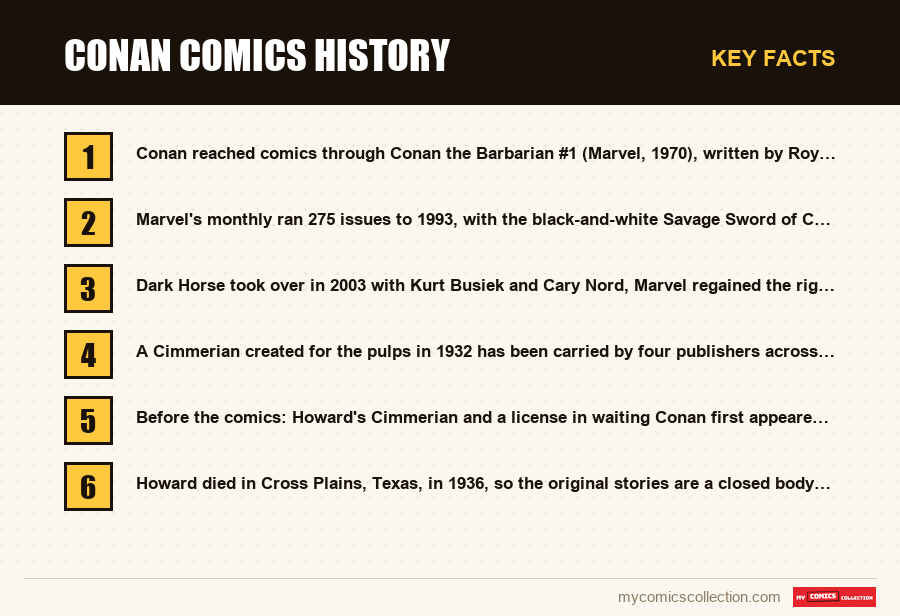
Conan reached comics through Conan the Barbarian #1 (Marvel, 1970), written by Roy Thomas and drawn mostly by Barry Windsor-Smith, after Thomas secured the license from the Robert E. Howard estate. Marvel's monthly ran 275 issues to 1993, with the black-and-white Savage Sword of Conan beside it from 1974. Dark Horse took over in 2003 with Kurt Busiek and Cary Nord, Marvel regained the rights in 2018, and Titan acquired the license in 2022.
Conan is an unusual comics character because the page version was never owned by one house for long. A Cimmerian created for the pulps in 1932 has been carried by four publishers across more than fifty years of American comics, and each handover reset the numbering, the tone and the collecting logic.
Each credit, issue number and run length in this history was checked before it went in, and the passages that compare one era with another are interpretation. Where a date could not be confirmed to the month, only the year appears.
Before the comics: Howard's Cimmerian and a license in waiting
Conan first appeared in print in Weird Tales in December 1932. Robert E. Howard died in Cross Plains, Texas, in 1936, so the original stories are a closed body of work, and everything in comics is an adaptation or an extension of it. That distinction matters for the collector because publishers have drawn the line in different places: some adapt Howard's prose almost directly, others invent new adventures for a hero whose chronology Howard never fixed.
Comics reached the character earlier than most people assume. The earliest Conan comic was written in Spanish and published in Mexico in the 1950s, unauthorized and loosely based on the prose story "Queen of the Black Coast." It left no trace in the American market. The line that matters starts with Marvel, where Roy Thomas, obtained the rights from the Howard estate and persuaded the company to try a sword-and-sorcery book at a moment when superhero titles dominated the racks.
For collectors, "Conan comics" is therefore a set of separate runs with separate creators, each needing its own shopping list.
Conan the Barbarian #1 (1970): Thomas and Windsor-Smith build the book
Conan the Barbarian #1 carries an October 1970 cover date. Thomas wrote it, and Barry Windsor-Smith, credited on the cover as Barry Smith, penciled most of the first two dozen issues. The pairing gave the series an ornamental look that set it apart from the superhero titles around it and shaped the visual vocabulary the character still uses: the heavy architecture, the thieves and sorcerers.
The early schedule was shaky. The book began bimonthly and moved to monthly after strong sales on the first issue. Stan Lee decided to cancel the title with #7, partly over weak sales, yet the series continued.
Two guest appearances from this stretch matter to collectors. Elric of Melniboné, the Michael Moorcock hero, appears in #14 and #15 (March to May 1972), a crossover of two sword-and-sorcery properties that sits well outside the superhero universe. The series also earned recognition: it received Shazam Awards in 1971 and 1974.
Red Sonja and the Windsor-Smith peak (1973)
Issue #23 (1973) introduces Red Sonja, created by Thomas and Windsor-Smith and adapted from a Howard character, the 16th-century Red Sonya of Rogatino from the story "The Shadow of the Vulture." Thomas moved her into the Hyborian Age. She appears again in #24, and the story "Song of Red Sonja" in that issue won a Shazam Award in 1973. The pair of issues is one reason Marvel's Conan run stays in demand, since the character who debuts in them later carried her own series.
Windsor-Smith's departure from the title closes the first phase. His pencils run through the early issues, and the book that follows is drawn largely by someone else.
The John Buscema years: the long middle of the run
John Buscema penciled the bulk of issues #25 to #190, which makes him the artist most readers associate with Marvel's Conan. Ernie Chan is credited as an inker on the series. Thomas stayed as the writer through #115, a run that began with #1 in October 1970 and ended in October 1980, a decade of continuous authorship that gave the character a consistent voice.
The Buscema era also produced the spin-off formats that fill out the Marvel collection. Conan Annual ran 12 issues from 1973 to 1987, and Giant-Size Conan ran five 68-page issues from September 1974. They are easy to overlook next to the monthly, but they belong in a complete Marvel shelf.
Nothing in the middle of the monthly changes the character's status the way a reboot would. The reward is a serialized barbarian saga with one dominant penciler, which is why many readers treat #25 to #115 as the core.
The Savage Sword of Conan (1974): the mature magazine
The Savage Sword of Conan launched in August 1974 from Curtis Magazines, an imprint of Marvel. It was a black-and-white magazine, a more adult format than the color monthly. Boris Vallejo supplied the cover of #1, and Roy Thomas edited the magazine and wrote most of its early issues, until #60. The opening feature was Thomas and Barry Windsor-Smith's adaptation of "The Frost-Giant's Daughter."
Other notable names in the magazine include John Buscema, Esteban Maroto, Alfredo Alcala and Michael Fleisher. The original run reached 235 issues and ended in July 1995, two years after the monthly stopped.
The magazine format is the first numbering trap for newcomers. Savage Sword of Conan is not a variant of the color title but a separate series with its own issue count, so a listing for "Conan #50" and one for "Savage Sword #50" describe different books. Check the title on the cover and the format, black-and-white magazine against color comic, before comparing prices or condition.
The 1980s and the writer carousel
When Thomas left the color monthly after #115 in October 1980, the title entered a long period of rotating writers. The list of those who wrote it includes J. M. DeMatteis, Bruce Jones, Michael Fleisher, Doug Moench, Alan Zelenetz, Chuck Dixon and Don Kraar, and Jim Owsley wrote issues 172 to 213, the longest of the interim stretches. During those years Conan also reached newspapers: Marvel's Conan comic strip ran from September 1978 to April 1981.
A collector who stops at #115 skips more than half of the monthly's issue count.
Do you collect this series?
Track what you own, what you are missing and what your collection is worth. 7-day trial.
Start my trial →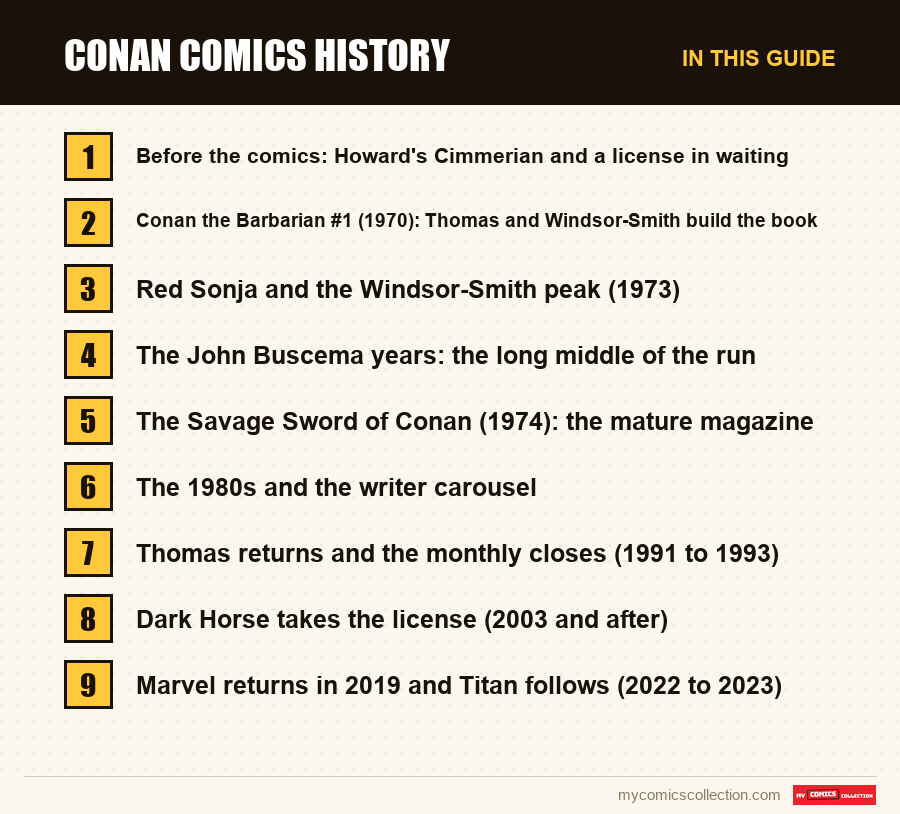
Thomas returns and the monthly closes (1991 to 1993)
Thomas came back as the writer from #240 in January 1991 and wrote through #275 in December 1993, the final issue of the Marvel monthly. The series therefore closed under the same writer who opened it, 275 issues across just over twenty-three years. The twelve annuals had already finished in 1987. Savage Sword continued two more years, ending in 1995.
The closing run is a bookend: the writer who opened the book in 1970 also closed it. After 1993 the Marvel material lived on as reprints. Essential Conan collected #1 to #25 in July 2000, and Dark Horse's Chronicles of Conan reprinted the entire 275-issue run in digitally recolored form between 2003 and 2017. Marvel then began its own omnibus line in January 2019, with a first volume covering #1 to #26.
Dark Horse takes the license (2003 and after)
Dark Horse began its own Conan series in 2003, written first by Kurt Busiek and drawn by Cary Nord. Tim Truman replaced Busiek later in the run. Where Marvel's version grew out of Thomas's adaptations and invented continuity, the Dark Horse series had no connection to Marvel's comics. The two publishers' Conans are separate continuities, so Marvel's #275 does not lead into Dark Horse's first issue.
The publisher then widened the line into a family of series. Conan the Cimmerian (2008), by Tim Truman and Tomás Giorello, ran 26 issues. Conan: Road of Kings (2010), by Roy Thomas and Mike Hawthorne, ran 12 issues and brought Thomas back to the character he opened in 1970. Conan the Barbarian (2012), by Brian Wood, ran 25 issues and expanded on "Queen of the Black Coast," the story at the root of the Mexican comic from the 1950s. Conan the Avenger (2014), by Fred Van Lente and Brian Ching, ran 25 issues, and Conan the Slayer began in 2016 under Cullen Bunn with Sergio Dávila.
Instead of one monthly that lasted two decades, Dark Horse ran a sequence of shorter series with different creative teams. A self-contained 25-issue run asks for far less commitment than 275 issues.
Marvel returns in 2019 and Titan follows (2022 to 2023)
Marvel reacquired the Conan publishing rights in 2018. A new Conan the Barbarian began in January 2019 with writer Jason Aaron and artist Mahmud A. Asrar and ended in November 2021 after 25 issues. A new Savage Sword of Conan began in April 2019 and lasted 12 issues, until February 2020, and Savage Avengers launched in 2019.
In 2022 and 2023, Titan Publishing Group acquired the rights to make Conan comics from Heroic Signatures, with a new ongoing series set for May 2023. The hand-off is the third change of publisher, and it gives a collector four shelves: Marvel's first run, Dark Horse, Marvel's second run, and Titan.
The key issues across Conan's comics history
- Conan the Barbarian #1 (Marvel, October 1970): Roy Thomas and Barry Windsor-Smith launch the series.
- Conan the Barbarian #14 and #15 (1972): Elric of Melniboné crosses over with Conan.
- Conan the Barbarian #23 (1973): Red Sonja debuts, adapted from Howard's Red Sonya of Rogatino.
- Conan the Barbarian #24 (1973): "Song of Red Sonja," the Shazam-winning sequel to her debut.
- The Savage Sword of Conan #1 (August 1974): Boris Vallejo cover and the adaptation of "The Frost-Giant's Daughter."
- Giant-Size Conan #1 (September 1974): the start of a five-issue, 68-page series.
- Conan the Barbarian #275 (December 1993): Thomas closes the Marvel monthly.
- Conan the Barbarian #1 (Marvel, January 2019): Jason Aaron and Mahmud A. Asrar open the second Marvel run.
How to follow Conan in a collection
Start by deciding which Conan you are collecting. The Marvel monthly from 1970 to 1993 is one numbering sequence of 275 issues; Savage Sword of Conan from 1974 to 1995 is a second sequence of 235 magazine issues; Dark Horse's series restart their numbers each time; and the 2019 Marvel book is a new first issue. A numbered gap in your list is usually a different publisher, not a missing issue.
Read the cover, the publisher and the cover date together, as Marvel's and Dark Horse's titles can share the words "Conan the Barbarian." Dark Horse's 2012 Conan the Barbarian by Brian Wood and Marvel's 2019 Conan the Barbarian by Jason Aaron are different books under one title. Many Marvel issues were reprinted in recolored form, so a modern trade is not a substitute for a copy of the original comic.
For reading rather than collecting, the reprint volumes are the economical route into the Marvel years, starting with Essential Conan for #1 to #25. For a French-language edition, the Arédit-Artima series from 1979 has its own numbering, covered in the guide to hardcover issues 8 and 9 linked above. Whatever the entry point, a printed checklist by title and volume stops you from buying the same material twice.
Frequently asked questions
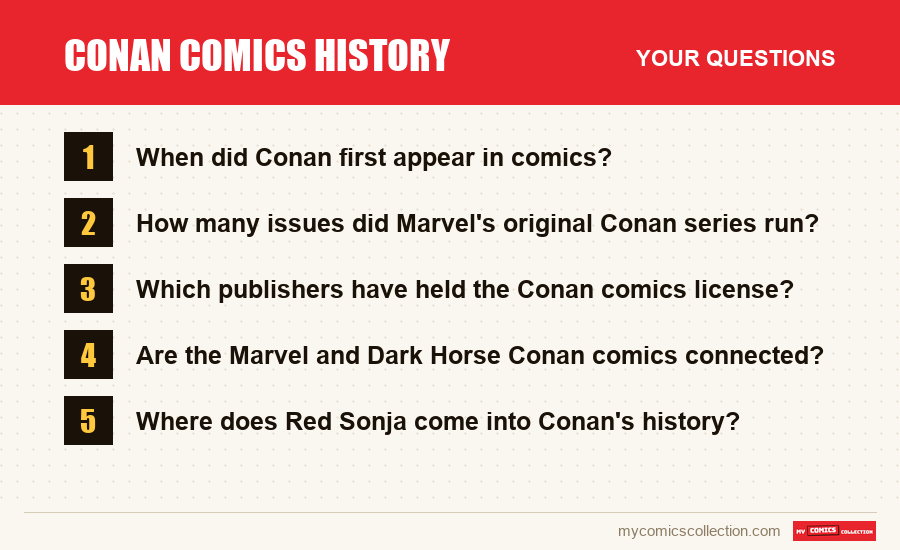
The authorized American line starts with Conan the Barbarian #1, cover-dated October 1970, from Marvel, written by Roy Thomas with art mostly by Barry Windsor-Smith. An unauthorized Spanish-language Conan comic had been published in Mexico in the 1950s, but it was loosely based on Howard's prose and played no part in the Marvel story.
The Marvel monthly ran 275 issues and ended with the December 1993 issue, with 12 annuals from 1973 to 1987. The black-and-white Savage Sword of Conan is a separate series that reached 235 issues and ended in July 1995. The two titles are numbered independently.
Marvel from 1970, Dark Horse from 2003, Marvel again after reacquiring the rights in 2018, and Titan, which acquired the license in 2022 from Heroic Signatures with a new ongoing series set for May 2023. Each publisher keeps its own continuity and numbering.
No. Dark Horse's series that began in 2003 with Kurt Busiek and Cary Nord had no connection to Marvel's comics. A reader can start with either without having read the other, though the Dark Horse reprint line, Chronicles of Conan, recolored the entire Marvel run.
In #23 (1973) of the Marvel monthly, Roy Thomas and Barry Windsor-Smith bring in Red Sonja, adapted from a Howard mercenary, and she returns in #24. She later moved into series of her own, so #23 is a key issue for both Conan and Red Sonja collectors.
Holding a Marvel-era Conan issue or a Savage Sword magazine and unsure of its condition? Start with an estimate of that copy.
Estimate my comic