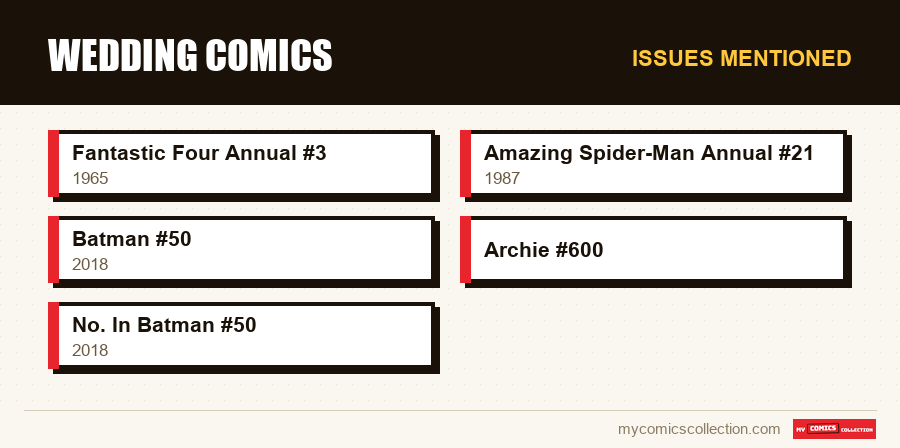
“Wedding comics” form a subcategory popular with collectors: Fantastic Four Annual #3 (1965, wedding of Reed Richards and Sue Storm), Amazing Spider-Man Annual #21 (1987, wedding of Peter Parker and Mary Jane, with live ceremony at Shea Stadium), X-Men vol. 2 #30 (1994, Cyclops and Jean Grey), Superman: The Wedding Album (1996, Clark Kent and Lois Lane) and Batman #50 (2018, the “non-wedding” of Batman and Catwoman) are the centerpieces. Their value depends above all on the condition, the format (kiosk or direct market), the first impression and the notoriety of the couple depicted: always check the real price before buying or selling.
There is a category of comics that collectors treat almost like wedding invitations: wedding issues. For six decades, major American publishers have regularly organized the weddings of their key figures, often with an editorial aplomb worthy of a social event. These episodes are not just stories among others: they mark breaks in continuity, mobilize entire creative teams and, for some, give rise to extraordinary communication operations, such as the ceremony organized at Shea Stadium in New York in 1987 for the union of Peter Parker and Mary Jane Watson. For a collector, being interested in "wedding comics" means following a particular thread in the history of the comic book: that of the major editorial decisions which transformed single characters into established couples, before some of these unions were sometimes undone subsequently, which adds an additional layer of narrative and commercial value to these issues. It's also a natural way to offer an original gift to a close comic book fan at their own wedding, or to complete a thematic collection around a specific character. This article lists the most significant combinations of comics from an editorial and collector's point of view, explains what really determines their value, and gives concrete guidelines for purchasing these issues without making a mistake about the edition, condition or authenticity.
The origins of marriage in superhero comics
The first big marriage of the Marvel Silver Age took place in October 1965, in Fantastic Four Annual #3, written by Stan Lee and drawn by Jack Kirby. The issue, sold for $0.25 at the time, unites Reed Richards and Susan Storm at the end of an intrigue where Doctor Doom attempts to sabotage the ceremony by manipulating the entire gallery of Marvel villains thanks to a device capable of exacerbating emotions. The reception brings together a good part of the emerging Marvel universe, with appearances from the Avengers, the X-Men, Daredevil and Nick Fury, up to the Watcher who came to observe the scene from the cosmic hangers. Kirby and Lee even take the stage themselves, turned away at the entrance for lack of an official invitation, a rare metafictional wink for the time. This issue also makes the first appearance of Patsy Walker, a character later converted into Hellcat, which gives her an additional key interest independent of the wedding scene alone. This editorial choice from 1965 established a model that Marvel and then DC regularly adopted: transforming a main character's marriage into a major event, often in an annual or one-shot format, with an expanded creative team and specific promotion. It is this pattern that explains why most notable wedding issues are Annuals, Giant-Sizes or one-shots rather than regular issues of the monthly series: an important point to know before purchasing, as this directly affects the print run and therefore current availability on the resale market.
The wedding of Spider-Man and Mary Jane: the most publicized event of its kind
No comic book wedding has benefited from a communications operation comparable to that of Amazing Spider-Man Annual #21, published in June 1987. The screenplay is by David Michelinie and Jim Shooter, the drawing is entrusted to Paul Ryan, the inking is by Vince Colletta and the cover by John Romita Sr. The story itself is secondary to the event that accompanies it: Marvel organizes a real wedding ceremony at the Shea Stadium in New York, with Stan Lee as master of ceremonies in front of tens of thousands of spectators, and a wedding dress designed especially for Mary Jane by the designer Willi Smith, who died shortly after completing the creation. The plot is even synchronized with the daily Spider-Man comic strip distributed in the American press, a logistical feat that Stan Lee himself described as one of the most difficult of his editorial career.
A marriage which was then erased... then remains cult
What sets this issue apart from most other comic book marriages is its subsequent fate. In 2007, the arc "One More Day", written by J. Michael Straczynski with Joe Quesada on the editorial screenplay, retroactively erased the marriage of Peter Parker and Mary Jane via a pact with the demon Mephisto, who exchanged Aunt May's life for the couple's union, which no one would remember afterwards. The decision, motivated by Quesada's desire to return Spider-Man to a single status deemed more timeless in the long term, remains one of the most controversial in the character's history, and Straczynski himself has publicly expressed his disagreement with the method used to undo this union. This editorial cancellation has not reduced collectors' interest in Amazing Spider-Man Annual #21 - on the contrary, it has reinforced its status as a historical piece, since the issue now represents a moment of continuity that no longer officially exists in the current Marvel universe, which fuels a form of nostalgia in readers who grew up with this couple. As an indication, an eBay sale spotted in 2020 for a newsstand copy in VF/NM condition (cover with Peter Parker) ended at $29.99; this figure, already dated and strongly dependent on the exact state and the sales channel, should only serve as a historical benchmark. For a reliable and up-to-date estimate of your own copy, it is better to use a tool that is based on recent eBay sales rather than on an isolated price recorded several years ago.
Superman and Lois Lane: Marriage has five screenwriters
Nine years after the Parker-Watson union, DC Comics in turn organized the marriage of its founding character with Superman: The Wedding Album, published on October 7, 1996 (cover date December 1996). The editorial choice is radically different from that of Marvel in 1987: rather than entrusting the story to a single creative team, DC brings together the five screenwriters who then wrote all of the Superman titles (Dan Jurgens, Karl Kesel, David Michelinie, Louise Simonson and Roger Stern) accompanied by a long list of artists from the different series, including John Byrne, Jon Bogdanove, Tom Grummett, Stuart Immonen, Dick Giordano and George Perez. This choral format makes it a particularly dense issue, conceived as a collective synthesis of several years of continuity rather than as a simple episode. The operation is also designed in tandem with television: it coincides with the wedding episode of the series Lois & Clark: The New Adventures of Superman, broadcast at the same time on ABC. This synchronization between the comic book and its TV adaptation is quite rare for the time and partly explains why this issue remains sought after by collectors who follow both the comics and the audiovisual adaptations of Superman.
X-Men vol. 2 #30: the wedding of Cyclops and Jean Gray
Published in March 1994 at a cover price of $1.95, X-Men vol. 2 #30 ("The Ties That Bind") is entirely devoted to the marriage of Scott Summers (Cyclops) and Jean Grey. Unlike previous Marvel weddings, the plot does not involve any villains coming to disrupt the ceremony: the issue focuses entirely on the course of the wedding itself, from the preparations to the reception, including the exchange of vows. The scenario is by Fabian Nicieza, the drawing by Andy Kubert, the inking by Matt Ryan, under the editorial direction of Bob Harras. The wraparound cover (continuous illustration on both sides of the issue) makes it visually distinct from other issues in the series, a criterion that matters to collectors who are attentive to format variants. The issue also includes a wink appreciated by longtime fans: Wolverine claims not to attend the wedding, but a figure seen in the woods outside the ceremony suggests otherwise: a detail later confirmed in What If...? #60. This kind of easter egg contributes to the narrative value of the issue beyond just the wedding event.
Collecting this series?
Track what you own, what you are missing and what your collection is worth. 7 day trial.
Start my trial →Batman #50: The Wedding That Never Happened
Published in July 2018 as part of Tom King's run on the series, Batman #50 was initially supposed to seal the marriage of Bruce Wayne and Selina Kyle after several years of narrative rapprochement between the two characters. The drawing is provided by Mikel Janin, with pin-ups interspersed every two pages, created by leading DC artists such as Jim Lee, Jason Fabok, Mitch Gerads and Frank Miller, which accompany letters exchanged between Batman and Catwoman. At the last moment, Selina Kyle gives up on getting married, believing that marital happiness would destroy the "engine" that pushes Bruce Wayne to continue to protect Gotham under the costume of Batman. This story choice, presented as a surprise but prematurely reported in the press before the release of the issue, aroused a very strong fan reaction: to the point that Tom King reported having received threats after publication. On a collector's level, Batman #50 illustrates a particular case: it is a "marriage issue" which owes its notoriety to the absence of marriage. Its value lies less in a consummate narrative event than in the editorial controversy it triggered, making it an important milestone in recent Batman history regardless of the strict content of the story.
The particular case of Archie: two alternative marriages for a single character
Archie Comics explored the theme of marriage in an original way with the arc "Archie Marries Veronica" / "Archie Marries Betty", published in Archie #600 to #606 between October 2009 and April 2010, based on a concept by Michael Uslan. Rather than deciding between the character's two historical loves, the editor chooses to tell two parallel alternative futures: in one, Archie marries Veronica Lodge, in the other, Betty Cooper. The success of this editorial experiment led to the launch, starting in 2010, of the spin-off series Life with Archie: The Married Life, written by Paul Kupperberg, which extended these two timelines until 2014. This case is interesting for a collector because it shows another way of approaching the "wedding issue": instead of a single and definitive event as at Marvel or DC, Archie Comics has constructed an alternative continuity assumed as such from the start, which changes the nature of the rarity sought: here, it is the complete series of the arc, rather than a single isolated issue, which constitutes the coherent collector's item.
The impact of adaptations on the rating
Audiovisual adaptations play a real, although often indirect, role in driving interest in marriage numbers. The most direct case remains that of Superman: The Wedding Album, whose release was timed to the wedding episode of the series Lois & Clark broadcast on ABC in 1996: the synchronization between the two media created a peak of simultaneous attention rarely reproduced since for a comic book issue. For Spider-Man, the situation is more indirect: neither the Sam Raimi trilogy (2002-2007) nor the MCU films have adapted the 1987 wedding ceremony for the screen, but the Peter Parker/Mary Jane relationship popularized by these films has maintained a constant interest in the comics version of the couple, including among spectators who came to the character through the cinema rather than through reading the comics of the 1990s. 1980. The "One More Day" retcon from 2007 was also frequently commented on in parallel with the cinema releases precisely because the general public discovered at the same time a Spider-Man married on screen (in the Raimi films) and single in contemporary comics, a discrepancy which itself fueled curiosity for the original 1987 issue. For Batman, the renewed interest in the character of Catwoman maintained by recent adaptations of the Dark Knight has kept Batman #50 in fan discussions, particularly because the issue remains the most direct editorial reference to a possible Batman/Catwoman union in the main DC continuity, a subject that regularly comes up in creator interviews and fan polls on the future of the character. Generally speaking, these examples confirm a useful rule for a collector: a marriage issue rarely draws its value from a one-off adaptation, but rather from its position in an editorial continuity followed over the very long term: which makes it all the more useful to check the real and current rating rather than relying on an intuition linked to current cinema or series news of the moment.
Buying guide
- Check the exact edition: several of these issues exist in a newsstand version (newsstand) and in a version reserved for the direct market (direct edition), recognizable by a different detail on the cover or the barcode; Newsstand prints are generally rarer today because they are more subject to wear and destruction over time.
- Distinguishes first printing and reissue: issues like Amazing Spider-Man Annual #21 have been the subject of more recent facsimile editions, clearly identified as such by the publisher but sometimes confused by inattentive buyers; Always check the original imprint and cover price before purchasing.
- Look at the quality of the pages for issues from the 1960s-1980s like Fantastic Four Annual #3: the paper from this era yellows easily, and the mention "white pages" or "cream to off-white pages" on a sales sheet has a direct impact on the value, much more than for recent issues printed on more stable paper.
- Take into account the wraparound cover for X-Men vol. 2 #30: a continuous cover damaged on the edges or on the back loses more value than a traditional cover, because the defect is visible throughout the illustration.
- Don't neglect satellite numbers: around a wedding event, publishers often publish tie-in issues in the regular series (this is the case around Amazing Spider-Man Annual #21 with the regular issues of the same period); these additional issues can have a strong narrative interest to complete a thematic collection, even if they are individually less researched than the main issue.
- Always compare several recent sales rather than a single price found online: the differences between an auction, a fixed price sale on a marketplace and a transaction between collectors can be significant for the same state of conservation.
- Document your collection as you go: if you gather several wedding issues around a theme or a character, keeping an up-to-date file (condition, edition, date of purchase, price) greatly facilitates a resale or a future inheritance: the application-collection-comics/ allows you to centralize this information directly from your phone.
Before any purchase or sale of a wedding number, the most useful reflex remains to compare your precise copy (edition, condition, presence or absence of the CGC certificate) to comparable recent sales rather than to an isolated figure found on a forum or an old ad. This is particularly true for these issues, whose rating can vary greatly depending on whether they are read as a simple episode of continuity or as an entire piece of the editorial history of a character.