A "fake" comic is almost never a crude forgery: it is most often an official reprint (Famous First Edition, Whitman, treasury) sold as an original, or a restored copy (color touch, trimming, married pages) presented as "almost new". The signals to systematically check: the indicia (legal notice on the inside page), the margins around the Comics Code logo, the fluorescence under UV lamp and, if the comic is graded, the exact color of the CGC/CBCS label (blue = universal, purple = restored, green = qualified). A persistent doubt always justifies a second opinion before payment.
The market for old comics is based on a fragile promise: that the paper you are holding is really the one printed at the time, in the condition described to you. This promise has been undermined several times since the 1970s, by publishers who have themselves produced misleading reprints, by restorers who disguise defects with formidable talent, and more recently by organized fraud affecting even comics already certified in plastic. Understanding these pitfalls is not just for experts: it is a basic skill for anyone buying or selling old comics, whether for 20 euros at a flea market or for several thousand euros at an auction.
This guide details the three main families of traps (diverted official reprints, camouflaged restorations, and fraud affecting graded comics) with, for each, the concrete signs to spot and the tools that allow you to make a decision without the need for a laboratory.
Why do some old comics look like originals?
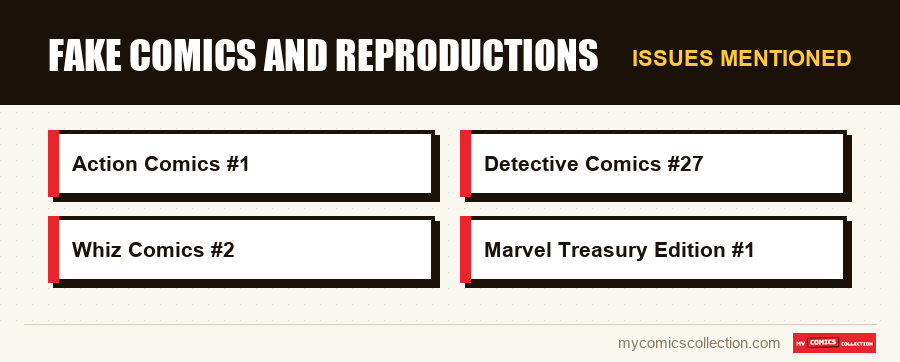
The first big trap is not even a counterfeit in the legal sense of the term: they are perfectly legal reprints, published by the publishers themselves, but which resemble the original so much that they regularly end up resold as such, voluntarily or through ignorance. The textbook case is that of the “Famous First Editions” of DC Comics. Between 1972 and 1978, DC published a collection entitled "Limited Collectors' Edition", numbered from 20 to 59 with a "C" prefix, in an oversized 25 x 34 cm format: the "treasury" format. This collection includes almost perfect facsimiles of legendary Golden Age covers: Action Comics #1, Detective Comics #27, Whiz Comics #2. The trap lies in the physical construction of the object: the visible cover, made of thick magazine-style cardboard, clearly announces "Famous First Edition" and the unusual format. But inside is a second cover, printed on classic glossy paper, that faithfully reproduces the original artwork: including, in some cases, the original copyright date on the title page. Simply remove the outer cardboard cover to find yourself with a booklet which, in a photo or in a sleeve, can mislead a buyer in a hurry. This type of manipulation still exists today on peer-to-peer sales platforms.
Marvel followed a similar logic with its own Treasury Editions, initiated in 1974 with Marvel Treasury Edition #1 devoted to Spectacular Spider-Man, a series which will include a total of twenty-eight oversized issues covering classic arcs from Fantastic Four, Thor, Conan and Howard the Duck. Here, the risk of confusion with a standard comic is less due to the format, but detached pages from these editions sometimes circulate cropped to resemble original plates sold individually.
A second frequent case concerns Whitman prints, distributed in the United States in mass distribution channels from the mid-1970s. These copies are normally recognized by a diamond replacing the UPC barcode on the cover, or by a blank price box without the round characteristic of newsstand prints. The problem arises with "no month variants": Whitman prints whose cover presents no visible difference with the classic newsstand edition, the only proof being found in the indicia: the block of legal notices printed in small characters, generally at the bottom of the first interior page or on the contents page. Some Whitman copies in sets of three (the "3-packs") even bear the explicit mention "THIS IS A REPRINT OF A PREVIOUSLY PUBLISHED ISSUE", buried in the legal text and therefore invisible to those who do not take the trouble to open the comic and read this page. There are documented cases of sellers discreetly removing staples from a Whitman copy to exchange the front cover for that of an authentic newsstand print, making detection significantly more difficult without full physical inspection.
The lesson common to these three examples: the trap is almost never a crude fake fabricated from scratch. It is a real object, printed by the legitimate publisher, but whose exact nature has been erased or disguised to deceive about the rarity and therefore the price.
Restoration techniques that fool the untrained eye
The second large family of traps affects authentic comics whose state has been modified after printing, without this intervention always being revealed by the seller. Restoring comics is a legal practice and even sometimes recommended to stabilize a fragile copy: the problem is not the restoration itself, but its lack of mention during the sale.
Color touch, or color retouching
Color touch consists of masking a discolored area, a scratch or a missing ink stain using acrylic paint, watercolor, felt-tip pen, pastel or even just white corrector, applied directly to the cover. A well-executed color touch can be almost invisible to the naked eye under standard lighting. Two control methods generally make it possible to flush it out: place the opened comic on a light table (light box), cover side up, to observe if the light passing through the paper reveals a difference in localized ink density; and especially the examination under UV lamp, where most touch-up paints and varnishes fluoresce clearly, unlike the original printing ink which remains matte. Another classic clue: at the spine of the comic, the small white folds characteristic of handling ("spine ticks") should normally break the background color and appear white. If at this precise location the shade is slightly darker or lighter than the surrounding ink instead of being frankly white, this is a sign that a retouch has filled the crease.
Trimming, or trimming the edges
Trimming consists of finely cutting the edges of a damaged comic book (dog-eared corners, frayed edges) to artificially give it a clean appearance and sharper angles, with the aim of misleading the grade. Detection is based on comparing the margins and proportions with a reference copy of the same series and the same issue: if the head of a character on the cover seems "stuck" to the edge of the page, or if the space which should normally separate the edge of the box from the Comics Code Authority logo (or any other fixed element printed near the edge) has disappeared, the comic has most likely been cropped. A comparison of dimensions to the nearest millimeter with a non-suspect copy of the same print run remains the most reliable method, because trimming, even minimal, slightly reduces the external dimensions of the booklet compared to the standard printing format.
Married pages and cover grafting
A "married page" is a page, sometimes the cover itself, from another copy of the same issue, grafted to replace a missing or damaged page. Identification involves observing the quality and color of the paper: a married page often has a different level of whiteness from the rest of the booklet, visible to the eye under neutral light when comparing several pages with each other. A difference in size, even of one or two millimeters, between the cover and the interior pages is also a strong signal, as is a misalignment in the staples or a staple visibly replaced by a more recent model than that used at the time of printing.
What is not considered catering
It is useful to know that certain interventions are not classified as restoration by the certification bodies: pressing (pressing to smooth out surface folds without adding material) and dry cleaning are among the so-called "non-additive" processes, tolerated because they do not modify the color or structure of the paper. This distinction is important so as not to confuse a simply pressed copy, which remains "universal", with a truly restored copy.
Decoding a certification label before purchasing
For comics that have already passed certification (CGC or CBCS), most of the anti-fraud information is supposed to appear on the label itself: you still need to know how to read it. At CGC, the color of the label is the first indicator: a blue label ("Universal") indicates an unrestored and unsigned copy; a yellow label (“Signature Series”) indicates a signature affixed under the witness of a CGC employee; a green label (“Qualified”) indicates a significant defect that falls outside the usual framework of the rating grid (missing coupon, unattested signature, added cover from another copy) described explicitly on the label rather than buried in the overall rating; finally a purple label ("Restored") certifies that a restoration has been detected and that it is described with its type and extent.
Since the introduction of the updated restoration scale, CGC has refined its evaluation: each type of intervention detected on the same comic (color touch, trimming, married pages, etc.) receives its own quality and quantity rating, with the label's overall rating reflecting the most severely rated technique. An example that has been the subject of reversible, non-aesthetic conservation work, without the addition of color or visible filling, can receive a "Conserved" label rather than "Restored", a distinction which is important for resale value: the "Conserved" label by definition excludes aesthetic interventions such as color touch or material filling, while the "Restored" label includes them.
In all cases, checking the certification number directly on the organization's website remains the basic reflex before any purchase of an already slabbed comic: this allows you to confirm that the label displayed corresponds to the copy physically offered, and not to another comic whose photos have been recycled.
Collecting this series?
Track what you own, what you are missing and what your collection is worth. 7 day trial.
Start my trial →The scandal which reminded us that a slab is not an absolute guarantee
The most notable case of recent years illustrates that even an officially certified comic can be the victim of fraud after the fact. The mechanism discovered involved the purchase of a high-value comic in high condition, its certification and normal encapsulation by CGC, then the fraudulent opening of the case ("slab") to extract the authentic copy and replace it with a lower quality comic. This replacement comic was then returned to CGC on the grounds of a damaged case, as part of the legitimate "reholdering" service (replacement in a new cover without resuming the grade), which made it possible to bring it out with a label showing the old grade: the highest, obtained by the authentic copy now sold separately.
The case came to light when the abnormally high volume of rare examples, notably highly sought-after "Mark Jeweler" variants, offered for sale by the same profile ended up arousing the suspicions of the collector community on specialized forums. The investigation that followed made it possible to identify several dozen and then, according to circulating estimates, several hundred potentially affected comics, with suspicions that this type of manipulation could have been practiced over a long period before being detected. This episode highlighted a structural flaw: the reholdering service, designed to replace a damaged box without devaluing the comic it contains, did not provide for systematic control to ensure that the reinserted comic was indeed the original one.
The impact of these cases on confidence and on the rating
This type of scandal has a measurable effect on market behavior, even if it is not a movie adaptation changing demand on a character. First, it reinforces the already existing premium granted to universal examples (blue label, without restoration or incident) compared to restored or qualified examples bearing the same numerical rating: at the same displayed grade, a purple or green label is negotiated structurally less expensive than a blue label, because the buyer includes a precautionary discount. Then, it pushes some experienced buyers to favor copies whose sales history (provenance) is traceable over several transactions, rather than a slab that appeared without a known history, even if its label seems in order. Finally, it accelerated the dissemination of good verification practices on the buyers' side: systematic control of the certification number online, photography of the comic from several angles before any major payment, and use of rating monitoring tools based on sales actually concluded rather than on displayed prices, to spot a price anomaly which would betray a doubt about authenticity.
Collector's tools to check yourself
The good news is that you don't have to be a grading professional to eliminate the vast majority of pitfalls. Three simple tools allow, according to experienced practitioners, to detect most cases of undeclared restoration:
A portable UV lamp (blacklight) remains the reference tool for color touch: placed a few centimeters from the cover in a dark room, it almost always makes paints, varnishes and restoration glues fluoresce, while the original printing ink remains dull. A classic flashlight, used for grazing lighting on the cover, reveals surface irregularities (reliefs, flat areas of paint, differences in shine) invisible under frontal lighting. Finally, a magnifying glass or a mini USB camera allows you to closely examine sensitive areas: borders for trimming, joining of pages to identify a marriage of pages, and especially the indicia, this legal notice page too often ignored even though it contains the most reliable information on the exact nature of the print (edition number, reprint mention, legal deposit date).
To organize and secure the monitoring of their collection throughout these checks (note the provenance, the condition observed, any doubts raised about an item) many collectors now rely on a dedicated application rather than a simple spreadsheet, which also facilitates resale if necessary by keeping a complete trace of each acquisition.
Buying guide: reflexes to adopt before paying
Whether the purchase is made at a flea market, between individuals or via an online sales platform, a few systematic checks make it possible to avoid almost all of the pitfalls described above:
- Always open the comic and read the index before making a purchase in person: it is there, and not on the cover, that you will find the legal notice confirming whether it is an original print, a Whitman, or a Famous First Edition reprint.
- Compare the external dimensions of the booklet with those of a reference copy of the same issue if trimming is suspected, particularly on high-end comics offered outside certification.
- Systematically request photos under natural light and, if possible, under a UV lamp before any remote payment for a copy presented as unrestored.
- On a comic already certified, check the certification number directly on the website of the issuing organization and ensure that the color of the label (blue, yellow, green, purple) corresponds to the description given by the seller.
- Be wary of an abnormally low price for a high advertised grade: this is often a signal of an undeclared restoration or a doubt that the seller prefers not to mention.
- For oversized formats from the 1970s (treasury, Famous First Edition), check for the presence of the complete outer cardboard cover: its absence is in itself a warning signal, even if the contents appear to be from the period.
- Keep a trace of each important acquisition (photos, exchanges with the seller, certification number) to facilitate any possible dispute or subsequent resale in complete transparency.
- If any doubt persists after these checks, do not hesitate to seek a second opinion from an experienced collector or a restoration professional before finalizing a substantial purchase.
Finally, to situate a proposed price in relation to sales actually concluded on comparable examples and therefore identify a suspicious anomaly, a comparison based on actual transactions remains more reliable than a simple displayed estimate: this is exactly what allows you to quickly check a rating estimator based on actual sales before committing to a major purchase.