To choose a comic book as a birthday gift, you must first identify what the person really collects (character, publisher, editorial era) rather than buying a known issue at random. A key number (first appearance, first costume, death or return of a character) will always have more effect than a “random” number from the same series, and a copy graded by a recognized service (CGC scale of 0.5 to 10) eliminates any doubt about the condition. On a tight budget, a modern print or a recent variant cover remains a relevant gift and much more affordable than a comic from the Golden Age or the Silver Age.
Offering a comic to a collector has nothing to do with offering a book or a DVD: the person in front most likely already has a precise inventory of what they own, a mental (or written) list of what they are missing, and a keen sensitivity to the state of conservation. A poorly chosen gift (a copy she already has, a reissue presented as an original, or an issue unrelated to what she collects) is immediately noticed and falls flat, even if the intention was good.
Conversely, a methodically chosen comic remains one of the most memorable birthday gifts you can give to a collector, because it touches on nostalgia, pop culture and an object that has a verifiable editorial history. This guide details how to navigate the major periods in the history of American comics, how to read a gradation, how to spot a truly significant number, and how to adapt the gift to a given budget without making a mistake.
We will also see why the cinema release calendar and major industry events (Free Comic Book Day, conventions) directly influence interest, and therefore the difficulty of finding, certain titles when you are looking for the ideal gift.
Understand the major editorial periods before choosing
A collector almost never thinks of “comics” in a generic way: he thinks in eras. Knowing how to place a number in the sector's editorial chronology is what distinguishes a thoughtful gift from an impulsive purchase on the shelf of a supermarket.
The Golden Age (late 1930s: late 1940s)
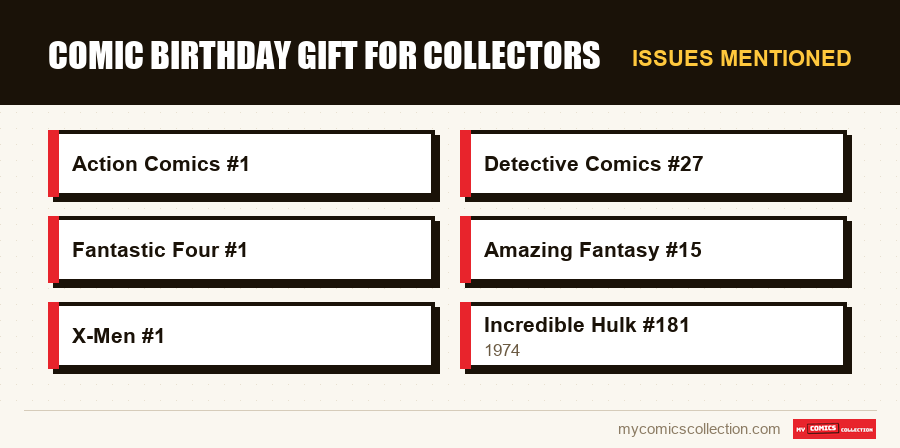
This period opens with Action Comics #1 in June 1938, which introduced Superman under the pen of Jerry Siegel and the pencil of Joe Shuster, then continued with Detective Comics #27 in May 1939, first appearance of Batman by Bob Kane and Bill Finger. These are extremely rare comics, published on very fragile pulp paper, and the copies in circulation today are essentially graded and kept in sealed cases rather than read. Offering a comic from this period to a collector requires a very specific budget and generally concerns official facsimile reissues rather than the original, except in exceptional cases.
Silver Age (mid-1950s: late 1960s)
This is the period which saw the birth of the majority of characters still at the center of current franchises: Fantastic Four #1 in November 1961 (Stan Lee and Jack Kirby), Amazing Fantasy #15 in August 1962 with the very first appearance of Spider-Man, or even X-Men #1 in September 1963. These issues are the most sought-after targets for a “high-impact” gift, but their relative rarity and the sustained demand from long-time collectors make them priority pieces if you know the recipient's favorite character.
Bronze Age (circa 1970 - mid-1980s)
A pivotal period marked by a more mature tone, the appearance of numerous secondary characters who have become cult: Wolverine thus appears for the first time as a complete character in Incredible Hulk #181 (November 1974), and a broader production which makes certain issues more accessible than a Golden or Silver Age, while retaining a real historical weight.
The Modern Age (since the mid-1980s)
This is the simplest period for a successful birthday gift with a controlled budget: larger print runs, a multiplicity of variant covers, and much more direct access to new issues or in very good condition. This is also the period when the slightest film or series release can increase collector interest in a specific issue in a few weeks.
Identify precisely what the recipient collects
Before even thinking “which number to give”, the question to ask yourself is: what does this person really collect? A collector can follow a single character (any Daredevil, for example), a publisher, a designer, a period, or even a specific variant cover available on several titles. The worst gift is not an expensive or cheap gift: it is an irrelevant gift in relation to this logic of collecting.
Some concrete levers to identify the target without making a mistake:
- Looking at what is already on display or carefully stored (pockets, boxes, classification in order): this often reveals the axis of the collection more than what the person says themselves.
- Check whether the collection is made up of “raw” copies (ungraded, intended to be read and handled) or graded copies in a sealed case: this completely changes the type of relevant gift, a raw copy being able to become an annoying duplicate again if it is already read, a graded copy being a collector's item in its own right.
- Discreetly ask a mutual relative (spouse, convention friend) if there is a missing list: many collectors keep one, sometimes via a collection tracking application.
- Spot the Dominant Publisher on the Shelf: A very Marvel-oriented collector will rarely appreciate a DC gift chosen solely because it's famous, and vice versa.
Read a gradation before buying
The world of old comics operates with a precise grading vocabulary, inherited from the Overstreet Comic Book Price Guide and taken up by the certification companies. It is better to master it before buying, otherwise you will pay the price for a condition that is not the one actually offered.
The main categories, from best to worst condition, are: Gem Mint, Mint, Near Mint (NM), Very Fine (VF), Fine (FN), Very Good (VG), Good (GD), Fair and Poor. The difference between Near Mint and Very Fine, for example, comes down to very specific details: a Near Mint example has a flat cover with no surface wear, still vibrant print colors, sharp corners with barely perceptible dulling, while a Very Fine tolerates minimal beginning wear at the corners and a light crease that does not result in color breakage.
Independent certification companies use a standardized numerical scale that ranges from 0.5 (Poor) to 10.0 (Gem Mint). Between 0.5 and 9.0, the rating levels are spaced by 0.5 points; beyond 9.0, they tighten to increments of 0.2 points or less, because the difference in value between two very close states becomes much more significant on high-end examples. A comic thus certified is sealed in a transparent rigid case with the unique note and certification number, which guarantees the recipient that the displayed condition cannot be disputed or altered over time.
For a birthday gift, this distinction matters enormously: a graded and sealed copy is an object to be kept and exhibited as is, while a raw copy leaves the collector free to read it, handle it, or even have it certified himself later if he judges it interesting enough.
Key number or simple reading pleasure?
In the vocabulary of collectors, a “key issue” designates a comic book which marks a precise and lasting editorial event: first appearance of a character, first appearance of a team, first costume, death or return of a major character, or first work of a creator who has become essential. These issues concentrate demand because they are inseparable from the character's story, regardless of the quality of the story told within.
Amazing Fantasy #15, Action Comics #1, Detective Comics #27, X-Men #1, Fantastic Four #1 or Incredible Hulk #181 are the most cited examples, precisely because they each correspond to a first founding appearance. But a key issue is not necessarily an old issue: in the Modern Age, a first appearance in a recent mini-series or a first issue of a well-followed relaunch may well constitute a key issue for the current generation of collectors.
Conversely, a “reading” number (a notable episode of a popular run, without first appearance status) remains a perfectly valid gift if the recipient collects above all for the pleasure of (re)reading a specific story, and not for the heritage value of the object. The good instinct is to identify which of the two profiles matches the person rather than assuming that a key number is always the “superior” choice.
Collecting this series?
Track what you own, what you are missing and what your collection is worth. 7 day trial.
Start my trial →Spot common pitfalls before buying
The second-hand market is full of good deals, but also some classic traps that an uninformed buyer may not see, while an experienced collector spots them in a few seconds, and will judge harshly a gift that falls into them.
The first concerns the distinction between “direct market” edition and “newsstand” edition. Historically, comics sold on newsstands (newsstand) had a UPC barcode printed directly on the cover, while copies intended for specialized stores (direct publishing) instead displayed a box or a diamond without a visible barcode. On certain issues, the distribution between the two distribution circuits was very unequal, which makes one of the two formats significantly more difficult to find than the other for the same issue and the same publication date: a detail that many novices are completely unaware of when purchasing.
The second trap concerns undeclared catering. An old copy may have undergone a re-covering of the spine, an addition of color to the marker on a scratch on the cover, or a replacement of damaged pages with pages from another copy (we then speak of “married pages”). Independent certification companies are required to explicitly state any restoration detected on the sealed case label; a private seller, however, has no obligation to do so, hence the interest in favoring an already graded example when the gift budget becomes significant.
Finally, be wary of advertisements that use vague vocabulary such as “VF equivalent” or “close to the NM” without an official grade: these are commercial formulations, not recognized grades. An experienced collector always prefers a precise gradation, quantified and dated, to a subjective estimate from the seller.
The impact of adaptations on availability and interest
The calendar of film and series adaptations directly influences demand for certain issues, particularly those linked to the first appearances of characters who return to the fore. This phenomenon is well documented in the sector: each new release rekindles interest in the editorial history of the character concerned and pushes some occasional buyers to look for the founding issue, which can make certain copies more difficult to find in good condition on the second-hand market for several months.
The calendar of major events in the sector is also a useful guide for planning a gift purchase. Free Comic Book Day, organized each year on the first Saturday in May, will be held on May 2, 2026: this is the time when many specialized stores offer free special copies and when editorial news from major publishers is highlighted. San Diego Comic-Con International, one of the industry's largest gatherings, will take place from July 23 to 26, 2026 (with a preview evening on July 22): announcements made there often influence collecting interest for the following months, including on vintage issues related to the characters featured.
For a birthday that falls close to one of these dates, it may be relevant to anticipate the purchase by a few weeks: demand for a given number can change quickly around these dates, particularly if an announcement related to the character sought occurs in the meantime.
Buying guide: good reflexes before offering a comic book
- Check that it is not a duplicate. Nothing is more frustrating for a collector than receiving an issue they already own: discreetly cross-reference the information with a loved one or observe their collection before purchasing.
- Distinguish between original and reissue. Many historical issues exist in facsimile or official reprint, clearly mentioned as such by the publisher: these are excellent budget appeal gifts, but they should never be presented (or purchased by mistake) as the original period edition.
- Choose a number linked to the recipient's year of birth. Offering a copy published in the month or year of the person's birth gives a strong personal dimension to the gift, regardless of its market value.
- Adapt the format to the intended use. A graded and sealed copy is suitable for a collector who exhibits and preserves; a raw copy in good condition is suitable for a reader who wants to be able to handle their comics.
- Check the status with the correct terms. Always ask or check the grading level (Near Mint, Very Fine, Fine, etc.) rather than relying on a single photo or a vague description like "good condition."
- Complete with a conservation accessory. A protective sleeve, a backing board and an acid-free storage box are inexpensive additions that show real attention to the preservation of the item offered.
- Consider collection tracking as a complementary gift. For a collector who is starting to structure his collection, a application dedicated to tracking and inventorying its comics can usefully accompany the physical gift.
- Check the rating before purchasing to avoid unpleasant surprises. The same issue can display significant price differences depending on the condition and the seller: comparing recent actual sales before confirming the purchase avoids paying too much for an overpriced copy.
- Don't overlook modern numbers. A recent variant cover or a first appearance in a current series can be an excellent gift, often much more affordable than a vintage issue, while having real collectible potential in the medium term.
- Anticipate periods of high demand. Around Free Comic Book Day (May 2, 2026) or major conventions like San Diego Comic-Con (July 23-26, 2026), the availability of certain issues may become tighter: it is better to bring forward the purchase rather than wait until the last week before the anniversary.
If you have any doubt about the consistency between the asking price and the actual condition of an item, it is always preferable to check the price range on comparable sales before confirming the purchase, rather than relying solely on the seller's announcement.
Create a gift according to the available budget
A successful comic gift is not necessarily an expensive gift. On a very measured budget, a modern copy in good condition, an official reissue of a historic issue, or a quality conservation accessory (sleeves, box, backing boards) accompanied by a little note explaining the choice of the issue already makes an appreciable difference for a collector attentive to personalized attention.
At an intermediate budget, aiming for a Bronze Age issue or a key modern issue (first recent appearance, first issue of a follow-up relaunch) allows you to combine editorial significance and accessibility. For a more substantial budget, a Silver Age issue directly linked to the recipient's favorite character, if possible graded to guarantee condition, remains the safest value in terms of emotion and recognition on the part of an experienced collector.
In all cases, the rule that takes precedence over budget remains relevance: a modest issue but perfectly aligned with what the person collects will always have more impact than a prestigious issue but off topic. It is also for this reason that a collector who structures his collection via a dedicated application constitutes an easier target to identify: the shortfall to be filled is explicit rather than inferred.