A pedigree designates a copy known to come from an identified original collection, assembled issue by issue and later found intact, often decades afterward. The most famous, the Mile High collection assembled in Denver by Edgar Church and dispersed from 1977 onward, established the practice. The designation acts as a guarantee of provenance and of uniform preservation, and it is in that capacity that it adds a premium to the market price.
You look at a listing, the stated condition seems right to you, yet the price far exceeds what you have seen for the same issue at the same grade. In small capitals under the heading, three words name a collection you do not know. Deciding whether that gap is justified requires understanding what the designation really brings, what it leaves to your account, and under what conditions it passes from one owner to the next.
As always on this guide, only verified information (creators, issue numbers, dates) is stated as fact; the analysis is our own, with no reproduction of panels or protected dialogue.
What a pedigree designates, exactly
The term is borrowed from livestock breeding and horse sales, where it describes a documented line of descent. Applied to comics, it qualifies neither an edition, nor a printing, nor a cover variant: it qualifies one specific physical copy, tied to the collection in which it spent most of its life. Two copies of the same issue, printed the same day on the same press, can therefore carry different designations, or none.
That tie only matters because the collections concerned have a particular history. It is almost always a lot bought from the newsstand at the time of publication, kept without being read over and over, stacked away from light, then forgotten for thirty, forty or fifty years. When the lot resurfaces, it has escaped the two main enemies of paper from the forties and fifties: repeated handling and direct light.
The consequence is counterintuitive for a beginner. The value of a pedigree does not rest on a prestigious owner but on a stroke of luck in storage. Edgar Church was not a figure in the trade; he was a Denver advertising illustrator who bought magazines and kept them. It was the dry basement of his house that made the history, not his name.
How a collection gains this status
No body officially grants a pedigree. Recognition is built by market consensus, and it requires several conditions to come together. The first is size: a box of fifteen issues, however superb, does not create a pedigree, because it does not allow a reproducible preservation profile to be established. Recognized collections are counted in the hundreds, sometimes in the thousands of issues.
The second condition is uniformity of condition. The copies in the lot must, as a whole, sit clearly above what the market usually sees for those titles and those years. A collection that yields a few remarkable copies and many tired issues does not make a pedigree: it makes an uneven lot.
The third is traceability of the discovery. It must be known who found the lot, where, when, and through whose hands it passed before being dispersed. That chain is what will allow, years later, the claim that a copy for sale really belongs to the original group. Without it, the designation becomes an unverifiable assertion, and the market ends up discounting it.
The fourth, often underestimated, is the period covered. A pedigree covering the forties weighs more, since survivors in fine condition are extremely rare. On titles from the eighties, kept in a sleeve from the moment of purchase, provenance adds nothing that the condition does not already document.
The collections that established the practice
The Mile High collection, also called the Edgar Church collection, is the reference. Discovered in Denver at the end of the seventies, it contained thousands of issues from the late thirties and the forties, in a condition that forced the market to revise what it believed possible for that era. The whiteness of the pages and the retention of colors became a yardstick for comparison.
Other groups have been recognized since, most often bearing the name of the place of discovery or of the original collector. The Allentown, Larson, White Mountain collections are regularly cited, along with, more recently, the Promise Collection, which appeared on the market in the early twenties. Each has its own signature: a range of issues, a dominant paper quality, sometimes recurring storage marks.
The list is not fixed and remains debated. Some collections circulate under a name known to everyone, others under a label claimed by a single figure in the trade. If you come across a designation for which you find no discovery history, treat it as information to verify, not as an established fact. The absence of documentation is not proof of fraud, but it does rule out paying the premium attached to established groups.
What the premium really rewards
Three things overlap in the price gap, and it is useful to separate them. The first is the condition itself, already reflected in the grade. The second is the intrinsic quality of the paper and ink, which does not always fully enter into the numerical grade: two copies can receive the same grade while one has clearly white pages and the other amber pages. The third is the rarity of the combination, that is to say the number of copies of the issue known at that level with that provenance.
It is the second component that most often explains the premium. On older titles, the color of the paper weighs heavily in the eye and cannot be made up for. A buyer looking for the best possible copy of a given issue therefore pays for the probability that the provenance will deliver clean pages, without having to inspect fifty copies to find one.
The third creates asymmetries: for an issue of which the collection yielded only one copy, the designation becomes a near-unique identifier, whereas the premium fades as soon as several copies from the same group are in circulation.
Why the premium varies from title to title
One and the same pedigree does not produce the same surplus on everything it contains. On a highly sought-after issue, where dozens of buyers compete for a small number of top-grade copies, provenance serves as a tiebreaker and the gap can become considerable. On a little-sought issue from the same lot, the market does not find enough bidders for the designation to be monetized, and the price stays close to the ordinary market for the grade.
The decisive factor is therefore the depth of demand, not the fame of the collection. Golden Age superhero titles, structuring first appearances and covers that entered the popular imagination concentrate that depth. Anthologies, humor titles, westerns and romances from the same period concentrate it far less, even though they often come from the same cellars.
The makeup of demand also matters. On an issue bought mainly to be read or to complete a series, provenance interests no one. On an issue bought as a reference piece, it becomes an explicit criterion in the specifications. If you are building a thematic collection around a character, for example by following the milestones we detail on the X-Men or Fantastic Four side, you will see this shift happen on only a few specific issues.
Do you collect this series?
Track what you own, what you are missing and what your collection is worth. 7-day trial.
Start my trial →
How the designation is certified
In practice, the designation today lives on the label of copies encapsulated by a grading company, which prints it next to the grade when it considers the provenance established. For this, the companies rely on lists of recognized collections and on internal markings: storage marks, pencil annotations, the original seller's numbering, and in some cases the documentation of the discovery.
Outside encapsulation, attestation rests on a set of evidence: a purchase invoice mentioning the collection, correspondence with the finder of the lot, an old sales catalog in which the copy can be identified, a period photograph of the lot. Taken individually, each of these elements is weak. Together and mutually consistent, they hold up.
One point that is often missing from listings: the designation is attached to the copy, and it is not lost when the copy changes hands. It can, however, cease to be demonstrable if the file that accompanied it is separated from the comic. That is why a copy whose provenance you are buying should arrive with its documents, not with a sentence.
What the pedigree does not replace
A provenance designation says nothing about the physical integrity of the object you are looking at. A copy from a prestigious collection may have been restored after leaving the lot, may have been pressed hot, may have lost a coupon cut out at the time, or may have been chemically cleaned by an intermediate handler. Provenance tells you about the decades spent in the cellar, not about the years spent since.
The examination therefore remains complete. Check the interior completeness, the presence of advertising pages and any inserts, the flatness, the alignment of the staples, the actual color of the pages, and any restoration or cleaning marks on the label. A copy bearing a designation and flagged as restored is negotiated in an entirely different range than a copy bearing the same designation and declared intact.
Also keep in mind that the premium is not secured at resale. It depends on demand for the issue at the moment you sell, and it evaporates if the market stops considering the collection established. Paying for a provenance amounts to betting on the permanence of a consensus, which is not the same thing as paying for a condition.
Abuses and claims without proof
The first abuse, by far the most widespread, is claiming a pedigree on the basis of a resemblance. The seller saw that the copies of a known collection have very white pages, his copy has very white pages, and he concludes an origin. The reasoning is backwards: it is storage conditions that produce white paper, and many dry cellars have never been pedigrees.
The second abuse is the unwarranted extension of scope. A recognized collection covers a precise range of publication dates; seeing the same designation appear on issues published ten years after it was assembled should stop you dead. Comparing the issue date with the documented period of the lot is enough to rule out a good share of doubtful listings.
The third is the accommodating designation: an invented collection name, sometimes geographic to sound credible, used as a sales argument with no history behind it. Nothing prevents a seller from writing what he likes in a listing title. The rule of conduct is simple: if the designation does not appear on a grading label and is not backed by a file, it counts as the seller's opinion and should be paid for at the price of the grade alone.
Buying, reselling, and keeping the file
Before buying, ask the seller three questions and keep the answers in writing: what the designation rests on, which documents accompany the copy, and whether the copy has undergone any intervention since leaving the lot. An evasive answer on any one of the three points is information in itself. Then compare the asking price not with the market for the issue in general, but with transactions for the same issue at the same grade without a designation, so as to isolate the premium you are being charged.
When reselling, your job is to pass on the file as complete as you received it, and to add your own holding history to it. A copy whose chain of possession is continuous since the discovery of the lot defends itself; a copy whose chain shows a fifteen-year gap forces the buyer into an act of faith, and they will make you pay for it.
On the tracking side, treat provenance as a data point in its own right on your record, on the same level as condition and edition. Note the name of the collection, the source of the designation, the certificate number where applicable, and where the supporting documents are kept. If you keep your inventory in My Comics Collection, these details fit into the copy's condition and notes fields, which saves you from rebuilding a history in a hurry on the day you sell.
What to take away
A pedigree is a fact of provenance, not a quality of the edition. It rewards exceptional preservation and documented traceability, it concentrates on older publications, and it is only truly monetized on issues whose demand runs deep. It does not exempt you from any verification of the object, and it loses all market value as soon as the proof is missing.
The reasonable position, when a designation is put to you without a file, is to set it aside in your calculation and to pay for the copy for what it shows. Established collections will continue to exist without you, and the issues you are looking for will come back on the market. To gauge the premium being asked of you, start from the value of the issue at the stated grade.
Torn between a copy bearing a collection designation and an ordinary copy at the same grade? Value the base first; the premium can be negotiated afterward.
Estimate my comic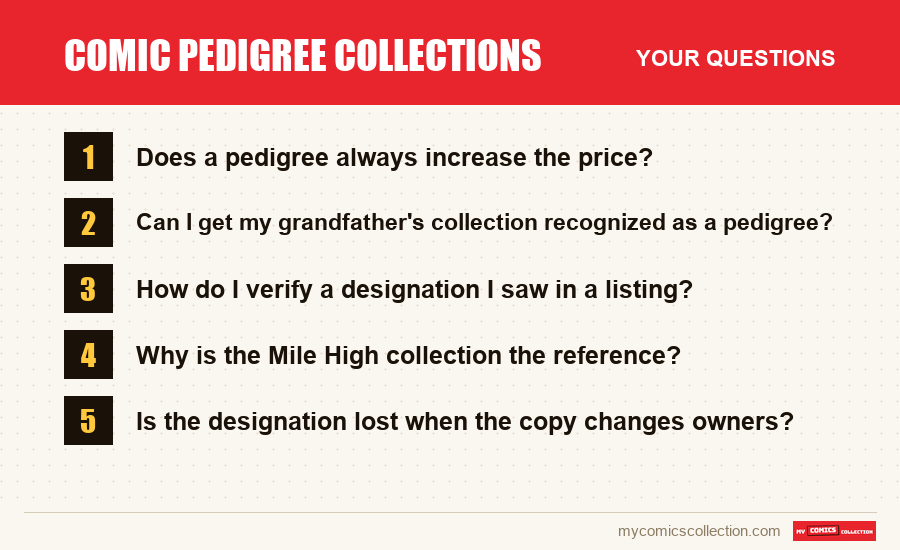
Frequently asked questions
No. The premium presupposes deep demand for the issue in question. On a little-sought anthology or western from the same lot, the market lacks bidders to value the provenance, and the copy trades at the price of its grade. The gap is concentrated on the most contested issues in the collection.
It is very unlikely. It takes several hundred issues, a uniform condition clearly above the average for the period, an early publication range and a documented discovery. A family inheritance in good condition remains a good lot to sell, without thereby reaching that status.
Check whether it appears on the grading label or only in the seller's text. Then compare the issue date with the documented period of the collection cited, and ask for the documents: original invoice, old sales catalog, correspondence with the finder of the lot. Without them, treat the designation as an opinion.
Because it brought together thousands of issues from the late thirties and the forties, kept in Denver in conditions that preserved the whiteness of the paper. Its dispersal from 1977 showed the market a level of preservation that was thought unattainable for that period.
Provenance is attached to the copy and follows it. What gets lost is the ability to prove it, when the supporting file is separated from the comic or when a gap appears in the chain of possession. Pass the documents on with the object and complete them with your own history.