Usagi Yojimbo is one of the cheapest major works to collect, with one exception that you should know to avoid. As of August 29, 2026, the medians requested in gross terms are between $13.49 and $15.00 over four decades of publication, with entries at $2.50. The only expensive segment is first anthology appearances, where the certified median reaches $330.00. Discard this segment and forty years of series opens up for the price of a handful of modern issues.
Few series of this reputation allow this, and the reason lies in specific properties of the market which are worth knowing.
This article gives the method of purchasing on a constrained budget, the segments to favor, the one to exclude, and what an inventory should follow when you buy little and often.
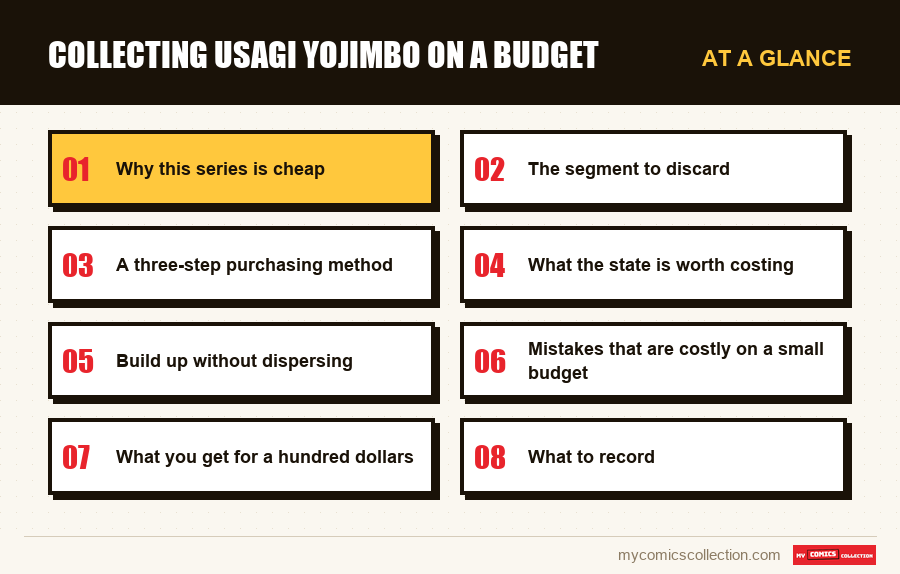
Why this series is cheap
Three properties combine, and none is accidental.
No speculative peak in its history. The series has never experienced any boom that would have established lastingly high prices. It sold regularly, smoothly, for forty years.
An abundant and continuous supply. Several hundred raw announcements circulate constantly, spread over all periods. Nothing is hard to find except the beginning segment.
An almost non-existent certified market. In three of the four editorial periods, the graded announcements can be counted on the fingers of one hand. However, it is certification which, elsewhere, pushes prices upwards by removing beautiful examples from the raw market.
These three properties together produce a readers' market, where asking prices reflect usage rather than speculation. This is exactly the setup where a modest budget goes the furthest.
Where are the best entry points?
The following figures are asking prices observed on August 29, 2026, recorded separately in gross and graded, on fixed price advertisements.
The numbers of the founding period
Entrées relevées à 2,50 et 2,99 $requested for copies described in good condition, over a period median of $15.00.
These are numbers from the 1980s, and it's the best report in the entire survey.
Numbers from recent times
Entrées à 2,95 à 3,25 $requested, period median at $13.83. Excellent availability, including full spin-off series.
Presentation volumes
Introductory collections and selections from 7,50 à 8,64 $requested. One is enough: their content is reproduced in full elsewhere.
La branche dérivée récente
Numéros à 0,99 à 1,99 $requested, median $7.45, with no certified listings. The cheapest entry point in the entire work.
The segment to discard
Just one, but it alone represents most of the budgetary risk.
The character's first appearances, appearing in collective anthologies from the mid-1980s, follow an entirely different logic: 49 certified listings at $330.00 median asking, compared to only 10 raw listings. This is the only place in the work where the raw offer is rare.
A buyer with a constrained budget has no reason to go there. The stories contained in these issues have been collected in a collection and can be read for a few dollars; the original object involves purchasing a piece, not building a collection.
The trap would be to enter by accident. Since the original anthology title was taken over a decade later by another publisher, an imprecise search massively backs up the late recovery: to a median of $14.62, with no certified listings.
In other words, there is less risk of paying too much by mistake than buying the wrong item thinking you are getting a deal. Check the publisher and the year before purchasing in this segment, ou évitez-le entièrement.
The rule that sums it all up: never pay a publisher's premium. All four reporting periods have raw medians within a range of $1.51.
A seller who justifies a higher price by the prestige of a house describes a real fact whose statement shows no translation into price. In comparable condition, buy the cheapest, regardless of the logo on the cover.
A three-step purchasing method
It exploits the market properties described above rather than fighting against them.
First stage: a volume of presentation, only once. For a few dollars, you will know if the series is right for you. This is the only purchase of its kind: buying three is like buying the same powerful stories three times.
Second phase: isolated numbers, taken at their lowest. Entries at $2.50 or $2.95 allow you to accumulate around thirty complete stories for the price of a single collection. Since each issue contains a closed story, none is useless in isolation.
Third step: collections, but only for what you like. Once your preferences are known, the cost per story of the collection becomes unbeatable: provided you stick to the volumes that are widely available.
This progression has a decisive merit: she places financial commitment after knowledge, while the reverse order is the one most readers follow.
What the state is worth costing
A question quickly arises on a constrained budget, and the answer here is less clear-cut than elsewhere.
On most series, deciding between a cheap damaged copy and a beautiful, more expensive copy involves a consideration of future value. Here, this consideration disappears almost entirely: with a certified market almost absent and flat medians for forty years, nothing indicates that a beautiful copy will be valued more than a correct copy.
The criterion therefore becomes purely practical again. A copy in poor condition reads poorly, handles poorly and stores poorly; a correct copy is enough for everything else.
The statement supports this approach: the difference in price asked between a copy described in average condition and a copy described in very good condition remains small for this series, often a few dollars. Paying these few dollars is reasonable; paying a significant premium for perfection is not, for lack of a market that recognizes it.
The only exception concerns the segment of first appearances, where certification dominates and the state controls everything. But this segment is precisely the one that a small budget excludes.
Collecting this series?
Track what you own, what you are missing and what your collection is worth. 7 day trial.
Start my trial →Build up without dispersing
A particular risk awaits opportunistic buying on this series, and it is worth anticipating.
Since each issue contains a complete story, there is no incentive to buy in order. We take what passes, at the appropriate price, and the collection is constituted by dispersed accumulation.
It's perfectly viable for reading. This becomes problematic the day we want to complete, because we then discover that we have fragments of four series with distinct numberings, without knowing what is missing or even what set we were aiming for.
The solution costs nothing: decide from the start on a period of attachment, and buy the rest as a bonus. You can read anything while still constituting something specific.
This framing avoids the most discouraging outcome of low-budget collecting: two hundred accumulated issues of which no set is complete, and the feeling of having gotten nowhere despite the expense.
Mistakes that are costly on a small budget
The out-of-print collection
Paying three figures for a volume whose content is available elsewhere, for lack of having verified what it contains.
Accumulated introductory volumes
Buying several amounts to buying the same selection: duplication is guaranteed, not accidental.
Port by number
On $3 copies, shipping individually doubles the price. Grouping your purchases from the same seller changes the whole calculation.
The keyword premium
Ads referenced on a news story display significantly higher medians for ordinary copies.
Finally, a note on rhythm. There is no reason to buy quickly on this series: the supply is continuous, the prices have been stable for decades, and no scarcity mechanism threatens the ordinary issues. Waiting for the right lot from the right seller therefore costs nothing, whereas in a tense market patience is paid for in missed opportunities. It's a rare comfort, and it's worth taking advantage of it rather than buying in a hurry.
What you get for a hundred dollars
It is useful to make the order of magnitude concrete, based solely on the prices recorded.
At the admissions observed between $2.50 and $3.25 requested, one hundred dollars represents approximately thirty issues: therefore approximately thirty complete stories, each autonomous, spread over several periods.
The same amount buys a single volume of the thick collection line, the median asking price of which is $115.00. This volume contains more stories, but it takes up the entire budget at once.
The difference is not the number of pages: it's the reversibility. Thirty numbers purchased one by one can be stopped at any time, resold in batches, and gradually completed. A single volume does not split.
For a new reader, this reversibility is worth more than the savings per page. It no longer matters once we know we will stay.
What to record
With a constrained budget, the decisive field is neither the condition nor the value: it is the real cost of each acquisition.
The price paid including shipping, and the number of copies in the shipment. On $3 issues, shipping is often more than the item, and a "$2.50" copy purchased alone costs more than a "$5" copy purchased in a set of ten.
This is the information that is missing from all inventories and yet decides everything when we buy little and often. Without it, we believe we are optimizing by seeking the lowest unit price, which is exactly the wrong strategy in this market.
The seller deserves to be noted for the same reason: finding the one with whom you had grouped an economical shipment is better than starting from a search each time.
These two fields do not describe objects. They describe the way you buy, and that's where the return on a small budget comes into play.
Frequently asked questions
A hundred dollars is more than enough. At the entry price of between $2.50 and $3.25, this represents around thirty issues, therefore around thirty complete and autonomous stories spread over several periods. The same amount buys only one volume of the thick compendium line.
Not at all, and that's the surprise of the statement. Issues from the 1980s fetch $2.50 and $2.99 in good condition, with a period median of $15.00. This is the best relationship observed in the entire work: there is no price for seniority here, except in the segment of the first appearances.
No, and paying for it would be a mistake: all four periods have raw medians within a range of $1.51. In comparable condition, buy the least expensive regardless of the publisher: the statement shows no premium attributable to a house.
Shipping per unit. On $3 copies, individual shipping doubles the price, and a “$2.50” issue purchased alone costs more than a “$5” issue taken in a bundle. Looking for the lowest unit price is exactly the wrong strategy in this market.
This does not make sense in a collection logic. These issues belong to collective anthologies, not to the series, and the stories they contain are collected in collections for a few dollars. It is a purchase of a piece, legitimate in itself, but unrelated to the creation of a collection.
How much did this number actually cost you?
Postage included and lot deducted, the response is rarely that displayed on the ad.