Loki does not have a reference silhouette: his shape, his face, his size, his costume and his gender change from one era to another, and this instability is not a lack of continuity, it is the very definition of the character. The consequence is concrete for those who arrange a collection: visual recognition, which is sufficient for almost all the other protagonists of the medium, does not work here. On a cover, there is no guarantee that a green, horned figure is him, nor that an unknown silhouette is not. Documenting its appearances therefore requires relying on the declared name and the series in which the number appears, never on what the drawing shows.
Comics is a medium where identity first passes through the eye. A reader who flips through a bin recognizes a character before reading his name: a dominant color, a cutout of a mask, a posture are enough. It's even one of the industrial driving forces of the medium: the silhouette functions like a brand, it can be read from three meters away, it survives translation, it crosses the decades without needing to explain anything. Almost the entire mechanism of recognition is based on this implicit postulate: a character has an appearance, and this appearance belongs to him.
Loki structurally challenges this postulate. The change in appearance is not for him a production accident nor a designer's whim: it is a claimed narrative capacity, exploited by dozens of successive authors, and extended over the decades to encompass age, build and gender. It is not a question of a costume that is redesigned in the fashion of an era, as happens to everyone, but of a figure which in principle has no form of rest. This article takes this property seriously and draws its documentary consequences, because they are real and they impact the way in which we keep an inventory.
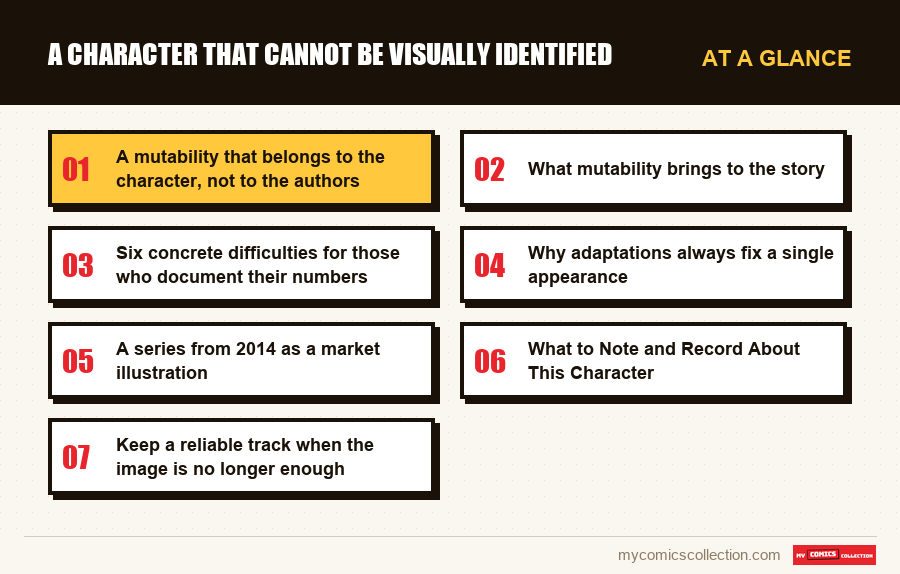
A mutability that belongs to the character, not to the authors
The distinction is essential and it is often poorly stated. When a series changes designers, all the characters change a little: the proportions move, the lines thicken, a cape falls differently. It's a graphic style, and the reader mentally corrects it without thinking about it: he knows that the figure under the line remains the same. Loki comes from a completely different regime: it is not the rendering that varies, it is the body described by the story. An author who makes him appear in an unexpected form has not contradicted the character, he has used him in accordance with what he is.
This difference has immediate practical significance. Faced with a variation in style, we can establish a rule of recognition which absorbs the difference: the color remains, the accessory remains, the pattern remains. Faced with diegetic variation, no rule holds, because variation is precisely the subject. There is no common graphic denominator for all the apparitions, and a reader who looks for one ends up artificially creating one, favoring one period to the detriment of others.
The consequence is that any attempt to summarize this character through an image betrays the character. A presentation thumbnail, a section icon, a thumbnail in a database: each of these objects supposes that we choose a shape and declare it representative. The choice is always possible, but it is always false in the strict sense. It doesn't say what the figure is, it says what era the chooser had in mind.
What mutability brings to the story
No situation is closed to him
A character with a fixed silhouette is limited by his silhouette: he cannot enter a room discreetly, he cannot sit in an assembly without being identified, he cannot remain present in a scene that is not intended for him. Loki does not have this constraint. He can occupy any setting, any social role, any stage scale, which opens up to authors a range of situations that most costumed figures cannot achieve.
The reader never knows who is who
Since a character can wear any face, every scene becomes potentially suspect. This is not a one-off effect reserved for substitution plots: it is a permanent climate, which modifies the reading of sequences where it does not even appear. Few narrative devices offer comparable performance for such a low cost of exposure.
The transformation says something
In other figures, a change in appearance is a rare event that calls for explanation. Here, the form adopted becomes a means of expression in its own right: it indicates a balance of power, an intention, an internal state. The author has an additional register of characterization, which involves drawing without using dialogue.
Editorial longevity without wear
Many characters become exhausted because their form freezes their use: we know in advance what they can do in a story. A figure without an apparently stable appearance reinvents itself without breaking continuity, which explains why it goes through very different editorial periods without needing to be restarted.
These narrative advantages are real and they explain the lasting place of this character in the editorial landscape. But each of them is paid for on the documentation side, and the price is exactly symmetrical: what makes the figure inexhaustible for an author makes it elusive for those who keep a catalog. The reader who “never knows who is who” has a successful reading experience; the collector who never knows who is who has an inventory problem.
The useful rule is contained in one sentence: on this character, the image is not proof of identity. A cover can show it without being recognized, and can appear to show it when it is someone else.
Any classification based on “I saw it on the cover” therefore produces holes and false positives. The only reliable anchor point remains what the story states and the series in which the issue appears.
Six concrete difficulties for those who document their numbers
Tray tracking does not work
The most common method in stores is to scan the spines and covers for a familiar silhouette. It is ineffective here: the desired figure can occupy the cover without presenting any of the expected signs. You have to go through the title of the series and the numbering, that is to say by a slow search where the other characters allow an instantaneous search.
The costume no longer dates anything
For most characters, the version of the costume allows us to approximately situate an appearance in time: such a cutout refers to a decade, such a logo to a redesign. This chronological crutch disappears when the appearance varies within the same period. Two neighboring numbers can have two very distant shapes without this indicating the slightest difference in date.
The visual description is unusable
Many collectors annotate their cards with a quick description of what the specimen shows. On this character, this annotation does not allow any grouping: two correctly completed sheets can describe two beings with no apparent connection. The field fills up, but it no longer serves to find anything.
Lots purchased remotely are difficult to control
When an ad shows a cover photo, the buyer usually checks at a glance that the content matches what they are looking for. Here, the photo does not decide: it neither confirms nor denies the presence of the character inside. The check must refer to the serial and number references provided by the seller, with the risk of error that this implies.
Counting appearances requires an explicit convention
Should we count a scene where the figure acts in an unrecognizable form? An appearance where she is only identified a posteriori, in a later issue? Without a written answer to these questions, two inventories of the same shelf result in two different totals. The convention must be stated once and for all and noted down somewhere.
Visual ranking collapses
Arranging by character requires knowing how to tell, copy in hand, whether or not it belongs in the pile concerned. This operation, immediate elsewhere, becomes a documentary decision here. Sorting based on appearance mechanically produces incomplete stacks, with important numbers filed under another entry because they were not recognized.
Collecting this series?
Track what you own, what you are missing and what your collection is worth. 7 day trial.
Start my trial →Why adaptations always fix a single appearance
A film or television series cannot afford the graphic instability of printed media. The reason is not artistic, it is economic and perceptive: an actor embodies a role, his face becomes the character's commercial interface, he appears on posters, derivative products, platform thumbnails. The audiovisual media needs a unique face because its entire value chain is based on immediate recognition: the same recognition that the character inherently refuses in the pages where he was born.
The result is a shrinkage, and it is worth naming what it shrinks. A fixed appearance transforms the metamorphosis into a one-off special effect: it becomes a moment in the story, spectacular and signal, instead of being a permanent state. What was a property becomes a trick. The spectator finds a figure that he can follow with his gaze, but he loses the sensation, specific to the printed medium, of never knowing with certainty who is in a scene.
This shrinkage then propagates upstream, towards the print itself. An adaptation with a wide audience establishes a reference image in the mind of the public, and the readers who come through it naturally seek this image in the pages. They sometimes find it, and conclude that the rest is marginal; they do not find it, and conclude that they have got the series wrong. In both cases, the expectation formed by the adaptation degrades the reading of the printed production, which has never functioned according to this rule.
For a collector, this dynamic has a measurable side effect: it focuses attention on the periods which most resemble the installed image, and leaves in the shadow those which move away from it. This is not a value judgment on the quality of the stories concerned, it is a simple effect of visibility. Knowing that this bias exists is often enough to rebalance research.
A series from 2014 as a market illustration
A survey carried out on August 29, 2026 on a 2014 series taking this character as the protagonist gives a useful photograph, provided you read it for what it is. One hundred and sixty-one proposals were then open, with requested amounts ranging from $0.99 to $85.97 and a median value of $6.99. These are sums claimed by sellers that day, not completed transactions: no one guarantees that a single one of these copies has changed hands at this level.
The exploitable fact is the abundance combined with the floor. One hundred and sixty-one simultaneous proposals for the same series, with an entry level under the dollar, describe a supply well above current demand. The cautious formulation that results from this applies well beyond this particular case: a recent and widely commented series may have no market. Critical notoriety and market tension are two independent quantities, and confusing the two is the most frequent error in recent production.
As for copies verified by an organization, the survey included only nine advertisements, between $20.00 and $79.99, for a median of $39.95. Nine is a low number, and it must be said frankly: at this level, no conclusion on a price level is legitimate. A single ad removal would move the median by several dollars. These nine lines indicate that a verification practice exists on this series, nothing more.
A final warning is in order on the upper boundary. The higher amount observed, in both sets, expresses the hope of a seller at a given moment; it does not constitute an established price and should never be used as an estimate benchmark. And because this reading was taken on a single date, it strictly says nothing about an evolution: we would need two measurements spaced over time to speak of a movement, and we do not have that here.
What to Note and Record About This Character
Note the name declared in the number, not the drawn form. This is the central methodological inversion of this entire issue. On a figure without a stable appearance, the useful identity is the one that the story states (through dialogue, narration, or subsequent attribution) and not the one that the eye thinks it recognizes. A form which records “present, identified in the text” is infinitely better than one which records a perfectly accurate physical description but which is perfectly unusable when it comes time to find the number.
Always record the series and number as the identification key. These are the only two attributes that remain stable regardless of metamorphoses. Where, for a character with a fixed silhouette, the bibliographical reference is a comfort, here it becomes the backbone of the inventory: without it, an appearance in an unexpected form is simply impossible to find, including in one's own collection.
Write down your counting convention before counting. Explicitly decide whether an appearance in unrecognizable form counts, whether retroactive identification in a later issue counts, and whether an unconfirmed presence counts. Write this rule down in your tracker, not just in your head. The problem is not to choose the right convention, many argue, but to apply a single one over the entire duration of the collection.
Mark the apparitions whose identification seems uncertain to you. On this character, uncertainty is a normal state, not negligence on your part. An accepted area of doubt, revisable later, is more honest and more useful than a wrongly decided classification. It allows you to reopen the question when a subsequent reading sheds light on the scene, without having to reconstruct from memory why you hesitated.
Record the editorial period rather than the appearance of the costume. Since the appearance does not date anything, the only usable chronology is that of the publication itself. Note the time of publication and the host series; these two pieces of information advantageously replace the visual cue you have for the other figures in your collection, and they make it possible to reconstruct a coherent reading order even when the drawing does not cooperate.
Because none is more legitimate than the others. Retaining a single form amounts to favoring the period in which you encountered it, and to mechanically discarding all appearances which move away from it. The result is not a convenient simplification: it is an amputated collection, the gaps of which follow exactly the contour of your personal marker.
By abandoning coverage as a criterion. The reliable path goes through the series and the numbering: we identify the titles where the character intervenes over a given period, then we go down to the number. It's slower than a visual scan, but it's the only method that doesn't produce invisible holes in the inventory.
It fits in the same capacity as the other transformations. The mutability of this figure concerns all the attributes of appearance, and gender is part of it in the same way as size or face. From a documentary point of view, this does not change anything in the method: it is one more variable attribute, therefore an attribute on which we do not base a classification.
No, and the August 29, 2026 statement precisely illustrates the discrepancy. One hundred and sixty-one proposals open at the same time, with a floor below the dollar, describe a widely available supply. The critical conversation around a series and the tension between buyers and sellers are two distinct phenomena, which can evolve independently of each other.
Very little. Nine lines constitute too small a number to support a conclusion: the removal or addition of a single ad would significantly move the median, and what's more, these are amounts requested, not sales concluded. This figure attests that a verification practice exists on this series; it does not provide an enforceable price level.
Keep a reliable track when the image is no longer enough
When a character cannot be identified at a glance, inventory must take over from visual memory. Record series, number, mode of identification, and level of certainty at the time you read, and your apparitions remain discoverable years later, whatever form they were in.