
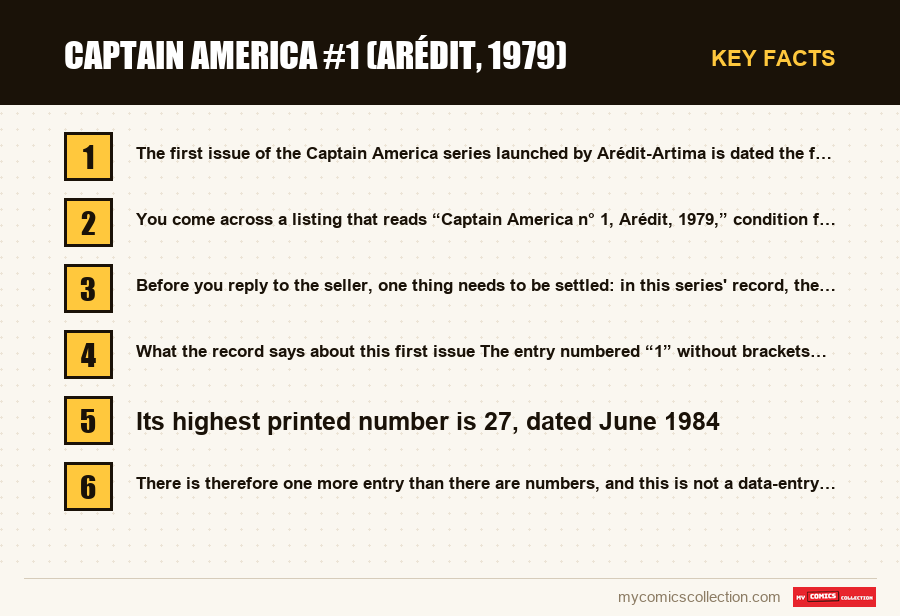
The first issue of the Captain America series launched by Arédit-Artima is dated the first quarter of 1979. The catalog credits Stan Lee on writing and three artists, Jack Kirby, Jim Steranko and Gene Colan, for a single recorded title. Be careful: a second entry carries the same quarter with a hardback binding mention, so a listing for “issue 1” can refer to two distinct objects.
You come across a listing that reads “Captain America n° 1, Arédit, 1979,” condition fair, photo of a folded spine. Before you reply to the seller, one thing needs to be settled: in this series' record, the first quarter of 1979 has two entries, not one. One is numbered without ambiguity, the other comes with a hardback mention and a reconstructed number. Until you know which of the two you are buying, you are not negotiating anything, you are gambling.
As always on this guide, only verified information (creators, issue numbers, dates) is stated as fact; the analysis is our own, with no reproduction of panels or protected dialogue.
What the record says about this first issue
The entry numbered “1” without brackets is dated the first quarter of 1979. The writing is credited to Stan Lee. On art, three names appear side by side: Jack Kirby, Jim Steranko and Gene Colan. And a single title is recorded: “Les Dents de la Mer - 2e Partie” (the French title of the shark film, part 2).
This imbalance between one title and three artists is already information in itself. French comics of the period assembled several episodes per issue, sometimes drawn from different American series. The record keeps only one title per entry: it does not describe the contents, it gives a fragment of them. The three artist names, on the other hand, cover the whole issue. In other words, you know who worked on this issue, but not who drew what, nor how many stories it contains.
For this reason, nothing in these few lines allows us to say which American issue this first number corresponds to, or whether it contains the first French publication of a given character. On this point the sources disagree, and the only honest answer is to open the copy.
Twenty-eight entries for twenty-seven issues
The record for this series holds twenty-eight entries. Its highest printed number is 27, dated June 1984. There is therefore one more entry than there are numbers, and this is not a data-entry error: the first quarter of 1979 is represented twice, once by the issue numbered 1 and once by an entry carrying the hardback mention.
For a collector, this one-entry gap has a very concrete consequence. If you count the lines of a record to find out how many pieces you are missing, you count twenty-eight boxes while the printed numbering offers only twenty-seven. You will believe you are one issue behind on a ghost number. Conversely, if you treat the hardback as a mere variant and remove it from your count, you risk missing a physically different object, one that does not file like a comic and does not turn up in the same lots.
Bracketed numbers cannot be read on the object
Four entries in this record carry a number in square brackets. Three of them correspond to ranks 2, 3 and 4, which never appear in bare form, and the fourth is precisely the hardback entry of the first quarter of 1979. The brackets are a cataloging convention: they signal a number reconstructed by deduction, from the position in the sequence or from the date, and not a figure read on the cover or the indicia of the copy.
The practical lesson is simple. For ranks 2 to 4, do not look for a large printed number, you may not find one. Date the copy by what is actually on it: the quarter printed on the cover or the spine fold, the printed price, the list of titles announced on the last page. These three entries fall in the second quarter of 1979 for two of them and the third quarter of 1979 for the last, which gives a narrow and usable dating frame.
So be wary of a seller who is very assertive about a “no. 3” of this series: if they do not show where the number comes from, they have probably copied it from a record where it already appeared in brackets. Ask for a photo of the bottom of the cover.
Behind “issue 1,” two possible objects
Here is the point that gives this record its real interest. Two entries share exactly the same date, the first quarter of 1979. The first is the softcover issue numbered 1, with Stan Lee on writing and three artists. The second is reconstructed in brackets, carries the hardback mention, has no recorded title, no recorded writer, and a single artist name, Jack Kirby.
The emptiness of the second line is not trivial: a hardcover collecting several installments is not described like a comic, so the catalog leaves it largely unrecorded. For you, this means that a listing for “issue 1” can cover two realities: the original softcover, or a bound object, thicker and heavier, which is not measured or graded the same way.
The reflex to adopt comes down to two questions before any payment. What is the thickness at the spine, by asking for a photo of the edge laid flat? And is the spine stapled, or glued under a rigid cover? The answer tells you immediately which family you are in, and it changes the condition grid to apply: a staple fold has no equivalent on a hardback, whose weak points are blunted corners and split hinges.
The recorded title, and the trap of advertising pages
The title recorded for issue 1 is “Les Dents de la Mer - 2e Partie.” The form resembles that of a story cut into episodes, and one might be tempted to conclude that the issue opens on the continuation of a story. Caution: in this series, several recorded titles are not stories at all.
The record gives examples that leave no doubt. It includes “Arédit présente 4 albums Super Star,” “Voici la collection Super Star,” “Albums déjà parus,” or “Ces albums sont en vente chez votre fournisseur habituel.” These are in-house advertising pages, through which the publisher pushed its own catalog inside its comics. Other titles relate to current events rather than fiction, such as those announcing a superhero on the big screen, or the one from spring 1983 devoted to the life of Pope John Paul II.
Two other lines complete the demonstration. Issue 11 is recorded as “Captain America et Spider-Man,” and issue 13 as “Captain Comète et Superman” (Captain Comet and Superman). A title citing Superman in a French-language Marvel series cannot be the main story: it is the announcement of another publication from the same house. The conclusion for your issue 1: the recorded title tells you that a page carries this heading, not that the comic tells this story. As to its exact nature, the sources disagree, and only the table of contents of your copy will settle it.
Do you collect this series?
Track what you own, what you are missing and what your collection is worth. 7-day trial.
Start my trial →
What sets this issue apart from the following ones
The series starts on an announced quarterly rhythm, and the record shows that each quarter of 1979 and 1980 in fact received two issues: ranks 2 and 3 share the second quarter of 1979, ranks 6 and 7 the fourth. Issue 1 therefore belongs to a dense phase, where releases followed one another quickly and readers had no reason to keep the first issue rather than the second.
A second peculiarity is the dating itself. Up to rank 15, in 1981, the record only logs quarters, with one line even writing out the fourth quarter of 1980 in words instead of the usual numeral. From rank 16, in February 1982, the dates become monthly. Issue 1 sits on the old side of this switch: you will find no printed month on it, and any listing that claims to sell you a “January 1979” copy of this series has invented a precision the object does not carry.
Finally, there is a gap at the hinge: between rank 15, third quarter 1981, and rank 16, February 1982, the record logs nothing. This silence calls for vigilance rather than proving an absence.
What to look at on the object before buying
Start with the spine, since it is what separates the two possible objects of the first quarter of 1979. Visible staples and a soft cover on one side, a rigid cover and a glued spine on the other. On a softcover, examine both staples: rust stains the paper in a halo and runs through the first leaves, which is irreversible and weighs more than a dog-eared corner.
Next, check that the block is complete. The internal advertising pages, the ones carrying the collection titles recorded in this series, are the first to be torn out by former readers who wanted to keep an order form. Count the leaves at the center of the book, which is where gaps show up best. Also note the full table of contents: it is the only document that tells you what your copy really contains.
Finally, look at the fold and the last page. The quarter, the printer's mention and the list of announced titles form a dating cluster far more reliable than the number displayed by a seller. If these three elements contradict each other, abstain or ask for additional photos before committing to anything.
What its relative scarcity rests on
This first issue is not scarce because it was printed in small numbers, and no one can claim that from a record of contents. Its scarcity is one of condition and recognition, and it rests on three identifiable mechanisms.
The first is format and support. A popular comic from 1979 to 1984, sold at newsstands and in press shops, read and then stacked, rarely reaches fine condition without having been protected very early. The second is the numbering confusion described above: when four entries out of twenty-eight carry a reconstructed number, part of the market describes poorly what it sells, and the early-series copies circulate under approximate labels. The third is the duplication of the first quarter of 1979, which spreads demand across two objects and blurs the benchmarks for comparison.
The practical consequence is that it is better to reason in ratios than in levels. Compare the value of a complete, flat softcover number 1 against a copy of the same rank with a rusted spine, then against the hardback of the same quarter. These three ratios, measured on sales actually concluded rather than on asking prices, will give you a usable scale, one that stays valid even when the market moves.
Keeping a list of gaps that does not mislead you
A gap list copied straight from this record will mislead you in both directions, and this is the most common criticism of improvised tracking sheets.
In one direction, it will count boxes that do not exist in the expected form: twenty-eight lines for twenty-seven printed numbers, with rank 1 present twice. You will search endlessly for a softcover that is in fact only the hardback entry of the same quarter. In the other direction, it will forget things: if you decide to merge the two lines of the first quarter of 1979 to get back to a round count, you erase from your tracking an object you do not own and will therefore never look for.
The method that holds up is to separate three columns in your inventory: the rank as printed on the object, the reconstructed rank when the object carries nothing, and the physical nature of the support. With these three columns, the four bracketed entries of this series stop being a problem and become what they are, a documented uncertainty. If you also maintain a character hub, for example around Captain America, record the tables of contents you verify there: it is the only way to gradually reconstruct what the catalog does not keep.
Frequently asked questions
The record places it in the first quarter of 1979, with no month. That is the maximum precision the object carries for that period, since the series only adopted monthly dates from its sixteenth rank, in February 1982. A listing that gives you a specific month for 1979 adds information the cover does not contain.
Because one is the softcover issue numbered 1 and the other a reconstructed entry with a hardback mention. The second has no recorded title or writer, and a single artist name, Jack Kirby. These are two distinct objects, and a listing for “issue 1” can refer to either one without the seller being aware of it.
They indicate a rank deduced from position and date, not read on the copy. Four entries in this series are in that situation, including ranks 2, 3 and 4, which never appear in bare form. For these issues, date by the printed quarter and the titles announced on the last page rather than by a number on the cover.
Nothing allows us to say so. In this series, several recorded titles are in-house advertising pages, promoting the publisher's album collection, or current-events pages. The sources disagree on the nature of this line, and only the table of contents of your copy will settle it.
The highest printed rank is 27, dated June 1984, but the record lists twenty-eight entries because of the duplication in the first quarter of 1979. So aim for twenty-seven numbered ranks, and treat the hardback as a separate piece in your inventory rather than as a missing number.