
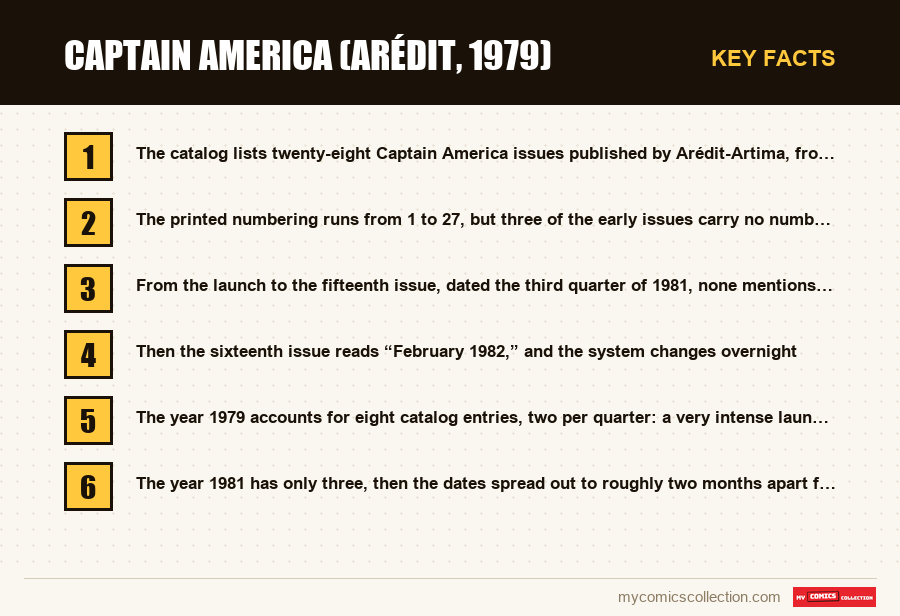
The catalog lists twenty-eight Captain America issues published by Arédit-Artima, from the first quarter of 1979 to June 1984. The printed numbering runs from 1 to 27, but three of the early issues carry no number on their cover: these are the ones missing from lots sold as complete. The series changes dating system twice, and that detail is enough to reclassify an entire stack.
You have a pile of pocket-sized comics, the hero's name written in English on the cover, and no idea what order to file them in. If the dates say quarters on some and months on others, you do not have two series: you have the two halves of a collection that changed pace along the way. Finding where the switch happens is the first thing to establish.
As always on this guide, only verified information (creators, issue numbers, dates) is stated as fact; the analysis is our own, with no reproduction of panels or protected dialogue.
What the comic published
The catalog holds twenty-eight entries for this series. Each gives an issue number, a cover date, a writer, pencillers, and a single page title. That last point is crucial: a comic of this kind stacked several episodes together, so the title kept in the record never describes the full contents.
The creators recorded make the nature of the material unambiguous: Stan Lee writing the first issues, then Gary Friedrich, then Steve Englehart; Jack Kirby, John Romita, Gene Colan, Marie Severin, Sal Buscema and Gil Kane on art. The comic is not a local creation; it is a reprint vehicle. So you are not hunting a story that cannot be found elsewhere, but a specific format, with its paper, its in-house advertising pages and its numbering. That format cannot be replaced.
Marvel outside the dominant circuit
In the late 1970s, most translated Marvel comics in France circulated through the magazines of another publisher, the ones everyone knew from the newsstand. This series comes from elsewhere: the imprint recorded in the catalog is Arédit-Artima. A collector who built his knowledge of French Marvel on the main circuit will not recognize these comics, and that is why they get lost.
This off-center position still shows up on the secondhand market. When one of these comics lands in a box, it is described vaguely, filed with something else, or sold on its own without anyone looking for its place in a series. You often buy them cheaper, but you buy them blind.
The non-substitutable character is the key point. If you are looking for one specific story in French, other editions will provide it. If you are looking for this comic, no recent reprint or omnibus will replace it: it exists only in its original print run, spread over a little more than five years.
Three publishing rhythms in five years
The cover dates tell what the issue numbers alone do not. From the launch to the fifteenth issue, dated the third quarter of 1981, none mentions a month: everything is expressed in quarters. Then the sixteenth issue reads “February 1982,” and the system changes overnight.
This switch is not just a printer's quirk. It means that sorting by cover date alone will produce disorder if you mix the two logics. The right habit is to sort by issue number, then use the date to check that you have not swapped two copies whose numbers are rubbed off or torn away.
The pace changes too, twice. The year 1979 accounts for eight catalog entries, two per quarter: a very intense launch, typical of a title meant to get into newsstands fast. The year 1981 has only three, then the dates spread out to roughly two months apart from February 1983, up to the final issue of June 1984. The end of the series is therefore more regular than the beginning, but slower.
This translates into uneven hunting difficulty. The launch issues, printed and distributed over a short period, turn up more often, sometimes several copies in the same lot. Those from the slow year and from the very end circulate less: put them at the top of your search list.
The three issues with no printed number
Here is the trap specific to this series, and it is a serious one. Between the first issue and the fifth, the catalog records three entries whose number appears in square brackets, meaning it was reconstructed in order of publication because the object did not carry it. They fall in the second and third quarters of 1979, right after the launch.
The recorded contents are indeed those of the series: Stan Lee and Larry Lieber on writing, Marie Severin, Gene Colan, Don Heck and Frank Bolle on art. These are regular issues of the collection, except that they do not announce their rank.
The consequences are very concrete. A lot offered as “1 to 27” can look complete and still leave you with a gap of three pieces, because the seller counted the printed numbers rather than the comics. Conversely, whoever owns these three objects cannot name them, lists them without a number, and nobody finds them. So never ask “which numbers do you have,” but ask for the count of comics and the dates of those that show no number.
The hardback of the first quarter of 1979
The catalog distinguishes, in the first quarter of 1979, an entry described as a hardback, with Jack Kirby on art, and on the same date an entry numbered 1. So two objects with different bindings exist from the very start of the series.
This is valuable information, and a source of buying mistakes. If a listing shows a rigid object, do not assume it is the same piece as the softcover issue of the same date: check the binding in the photos, both the back and the spine edge. An exhaustive collection aims for both formats; a collection limited to softcovers should say so in its inventory so as not to mistake the gap for a missing piece. Finally, note that this hardback entry carries no page title in the catalog: you have to open it to know what it contains.
Do you collect this series?
Track what you own, what you are missing and what your collection is worth. 7-day trial.
Start my trial →
The creators who structure the series
The names recorded form clear blocks, much better landmarks than the numbers for knowing where you stand. On writing, Steve Englehart holds a continuous run from the eleventh issue, dated the third quarter of 1980, to the sixteenth, in February 1982. These six consecutive issues cross the dating switch described above: it is the only block that spans both systems, which makes it an excellent anchor point when you reconstruct an order.
On art, Sal Buscema is the most present hand in the series: he appears from the sixth issue, in the fourth quarter of 1979, and his name recurs up to the one from February 1984. If you retain only one name to recognize the heart of this collection, it is his. At the other end, Roger McKenzie signs most of the issues from June 1983 to June 1984: his name in a listing places you in the final stretch.
Jack Kirby, for his part, frames the series: present on the hardback from the very beginning, he returns as writer and artist on three issues of 1982. This grouped reappearance deserves to be known, because it creates a localized demand: Kirby fans buy these three objects without caring about the rest, which makes them more contested than their immediate neighbors. The same logic, more discreet, applies to the April 1984 issue where the catalog records John Byrne. At the other extreme, Jim Steranko is credited on around ten entries up to the second quarter of 1981, then disappears: his name is a reliable indicator of the first half of the series.
What the indexed pages reveal
One detail of the record looks like an error but is a mine of information. For many issues, the recorded title is not an episode title but an advertising tagline: “Albums déjà parus,” “Voici la collection Super Star,” “Ces albums sont en vente chez votre fournisseur habituel.” The record keeps only one element per issue, and that element is frequently an in-house promotional page.
This teaches you two things. First, that these issues served as sales vehicles for the publisher's other collections, which explains the wording addressed to the “usual supplier.” Second, and this is useful for authentication, that these pages are part of the object: a copy from which they have been removed is incomplete, even if the story itself is intact.
Some of these pages date the object better than a stamp would. Two issues from 1979 carry an advertisement for a Marvel hero who had moved to the big screen, the announcement of the television adaptation of Hulk; the tenth, in the second quarter of 1980, announces Captain America on screen; the first refers to the sequel to a shark film released shortly before. Later, a page from April 1983 mentions the life of Pope John Paul II, and others point to Conan specials or to the Epic collection. The one from February 1984 carries a tagline about the end of a black-and-white publication: take it as an announcement printed in the object, to be checked on the copy, and not as proof that this series changed process.
A few taglines, on the other hand, are indeed translated titles: “L'imposteur,” “Le royaume des ombres,” “Objectif... Terre !,” “El Toro.” One issue also mentions the hero alongside Spider-Man. These mentions indicate what is present, never what is absent: the rest of the contents must be verified with the copy in hand.
Recognizing the edition, and searching under a name that stayed English
First identification rule: the publisher's imprint, which the catalog attaches to Arédit-Artima, and which you look for on the cover or the last page. Second rule: the wording of the date. A quarter written out places you before autumn 1981; a month places you after. Third rule, less obvious: the interior taglines name a collection of albums specific to this publisher, a sign of belonging more reliable than the cover logo, which is often illegible in a blurry listing photo.
Then comes the problem of the name. On this title, the hero's name was not translated into French, unlike what was done for other characters published in French at the same time. Bad news for searching: your query brings back American comics, recent editions and merchandise in far greater numbers than the issues you want. So always pair the hero's name with the publisher's name, and add a word describing the date. For the three issues without a number, search by date and watch lots described by the stack.
Condition of a copy and buying traps
These comics always suffer in the same places, and knowing this keeps you from paying for a defect that cannot be seen in a photo. The folded spine first: stapled, read and folded, the object keeps a whitened central mark that nothing corrects. Corners rounded by friction in a stack next, then yellowing, which here is the norm rather than an anomaly.
Three checks are worth an extra request for photos. The staples, whose rust and enlarged holes announce pages that will come loose. The pagination: ask for the last page before the back cover, since that is where the promotional pages tend to disappear. And the inscriptions, finally, since this format was often marked in pen by a dealer or a young reader.
The costliest trap, however, is descriptive. A listing that speaks of a “complete” set while quoting an arrival figure tells you nothing useful here, for the reason explained above. Have the comics counted.
Completing the series and tracking its price
The effective strategy here is the reverse of the usual one. Rather than aiming for the prized pieces, build the middle of the series first, which circulates in lots, then deal separately with the four singular objects: the three issues without a number and the hardback from the start. Those cannot be bought by searching for them; they are recognized in poorly described listings.
On value, two principles hold without citing any amounts. The price gap between a creased copy and a flat copy is, for this kind of comic, proportionally wider than for a thick magazine: there is less material, so each defect weighs more. And the rarity of this series is poorly understood, for lack of catalogs that publish its details; a precise description, with the count of comics and the dates, is worth more than a flattering adjective, whether you are buying or selling.
So inventory each copy with its cover date as printed, quarter or month, and not just its number. That double entry is what will let you prove that an unnumbered issue belongs where it is, and see at a glance that your slow year is incomplete.
Frequently asked questions
The catalog holds twenty-eight entries, while the printed numbers stop at twenty-seven. The gap comes from the issues recorded with a reconstructed number, because the cover shows none, and from the hardback at the start. So count the physical comics, never the numbers quoted in a sales listing.
Because the series changed its dating system along the way. The dates stay quarterly up to the third-quarter 1981 issue, then switch to months from February 1982. Your copies do belong to the same collection: sort them by number, and use the date as a check.
No, and this is a documented feature of this series: three 1979 issues do not show their rank. Check the publisher's imprint, the cover date and the presence of the in-house promotional pages. If these three elements match, you hold a normal piece, simply one that is hard to name.
Nothing in the available data allows us to say so. The record keeps only one title per issue, and that title is often an advertising page, not an episode title. To match it with an American edition or establish a French precedence, you need to open the copy and record the full contents.
Demand concentrates where the creators attract buyers from outside the series: the three 1982 issues the catalog attributes to Jack Kirby, the April 1984 issue featuring John Byrne, and the run signed by Steve Englehart from the third quarter of 1980 to February 1982. Added to these, for sheer hunting difficulty, are the issues with no printed number.