
The best budget entry points for Wonder Woman: Wonder Woman #1 (1987, George Pérez reboot, €15-25), #164 (first Adam Hughes cover run, €5-12), and the Rucka/Simone runs at €2-5 per issue. The Wonder Woman catalog is vast and largely underrated compared to Batman or Superman.
Wonder Woman is the third pillar of the DC trinity with Batman and Superman, but her back issues are significantly less expensive than those of her male colleagues. This historic undervaluation of the market is a golden opportunity for budget collectors: quality complete runs can be found at a fraction of the price of an equivalent Batman run.
With the success of the Gal Gadot films and the growing interest in female characters in comics, prices could rise. So now is the perfect time to build a solid Wonder Woman collection at a low price.
Affordable Wonder Woman key issues
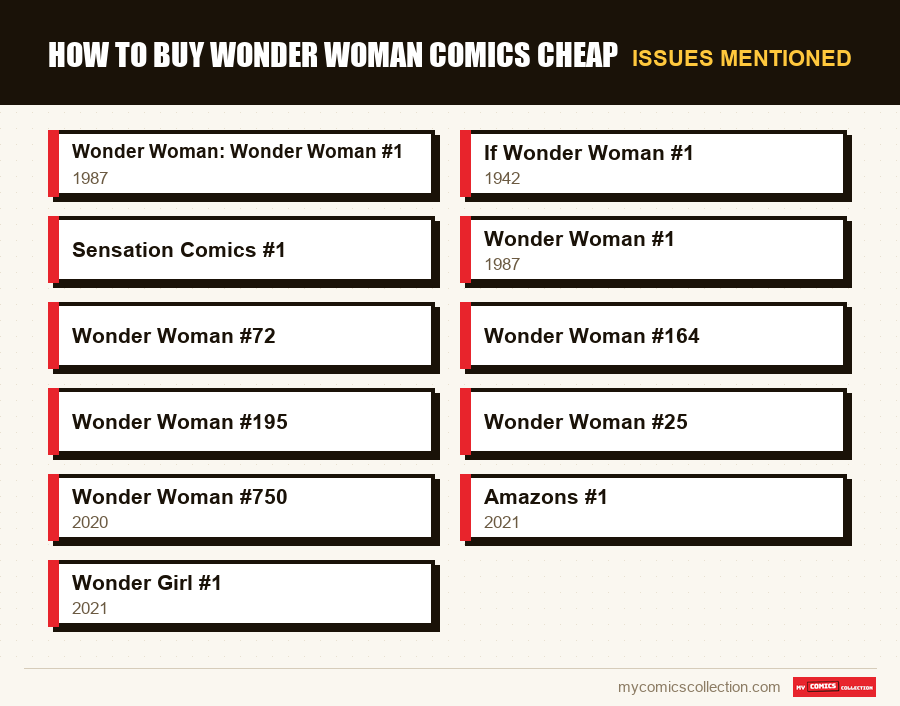
If Wonder Woman #1 (1942) and Sensation Comics #1 are in the stratosphere of Golden Age awards, George Pérez's post-Crisis reboot (1987) offers a remarkably accessible historical entry point for a #1 of such an iconic character.
Key numbers under €25
- Wonder Woman #1 (1987, Pérez): €15-25 in mid-grade, one of the best quality/price ratios DC
- Wonder Woman #72 (start of Bolland covers): €5-10
- Wonder Woman #164 (start of Adam Hughes cover run): €5-12
- Wonder Woman #195 (start of Greg Rucka run vol. 1): €4-8
- Wonder Woman #1 (2006, Allan Heinberg): €4-8
- Wonder Woman #1 (2011, New 52, Azzarello/Chiang): €8-15
Check out our complete guide to Wonder Woman key issues for all the first appearances and historical moments of the Amazon.
Underrated Runs to Grab
The George Pérez run (#1-62, 1987-1992) is the most acclaimed, but even the current numbers from this period remain affordable. The runs that follow are even cheaper despite often excellent narrative quality.
Particularly accessible periods
- Wonder Woman vol. 2 #63-136 (post-Pérez, Messner-Loebs then Byrne): €1-3 per issue
- Wonder Woman vol. 2 #137-226 (Jimenez, Rucka): €2-5 per issue
- Wonder Woman vol. 3 #1-44 (2006-2010): €2-4 per issue
- Wonder Woman vol. 4 #1-52 (New 52, Azzarello/Chiang then Finch): €2-5 per issue
The Pérez run: accessible quality
- Wonder Woman #1-24 (Pérez): €3-8 per current number (excluding #1)
- Wonder Woman #25-62 (Pérez): €2-5 per number
- Run Pérez complete (#1-62): estimate €120-180 depending on the state
Where to find Wonder Woman cheap in France
Wonder Woman is less common than Batman in French stores, but remains regularly available. As demand is lower, prices are often negotiable.
- eBay.fr and eBay.com: full Wonder Woman runs often underbid
- Agreements: DC bins systematically contain Wonder Woman at low prices
- MyComicShop: excellent stock with precise grades, frequent promotions
- Dollar bins: Wonder Woman is one of the most popular DC titles in discount stores
Budget strategy for Wonder Woman
Wonder Woman has the advantage of having a single main title (with a few exceptions), which makes the run easier to follow than Batman or Superman with their multiple parallel series.
Advice : The Pérez run (#1-62) is the ideal starting point: narratively excellent, historically important, and doable for €120-180. If you're on a tighter budget, the Azzarello/Chiang run (New 52, #1-35) is a brilliant reinvention available for €50-80 full. Both are finished, consistent runs.
Modern keys Wonder Woman under €20
- Wonder Woman #1 (2016, Rebirth, Rucka): €5-10
- Wonder Woman #750 (2020, legacy anniversary issue): €5-10
- Wonder Woman #1 (2023, Tom King): €4-8
- Nubia and the Amazons #1 (2021): €3-6
- Wonder Girl #1 (2021, Yara Flor): €4-8
Wonder Woman #750 is a historic legacy issue (a tribute to continuous numbering since 1942) with multiple variant covers, all accessible under €15.
Build your amazon collection stress-free
From Pérez to King, Wonder Woman has hundreds of issues spanning several volumes. My Comics Collection tracks your progress and identifies your missing items by era.
🚀 Free trial 7 days, No obligationFinding your way through the Wonder Woman volumes
A beginner's first instinct is to search for "Wonder Woman #1" and land on several issues sharing the same number. That is normal: the series has been relaunched many times, and each relaunch restarts at a new issue 1. To buy without mistakes, think in terms of volumes rather than bare issue numbers.
The main periods to know
- 1942: the character's Golden Age debut, with Sensation Comics #1 and Wonder Woman #1. These are museum pieces, out of reach for most readers.
- 1987: George Pérez's reboot, which starts over with a new #1 and runs to #62.
- After Pérez: volume 2 continues for more than two hundred issues, with Messner-Loebs then Byrne, Jimenez and Greg Rucka.
- 2006: a fresh start with Allan Heinberg's #1 (volume 3).
- 2011: the New 52 run by Azzarello and Chiang (volume 4).
- 2016 then 2020: Rebirth with Greg Rucka, then #750, which restores continuous numbering from 1942.
- 2023: a new #1 by Tom King.
Three habits before buying
Check the cover year. A listing that only says "#1" does not tell you which volume it is. Compare the publication date and the creative team with the one you are after.
Tell standard covers from variants. #750 exists with many covers. If you are completing a collection, the main cover is enough and is the easiest to find again; variants are a collector's choice, not an obligation.
Favor finished runs. Unlike open-ended series, the Pérez and Azzarello/Chiang runs form coherent sets with a beginning and an end. Lots that bundle them are often better value than buying issue by issue, as long as you check the condition of each copy.
Reading and collecting at the same time
If you are discovering the character, start with the beginning of the Pérez run: it introduces the Amazon, Themyscira and her allies in a setting designed for new readers. You can then pick the era that appeals to you (Rucka for the political and mythological tone, Azzarello for the fantasy side) without having read the rest. That freedom is good for the budget: you do not need to buy everything to follow the story.
Frequently asked questions
George Pérez's 1987 reboot #1 is the best entry point: it is a historic first issue that remains accessible for such an iconic character. The Pérez run (#1-62) then makes a coherent set, narratively excellent and achievable as a lot.
The market has historically undervalued her back issues compared with those of her fellow members of the DC trinity. Complete quality runs can be found at a fraction of the cost of an equivalent Batman run, which makes her an opportunity for tight budgets.
It depends on your goal. The key issues (the 1987 #1, #164, #195) are enough for a targeted collection, while the Pérez or Azzarello/Chiang runs, which are finished and coherent, lend themselves well to buying as a lot.
No. This anniversary issue exists with many variant covers, all of which remain affordable. To complete a series the main cover is enough; variants are a collector's choice.
Conventions, with their DC bins, and discount bins regularly hold issues of the series. Since demand is lower than for Batman, prices are often negotiable and complete runs are sometimes under-bid in online sales.