
In short
The Blue Marvel, Adam Brashear, first appears in Adam: Legend of the Blue Marvel #1, cover-dated November 2008, written by Kevin Grevioux with art by Mat Broome. The five issue Marvel miniseries presents a hero of the 1960s, a former Cornell fullback and Korean War Marine turned physicist, whose old friend Conner Sims later returns as the villain Anti-Man. Grevioux, who conceived the character in his youth, is the credited creator alongside Broome.
Most key issue hunts follow a hero who debuted decades ago, so a number from 2008 asks for a different kind of attention. Adam: Legend of the Blue Marvel #1 is a modern book with a Silver Age mythology built into it, and the collector's job is to separate what the issue actually introduced from the many later appearances that built the character's reputation.
Before publishing, we checked the November 2008 date on the cover, the credits for Grevioux and Broome, the length of the miniseries and each later Brashear appearance named on this page against published histories of the character and of his writer. The condition notes and the reasoning on how to rank the issue are our own analysis, with no dialogue quoted and no pages reproduced.
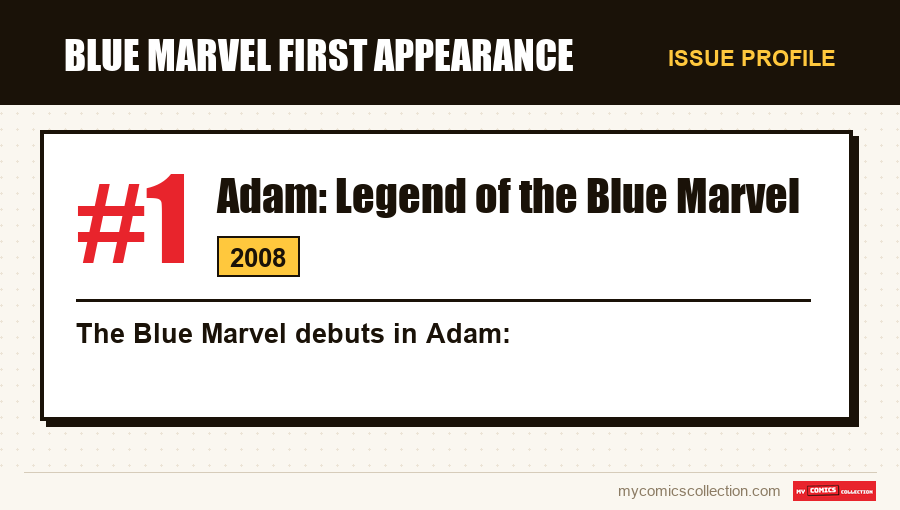
The issue at a glance: Adam: Legend of the Blue Marvel #1
The book is Adam: Legend of the Blue Marvel #1, published by Marvel Comics with a November 2008 cover date. Kevin Grevioux is credited with the script, and Mat Broome with the art; across the run the miniseries was drawn by Broome and Roberto Castro. The series is a limited run of five issues, published from November 2008 to May 2009, which makes it a compact object: one number to chase for the debut and four more to complete the story.
Inker, colorist and letterer credits are left out here. If a listing names an inker, check the credits box printed inside the copy before relying on it.
Two features make the book easy to misread. Its title begins with the character's real name, Adam, rather than with the hero name, so a search for "Blue Marvel #1" can miss it. And the miniseries is a standalone story rather than an issue of an Avengers title, so it will not turn up in a run of any ongoing team book. The number to write on a want list is the full title, the issue and the year.
How the Blue Marvel is introduced
The miniseries presents the Blue Marvel as a hero from an earlier era, someone whose career belongs to the 1960s and who was pushed out of public life. In 1962 he is outed as Black and forced to retire, and the story asks what lies behind the return of a figure with that kind of past.
The character himself is Adam Bernard Brashear, a former Cornell fullback and a veteran who served in the Marine Corps during the Korean War. He holds a doctorate in theoretical physics, and his work on harnessing anti-matter from the Negative Zone leads to the accident that defines him. The reactor becomes unstable, and the radiation exposes Brashear and his friend Conner Sims. Sims is turned into energy, and Brashear becomes what the story describes as an antimatter reactor in human form.
Later issues in the miniseries expand the picture. In Adam #2 and #3, from February and March 2009, Brashear gives up the Presidential Medal of Freedom that President Kennedy awarded him, leaving it on the Blue Area of the Moon. He then faces an alien armada, and the United States government fakes his death. By the time of the present day story he is a tenured physics professor at the University of Maryland. In #5, from May 2009, he confronts Sims, who has returned as the villain Anti-Man.
The 1960s setting gives the book a layer that most modern debuts lack. A president's medal, a Cold War era scientist and a hero who steps out of public life all point to an earlier decade, while the story is told for readers of 2008. Read that way, the miniseries works as a modern comic that carries a Silver Age style history inside it, and a collector shopping for it is buying a contemporary book with a retro premise rather than a vintage one.
For a collector, the important point is that issue #1 sets up the premise and the hero, while the backstory is laid out across the rest of the run. That is the reason a complete set of five has a logic that a single debut copy does not.
Who made it, and where the idea came from
Kevin Grevioux and Mat Broome are the credited creators of Adam Brashear. Grevioux conceived the character in his youth, well before the book reached the stands, which fits a miniseries that reads as a fully formed hero with a long backstory. Grevioux's Marvel work also includes the fourth volume of New Warriors.
The creators' backgrounds also matter for context. Grevioux's other Marvel work includes Young Avengers Presents #5 (2008) and Age of Heroes #3 (2010), the latter of which is one of the Blue Marvel's later appearances. Our page on modern age Avengers key issues places that period of Marvel's publishing in context, and our Avengers hub collects the team's own books.
Why #1 is the key issue
The argument for the debut rests on a straightforward chain. The Blue Marvel is a character who moves from a standalone miniseries into the main Marvel Universe. He rejoins as a full time hero in Age of Heroes #3, cover-dated September 2010, where he helps the Winter Guard against King Hyperion. In 2013, during the Infinity crossover and the Marvel NOW relaunch, he joins Luke Cage's team in Mighty Avengers, with appearances in volume 2 #2 and #3 and again in #12, from July 2014. In 2015 he becomes a member of the Ultimates, appearing in The Ultimates volume 2 #1 to #4 and #9. His powers and background are also summarized in The Official Handbook of the Marvel Universe A to Z Update #1.
It also helps to count the distinct creative teams involved. The debut comes from Grevioux and Broome, the 2010 return from Age of Heroes, the 2013 and 2014 appearances from the Mighty Avengers team, and the later appearances from the Ultimates team. Four different publishing contexts keep returning to a character who started in a five issue miniseries, and that spread is what gives the debut its standing.
Each of those steps points back to the 2008 miniseries. A character who joins Luke Cage's Mighty Avengers and then the Ultimates, is a character whose origin story people look for. For a modern book, that is a solid reason to expect continuing interest, although it does not set the terms for any individual copy.
The weaker point of the case is the one a good collector acknowledges: the miniseries is a modern book, so any premium for a copy comes from condition and demand rather than from age. The distinction matters when you plan how much to spend and how long to wait. It argues for patience and for checking several copies rather than rushing to the first one that appears.
Do you collect this series?
Track what you own, what you are missing and what your collection is worth. 7-day trial.
Start my trial →
Reprints, collections and look-alike listings
A search for the Blue Marvel's debut returns a mix of books, and a careful buyer separates them.
- Adam: Legend of the Blue Marvel #1 (November 2008): the debut comic, the one this page covers.
- Adam: Legend of the Blue Marvel #2 and #3 (February and March 2009): the middle of the story, with the medal and the faked death.
- Adam: Legend of the Blue Marvel #5 (May 2009): the confrontation with Anti-Man.
- Age of Heroes #3 (September 2010): the return to the shared universe.
- Mighty Avengers volume 2 #2, #3 and #12 (2013 and 2014): the Avengers appearances.
- The Ultimates volume 2 #1 to #4 and #9 (from 2015): the Ultimates run.
The cover date on copies reads November 2008, and a store may describe the on sale month differently because the cover date and the shipping date are two different things. If a listing names another month, trust the printed cover and ask the seller for photos of the front and the indicia box. Also check for printing markings: a copy described as a later printing is a different purchase from the original issue.
Series names deserve the same care. Mighty Avengers has more than one volume, and the 2013 relaunch belongs to volume 2. The Ultimates also has several volumes, and the appearances above come from volume 2. A bare issue number without a volume is not enough to identify a book.
Vetting a copy of Adam #1
A modern comic is usually available in high grade, so the question is less whether a good copy exists and more how to tell a well kept copy from an average one. This method uses no prices.
- Confirm the title, the number and the date. The cover should read November 2008 and show the full Adam: Legend of the Blue Marvel title with the number 1.
- Inspect the spine. Small stress marks and color breaks are visible on a dark cover and often decide the difference between a very good copy and an average one.
- Check the corners and the edges. Soft corners do not always show on a small scan, so ask for large photos.
- Look at the staples and the pages. The paper should be clean and flat, with no creasing from a past reader.
- Ask about restoration and cleaning. On a recent book these are rare, but a note is cheap to ask for. Our page on how restoration affects value explains what the terms mean.
- Read the label on a graded copy. It should name the title, the issue and the year, and the number on it should match the book inside the case.
Our raw versus graded comparison weighs the two routes. For a modern book that is easy to find in good condition, a graded copy is mainly a way to remove doubt about condition, while a raw copy lets you judge the book for yourself.
The Blue Marvel appearances that follow
If you want to follow the character beyond the debut, this order keeps the story in sequence.
- Adam: Legend of the Blue Marvel #1 to #5 (2008 and 2009): the complete miniseries by Grevioux and Broome.
- Age of Heroes #3 (September 2010): Brashear rejoins as a full time hero and helps the Winter Guard.
- Mighty Avengers volume 2 #2 and #3 (2013): the Infinity period and Luke Cage's team.
- Mighty Avengers volume 2 #12 (July 2014): a later appearance with the same team.
- The Ultimates volume 2 #1 to #4 and #9 (from 2015): membership of the Ultimates.
To place those books in the larger picture of the team's publishing history, see our Infinity reading order, which covers the crossover that brought the character into the Avengers.

Frequently asked questions
The Blue Marvel, Adam Brashear, first appears in Adam: Legend of the Blue Marvel #1, cover-dated November 2008, written by Kevin Grevioux with art by Mat Broome. The series runs five issues, ending in May 2009, so the debut is the number to look for.
Kevin Grevioux and Mat Broome are the credited creators. Grevioux wrote the miniseries and conceived the character in his youth, and Broome is credited with the art, and Roberto Castro also drew part of the run.
Anti-Man is the villain of the miniseries. By issue #5, from May 2009, Brashear confronts Conner Sims, his friend from the reactor accident, who has returned as the villain Anti-Man. In The Ultimates volume 2 #3 he finds Anti-Man in Exo-Space.
In 2013, during the Infinity crossover and the Marvel NOW relaunch, he is named to Luke Cage's team in Mighty Avengers volume 2. Before that he rejoins as a full time hero in Age of Heroes #3 from September 2010, and in 2015 he becomes a member of the Ultimates.
No. It is a limited series: five issues that appeared between November 2008 and May 2009. Issue #1 introduces the character, issues #2 and #3 cover the medal and the faked death, and issue #5 brings Brashear face to face with Anti-Man. A complete set means all five numbers.
If you own Adam: Legend of the Blue Marvel #1 or another modern Avengers era book, a quick check of its condition details can help you decide what to do with it.
Estimate my comic