
Bloodshot Reborn (Valiant, 2015-2017) is Jeff Lemire's run on a programmed killer deprived of his nanotechnology. Ray Garrison, freed from the machines that controlled him, tries to live like an ordinary man in a Colorado motel, and fails. This is the best entry point into the modern Valiant universe, and can be read without knowing anything about this publisher.
Bloodshot Reborn is Jeff Lemire's run about a programmed killer trying to stop. Regularly cited as the best title of the modern Valiant era.
It is also the least known of his works for a major publisher, because Valiant has never had the visibility of Marvel or DC in France. This article explains what the run contains, why it works without knowing the universe, and how to approach a series published by a publisher whose catalog few people know.
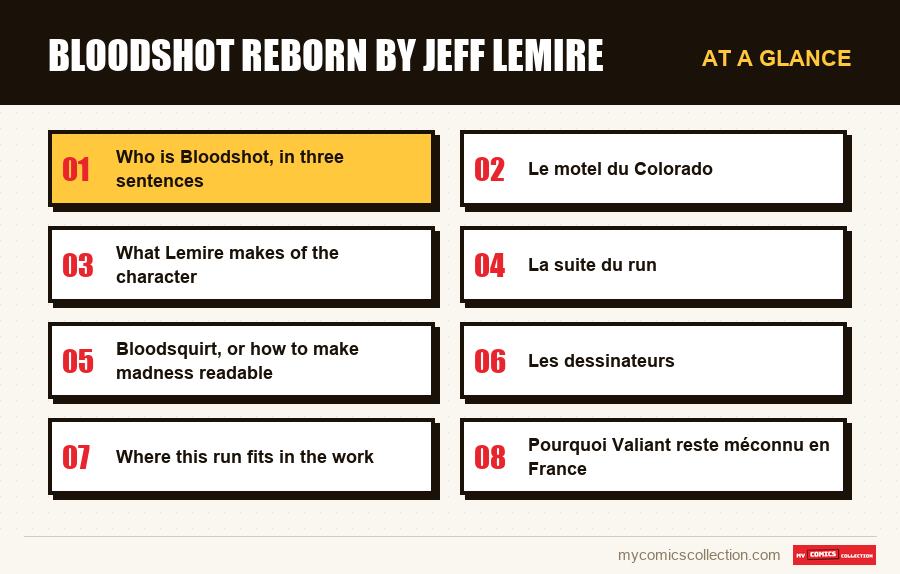
Who is Bloodshot, in three sentences
Ray Garrison is a soldier whose blood has been replaced by nanomachines. They make him almost indestructible, increase his strength tenfold, and allow him to hack any electronic device. They also create false memories for him.
This has been the heart of the character since his creation: Bloodshot doesn't know who he was. The organization that employs him implants in each mission the memory of a family to avenge, of a home to find, of a reason to kill. When the mission ends, we erase and start again.
Lemire's run begins afterwards. The nanomachines have been removed. Ray is free, alive, and has no idea who he's supposed to be.
Le motel du Colorado
The first few issues are unlike any action series. Ray lives in a seedy motel, drinks, and talks to two hallucinations: a version of himself as Bloodshot, who drives him to kill, and an animated rabbit named Bloodsquirt, who finds it very funny.
Un western contemporain
The first part of the run borrows from the twilight western: the killer who hung up the phone, the small town, the inevitable return to violence. Lemire takes his time, and the pace surprises readers who come looking for action.
Hallucinations as dialogue
Lacking an interlocutor, Ray speaks to himself in two opposing forms. The process allows an inner conflict to be externalized without a single line of exposition, and it is graphically treated in a distinct way.
A spreading threat
Other people have received nanomachines, and in turn believe they are entrusted with a mission. The violence multiplies without any big bad orchestrating it: it has become contagious.
What Lemire makes of the character
He applies exactly his usual method: taking a gender figure defined by what she does, and observing her when she can no longer do it.
Le soldat de Bloodshot Reborn is the direct cousin of the heroes of Black Hammer stuck on their farm, and the hockey player Essex County after the injury. The difference is that Ray has a chance to start again, and the run is a matter of seeing how long it lasts.
The theme of manufactured memory serves this mechanic. A man who has had all his memories implanted cannot know what he really wants, or whether the desire to stop is his. Lemire never completely resolves this question, and this is what prevents the run from ending with a reassuring moral.
Faut-il connaître Valiant ?
No for the first half
The run begins as a self-contained story. No external character, no obligatory reference. You can open it without ever having read a comic from this publisher.
Yes for the second
The series gradually opens up into the Valiant universe, with characters and organizations from other titles. Nothing is incomprehensible, but we feel that a context exists elsewhere.
Un catalogue petit
This is an advantage: the Valiant universe has few titles compared to the major publishers. Catching up on context takes a few series, not decades.
The film does not exempt
A film adaptation exists. It takes up the idea of implanted memories but follows a different plot, and has nothing to do with Lemire's run.
La suite du run
Après Bloodshot Reborn, Lemire continues with a series which directly extends the story under another title: a pattern that we find in his work, as with Descender devenu Ascender ou Royal City devenu Sonic Youth.
This is a practical point to know: looking for “the continuation of Bloodshot Reborn» under this name does not give anything. The continuity involves a change of title, which disoriented many readers and explains part of the low visibility of the run as a whole.
The recurring trap in Lemire, and it is worth stating once and for all: he regularly changes the titles of his series along the way. Descender devient Ascender, Royal City devient Sonic Youth, Bloodshot Reborn se prolonge ailleurs.
A catalog organized by title therefore suggests incomplete or completed series even though they continue under another name. The only solution is to record the numbers and note the continuity: it's exactly the kind of information you're sure to remember and then forget eighteen months later.
Bloodsquirt, or how to make madness readable
The animated rabbit deserves attention, because it is the riskiest idea of the run and the one that saves it.
Bloodsquirt is a small, curvy cartoon creature who accompanies Ray and comments on his actions with bloody enthusiasm. He only exists in his head. On paper, the idea seems catastrophic: introduce a cartoon character into a hyperrealistic story about an alcoholic killer.
It works for a specific reason. Stories about mental health almost always run into the same problem: how to show an inner voice without reducing it to an explanatory monologue. Lemire resolves the difficulty by giving this voice a body that does not belong to the same graphic world: the reader sees immediately, without being told, that what he is looking at does not exist.
The process also allows for something more subtle: Bloodsquirt is funny. It relaxes unbearable sequences, and this relaxation makes the return to violence more brutal. This is the same mechanic as the child's superhero mask in Essex County, or that Abraham Slam's costume in Black Hammer: a light element placed at the heart of a story that is not.
Collecting this series?
Track what you own, what you are missing and what your collection is worth. 7 day trial.
Start my trial →Les dessinateurs
The run changes artists several times, which is usual for a monthly series but is worth noting here, because the styles differ markedly.
Mico Suayan opens the series in a hyperrealistic, very inky, almost photographic register. It's an unexpected choice for a story that deals with hallucinations, and the contrast between this realism and the animated rabbit who appears in the same panels produces exactly the discomfort sought.
Other designers then take turns, with more classic or more stylized approaches depending on the arcs. This graphic variation is not gratuitous: it accompanies the changes in the character's mental state, and the series uses it rather than suffering it.
Where this run fits in the work
Bloodshot Reborn appeared at a time when Lemire was writing simultaneously for Marvel, DC, Valiant and Image. This is his most dense period in commissioned work, and the one where we can verify that his method works independently of the catalog.
Taken together, his runs from this period all tell the same thing in different costumes: a man defined by a function that he can no longer exercise, a memory that does not stick, an absent or reconstituted family. The killer deprived of his machines, the animal hero overtaken by his daughter, the veteran of a destroyed future: it's a single character, declined.
For a reader who wants to measure this constancy, the most telling comparison is precisely between Bloodshot Reborn et Animal Man. Two editors, two genres, two designers, and the same question asked twice.
Pourquoi Valiant reste méconnu en France
A helpful word of context, because it explains why this run is hard to find and why it's worth looking for.
Valiant is an American publisher with a small catalog, relaunched in the early 2010s with a handful of interconnected series. His strategy was the opposite of that of the big publishers: few titles, few characters, short and readable continuity. A reader could catch up with the entire universe in a few months.
This approach produced remarkable average quality, and attracted recognized screenwriters: including Lemire. It was never enough to establish the publisher in France, where its distribution remained irregular and where its characters benefited from no prior notoriety.
The consequence for the collector is twofold. On the one hand, Valiant titles are more difficult to bring together in French, and some have never been translated. On the other hand, American prints remain affordable for work of this quality: it is one of the rare places on the market where a critically acclaimed run does not come at the price of its reputation.
Formats and availability
The run exists in soft issues and collections. Valiant has also published multi-volume editions, as well as collections covering the entirety of Lemire's work on the character.
These are the best buy if you are interested in the run: they solve the problem of changing titles at once, presenting continuity in order. However, check the list of numbers on the endpapers: some volumes end before the end of Lemire's work.
The French availability of Valiant titles has been irregular depending on the periods and series. This is the main practical obstacle for a French-speaking reader, and the reason why many discover this run in the original version.
Questions fréquentes
No to begin with. The run begins as a self-contained story, with an isolated character in a motel and no obligatory references. The publisher's world gradually appears in the second half, but nothing becomes incomprehensible: at worst, we feel that a context exists elsewhere.
No plot report. The film adaptation takes the concept of implanted memories, which has belonged to the character since its creation, but follows its own story. Having seen the film neither prepares nor spoils the reading of the run.
His story continues beyond the series entitled Bloodshot Reborn, under another title. It's a recurring trap with him: looking for "the sequel" under the original name gives nothing. Check the list of numbers in the grouped editions rather than relying on the headings.
Yes, and it's assumed: the character is a professional killer, and the series never tries to soften him. Violence, however, is treated as a symptom rather than a spectacle: it occurs, it costs, and the narrative focuses on what it leaves rather than its execution. This is what distinguishes it from a classic action story built on the same material. and the series does not try to soften it. The violence, however, is treated as a symptom rather than a spectacle: this is what distinguishes it from a classic action story on the same subject.
By recording numbers rather than titles, and noting continuity between series. Lemire practices this change of title on at least three of his works, which makes incomplete collections appear as completed, and the reverse. A catalog by issue is never fooled by a cover.
One series, two titles, one collection
Save your numbers and note the continuities: never again look for a sequel that exists under another name.