
In short
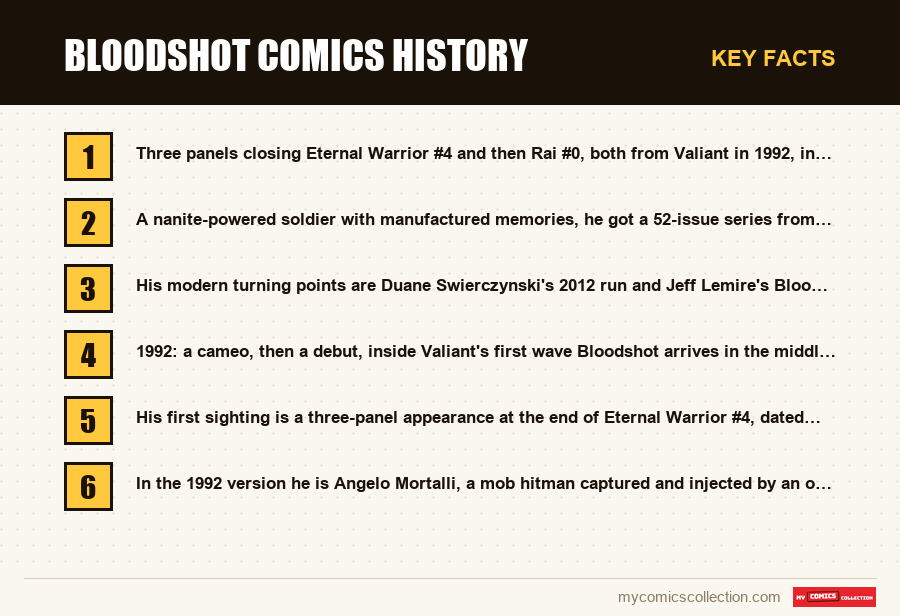
Three panels closing Eternal Warrior #4 and then Rai #0, both from Valiant in 1992, introduced Bloodshot, whom Kevin VanHook, Don Perlin and Bob Layton created. A nanite-powered soldier with manufactured memories, he got a 52-issue series from 1993, an Acclaim relaunch in 1997, and a Valiant revival in 2012. His modern turning points are Duane Swierczynski's 2012 run and Jeff Lemire's Bloodshot Reborn in 2015.
Bloodshot is a character defined by an absence: he does not know who he was. That premise has been rewritten at least three times across his publishing life, and each rewrite came with a new publisher, a new numbering and a new first issue. Following him means following a rights chain as much as a story.
We checked the VanHook, Perlin and Layton credit, the issue count of each series, the cover dates and the corporate sales of the Valiant library before writing, and left out every month we could not confirm. How the four versions compare, and what to do about it on a shelf, is our own analysis.
1992: a cameo, then a debut, inside Valiant's first wave
Bloodshot arrives in the middle of Valiant's early expansion, when the publisher founded by Jim Shooter was adding characters at speed. Kevin VanHook, Don Perlin and Bob Layton created him. His first sighting is a three-panel appearance at the end of Eternal Warrior #4, dated November 1992, and his full debut is in Rai #0, also from 1992. That makes a pair of books, one a teaser and the other a proper introduction, and a catalog should hold both.
The original concept is blunt. Bloodshot is a man whose blood is full of nanites, microscopic machines that repair his body and give him enormous strength. Their cost is memory: the nanites erase who he was, and the people running him supply false recollections to keep him pointed at a target. In the 1992 version he is Angelo Mortalli, a mob hitman captured and injected by an organization called Project Rising Spirit, and he carries a red circular scar on his chest.
The look was set from the start: chalk-white skin, red eyes and the red circle on the chest. That silhouette is the constant across the later rewrites: the backstory changes, but the white skin and the red mark stay.
The context explains why the character was built this way. Shooter's company had launched in the early 1990s with an ambition to run a tightly planned shared universe, and the 1992 books were the stretch where original characters such as X-O Manowar, Harbinger and Rai were joined by the next wave. Bloodshot, a soldier whose past is a file that other people can rewrite, fits that design as a character with no fixed history of his own.
1993 to 1996: the original ongoing series
Bloodshot #1, dated February 1993, launched the ongoing series with VanHook writing and Perlin drawing, and it carried a chromium cover. The series ran 52 issues and ended in 1996. In the middle of that stretch, Acclaim Entertainment bought Voyager Communications, the parent of Valiant, in 1994, and the books became part of what is known as the Acclaim Comics period.
For collectors the 1993 series is the central block of the original era: one title, one creative anchor at the start, and a run length that is easy to verify. It also sits in the speculative climate of the early 1990s, with enhanced covers and large print runs, which is why the Valiant key issues for 1991 to 1993 treat the first issue as a book defined by its chromium cover.
The 52nd issue closed the series in 1996, and the next attempt at the character came only with the 1997 Acclaim relaunch.
1997 to 1998: the Acclaim relaunch and a second origin
Acclaim relaunched the character in 1997 with a second Bloodshot series written by Len Kaminski, with art by Sal Velluto, which ran 16 issues and ended in 1998. The relaunch also rewrote the origin. In this version Raymond Garrison is an operative of an agency called D.O.A. who infiltrated the mob under the name Angelo Mortalli. After being killed, he was brought back with nanites through a program named Project Lazarus, and he kept partial amnesia.
That is the moment the name Ray Garrison attaches to the character, and it matters for any reader who comes to Bloodshot through the 2012 books or the film. The Garrison identity is not the one he was created with, but it is the one that stuck. The 1993 series and the 1997 series are two different books, each starting at #1, and the shared title is the first catalog trap.
The Acclaim era ended with the company itself. After losing a major sports video game license, Acclaim became financially insolvent in 2004 and later filed for bankruptcy, which left the Valiant library without an owner.
2005: the library changes hands
A group led by Dinesh Shamdasani and Jason Kothari acquired the Valiant library in 2005 and formed Valiant Entertainment. The passage of rights matters because it separates two publishing worlds: everything up to 2004 belongs to Voyager and Acclaim, and everything from the 2012 relaunch belongs to the new Valiant Entertainment.
The new owners prepared the return carefully. Gavin Cuneo joined the company in 2011 through the investment of his own firm, becoming chief financial officer and chief operating officer, and the relaunch followed in 2012. For the full corporate story, including the 2018 sale to DMG Entertainment, the history of Valiant Entertainment goes further than this article needs to.
2012 to 2014: the Summer of Valiant and a third origin
The 2012 relaunch, the Summer of Valiant, released one new ongoing title a month over four months: X-O Manowar, Harbinger, Bloodshot and Archer & Armstrong. Bloodshot #1, from July 2012, was written by Duane Swierczynski, with art by Arturo Lozzi and Manuel Garcia, and it ran 27 issues.
This is the version that fixes the modern character. He is a soldier who died and was brought back by nanites, and he believes he is Ray Garrison. His memories, however, were altered, and some of them are the recovered memories of dead soldiers. That device lets the earlier origins sit beside the new one as possible pasts rather than discarded continuity, which keeps the older books relevant.
The run also shows how Valiant's crossovers touch the title. After the 2013 Harbinger Wars crossover it was retitled Bloodshot and H.A.R.D. Corps, and after the 2014 Armor Hunters crossover it went back to its original name, with a separate Armor Hunters: Bloodshot miniseries beside it. A retitled run inside one numbering is a second catalog trap, and it means a shelf search by title will miss part of the same series.
Do you collect this series?
Track what you own, what you are missing and what your collection is worth. 7-day trial.
Start my trial →
2015 to 2018: Jeff Lemire and Mico Suayan
The creative high point of the modern character arrived in 2015 with Bloodshot Reborn, written by Jeff Lemire with Mico Suayan as artist, as part of Valiant's 2015 Valiant Next initiative. The run strips the character down to a man trying to live without being a weapon, and its tone is quieter than the action books before it. It received eight Harvey Award nominations in July 2016, and the Bloodshot Reborn guide covers the run itself in depth.
The run was supplemented by a miniseries, Bloodshot U.S.A., and a one-shot, Bloodshot's Day Off.
Lemire continued the story in Bloodshot Salvation, published from 2017 with Suayan and Lewis LaRosa on art, which ran 12 issues. Together the two runs make up the closest thing Bloodshot has to a single author's saga, and they are the natural place for a reader to stop if the 1990s books look daunting.
What distinguishes the Lemire years from the earlier versions is where the story puts its weight. The 1992 and 1997 books treat the nanites as a weapon system and the identity as a puzzle, whereas Bloodshot Reborn asks what is left of a person when the system is gone. That question is why the run reads well for someone who has never opened a Valiant book, and why it works as an entry point to the publisher.
2018 to 2022: prequels, a new volume and a mature readers title
Bloodshot Rising Spirit, from 2018 to 2019, was an eight-issue prequel by Kevin Grevioux, Lonnie Nadler and Zac Thompson with Ken Lashley on art, which went back to the program behind the character. A fourth Bloodshot series followed from 2019 to March 2021, by Tim Seeley and Brett Booth, in 13 issues.
The film closed this stretch from the outside. The film adaptation, Bloodshot, opened in United States theaters in March 2020, and the film versus comics comparison details what it kept and what it changed. In publishing terms the film landed in the middle of the Seeley and Booth series, which is one reason that volume is easy to place by date, and why a reader who came from the cinema is more likely to find that volume than the 1990s books.
In 2022 Bloodshot Unleashed, by Deniz Camp and Jon Davis-Hunt, appeared as the first mature readers title from Valiant Entertainment. The premise stays, the audience changes, and it is the latest entry point.
The key issues across his history
- Eternal Warrior #4 (Valiant, November 1992): the three-panel cameo that opens the character's publishing history.
- Rai #0 (Valiant, 1992): Bloodshot's full debut, the book that completes the pair with Eternal Warrior #4.
- Bloodshot #1 (Valiant, February 1993): the start of the 52-issue series, with the chromium cover.
- Bloodshot #1 (Acclaim, 1997): the Kaminski and Velluto relaunch, which carries the Ray Garrison origin.
- Bloodshot #1 (Valiant, July 2012): Duane Swierczynski's relaunch, part of the Summer of Valiant.
- Bloodshot Reborn #1 (Valiant, 2015): the opening of Jeff Lemire and Mico Suayan's run.
- Bloodshot Salvation #1 (Valiant, 2017): the second Lemire and Suayan series, with Lewis LaRosa.
- Bloodshot #1 (Valiant, 2019): Tim Seeley and Brett Booth's volume, the one running during the 2020 film.
How to follow Bloodshot in a collection
The main risk is the repeated first issue. Series titled Bloodshot begin at #1 in 1993, 1997, 2012 and 2019, so every copy needs its volume, publisher and cover date written down, or two unrelated books will collapse into one entry. The same applies to the 2012 run, whose retitled stretch as Bloodshot and H.A.R.D. Corps sits inside the same numbering.
A practical order is to decide the era first. A collector of the 1990s starts with the Eternal Warrior and Rai pair, then the 1993 series, while a reader of the modern character begins with the 2012 volume or goes straight to Bloodshot Reborn. Reprint collections of the Lemire run are the easiest way in for a reader who wants the story without hunting for single issues.
Chromium and enhanced covers of the 1990s need flat, careful storage, and the comic preservation guide covers sleeves and boards. For a wider view of the decade that produced the first books, the signs of a speculation bubble explains the climate in which they were printed.
Frequently asked questions
The character shows up in a short closing scene of Eternal Warrior #4 (November 1992), then gets his full introduction in Rai #0 the same year. Layton, Perlin and VanHook share the creator credit, and a solo series arrived in 1993.
The identity has changed with each relaunch. In 1992 he was Angelo Mortalli, a mob hitman. The 1997 series made him Raymond Garrison, an agent who used the Mortalli name. In the 2012 version he believes he is Garrison, but his memories were manipulated and partly belong to other dead soldiers.
At least four ongoing Bloodshot series start at #1: the Valiant series of February 1993, the Acclaim relaunch of 1997, the Valiant relaunch of July 2012, and the Tim Seeley and Brett Booth volume of 2019. Recording the year and publisher prevents confusion between them.
Most readers start with Bloodshot Reborn by Jeff Lemire and Mico Suayan, which began in 2015 and continues in Bloodshot Salvation. It tells a complete story about a man freed from the machines, while the 2012 run by Duane Swierczynski gives the modern origin.
Acclaim bought Valiant's parent in 1994, kept publishing until its 2004 bankruptcy, and the library sat idle until Dinesh Shamdasani and Jason Kothari's group acquired it in 2005. Their Valiant Entertainment relaunched the character with Bloodshot #1 in July 2012.
Holding a chromium Bloodshot #1 or an Eternal Warrior #4 from the Valiant boom? Describe it and see how it sits in the character's history.
Estimate my comic