
The most highly rated Black Widow variants are the Black Widow #1 (2014) variant 1:100 by J. Scott Campbell ($300-500), the Artgerm cover for Black Widow #1 (2019) ($150-250) and the variant Adam Hughes for Black Widow #1 (2010)($200-350).
Black Widow occupies a unique place in the variant market: its alternative covers attract collectors of the character as well as fans of pin-up art and fans of star artists like Artgerm, Adam Hughes or J. Scott Campbell. Each relaunch of the series generates variants which instantly become centerpieces thanks to the combination of the iconic character and artists with strong personal appeal.
The success of the Black Widow (2021) solo film and the continued presence of Natasha Romanoff in the MCU have consolidated an already dynamic market. The most sought-after variants combine rarity (ratio 1:50 and beyond) and recognizable artistic signature, creating pieces that appreciate regularly independently of the usual speculative cycles of the comics market.
Types of Black Widow variants
Artgerm Blankets (Stanley Lau)
Artgerm has become synonymous with premium variants at Marvel and DC. Its Black Widow covers, recognizable by their hyper-detailed style mixing realism and manga stylization, are among the most requested. Each new issue illustrated by Artgerm sells within a few hours at specialized retailers and immediately increases in value on the secondary market.
Variants Adam Hughes
Adam Hughes, undisputed master of good girl cover art, has produced legendary Black Widow variants. His work on the 2010 series and subsequent incentive variants combines elegance, dynamism and an eye for detail that makes them highly coveted pieces by cover art collectors.
J. Scott Campbell and variant ratios
J. Scott Campbell is the artist whose variants command the highest premiums in today's market. Her retailer exclusives, signed variants and ratio covers for Black Widow consistently reach new heights, driven by a dedicated fan base who specifically collect her works.
Top 10 most valued Black Widow variants
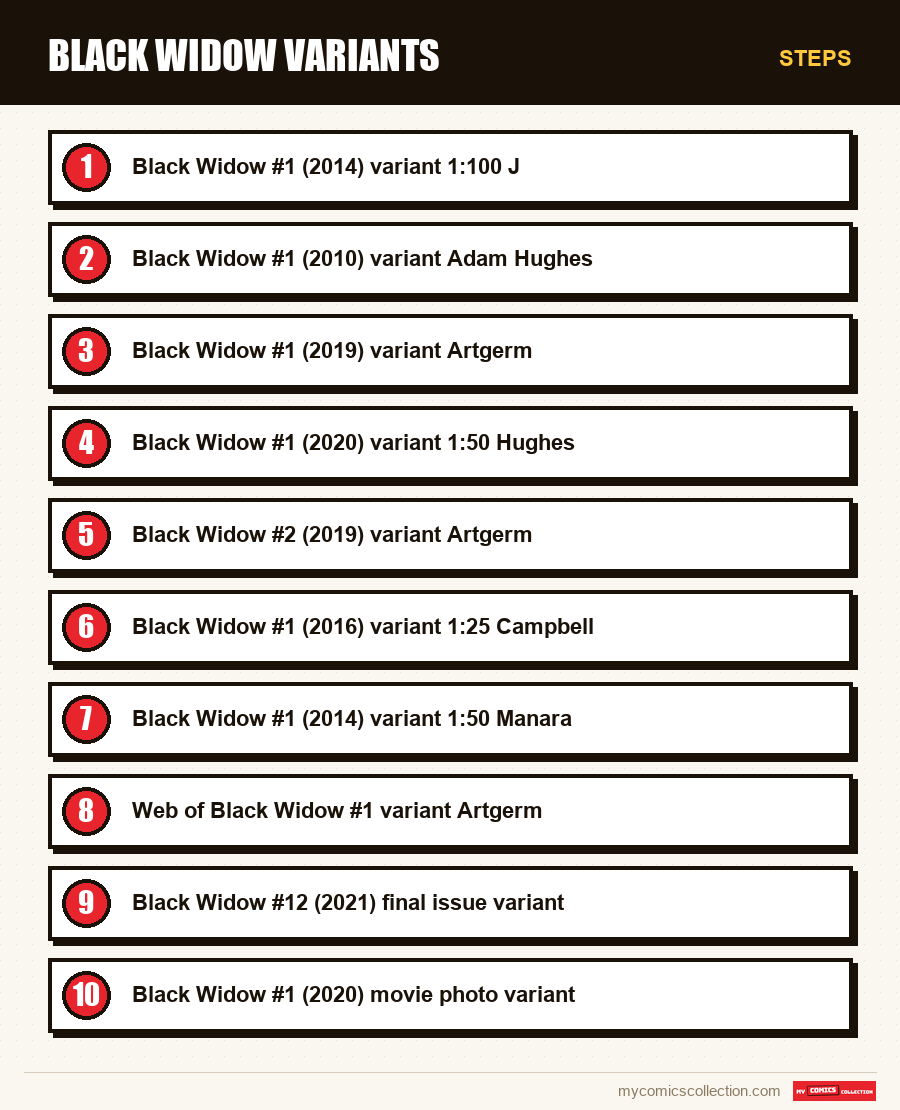
- Black Widow #1 (2014) variant 1:100 J. Scott Campbell: $300-500 in NM
- Black Widow #1 (2010) variant Adam Hughes: $200-350
- Black Widow #1 (2019) variant Artgerm: $150-250
- Black Widow #1 (2020) variant 1:50 Hughes: $150-200
- Black Widow #2 (2019) variant Artgerm: $100-160
- Black Widow #1 (2016) variant 1:25 Campbell: $80-140
- Black Widow #1 (2014) variant 1:50 Manara: $80-120
- Web of Black Widow #1 variant Artgerm: $60-100
- Black Widow #12 (2021) final issue variant: $50-80
- Black Widow #1 (2020) movie photo variant: $40-70
Identify authentic variants
Variants from cover artists like Artgerm or Campbell often exist in several “tiers”: trade dress cover (with logo), virgin (without logo), and signed virgin. Each version has a separate barcode and cover price. Retailer exclusives usually have the store name on the back. Always check the Certificate of Authenticity for signed editions: signatures without a COA lose considerably in value at CGC grading.
Investment potential
The Black Widow variants benefit from a triple driver: the MCU popularity of the character, the personal rating of the artists (Artgerm, Hughes, Campbell) and a pool of cross-genre collectors (comics/art/cinema). The Artgerm variants in particular have been following an upward curve for 5 years. Complete your knowledge with our guide to Black Widow key numbers.
Conservation and grading
The glossy covers of modern Black Widow variants are sensitive to fingerprints and pressure reflections (“spine ticks”). Always handle by the edges with gloves. For copies intended for CGC/CBCS grading, a professional dry cleaner can upgrade a 9.6 to 9.8, with a gain in value of 50-100% on premium pieces.
Track the value of your Black Widow variants in real time. Our collection tool helps you organize and monitor each alternative coverage.
Recognizing and choosing your Black Widow variants: ratios, editions and care
An alternate cover is not just a pretty image: its value depends on its rarity, its artist and the exact edition you hold in your hands. Here is how to find your way before buying, starting from the titles cited in this guide.
Reading a ratio
A "1:50" or "1:100" variant is a cover the retailer only receives by ordering a certain number of copies of the regular cover (one for fifty, one for a hundred). The higher the ratio, the rarer the cover. In this guide's list you find ratios from 1:25 to 1:100, such as the 2016 Black Widow #1 by Campbell at 1:25, the 2014 one by Manara at 1:50, or the 2014 one by Campbell at 1:100.
The three versions of one cover
Variants by artists such as Artgerm or Campbell often exist in several versions: the cover with the logo (trade dress), the virgin version without a logo, and the signed virgin version. Each has its own barcode and its own cover price. Before buying, check which one is advertised: the three are not equal and are not sought in the same way.
Retailer exclusives and signatures
- Store exclusives generally carry the store's name on the back: it is a simple check before buying.
- For signed editions, insist on the Certificate of Authenticity. A signature without a certificate loses considerable value at grading.
- Also look at the more atypical variants on the list: the 2020 movie photo cover, or the series' last issue, Black Widow #12 (2021), which have their own audience.
How the choice of artist changes the collection
Three artists dominate the selection: Artgerm (Stanley Lau), whose hyper-detailed style blends realism and manga stylization, Adam Hughes, master of "good girl art" covers, and J. Scott Campbell, whose exclusives and ratio covers command the highest premiums. Collecting by artist draws a wider audience than the character's fans alone, which explains the triple engine described in the article: the character, the artist and the pool of art and film collectors.
Preserving and preparing for grading
The glossy covers of modern variants are sensitive to fingerprints and pressure marks (spine ticks). Always handle them by the edges, with gloves. If you are aiming for grading, professional pressing can gain a premium copy a grade. Avoid trying it yourself: a pressing mistake cannot be undone.
A method for building your list
First choose an axis: an artist, a relaunch (2010, 2014, 2019, 2020) or a rarity level. For each variant, note the ratio, the edition (logo, virgin, signed) and the desired condition. Tick off as you buy: with so many versions of the same issue, an up-to-date inventory avoids duplicates and mistaken purchases.
Frequently asked questions
The guide puts first the Black Widow #1 (2014) 1:100 variant by J. Scott Campbell, then the Adam Hughes variant for Black Widow #1 (2010) and the Artgerm cover for Black Widow #1 (2019). The most sought-after variants combine rarity with a recognizable artist's signature.
They benefit from a triple engine: the character's popularity in the MCU, the personal standing of artists such as Artgerm, Hughes and Campbell, and a pool of cross-genre collectors (comics, art, film). Each relaunch of the series generates variants that quickly become centerpieces.
Artist variants often exist as trade dress (with logo), virgin (no logo) and signed virgin, each with its own barcode and cover price. Retailer exclusives generally carry the store's name on the back.
For signed editions, a signature without a COA loses considerable value at grading. Always check this certificate before buying.
They are sensitive to fingerprints and pressure marks, the spine ticks. Always handle them by the edges, with gloves. If you are aiming for grading, professional pressing can move a copy from 9.6 to 9.8.