
In short
The Beyonder key issues begin with Secret Wars #1 (cover date May 1984), where the entity moves Marvel's heroes and villains to Battleworld. Jim Shooter and Mike Zeck created the character. The ranking then follows him through Secret Wars #10, Secret Wars II #1 and #9 (Shooter and Al Milgrom, 1985 to 1986), Fantastic Four #319 (1988), which recasts his origin, and Secret Wars #1 (2015), where the Beyonders appear as a group.
A collector who types "Beyonder key issues" is rarely looking for one book. The character is spread across two miniseries, a bridge issue four years later and a reboot that borrows his name in the plural. The ranking below weighs each book by how much of his arc it carries, and the closing section covers the order of purchase and the lookalike titles that waste money.
Credits, cover dates and issue numbers in this ranking come from published reference pages; an inker or colorist who was not named for a given issue is simply absent here. The ranking is analysis, built on how much of the character's arc each issue carries.
The singular Beyonder is the 1984 creation of Shooter and Zeck, a being from a realm outside the universe who is curious about the beings he has seen. The plural Beyonders are a later idea, used in the 2010s to describe a race of entities behind the destruction of realities. They are connected, as the later entries show, but they are not the same character, and an issue that names one does not always involve the other.
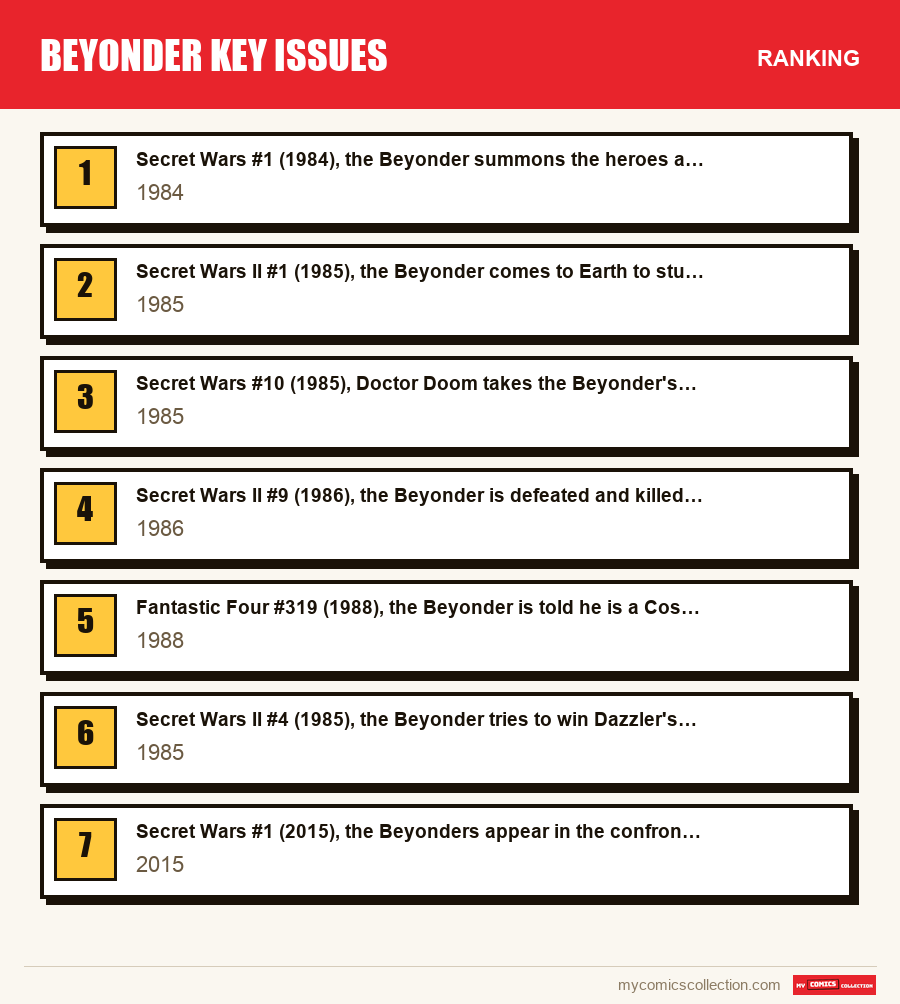
1: Secret Wars #1 (1984), the Beyonder summons the heroes and villains to Battleworld
The reason this issue tops the list is simple: it is where the Beyonder enters Marvel continuity. Marvel Super Heroes Secret Wars #1 carries a May 1984 cover date. The twelve-issue series ran from May 1984 to April 1985, written by Jim Shooter, with Mike Zeck and Bob Layton credited as pencillers and John Beatty as inker.
In this opening issue the Beyonder builds Battleworld from pieces of other planets, abducts a roster of heroes and villains from Earth and announces why they are there. The story shows his power through its effects: a planet assembled on demand and two armies placed on it.
For a buyer, the practical point is that the book is a limited-series opener with a long reprint life, so the cover and the indicia matter as much as the title. Read the cover date, the price box and the publication details, and compare the copy against a reference scan before assuming that it belongs to the original 1984 run. The dedicated guide to Secret Wars #1 covers the book from the Doctor Doom angle; this entry stays with the Beyonder side.
2: Secret Wars II #1 (1985), the Beyonder comes to Earth to study humanity
The sequel opens with a cover date of July 1985 and runs nine issues through March 1986. Jim Shooter wrote it, Al Milgrom drew it, Steve Leialoha inked it and Christie Scheele colored it. It sends the Beyonder to Earth, in search of enlightenment, and it lets the character act on the page for nine issues instead of watching from a distance.
Collectors value this issue for a different reason than they value the 1984 opener. It is the start of a long run of tie-ins: Captain America #308, Iron Man #197, New Mutants #30 and Uncanny X-Men #196 all carry a July 1985 date and the event logo. A buyer who picks up #1 is therefore stepping into a set with many surrounding titles, and it helps to decide early whether the goal is the nine core issues or the whole crossover.
The series was 1985's best-selling comic, and the fan press of the time reacted harshly to it. Copies are plentiful, so condition and completeness of the set decide how a given copy is received.
3: Secret Wars #10 (1985), Doctor Doom takes the Beyonder's power
Issue #10 is dated February 1985. In it, Doctor Doom uses a machine built from Klaw's body to absorb the power of Galactus and then takes the Beyonder's power. The issue turns the series on a character stealing god-like force from a cosmic entity, and it matters for any collector who follows Doom through his major appearances.
The reason it ranks third for a Beyonder list is that it changes what the Beyonder is allowed to be. Until this point he is an unfathomable host; afterward he is a being whose power can be lost. The sequel's premise, a Beyonder who is curious and a little diminished, follows directly from that.
Issue #3 (July 1984) is credited with Doom creating Titania and Volcana. Issue #6 (October 1984) introduces Julia Carpenter, the second Spider-Woman. Issue #8 is the black costume cover, which has its own audience; the dedicated page on Secret Wars #8 explains it. None of these three is a Beyonder issue by itself, so they are listed here to keep you from confusing a key issue of the series with a key issue of the character. For Doom's side of the saga, the Doctor Doom hub gathers the guides.
4: Secret Wars II #9 (1986), the Beyonder is defeated and killed by Molecule Man
The finale is dated March 1986. After a stretch in which the Beyonder decides to destroy the multiverse, a large group of heroes defeats him, and Molecule Man kills him. His energy returns to the Beyond-Realm and evolves into a new universe.
For a collector this issue is the end marker of the classic character. It also supplies the Molecule Man link, which matters because the origin of the Beyonder was originally tied to Owen Reece, the lab technician who accidentally reached into the Beyond-Realm. The energy that empowered Reece as Molecule Man left behind a sentient remainder, and that remainder became the Beyonder.
Because it closes a nine-part series, collectors tend to want it in the same condition as the opener, so check the spine, the corners and the top edge of the cover before you pay.
Do you collect this series?
Track what you own, what you are missing and what your collection is worth. 7-day trial.
Start my trial →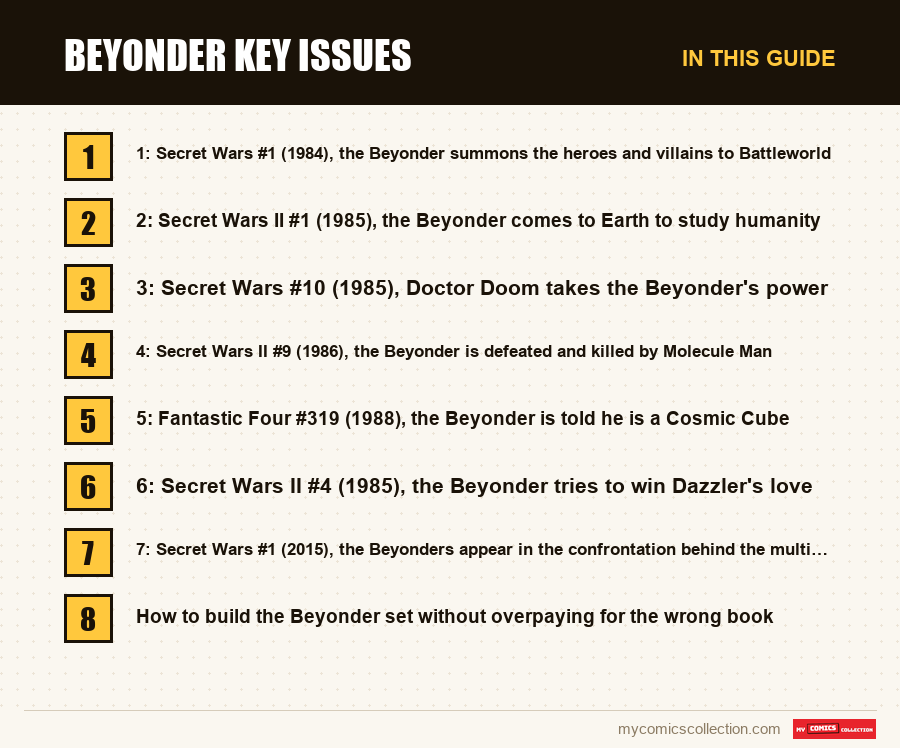
5: Fantastic Four #319 (1988), the Beyonder is told he is a Cosmic Cube
Four years after the sequel ended, Fantastic Four #319 (October 1988) revises where the Beyonder came from. Instead of leftover energy from Owen Reece's accident, the story says the Beyonders created pocket universes that are tapped to form Cosmic Cubes, that the Beyonder is told he is such a Cube, and that his energy merges with the energy of Molecule Man. The Cube later expels Molecule Man and evolves into a being named Kosmos, who later becomes insane and takes mortal form as the Maker.
The issue falls inside Steve Englehart's run as writer on the series. This book matters because it is the bridge between the 1980s character and the 2010s plural Beyonders; a reader who skips it will find the modern references less clear. The Beyonder is not named in the series title, which is why searches for his key issues often skip this book.
When you search for it, remember that the number is a regular-series issue with a long print life, so the purchase is about condition and a clean copy rather than hunting a limited run. A related book is Fantastic Four Annual #23 (July 1990), which is cited for retcons and power details.
6: Secret Wars II #4 (1985), the Beyonder tries to win Dazzler's love
This issue carries an October 1985 date and is where the Beyonder's attempt to win Dazzler's love fails. It is the best single issue for readers who want the human-scale side of the miniseries: the cosmic entity meets a person who does not owe him an answer.
It ranks sixth rather than higher because it matters mostly to those who already own #1 and #9, and it adds texture rather than structure. The same applies to #2 (August 1985), in which the Beyonder turns a building into gold, and to #6 (December 1985), in which he sends a horde of demons back to hell with a wave of his hand. For a short, readable run of the sequel, a good order is #1, #2, #4, #6 and #9.
Secret Wars II crossed into the monthly titles: Web of Spider-Man #6 (September 1985) and Daredevil #223 (October 1985) are two of those tie-ins, and The Amazing Spider-Man #268 and Fantastic Four #282, both dated August 1985, are two more. These are books where the crossover touches another series, so a completist should treat them as a second tier.
7: Secret Wars #1 (2015), the Beyonders appear in the confrontation behind the multiverse's end
Jonathan Hickman wrote the 2015 event, Esad Ribić drew it and Ive Svorcina colored it. Issue #1 carries a May 2015 cover date, with a cover by Alex Ross, and the series ran nine issues plus a Free Comic Book Day #0. It was planned at eight issues and extended to nine.
The reason it belongs on a Beyonder list is the plural. In #1, Doctor Doom, Doctor Strange and Molecule Man confront the Beyonders, described as the all-powerful entities responsible for the multiverse's destruction. In #4, Strange explains that they caused the universes to collide. In #5, the story shows that they were killed by a bomb made of Molecule Men from across the multiverse, and that their power was channeled to Doom, who built Battleworld with it; in #9, Molecule Man passes that power to Mister Fantastic. The singular 1984 Beyonder is not the subject of that event, so a buyer who wants the original character should not treat the 2015 book as a replacement for the 1984 one.
The link between the two eras is spelled out in New Avengers (volume 3) #30 (February 2015), where Hank Pym calls the Beyonder a "child unit" of the Beyonders, and in #33 (April 2015), where Molecule Man says the Beyonders engineered the accident that gave the Beyonder awareness. Those two numbers are the most direct bridge between the 1984 character and the 2015 event. For the event itself, see the guide to Secret Wars (2015) key issues.
How to build the Beyonder set without overpaying for the wrong book
A workable order has three stages. Start with the two 1984 books that matter most to the character, #1 and #10, because they establish what he is and what it costs him. Add Secret Wars II #1 and #9 as the opening and closing of the sequel, then choose between the single issues in the middle based on how much of the miniseries you plan to read. Put Fantastic Four #319 next, since it explains the retcon, and finish with the 2015 book and the two New Avengers numbers if the plural Beyonders interest you.
One trap is title confusion. The words "Secret Wars" appear on the 1984 series, the 1985 sequel, the 2015 event and several later titles, and a listing that omits the year can point at any of them. Match the cover date and the creator names to the entries above before you pay. Another trap is the set of alternate versions: a possible future version in Guardians of the Galaxy #38 (July 1993) and #50 (July 1994), the funny-animal "Bee-Yonder" in Spider-Ham #17 (September 1987), a version in Mutant X #31 and #32 (2001) and "Mister Beyonder" in Heroes Reborn #2 (May 2021). They are legitimate appearances, but they are a different shopping list.
For the comparison between the two events, Secret Wars 1984 versus 2015 sets out which one suits a given collection. The Avengers key issues guide is the right place to look next if the Beyonder interests you as part of the wider team history.
On condition, apply the same checks to every book in the set: spine stress, rusted staples, blunted corners, tape on the back cover. A professionally graded copy gives you a grade on the label, and the label tells you whether the book has been restored; a raw copy asks you to make that judgment yourself, so compare the paper tone with a reference scan and ask for photographs of the back and the interior pages.
Frequently asked questions
The Beyonder's debut is Marvel Super Heroes Secret Wars #1, cover-dated May 1984, from Jim Shooter and Mike Zeck, who created the character. In that issue the entity builds Battleworld and transports heroes and villains there. The sequel, Secret Wars II #1 (July 1985), brings him to Earth, so it is the next book to read.
Do not assume so. The confirmed turning points are #1, where he sets the conflict in motion, and #10 (February 1985), where Doctor Doom takes his power. Other issues of the twelve-part series center on the heroes and villains fighting on Battleworld, so check an issue before you buy it as a Beyonder book.
Writer Jim Shooter and artist Mike Zeck created the Beyonder. Secret Wars II (July 1985 to March 1986) was written by Shooter, penciled by Al Milgrom, inked by Steve Leialoha and colored by Christie Scheele. The 1984 series credits Mike Zeck and Bob Layton as pencillers and John Beatty as inker.
They are related but different. The 2015 event, by Jonathan Hickman and Esad Ribić, uses the Beyonders as a group of entities behind the destruction of realities. New Avengers #30 (February 2015) calls the 1984 Beyonder a "child unit" of that race, which links the two without making them one character.
The original origin ties him to Owen Reece's accident, which also made Molecule Man. Fantastic Four #319 (October 1988) revises it: he is told he is a Cosmic Cube, which later becomes Kosmos. If you want the revised version, that issue is the one to find.
If you hold a copy of Secret Wars #1 or #10, check the cover date and printing details, then request an estimate.
Estimate my comic