
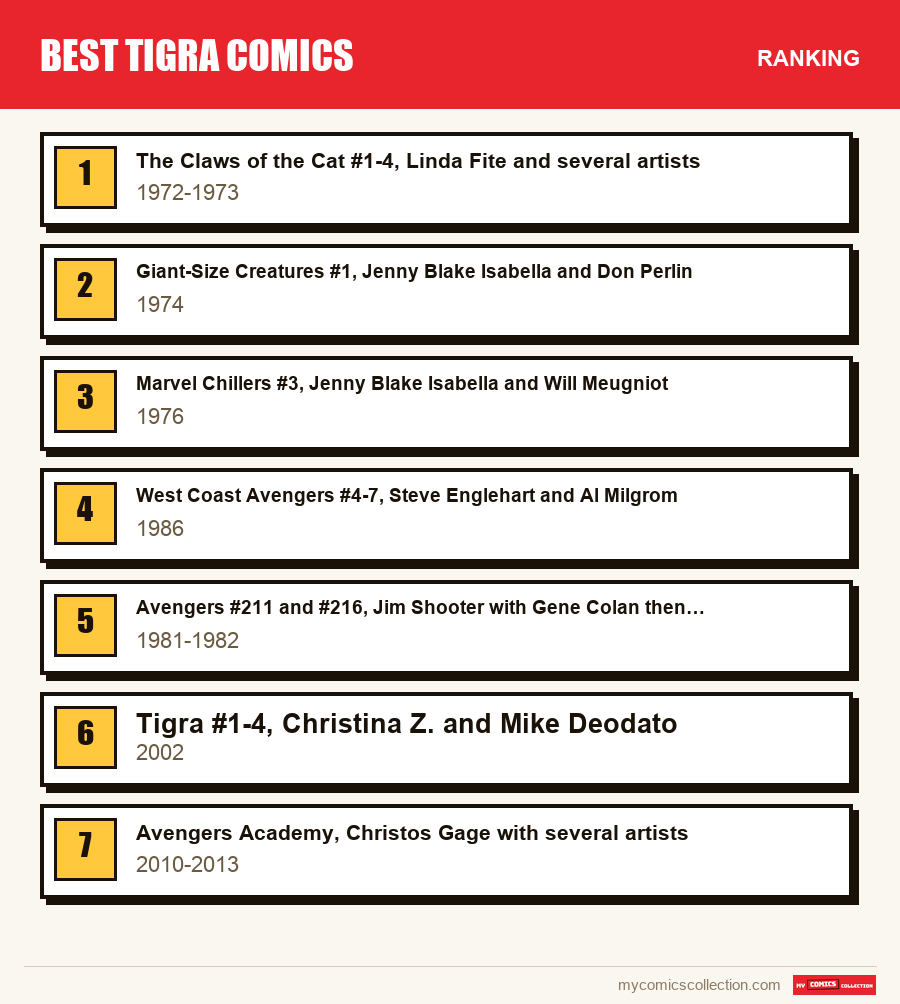
To read the best Tigra comics (Greer Grant Nelson), start with Giant-Size Creatures #1 (July 1974), where she appears under that name, then go back to The Claws of the Cat #1-4 (1972-1973), where she is still The Cat. Next read West Coast Avengers #4-7 (1986), by Steve Englehart and Al Milgrom, the Tigra miniseries (2002) by Christina Z. and Mike Deodato, then Avengers Academy (2010-2013) by Christos Gage.
Tigra has two debuts and two code names, and that is what makes her collecting path less obvious than it looks: the same heroine is called The Cat in 1972 and Tigra in 1974, and you rarely buy the same issue depending on which one you are hunting. The seven entries below run from The Cat to the teacher of Avengers Academy; each one says whether Tigra carries the story or shares it with a team.
As always in this guide, only verified information (creators, issue numbers, dates) is stated as fact; the analysis is our own, with no reproduction of protected art or dialogue.
Her first appearance
Greer Grant, who has not yet married Bill Nelson, becomes the vigilante The Cat in The Claws of the Cat #1, cover-dated November 1972. Linda Fite writes all four issues of the series, the first from a plot developed with Roy Thomas, and Marie Severin draws the opening. Each issue changes art team: Marie Severin is inked by Wally Wood on #1 and then by Jim Mooney on #2, Paty Greer and Bill Everett share #3, and Jim Starlin and Alan Weiss pencil #4 with Frank McLaughlin on inks. A fifth issue, assigned to Ramona Fradon, was never published.
The name Tigra appears later, in Giant-Size Creatures #1, cover-dated July 1974, written by Jenny Blake Isabella and drawn by Don Perlin. The story continues in Werewolf by Night #20 (August 1974), which is why the two issues are hunted together. Between the two dates, The Cat also showed up in Marvel Team-Up #8 (April 1973), alongside Spider-Man, which the Spider-Man hub lets you place within that series.
The distinction matters for collectors. If your goal is the heroine under her current name, the key is the 1974 issue; if you are following the character's origin, it is the 1972 one. Both are archival issues and do not read like today's stories, but they lay the foundations of a path that runs more than fifty years.
1: The Claws of the Cat #1-4, Linda Fite and several artists (1972-1973)
This is the birth certificate of Greer Nelson as a superhero, and the shortest series on the list: four issues, from November 1972 into 1973. It is written by Linda Fite, who builds the plot of the first issue with Roy Thomas, and each issue goes to different artists, which makes the whole uneven in art but curious to flip through, since you run into Marie Severin, Wally Wood, Bill Everett, Jim Starlin and Alan Weiss.
What it brings to the character comes down to context: the series ends for lack of sufficient sales, and the fifth issue, assigned to Ramona Fradon, remains unpublished. It therefore interests the reader of publishing history as much as the reader of the character's saga.
We recommend it to whoever wants to understand the origin of The Cat, not to whoever wants a fast-paced story. To read it, take the four issues in one go, in order, without trying to tie them to the later Avengers: the character is far from the team where we will find her.
2: Giant-Size Creatures #1, Jenny Blake Isabella and Don Perlin (1974)
The July 1974 issue is the one where Greer Nelson becomes Tigra and where her name enters the collectors' vocabulary. Jenny Blake Isabella writes it, Don Perlin draws it, and the plot continues in Werewolf by Night #20 (August 1974): the read therefore takes two issues.
The point of the read is not to discover a great story, but to watch Greer Nelson change name and register: the heroine of a canceled series reappears in a creature magazine, under the name she will keep.
The issue is for fans of the Bronze Age and of character debuts, more than for recent readers. If you simply want to enjoy reading Tigra, do not start here; take it instead as a complement once you have already tasted the entries that follow.
3: Marvel Chillers #3, Jenny Blake Isabella and Will Meugniot (1976)
In Marvel Chillers, the publisher's anthology series, Tigra gets a feature under her own name from issue 3 (February 1976) to issue 7 (October 1976). Issue 3 is written by Jenny Blake Isabella, with Will Meugniot on art. A Tigra story also appears in Marvel Premiere #42 (June 1978), which extends this period.
What you find there is a Bronze Age serial in five installments, which ends for lack of sufficient sales. For a collector, the appeal is that the whole can be bought as a small block of issues of a magazine whose other pages deal with other heroes.
It is for archive readers and for series completists. To read it, start with issue 3, which launches the sequence, and continue through issue 7: the read takes one evening, and it gives a clear picture of what Marvel could do with a character on a shoestring.
4: West Coast Avengers #4-7, Steve Englehart and Al Milgrom (1986)
This is the entry where Tigra stops being a magazine serial and becomes a team character. Tigra has been a founding member of the West Coast team since the September 1984 miniseries, and the Cat People thread, in issues 4 to 7 of the second volume (January to April 1986), gives her a story that touches on who she is. Steve Englehart writes, Al Milgrom draws, with Joe Sinnott on inks on some issues.
Issue 5 links the Cat People to the werewolf Jack Russell, issue 6 tells Tigra the history of this people, and issue 7 draws the team into their kingdom, where the Thing finds himself trapped in a world dominated by felines. Meanwhile, Hank Pym faces Ultron: the whole remains a team story, with Tigra at the heart of the plot but the screen shared with the team.
We recommend it to anyone who likes the tone of 1980s Marvel, with its crisscrossing subplots. For the read, take the four issues in order and keep the guide to the series' key issues handy to place each one in the whole.
Do you collect this series?
Track what you own, what you are missing and what your collection is worth. 7-day trial.
Start my trial →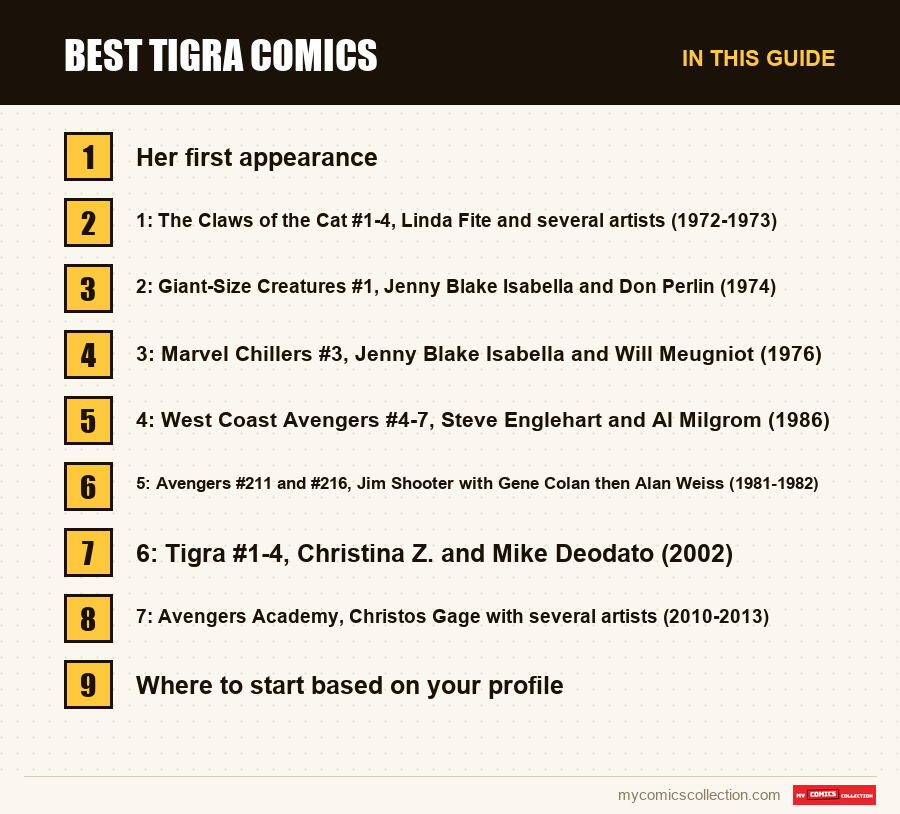
5: Avengers #211 and #216, Jim Shooter with Gene Colan then Alan Weiss (1981-1982)
In Avengers #211, cover-dated September 1981, Tigra joins the main team: the telepath Moondragon has forced several heroes, her included, through the admission trial. Jim Shooter writes, Gene Colan pencils, Dan Green inks and Bob Sharen colors. She resigns in issue 216, by Jim Shooter and Alan Weiss, and this brief stay, intended that way by the writer to show that not every hero keeps up with the Avengers' pace, makes these two issues a pair to read together.
Tigra is not the exclusive subject of these issues: she shares the billing with a whole team, and this guide ranks her here because her entry and her exit are the thread linking the two bookends.
The pair is for readers who follow the 1980s Avengers and for series collectors, who see in them team-composition milestones. To read it, start at issue 211 and jump to 216 if you only want the character's arc; the guide to the history of the Avengers restores the team's context at the time.
6: Tigra #1-4, Christina Z. and Mike Deodato (2002)
The Tigra miniseries, four issues from May to August 2002, is written by Christina Z. and drawn by Mike Deodato. It puts Tigra in front of an investigation: she takes an interest in the Brethren of the Blue Fist, and the truth she uncovers about this group upends her life.
It is the form of story closest to what you expect from a solo hero: a beginning, an investigation, an ending, and a darker tone than in the team books. The series also confirms that a second-tier character can carry a complete story if given the room.
It is for those who want a stand-alone read, short and finished, with no prior knowledge. The collection Tigra: The Complete Collection (December 2019) gathers part of the heroine's solo and team material, which lets you read several entries on this list without chasing the original issues.
7: Avengers Academy, Christos Gage with several artists (2010-2013)
In Avengers Academy, written by Christos Gage with Mike McKone on art at the start of the series, Tigra is part of the faculty around Hank Pym, alongside Justice, Speedball and Quicksilver. The series runs from issues in 2010 to the issue of January 2013, with other artists over the course of the arcs, including Tom Raney and Jorge Molina.
Tigra is not the series' heroine, which follows the students, but she holds an adult role in a team that serves as a mentor: in issue 8, a video of the Hood's attack on her circulates widely, and during the Fear Itself event, she leaves with the students for Washington to fight Skadi and her mechanized soldiers. This guide ranks it seventh because this teaching role is not the story of her character, but a recent chapter of it.
We recommend it to those who arrive through recent comics, since the series reads without heavy baggage, and it shows how a heroine born in 1972 finds a role as a trainer. To place the series among all the teams, the Avengers hub remains the best starting point.
Where to start based on your profile
If you want a short, self-contained story, read the 2002 Tigra miniseries: four issues are enough. If you prefer the atmosphere of the 1980s, take West Coast Avengers #4-7, which gives the heroine a story tied to her feline identity. If you are drawn to publishing history, go back to The Claws of the Cat and Giant-Size Creatures, then move on to Marvel Chillers.
If you discover the universe through recent series, Avengers Academy is the most accessible way in, because it requires no prior reading. And if you follow the Avengers in general, Avengers #211 and #216 supply a detail of team history that completes the picture.
The key issues to know
An issue becomes a key issue when it marks a turning point in the heroine's path, not because it shows her. Here are the landmarks, in chronological order.
- The Claws of the Cat #1 (November 1972): the first appearance of The Cat, by Linda Fite and Roy Thomas (plot), Marie Severin and Wally Wood.
- Marvel Team-Up #8 (April 1973): The Cat alongside Spider-Man.
- Giant-Size Creatures #1 (July 1974) and Werewolf by Night #20 (August 1974): the first appearance of Tigra.
- Marvel Chillers #3 (February 1976): the start of her serial.
- Avengers #211 (September 1981): her arrival in the main team.
- West Coast Avengers #5 (February 1986): the link between the Cat People and Jack Russell.
- Tigra #1 (May 2002): the start of her miniseries.
- Avengers Academy #1 (2010): her entry as a teacher.
To place a copy of The Cat or Tigra, compare closed sales of an identical issue in similar condition, set aside one-off listings, then factor in the intended use, reading or keeping. A 1970s archival issue is judged by its spine, its corners and its paper; a 2002 miniseries is judged mostly by the freshness of its colors.
Frequently asked questions
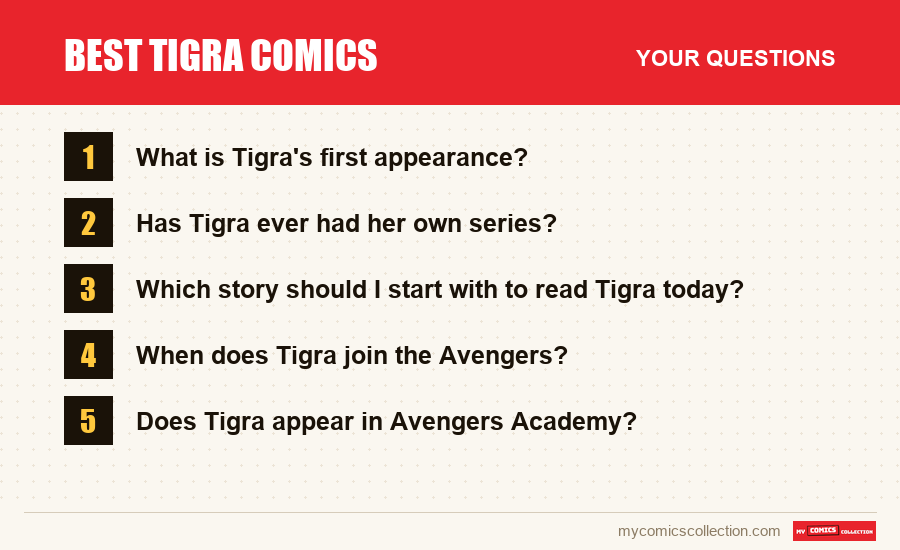
It depends on the name. Greer Grant Nelson appears as The Cat in The Claws of the Cat #1 (November 1972), and under the name Tigra in Giant-Size Creatures #1 (July 1974), written by Jenny Blake Isabella and drawn by Don Perlin. The story continues in Werewolf by Night #20 (August 1974).
She had a four-issue series as The Cat (1972-1973) and a four-issue miniseries as Tigra (May to August 2002), by Christina Z. and Mike Deodato. In between, she held a serial in Marvel Chillers #3-7 (1976), in a magazine that was not devoted to her.
For a finished story, take the 2002 Tigra miniseries. For a team read with a personal stake, choose West Coast Avengers #4-7 (1986), by Steve Englehart and Al Milgrom. The original 1970s issues mostly suit readers who like archives.
She enters the main team with Avengers #211, cover-dated September 1981, written by Jim Shooter and drawn by Gene Colan. Her stay is brief: she resigns in issue 216, by Jim Shooter and Alan Weiss. She has also belonged to the West Coast team since 1984.
Yes, she is part of the faculty around Hank Pym, with Justice, Speedball and Quicksilver. The series is written by Christos Gage, with Mike McKone at the start. Tigra is not its heroine, but she has standout moments, notably in issue 8 and during the Fear Itself crossover.
Have an issue of The Cat or Tigra, from the 1970s or more recent? Have its condition and value appraised before you put it away.
Appraise my comic