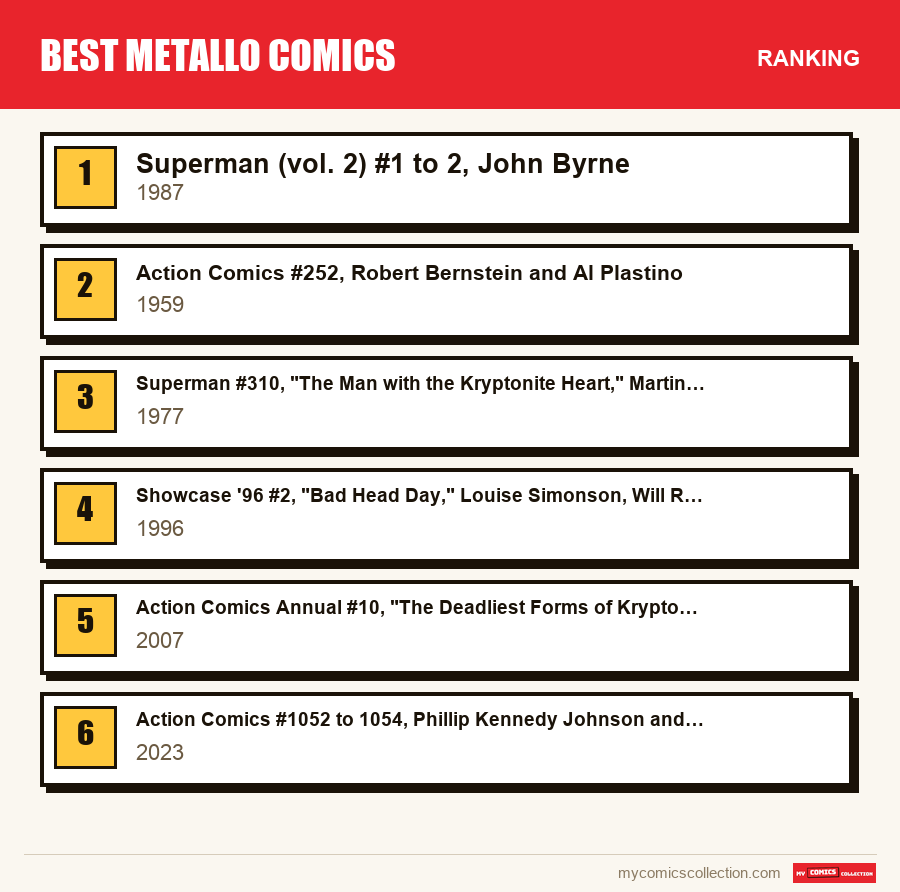
The best Metallo comics start with Superman (vol. 2) #1, "Heart of Stone" (January 1987), where John Byrne puts the kryptonite-hearted cyborg into modern continuity. Then go back to Action Comics #252 (May 1959), the first appearance of John Corben by Robert Bernstein and Al Plastino, and to Superman #310 (April 1977) for his brother Roger. Finish with Action Comics #1052 to 1054 (2023).
Metallo boils down to one image: a man whose heart is a piece of the material that weakens the Man of Steel. He is a laboratory villain, a trap built against Superman with every gear calculated. That simplicity hides a reading problem, though: the name has belonged to several men and several suits of armor, and few stories truly put him at the center. This guide keeps only the ones where he drives the action, and flags the smaller roles separately.
As always on this guide, only verified information (creators, issue numbers, dates) is stated as fact; the analysis is our own, with no reproduction of protected art or dialogue.
His first appearance
In comics, John Corben debuts in Action Comics #252, cover-dated May 1959. The story comes from the collaboration of Robert Bernstein, who wrote it, and Al Plastino, who drew it. The character already existed in newspaper strip form, however: the story The Menace of Metallo had run in the Superman daily between December 15, 1958 and April 4, 1959, so the comic book version reuses an idea already tested on a wide audience.
That issue is also the one where Supergirl makes her entrance, so it carries two debuts in Superman mythology, which explains the attention it gets. If you want to place the birth of Superman's cousin, the feature on Action Comics #252 covers the issue from the Supergirl side.
A namesake calls for caution: George Grant, known as "Metalo," had already appeared in World's Finest Comics #6 (Summer 1942), with a motorized suit of armor and a strength serum. He has nothing to do with the kryptonite cyborg. As for Roger Corben, John's brother, he debuts in Superman #310 in April 1977, written by Martin Pasko and drawn by Curt Swan. For the mechanics of the character, John Corben is the one that matters, and his modern version was born in 1987.
1: Superman (vol. 2) #1 to 2, John Byrne (1987)
When John Byrne relaunches Superman after the 1986 overhaul, he writes and draws issue #1 himself, cover-dated January 1987, with Terry Austin on inks. The story title, "Heart of Stone," already announces the central metaphor: a heart that is not really a heart. This is John Corben's entry into modern continuity. Issue #2, "The Secret Revealed" (February 1987), continues the story, again written and drawn by Byrne.
Why is this pair the best entry point? Because it scales the character back to one hero and one enemy, in a single-issue format you can read in an evening. Byrne had rewritten the foundations of the Superman universe a few months earlier in the miniseries The Man of Steel, and the new series serves as a demonstration of how he intends to handle the classic villains: without nostalgia, with clear mechanics and a title that says the essential.
Who is it for? The reader who wants a Metallo with no baggage, the collector of the 1987 series, and anyone trying to understand why later writers kept the idea of a cyborg Corben. How should you read it? Straight through, the two issues back to back, then go back to the 1986 miniseries if you want the backdrop of this new universe.
2: Action Comics #252, Robert Bernstein and Al Plastino (1959)
This is the founding text, and it reads like a period piece: the Silver Age looks for simple, tangible threats that hit Superman at his exact point of vulnerability. John Corben is a criminal rebuilt as a cyborg. The story rests on a very clear dramatic idea, that of a villain whose strength and the hero's weakness come from the same source, with no other explanation needed.
What the issue brings to the character: everything, since it sets up the combination of the metal body, kryptonite as the power source, and the lasting threat to Superman. This version of Corben belongs to the era before the 1986 overhaul, where he is presented as a criminal and journalist, then dies while trying to go after Lois Lane. It is therefore not the modern Metallo, but it supplies the codes that Byrne picked up nearly three decades later.
Who is it for? Silver Age fans and collectors who want the key to the character. How should you read it? With a historian's eye: the tone is direct, without the psychology of later decades. The story reads very well in a collected edition, which spares you from handling the original copy.
3: Superman #310, "The Man with the Kryptonite Heart," Martin Pasko and Curt Swan (1977)
When Martin Pasko and Curt Swan deliver "The Man with the Kryptonite Heart" in issue #310 (April 1977), they do not resurrect John Corben: they invent his brother. Roger Corben, presented as the second Metallo, takes up the armor and the motive of revenge. Later in his run, he allies with the organization SKULL to avenge John.
What the issue brings: a shift in the question. The original Metallo was a science fiction find; with Roger Corben, the armor becomes an inheritance, an object of mourning. The device is classic Bronze Age, but it gives the character an emotional engine he did not have. The issue also offers a fine example of Curt Swan's work, whose clear page layouts remain a benchmark for a whole generation of Superman readers.
Who is it for? Bronze Age readers and anyone interested in Swan's work, to which the creator page is devoted. How should you read it? After the 1959 issue #252, to measure the move from an idea to an inheritance, before moving on to Byrne's overhaul.
4: Showcase '96 #2, "Bad Head Day," Louise Simonson, Will Rosado and Prentis Rollins (1996)
Few stories feature Metallo as the star, and this ten-page story, published in Showcase '96 #2 (February 1996), is one of them. Louise Simonson writes it, Will Rosado pencils it and Prentis Rollins inks it. It fits into the period following Underworld Unleashed, the 1995 event in which Metallo makes a deal with the demon Neron for greater powers.
What this short story brings: an anthology format, which gives Metallo the room of a lead character, something the regular Superman series rarely grant him. It is a rarity, mostly of interest to the curious 1990s reader. To understand what comes before, the trail leads through Steel #21 (November 1995), where Metallo is the villain in an issue tied to Underworld Unleashed, with Louise Simonson writing, Phil Gosier on pencils and Rich Faber on inks.
Who is it for? The collector of the Underworld Unleashed period and anyone filling out a themed reading path. How should you read it? After the event rather than before: the story builds on what happened just prior, and the issue is clearer for anyone who knows about the deal with Neron.
Do you collect this series?
Track what you own, what you are missing and what your collection is worth. 7-day trial.
Start my trial →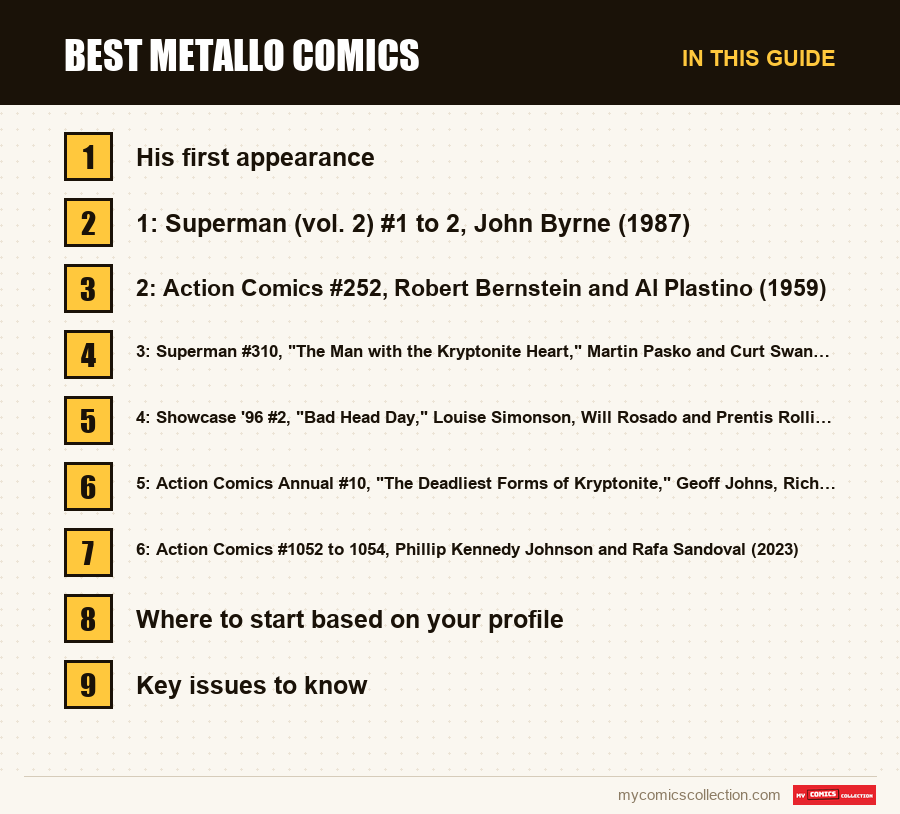
5: Action Comics Annual #10, "The Deadliest Forms of Kryptonite," Geoff Johns, Richard Donner, Gary Frank and Jonathan Sibal (2007)
In Action Comics Annual #10, cover-dated March 2007, a three-page story by Geoff Johns and Richard Donner, drawn by Gary Frank and inked by Jonathan Sibal, features Metallo: Lex Luthor equips him with several forms of kryptonite at once. The idea is simple, and its strength comes precisely from that: a demonstration in a few pages of what such an enemy can represent, with Luthor's usual calling card, method rather than brute force.
What this episode brings to the character: it shows him as a pure tool of Luthor, which is his historical role. It will interest readers of Johns and Donner's work on Superman, and collectors of annuals, which are often overlooked. To place the writer in his career, the page devoted to Geoff Johns points to the series to follow.
Who is it for? The curious about short formats. How should you read it? As a supplement and not an entry point: the three pages are best enjoyed after the 1987 #1, once the principle of the kryptonite heart is understood.
6: Action Comics #1052 to 1054, Phillip Kennedy Johnson and Rafa Sandoval (2023)
Metallo becomes the center of a story again in Action Comics #1052, "Enter Metallo!," published in 2023. Phillip Kennedy Johnson writes, Rafa Sandoval draws the main story. Metallo is both the adversary and a character the script wants to make understandable: he fights Superman at full power because he is trying to win his sister's freedom. Issue #1053, "Unmade," shows him leading the cyborgs of Blue Earth, convinced that Superman is hiding his sister, and under the influence of a voice claiming to be Lex Luthor.
What this stretch brings: a Corben with a family, a cause and a vulnerability, whom the voices in his head drive toward madness. Issue #1054 settles the confrontation: Superman overcomes Metallo, whose defeat serves as a step in the series' wider plot. The whole forms a short arc, readable in three issues, where Metallo leads the way.
Who is it for? The reader who wants a recent Metallo, after an era when the character mostly appeared as part of a group of adversaries. How should you read it? In three single issues in a row, accepting that the backup stories in these issues, with Jon and Glyanna or Power Girl and Supergirl, follow other plots.
Where to start based on your profile
The right entry point depends on what you want from a kryptonite cyborg.
- You are new to the character: read Superman (vol. 2) #1 and 2, then Action Comics #1052 to 1054. Between these two milestones, you will have seen the founding version of modern continuity and one of the most recent.
- You collect the Silver Age: start from Action Comics #252, then add Superman #310 for the next generation, that of Roger Corben.
- You like events: read Underworld Unleashed with Steel #21 and Showcase '96 #2, for the deal with Neron.
- You want the human angle: issues #1052 to 1054 from 2023 give Metallo a family cause, and that is what sets them apart from the other reads on this list.
If you are just starting to read Superman, check the franchise reading guide first: Metallo gains more depth when you know the rivalry with Lex Luthor, which the ranking of the best Lex Luthor runs details. And keep in mind that a villain of this type reads better in alternation: one Metallo issue, then a story where Superman faces an enemy with no gimmick.
Key issues to know
No numbers here: only the way of sorting matters. Each entry in the following list is ranked by its function, from the birth of the cyborg to his team appearances.
- Action Comics #252 (May 1959): the first appearance of John Corben, by Bernstein and Plastino, in the issue that also introduces Supergirl.
- Superman #310 (April 1977): the first appearance of Roger Corben, by Pasko and Swan.
- Superman (vol. 2) #1 (January 1987): John Corben's entry into modern continuity, by Byrne and Austin.
- Action Comics #647 to 649 (November 1989 to January 1990): the Brainiac trilogy by Roger Stern and George Perez; Metallo plays a supporting role, freed by Brainiac and then sent toward Metropolis against Luthor. Useful for the character's history, not to be read for him.
- Underworld Unleashed #1 and 3 (November and December 1995): the event that earns him his deal with Neron; he is not at the center of it.
- Action Comics #979 to 984 (summer 2017): the "Revenge" arc written by Dan Jurgens, where Metallo is among the adversaries banded together against Superman, including Eradicator, the Cyborg Superman and Mongul. It is a team role, not a story about him.
Before buying a copy of Metallo, check the volume: Superman #1 from 1987 is not issue #1 of another series with the same title, and a listing that leaves out "vol. 2" deserves a question to the seller.
Frequently asked questions
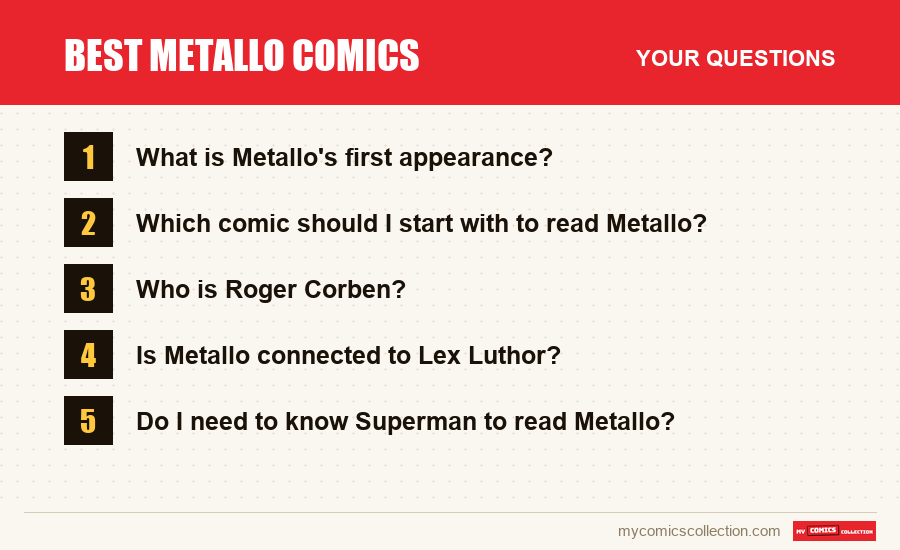
John Corben, the best-known Metallo, debuts in Action Comics #252, cover-dated May 1959, with Robert Bernstein writing and Al Plastino drawing. The idea had first existed in the Superman newspaper strip in late 1958. Roger Corben, his brother, debuts in Superman #310 in April 1977.
The simplest is Superman (vol. 2) #1, "Heart of Stone," written and drawn by John Byrne in January 1987, with Terry Austin on inks. It introduces the modern version of the character and reads with no preparation. Continue with issue #2, then with Action Comics #1052 to 1054 for a recent version.
Roger Corben is John Corben's brother and the second Metallo. He debuts in Superman #310, from April 1977, created by Martin Pasko and Curt Swan, and takes up the armor to avenge his brother, allying with the organization SKULL. He belongs to the era before the 1986 overhaul.
Yes, repeatedly. Before 1986, Luthor recovers Corben's kryptonite heart. In Action Comics Annual #10 (March 2007), he is the one who upgrades Metallo with several kinds of kryptonite. In 2023, a voice claiming to be Luthor weighs on Metallo in Action Comics #1053.
No, the stories on this list can be followed without long preparation. A little background helps for the 2023 entries, where Jon Kent, Steel and the cyborgs of Blue Earth play a role. The Superman reading guide on the blog gives the order of volumes for readers new to the franchise.
Do you own an Action Comics #252 or a Superman (vol. 2) #1? Get your copy appraised based on its condition and edition.
Appraise my comic