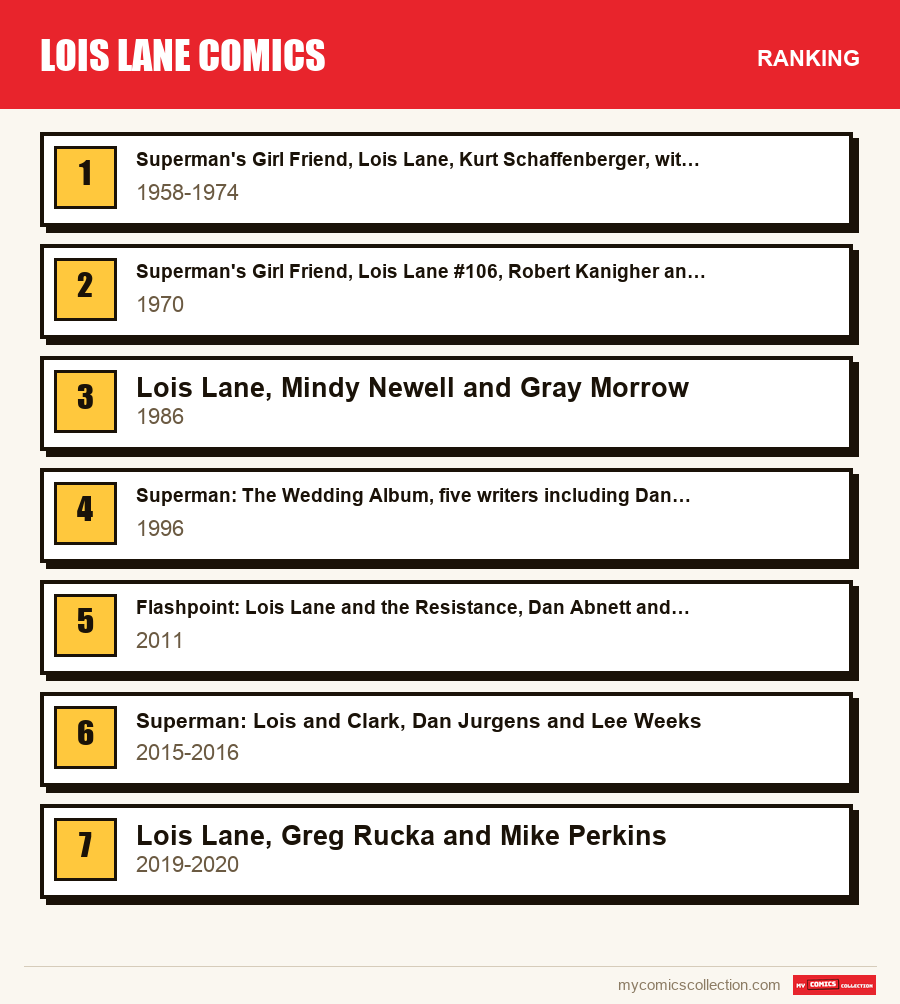
The best Lois Lane comics to start with begin with Action Comics #1 (June 1938), where Jerry Siegel and Joe Shuster introduce her, then the series Superman's Girl Friend, Lois Lane (1958-1974), which gives her her own title. Move on to the Mindy Newell and Gray Morrow miniseries (1986), Superman: The Wedding Album (1996) and the Greg Rucka and Mike Perkins maxiseries Lois Lane (2019-2020).
Lois Lane is one of the rare supporting characters in comics history to have carried series under her own name for decades. She has been a reporter in the 1930s, Lana Lang's rival in the 1960s, a bride in 1996, a resistance fighter in an alternate world in 2011, and then a long-form investigator in 2019. Seven reads follow, all centered on her, each with its creators and dates.
As always in this guide, only verified information (creators, issue numbers, dates) is stated as fact; the analysis is our own, with no reproduction of protected artwork or dialogue.
Her first appearance
Lois makes her entrance in Action Comics #1 (cover date June 1938), in the Superman story that Jerry Siegel wrote and Joe Shuster drew. The publisher at the time is National Allied Publications, one of the companies DC grew out of. She is kidnapped by a gangster after turning him down in a nightclub, and Superman rescues her: that rescue leads to the cover image, the car lifted at arm's length.
In this issue she is mostly the person to be rescued; most of what we remember about her develops in the stories that follow. For a reader who wants to understand what she brings to the myth, it is better not to stop at this single issue and to move on to the stories where she takes action. Our page on Superman's first appearance details the editorial context of this issue.
1: Superman's Girl Friend, Lois Lane, Kurt Schaffenberger, with several writers (1958-1974)
Before getting her own series, Lois leads two stories in Showcase #9 and #10; #9 is cover-dated July-August 1957, and it is the first time Lois headlines an issue. The success of the tryout leads to a monthly title, Superman's Girl Friend, Lois Lane, launched in 1958 and ended in 1974 after 137 issues and two 80-page annuals.
The writers are many: Cary Bates, Otto Binder, Leo Dorfman and Robert Kanigher are among them. On art, Kurt Schaffenberger pencils most of the first 81 issues, apart from #29, and many readers see his line as the definitive version of Lois. Lana Lang often returns as a romantic rival, while Lois schemes to push Superman toward marriage, before the plot makes her fail. From #105 to #130, the duo Rose and Thorn fills the series as a backup feature.
This read suits Silver Age readers and fans of naive humor: romantic mix-ups often take up more room than the reporting. It reads better in pieces, through reprints, than in one go, and the title merges in 1974 with The Superman Family, where Lois keeps stories until 1982. For context, see our page on the Superman family.
2: Superman's Girl Friend, Lois Lane #106, Robert Kanigher and Werner Roth (1970)
This November 1970 issue, "I Am Curious (Black)!," is written by Robert Kanigher, penciled by Werner Roth and inked by Vince Colletta. Lois uses a Kryptonian device to change her appearance and investigate the Black community of Metropolis.
It appears here because it matters in the character's history, not because it would be enjoyable to read: commentators often rank it among the controversial stories, and some judge that it has aged badly. It suits readers interested in how 1970s comics approached questions of race, and it reads as a document of its time. You can find it in Superman in the Seventies (2000) and in the collection Lois Lane: A Celebration of 75 Years, which spares you from hunting down the single issue.
3: Lois Lane, Mindy Newell and Gray Morrow (1986)
Two issues, one from August and the other from September 1986, make up this miniseries; it comes out at the same time as Whatever Happened to the Man of Tomorrow? and is set on Earth-One. Mindy Newell writes and Gray Morrow draws; the action takes place in Metropolis and at the Daily Planet.
Lois investigates missing children, which places her in a dark reporting register, far from the mix-ups of the 1960s. This read suits fans of short, dark stories: it shows that Lois can run an investigation without backup, and it works for anyone who wants the character for herself.
4: Superman: The Wedding Album, five writers including Dan Jurgens and Roger Stern (1996)
This one-shot, cover-dated December 1996, tells the wedding of Lois and Clark. Roger Stern, Louise Simonson, Dan Jurgens, Karl Kesel and David Michelinie write the text; John Byrne draws the cover, and the interior pages bring in nearly all of the major Superman artists of the time. The plot follows Lois, back from her job as a foreign correspondent after a year of separation, who agrees to marry Clark; Jimmy Olsen is a witness, Lucy Lane a bridesmaid, and Sam Lane attends the ceremony despite his disagreements with his daughter.
The honeymoon in Hawaii continues in The Adventures of Superman #541, Action Comics #728 and Superman: The Man of Steel #63. The collection Superman: The Wedding and Beyond (1997) gathers the wedding, the honeymoon and Superman #118. This story is split between Lois and Clark, but within the continuity of the time it closes the long wait for the wedding that Silver Age stories staged. It suits readers of the Jurgens and Stern era, and reading it in a collection is the most practical route. Our ranking of the best Superman runs gives the context of this period.
Do you collect this series?
Track what you own, what you are missing and what your collection is worth. 7-day trial.
Start my trial →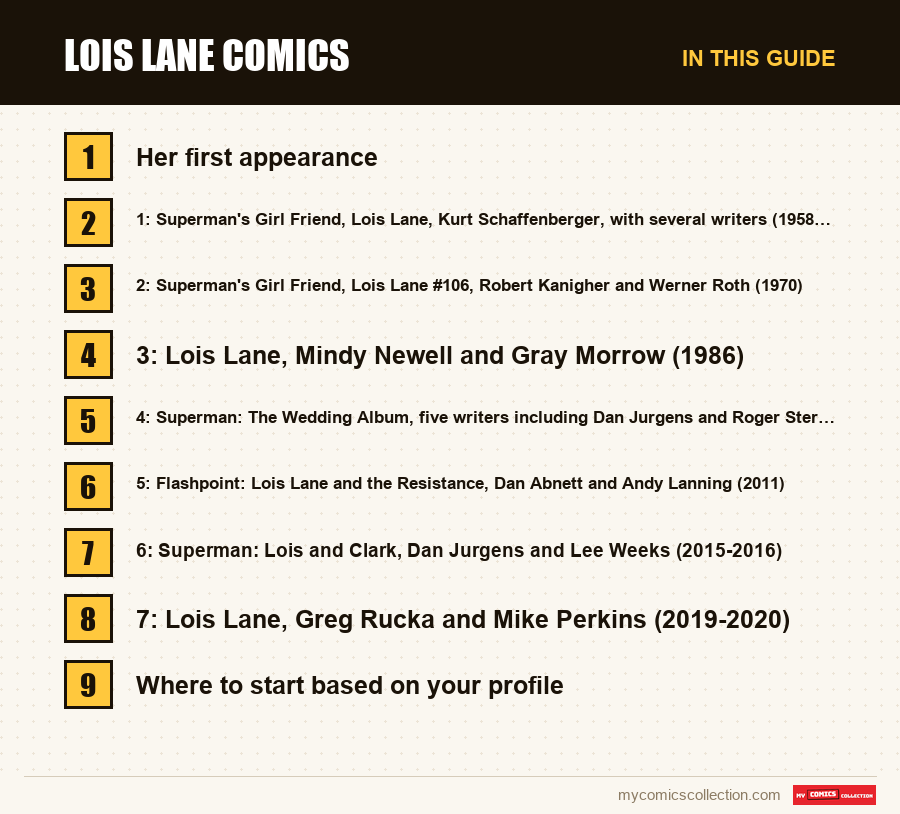
5: Flashpoint: Lois Lane and the Resistance, Dan Abnett and Andy Lanning (2011)
In this tie-in to the Flashpoint event, three issues come out from August to October 2011. Dan Abnett and Andy Lanning write, Eddy Nunez draws and Sandra Hope inks. In this alternate world, the Amazons have taken over the United Kingdom, renamed New Themyscira: Lois, a reporter stuck behind their lines, agrees to spy on behalf of Cyborg, then joins the Resistance and reveals to the world that the Amazons are interning civilians.
This story turns Lois into a resistance fighter on a continent at war. It suits Flashpoint readers who want a different viewpoint on the event, and it reads without knowing the other tie-ins. It remains a read of curiosity more than a pillar of the character, because it takes place outside main continuity.
6: Superman: Lois and Clark, Dan Jurgens and Lee Weeks (2015-2016)
This eight-issue series follows the couple after the birth of Jon. Dan Jurgens writes, Lee Weeks draws, and Scott Hanna inks #1, with Brad Anderson on colors. The first issue, "Arrival, Part I," is cover-dated December 2015: Lois and Clark live in hiding under the name White. Their son Jon was born in Convergence: Superman #2, cover-dated July 2015.
The series gives Lois the role of a settled adult, shared with Clark, and it suits readers who already know the 1996 wedding and want to know what becomes of the couple. It reads in one short collection and connects easily to later Superman series. If you like the family side of the character, it is the warmest read on this list.
7: Lois Lane, Greg Rucka and Mike Perkins (2019-2020)
DC announces this maxiseries as a twelve-issue title. Greg Rucka writes, Mike Perkins draws, Paul Mounts handles the colors and Simon Bowland the lettering. The first issue, "Enemy of the People," comes out on July 3, 2019, and the series wraps up in July 2020.
Lois investigates as a reporter. It is the most recent read on this list and the most accessible for anyone discovering the character in 2026: it requires no knowledge of the previous decades. It suits fans of political thrillers, and it reads like a novel in twelve chapters.
Where to start based on your profile
If you want today's character, start with the Greg Rucka and Mike Perkins maxiseries, then go back to the 1996 wedding. If you prefer the Silver Age, start from Showcase #9 and then Superman's Girl Friend, Lois Lane, going for the reprints. If you are first curious about the social history of comics, #106 is a document to read with perspective.
For readers coming from television, our comparison of Superman & Lois and the comics shows where the characters come from. And if you want to place these stories within the publisher's big timeline, the Superman reading guide serves as a compass: it gives the order of the eras, into which the entries on this list slot easily.
The key issues to know
For collectors, the hierarchy follows the logic of first appearances and turning points. The major landmark is Action Comics #1 (June 1938), the character's first appearance. Showcase #9 (July-August 1957) marks her tryout as a headliner, and Superman's Girl Friend, Lois Lane #1 (1958) her arrival in a title under her own name. #106 (November 1970) is sought after for its historical content.
Next come Lois Lane #1 (August 1986) by Mindy Newell and Gray Morrow, Superman: The Wedding Album (December 1996), Flashpoint: Lois Lane and the Resistance #1 (August 2011), Superman: Lois and Clark #1 (December 2015) and Lois Lane #1 (2019) by Greg Rucka. Our guide to Superman's Golden Age key issues puts Action Comics #1 in context.
As for method, separate what you hunt as a single issue from what you read in a collection. Action Comics #1 follows a logic of its own, approached by comparing sold listings and examining condition. Issues from the 1950s and 1960s are judged by spine strength, corners and paper. Modern series, printed in large numbers, are worth mostly for how readable they are in a collection: nothing justifies paying the price of a graded copy for a story you will read once.
Frequently asked questions
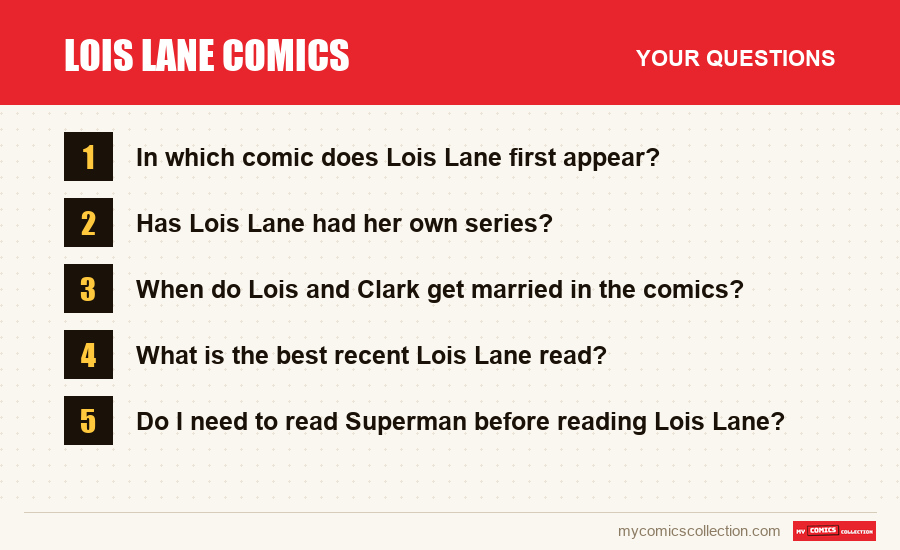
In Action Comics #1, cover-dated June 1938, in the Superman story by Jerry Siegel and Joe Shuster. She is kidnapped by a gangster, then rescued by Superman. Her role as a reporter is built up in the following issues.
Yes: Superman's Girl Friend, Lois Lane, launched in 1958 after two tryouts in Showcase, ran 137 issues until 1974. Lois then had stories in The Superman Family until 1982, followed by a miniseries in 1986 and a maxiseries in 2019.
In Superman: The Wedding Album, a one-shot from December 1996 co-written by five writers, including Dan Jurgens and Roger Stern, under a John Byrne cover. The collection Superman: The Wedding and Beyond (1997) extends the story with the honeymoon.
Lois Lane, twelve issues with Greg Rucka on script and Mike Perkins on art, launched in July 2019. It requires no prior knowledge and follows Lois as a reporter, without Superman carrying the story.
No. The 1986 miniseries by Mindy Newell and Gray Morrow and the 2019 maxiseries by Greg Rucka and Mike Perkins read without preparation. The 1996 wedding, however, is better read after a few stories from the Dan Jurgens era.
Do you own an issue of Superman's Girl Friend, Lois Lane or Showcase? Get it appraised before deciding whether to keep it.
Appraise my comic