
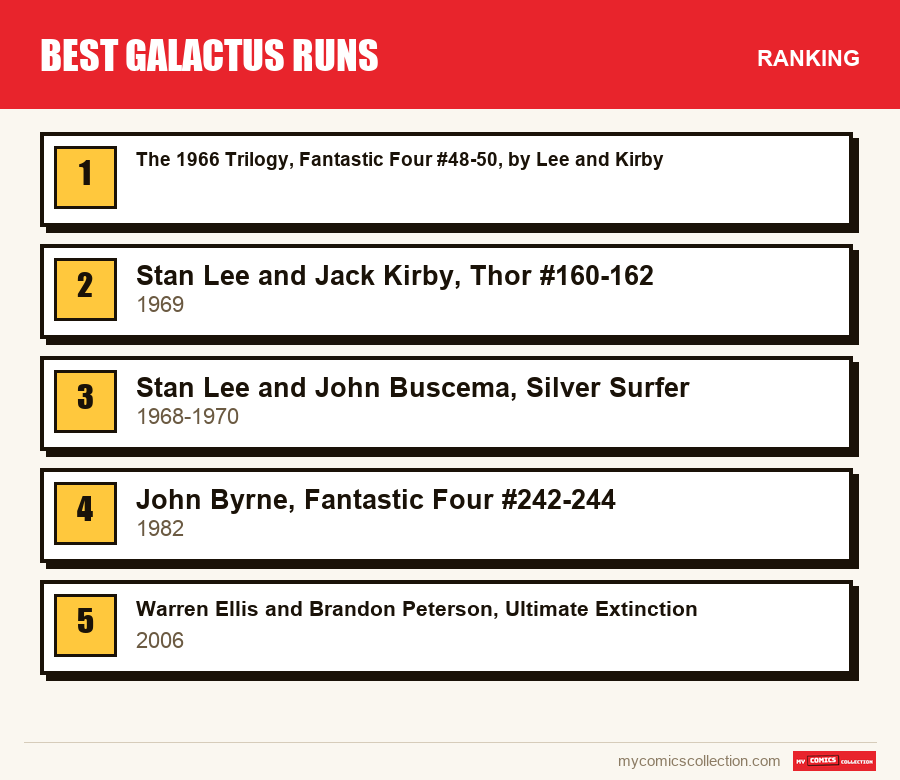
The best Galactus run is the Trilogy in Fantastic Four #48-50 by Stan Lee and Jack Kirby (1966), followed by Thor #160-162 (1969) and the Silver Surfer series by Stan Lee and John Buscema (1968-1970). This ranking covers five reading blocks, from the birth of the Devourer of Worlds to his 2006 Ultimate version, with the format to aim for in each case.
Galactus has never carried a regular series of his own for any length of time. He shows up, he threatens a world, he leaves, and his best material lives in those visits. A ranking therefore means selecting arcs and eras rather than whole monthly series. Each place in the list is discussed below.
As always in this guide, we state only verified facts (creators, issue numbers, dates); the analysis is our own, with no reproduction of protected artwork or dialogue.
How we ranked these runs
For a character who appears in bursts, we set a simple requirement: the story has to make Galactus its subject, not just its scenery. A spectacular scene is not enough; the story must deal with what he is, what he eats and what it costs the people who cross his path. We then weighed how self-contained the story is and its effect on later writers. A brilliant arc with no descendants stayed behind a founding one.
The ranking rewards reading quality, not market value. The priciest issues in Galactus's bibliography do not always coincide with the stories we prefer, and the last section handles collecting separately.
1. The 1966 Trilogy, Fantastic Four #48-50, by Lee and Kirby
Three consecutive issues of the Fantastic Four series, published from March to May 1966 with Joe Sinnott on inks. A silver herald precedes an entity that has picked Earth for its meal, and the team has to find, within days, a way to turn it from its plan. Issue 48 introduces the two figures, 49 puts Galactus on the cover, and 50 delivers Reed Richards's answer, with the weapon collectors call the Ultimate Nullifier.
This run matters because it tips Marvel into the cosmic: before it, threats were earthbound or close to home; afterward, the publisher accepts that a story's scale can exceed a city's. It also fixes Galactus's nature, which is not a villain in the usual sense but a biological necessity. It is for every reader without exception: the story is self-contained, and nothing on the pages requires having read earlier issues. On the question of which of the three is "the" first appearance, our article on Galactus's first appearance lays out the debate.
For collecting, the period edition is three Silver Age issues, with their frailties: acidic paper, fading tints, possible restorations. For reading, we would rather point you to a Masterworks or an Omnibus, which reprint the same content without those preservation problems.
2. Stan Lee and Jack Kirby, Thor #160-162 (1969)
Three years after the Trilogy, Lee and Kirby bring Galactus into the Thor series, in 1969, for a clash with Ego, the living planet. The two entities fight over a world, and the battle plays out at a scale where the god of thunder is almost a bystander. A few issues later, Thor #168 and #169 (also 1969) dig into Galactus's origin and his place in the cycle of the universe, material that later writers will keep returning to.
This block matters because it makes the character mythological: Galactus stops being a passing menace and becomes a principle, something later writers, from Byrne to contemporary authors, took as given. It is for the reader already won over by the Trilogy, who wants to see how far Kirby pushes the idea, rather than for the beginner: the 1969 storytelling remains dense and happily grandiloquent.
The original format is a block of Thor issues, more affordable than the 1966 Fantastic Four numbers but subject to the same age constraints. Our Galactus reading guide puts this block back in the recommended reading order.
3. Stan Lee and John Buscema, Silver Surfer (1968-1970)
The Silver Surfer's first series, eighteen issues published from 1968 to 1970, keeps Galactus in the background rather than the spotlight. Stan Lee and John Buscema tell the story of a herald condemned to stay on Earth, caught between the memory of his home planet and the gaze of a master who has abandoned him. Galactus acts here by ricochet: the series sheds light on his nature through the melancholy of his creature.
It matters because it explains the human price of a pact with the Devourer, which the Trilogy only sketches. It speaks to the reader who prefers inner stories to large-scale showdowns, and who can accept very emphatic writing, typical of Lee in this period. It is not strictly a run about Galactus, which explains third place.
The original format is a series of eighteen issues, completable with patience but demanding on condition. A collected edition gathers the period, and our ranking of the best Silver Surfer runs compares it with more recent versions of the herald.
4. John Byrne, Fantastic Four #242-244 (1982)
John Byrne writes and draws Fantastic Four from issue 232 through 293, between 1981 and 1986, and issues 242 to 244 (1982) bring Galactus back to the foreground. Byrne turns it into a matter of conscience: the Devourer is confronted with what he owes to those who spared him, and the question of his right to exist is put plainly. The arc's titles vary depending on editions and sources, which is a reason to look for the issue numbers rather than the name.
This stretch matters because it makes Galactus a moral subject, which Kirby had suggested without exploring. It is for the reader who already knows the Trilogy and wants to see how an author of the next generation answers Lee and Kirby. Its fourth-rung rank reflects its dependence: it gains a lot from being read after the first three.
The original format is a block of three 1980s issues, undemanding to preserve compared with Silver Age books. Collected editions of the Byrne period exist, in several forms. For the editorial context of the series, see our ranking of the best Fantastic Four runs.
Do you collect this series?
Track what you own, what you're missing and what your collection is worth. 7-day trial.
Start my trial →
5. Warren Ellis and Brandon Peterson, Ultimate Extinction (2006)
The final chapter of a trilogy written by Warren Ellis in the Ultimate universe, between 2004 and 2006, Ultimate Extinction (five issues, drawn by Brandon Peterson) reinvents Galactus. The entity is no longer a giant in armor but a threat of another order, a swarm that shows itself through appetite as much as through form. The idea is radical, and it deliberately breaks with Kirby's silhouette.
It matters because it shows the concept survives a complete change of appearance: what defines Galactus is hunger and scale, not the helmet. It is for the reader already familiar with the classic character and curious about a divergent take, and it belongs to a separate universe that has to be accepted on its own terms. It is not an entry point, which is why it comes last.
The format is a five-issue miniseries, easy to find, with a collected edition that places it within the whole trilogy. For a Galactus collection, it is a complement rather than a foundation.
And outside the ranking
Two absences call for an explanation. The first is the set of stories that retell Galactus's origin as a one-shot: sources disagree on the date of one of them, and we prefer not to state it rather than rule wrongly. We therefore leave it aside, and invite you to check the publication date on the copy you buy. The second concerns the first two parts of Ellis's trilogy, Ultimate Nightmare and Ultimate Secret: Galactus does not yet appear there in his final form, and only Ultimate Extinction gives him his central role, hence its sole presence in the ranking.
One last point of method: we did not include mere cameos, however spectacular. A panel where the Devourer crosses another hero's sky does not make a run, and a ranking that counted them would read like an index of appearances rather than a selection of reads.
Which one to start with, depending on your profile
If you are discovering Galactus, read the 1966 Trilogy: it is self-contained and holds everything that defines the character. If you want to grasp the myth, follow with Thor #160-162, then the Silver Surfer series. For a more modern, moral take, Byrne's stretch is a must. If you are after a shift in tone, Ultimate Extinction is the indicated read. Collectors can refer to our key Galactus issues guide to separate reading from buying.
What these runs are worth as a collection
The gap between the blocks in this ranking is considerable. The three 1966 issues sit at the top of the Silver Age comics market; every other block belongs to a different price regime, far more accessible. Before buying, separate reading from collecting: to read, a collected edition is plenty; to own, choose the issue that means something to you, probably 48 or 49.
The valuation method is the same for each block. For the issue you care about, browse several active listings, discard outlying prices, and set them against completed transactions at a comparable condition. For the Silver Age, the presence of a restoration or the thinness of the spine weighs more than the grade number. For Byrne and Ultimate Extinction, issues trade on series completion, with no particular premium; for Thor 160 to 162, the scarcity of clean copies is what drives the price. Our page on the value of Galactus comics extends these markers, with no invented figures.
A tip for building a collection: begin with the blocks that cost least and fill in fast, that is Byrne and then Ultimate Extinction, so you can learn to judge a single issue's condition on copies with little at stake. Next comes the 1968-1970 Silver Surfer series, eighteen issues that show concretely the difference between an ordinary copy and a well-kept one. The 1966 block comes last, once your eye is trained: buying an issue of that value without this apprenticeship amounts to paying for your own mistakes. If the budget does not allow it, a quality collected edition remains an excellent compromise, and nothing stops you from aiming later at a single issue, the one that matters to you.

Frequently asked questions
Fantastic Four issues 48 to 50 (1966), by Stan Lee and Jack Kirby, known as the Trilogy. It introduces Galactus and the Silver Surfer, it is self-contained and it set the character's nature. Every later story, from Thor to Byrne, takes it as a reference.
He has never had a lasting regular series under his name. His material is spread across Fantastic Four, Thor and the Silver Surfer series. That is why a ranking of his runs covers specific arcs, and not complete monthly collections.
It is not essential, but it sheds light on the relationship between the Devourer and his herald. The eighteen issues from 1968 to 1970 tell the price of the pact from the Surfer's point of view, a valuable complement to the Trilogy, especially for readers drawn to the tragic side.
No, it belongs to the Ultimate universe, separate from the main continuity. Warren Ellis reinvents the entity in a trilogy that ends with Ultimate Extinction (2006). It reads on its own, but it takes on its full meaning after the classic Lee and Kirby version.
For reading, collected editions are enough and avoid the fragility of old paper. For collecting, the 1966 issues form a market of their own, while the Byrne and Ellis periods are easy to complete. Decide first whether you want a book or an object.
Do you own an issue from the Galactus Trilogy or the Byrne period? Estimate it from current listings.
Estimate my comic