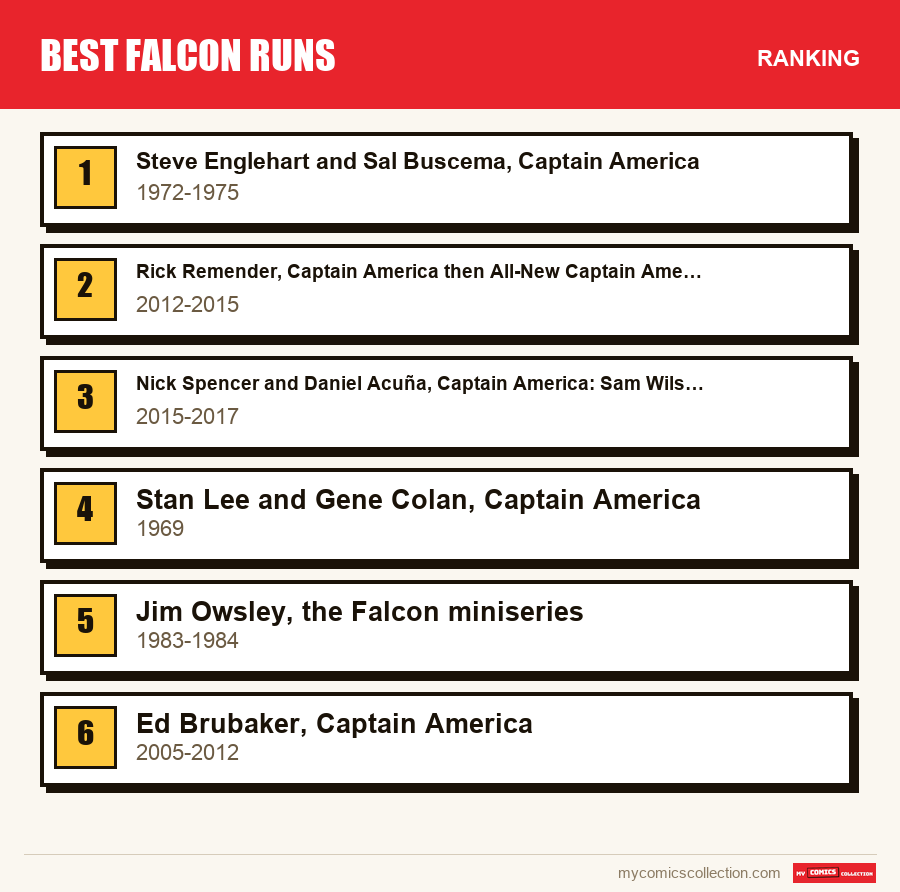
The best Falcon run is Steve Englehart and Sal Buscema's stretch on Captain America (1972-1975), where Sam Wilson becomes a true co-hero. It edges out Rick Remender's shield handover (2014), Nick Spencer's Sam Wilson series (2015-2017), the Stan Lee and Gene Colan debut (1969), the 1983 miniseries and Ed Brubaker's Captain America. Six picks, ranked, with the format to aim for.
Ranking Falcon is tricky: before 2015, Sam Wilson almost never had a long series under his own name. His best stories hide inside someone else's title, or in stretches where the shield changes hands. Rather than hunting for a single run, we compared reading periods, from the Harlem of 1969 to the contested America of Nick Spencer.
As always in this guide, only verified facts (creators, issues, dates) are stated as fact; the analysis is our own, with no reproduction of protected art or dialogue.
How we ranked these runs
The common thread of Sam Wilson's story is the question of what a partner becomes once he stops being a sidekick. So we set three requirements for each candidate: does Sam hold a role nobody else could fill, can it be read without wading through forty years of continuity, and is it available in a reasonable format? Stories where Falcon is merely a useful extra for Steve Rogers are set aside, even when they are excellent.
The ranking below judges reading pleasure, not the market price of the issues. The character's most sought-after issue, Captain America #117 from September 1969, belongs to the later part of this list, and that is deliberate: a founding issue is not necessarily the best story.
Top 1: Steve Englehart and Sal Buscema, Captain America (1972-1975)
Steve Englehart writes Captain America from roughly issue 153 to issue 186, with Sal Buscema on art for most of the period. The series carries a double title, Captain America and the Falcon, from issue 134 in 1971. Sam Wilson is no longer a passing guest here: he has his own life in Harlem, his disagreements with Steve Rogers and a part in every plot.
The showpiece is the Secret Empire saga, spread over 1973 and early 1974, which echoes the American political scandals of the day. By the end of that arc, Steve Rogers temporarily gives up his costume to become Nomad, and Sam Wilson remains one of the series' anchors. In this same run the character receives the mechanical wings given to him by Black Panther, around issue 170, and a revelation about his past as a small-time criminal, the "Snap" Wilson of issue 186, still divides readers.
This run matters because it builds the Falcon everyone recognizes: the winged partner with a social conscience. It suits the reader willing to accept dense 1970s storytelling, with its caption boxes and chatty titles. For collecting, the original issues are mostly found in mid grades, with the Secret Empire issues climbing far faster than the rest; period collected editions gather the run in chronological volumes and are fine for reading.
Top 2: Rick Remender, Captain America then All-New Captain America (2012-2015)
Rick Remender takes over Captain America at the 2012 relaunch, with John Romita Jr. on art for his first arcs, and slowly builds toward a move that upends the character: Steve Rogers suddenly ages, and Sam Wilson picks up the shield. The handover is written into Captain America #25 in 2014, then into the All-New Captain America series launched in the fall of that year with Stuart Immonen on art.
What this sequence tells is more intimate than the event suggests. Sam does not inherit by acclamation: he doubts himself, he carries the weight of twenty years as a sidekick, and he tries to earn acceptance in a costume that is not his own. The editorial angle is huge, since it is the first time a successor to the shield headlines Marvel's flagship Captain America title.
This run is for the reader who wants to understand why Sam Wilson is now a full Captain America, without going back to the seventies. It does still help to have a rough idea of Steve Rogers' history. For collecting, the 2012 to 2015 issues are easy to assemble one by one; a collected edition of the shield handover mostly saves you from missing the pivotal issues. Issue 25 and the first issue of All-New Captain America remain the natural landmarks.
Top 3: Nick Spencer and Daniel Acuña, Captain America: Sam Wilson (2015-2017)
Launched in 2015, this series puts Sam Wilson alone at the top of the bill, with Daniel Acuña opening the art and several artists following. Nick Spencer takes the opposite approach to caution: his Captain America crisscrosses the United States, faces fictional political movements inspired by public debate, and is criticized for taking a stand. The series divided readers when it came out, and it still does.
Its appeal comes down to a simple question: what does it mean to carry the shield when you come from Harlem rather than the trenches of 1941? It is for the adult reader curious about political comics, who accepts that a writer will pick a side. It also reads fine apart from neighboring events, even if its context crosses with that of Secret Empire (2017), the same writer's event.
For collecting, the issues are modern and affordable, and a volume-by-volume collected edition makes sense whenever you want to read the whole thing in one go. It is a recent series whose market price is not yet settled, and one that will probably only move on the back of a new Sam Wilson adaptation.
Top 4: Stan Lee and Gene Colan, Captain America (1969)
Sam Wilson's Harlem takes shape as early as the fall of 1969: Stan Lee writes and Gene Colan draws Captain America issue 117, where Falcon makes his entrance. Sam Wilson is a Harlem social worker, accompanied by his falcon Redwing, who teams up with Steve Rogers against the Red Skull. The next issue, 118, rounds out the character's identity. Together, the two issues form the launch pad for everything that follows.
This debut ranks fourth because it is historic before it is the most accomplished: Gene Colan gives the character an instant silhouette, but the storytelling is still that of a hero discovering his role. It is for the reader who wants to see how Marvel introduced its first recurring African American hero, with no qualifier in his name, something our article on the first appearance covers in detail.
For collecting, this is original-issue territory, but also the place where condition makes all the difference: issue 117 is by far the most coveted. If your main goal is to read, a collected edition of the Lee and Colan period is enough.
Do you collect this series?
Track what you own, what you're missing and what your collection is worth. 7-day trial.
Start my trial →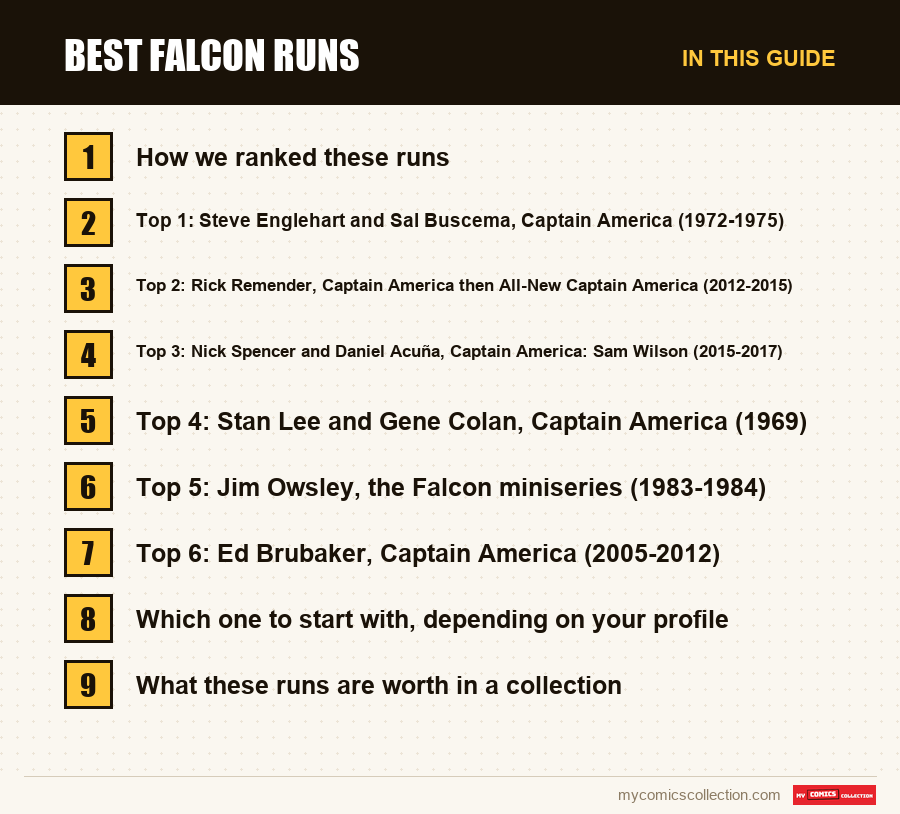
Top 5: Jim Owsley, the Falcon miniseries (1983-1984)
Four issues, between November 1983 and February 1984: this is Sam Wilson's first solo title. Writer Jim Owsley, who would later sign his work as Christopher Priest, sets the action in Harlem and makes Falcon more of an urban vigilante than a winged superhero. On art, Paul Smith draws the first issue and Mark Bright the following three.
The series matters because it shows that Sam Wilson can carry a story without Steve Rogers, and because it opens up a hypothesis about his origins that Marvel later closed again. It is for readers curious about editorial history rather than newcomers. For collecting, the four issues are easy to find individually, and the issues of this period are best treated as a small closed series: complete it in one go, or pick up a collected edition if you come across one.
Top 6: Ed Brubaker, Captain America (2005-2012)
In Ed Brubaker's Captain America, launched in 2005 with Steve Epting on art, Sam Wilson is not at the center of the plot. He appears as a serious, modern partner, woven into S.H.I.E.L.D. operations and the crisis scenes that follow the death of Steve Rogers. It is an essential run for anyone interested in Bucky and the Winter Soldier; for Falcon, it remains context, not subject.
We keep it in the ranking because many readers come to Sam Wilson through this door, and because it offers the steadiest picture of the character before 2014. It is for the thriller reader who wants an adult take on the duo. For collecting, the complete run exists in many collected editions; the issues from the start of the series are the most sought after.
Which one to start with, depending on your profile
If you are new to Sam Wilson and want to understand why he carries the shield today, read Remender then Spencer: two adjacent stretches, in a recent format, that tell the story of the handover. If you want the substance of the character, start with Steve Englehart and Sal Buscema and continue with the 1983 Falcon miniseries.
If you collect a character's first appearances, the pair of Captain America #117 and #118 is your priority, but read a collected edition first to find out whether the Silver Age suits you. Our Falcon reading guide offers the same path in chronological order, and the character's history puts these runs back in context.
What these runs are worth in a collection
The value of these six picks falls into three families. The issues from 1969 and the early 1970s carry the premium: a well-graded copy of issue 117 sits very far from a reading copy, and the gap between two neighboring grades weighs more than the gap between two years. The Englehart run trades in a more spread-out way, with peaks on the Secret Empire issues and on issue 186.
The 1983 miniseries holds an intermediate position: cheap individually, but complete only if all four issues are in the same condition. The 2012 to 2017 issues are recent print runs whose market price is not settled. Two things will move it: Sam Wilson's presence in adaptations and how long he keeps the shield.
Before buying a Captain America #117 or an Englehart issue, compare what sellers are asking with what has actually sold for the same grade. The breakdown of ranges by issue is in the article Falcon comics value.
Frequently asked questions
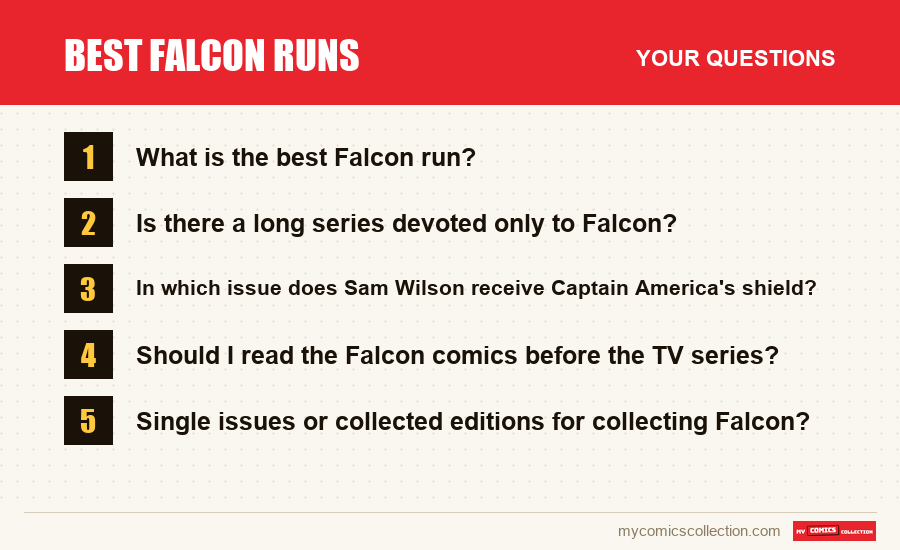
Steve Englehart and Sal Buscema's run on Captain America, between 1972 and 1975, remains the benchmark: it makes Sam Wilson a co-hero with a social voice, wings given by Black Panther and a key role in Secret Empire.
No, not before 2015. Before then, Sam Wilson only had the four-issue miniseries of 1983 and 1984; Nick Spencer's Captain America: Sam Wilson series, in 2015, is his first title of significant length under his own name.
The handover is written into Captain America #25 from 2014, by Rick Remender. The All-New Captain America series, launched in the fall of 2014 with Stuart Immonen on art, then establishes Sam Wilson under the Captain America costume.
It isn't necessary: the adaptations borrow the idea of a successor to the shield, but not the details of the stories. If you want to find the handover, read Remender (2014) then Spencer (2015-2017); Steve Englehart's seventies have a different tone.
Both, depending on the era. For 1969 and the 1970s, aim for original issues if the budget allows, otherwise a collected edition. For 2012 to 2017, modern issues are easy to assemble, and a collected edition works for reading.
Do you own a Captain America #117 or an issue from the Englehart run? Get your copy estimated based on its real condition.
Estimate my comic