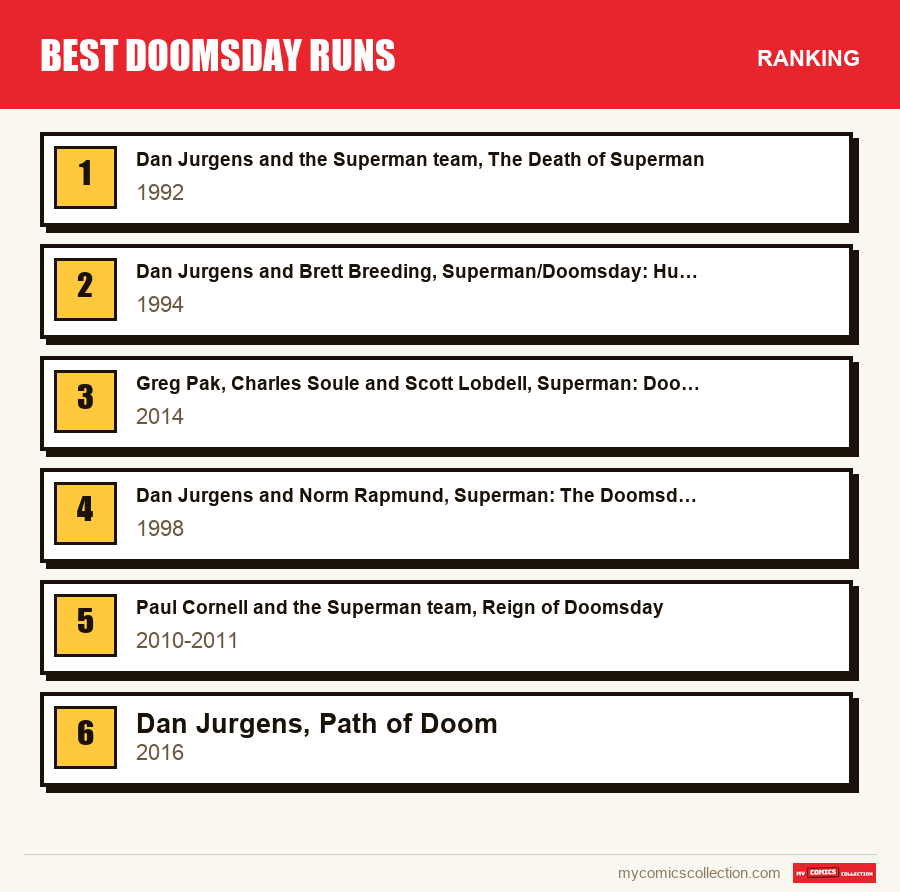
The best story about Doomsday remains The Death of Superman (1992), driven by Dan Jurgens and the team behind the four Superman series, ahead of the Hunter/Prey miniseries (1994), which reveals his origin, and the Superman: Doomed crossover (2014), which turns the monster into a contagion. This ranking covers six reading blocks, with the format to aim for in each: collected edition for reading, period single issues for collecting.
Doomsday has never had a regular series carrying him month after month: his strength lies in his rarity, and the voiceless monster has always crashed into other characters' titles. Listing "his best runs" therefore means isolating reading blocks, sometimes three issues, sometimes ten, all written around the same creature. Here is our selection, with the reasons behind each rank.
As always in this guide, only verified facts (creators, issues, dates) are stated as fact; the analysis is our own, with no reproduction of protected art or dialogue.
How we chose and ranked these six picks
For a character who doesn't speak, a story's quality can't be judged on its dialogue. Each candidate therefore went through a three-part test. Does the story make Doomsday the real subject, and not just an obstacle along the way? Can it be read without having followed ten years of DC continuity? Did it add a trait that later writers picked up: reactive adaptation, contagion, the double? The two 1993 cycles that follow the death, the funeral and then the replacement of the hero, stay off the list: the creature no longer appears in them.
The rank measures reading interest, not market price. The most sought-after issue in the file, Superman #75, does not belong to the finest story; the final section returns to this gap once the reading question is settled.
Top 1: Dan Jurgens and the Superman team, The Death of Superman (1992)
In late 1992, the four monthly Superman series stop telling their own stories and take turns telling just one. The catalog dates the on-sale date of the first chapter, Man of Steel #18, to October 15, 1992 and that of the last, Superman #75, to November 19; in between come Superman #74, Justice League America #69, Adventures of Superman #497, Action Comics #684 and Man of Steel #19, at a rate of one appointment per week. A creature emerging from a buried capsule advances on Metropolis, sweeps aside an improvised Justice League, then meets Superman.
This block comes first for a structural reason: the story rests on the repetition of one gesture, the advance, and on the gradual reduction in the number of panels per page, down to the full pages of the last issue. Dan Jurgens signs the concluding issue, with Brett Breeding on inks. The work is collective: Louise Simonson and Jon Bogdanove handle Man of Steel, while Jerry Ordway, Roger Stern, Karl Kesel and Tom Grummett share the other titles. It is for everyone, because it requires no prior reading. The page on Doomsday's first appearance details the Man of Steel #17 cameo that precedes this block by a month.
To read it, the collected edition of The Death of Superman is more than enough. To collect it, the difficulty is the reverse of that of the old classics: the print run of Superman #75 is counted in millions, so the ordinary copy is never in short supply. The difference lies between the black-bagged edition with its armband, the rarer newsstand version, and the platinum edition reserved for retailers, which our guide to the editions of Superman #75 helps you recognize.
Top 2: Dan Jurgens and Brett Breeding, Superman/Doomsday: Hunter/Prey (1994)
Three prestige-format issues, published in 1994, which answer the question deliberately left open two years earlier: where does this thing come from? The story goes back to prehistoric Krypton, where a scientist named Bertron experiments on a newborn until he builds an organism that comes back from death immune to whatever killed it. The title cuts both ways: the monster hunts, but he is also the prey of his own creators and then of Superman.
The run matters because it establishes the rule that becomes the character's signature, reactive adaptation, and because it places him in a cosmic story where Darkseid and Apokolips peek through. It requires having read the 1992 shock, since the effect of the reveal rests on what you already knew. There is no opening or closing issue to hunt down: three chapters, one volume. As for format, the three issues are easy to assemble in prestige or collected form, and the collected edition suits you better if you like large formats. Our history of Doomsday places this story within the character's biography.
Top 3: Greg Pak, Charles Soule and Scott Lobdell, Superman: Doomed (2014)
Superman: Doomed is a New 52-era crossover that runs through several Superman titles in 2014, with Aaron Kuder and Ken Lashley among the artists. The idea fits in one sentence: the fight with Doomsday leaves Superman with a wound that spreads, and the hero starts to become what he fought. The monster no longer merely strikes from outside; he becomes a possibility lurking inside the man.
This third place rewards conceptual daring. The three writers turn the monster's immunity against the hero, and the story reads as the modern answer to The Death of Superman, which it cites constantly. It is for the reader who already knows 1992 and accepts an ensemble story spread across several series. A dedicated collected edition exists; it is the logical route, because following the chapter order across scattered single issues requires a reading table. The one-shot Superman: Doomed #1 (2014) serves as the opening landmark, though we don't fix the details of the other issues here, for lack of certainty about the exact order.
Do you collect this series?
Track what you own, what you're missing and what your collection is worth. 7-day trial.
Start my trial →Top 4: Dan Jurgens and Norm Rapmund, Superman: The Doomsday Wars (1998)
The installment that closes Jurgens's trilogy. In 1998, Brainiac gets hold of the creature and turns him into a guided weapon: the monster with no plan finds himself piloted by the coldest intelligence in the Superman universe. Three prestige-format issues, drawn with Norm Rapmund, forming an action story more head-on than Hunter/Prey.
It matters for one precise reason: it is the only moment when Doomsday's muteness is put in the service of an outside will, which flips the 1992 equation, where nothing commanded him. It is for the reader who loved the initial shock and wants to see the character in another role; it will also interest those who follow the Coluan lineage, since the mastermind this time is Brainiac, whose other appearances are described in the Brainiac reading guide. It ranks below its two elders because the story leans more on mechanics than on a new idea.
To collect it, three issues with no famous variant: a small set to complete, which does not depend on record print runs. A collected edition exists too, sometimes grouped with other appearances of the creature.
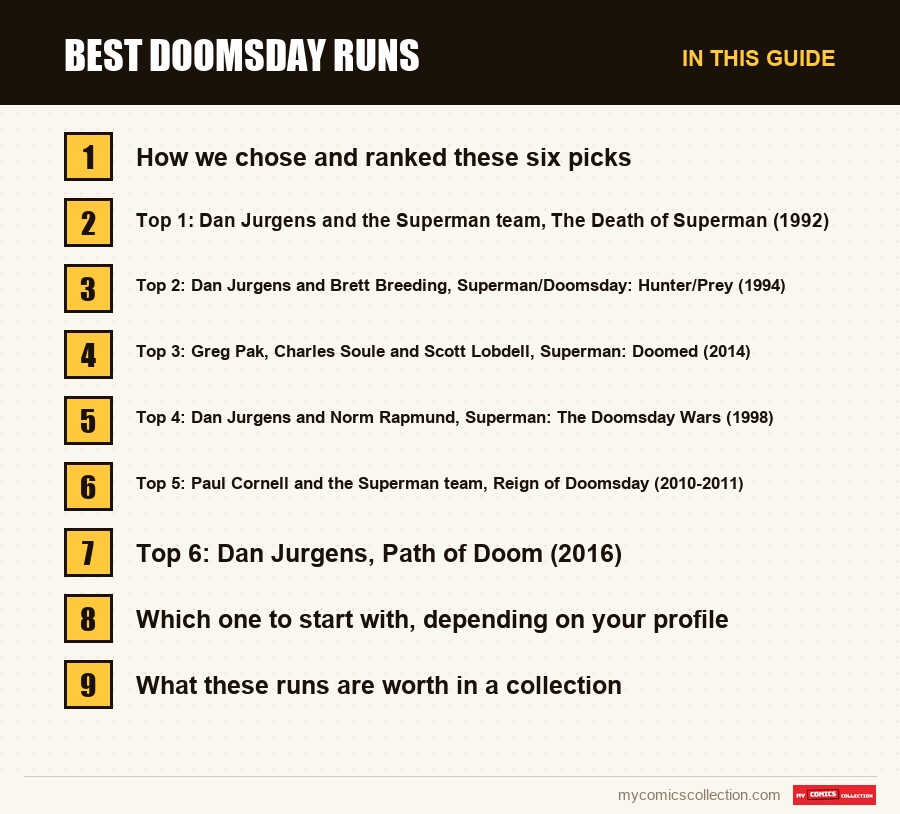
Top 5: Paul Cornell and the Superman team, Reign of Doomsday (2010-2011)
At the turn of 2010 and 2011, Action Comics, then written by Paul Cornell around its issue 900, welcomes a return of the monster who goes after Superman's loved ones one after another: Steel, Superboy, the Eradicator, the Cyborg Superman, Supergirl. Then comes the Doomslayer, a variant that claims to correct the original. Start and end dates differ by source, and we prefer not to pin down issue numbers.
The event matters because it pushes the logic of a mindless creature all the way to multiplication: if Doomsday always comes back, then the story can make several of him. It requires knowing the Superman family of the time, which reserves it for a reader already settled into the series. It is fifth because its interest depends more on context than on the monster himself.
The simplest format remains the event collected edition, which puts back in order chapters spread across several titles. In single issues, following it means hunting several series at once; it is only worth the effort for a complete collection of the period.
Top 6: Dan Jurgens, Path of Doom (2016)
When the Rebirth line relaunches Action Comics in 2016, Dan Jurgens returns to write the character he dreamed up twenty-four years earlier. The Path of Doom arc pits a Superman back in his solid-hero clothes against an unleashed Doomsday, as if to close a loop. The exact schedule of the arc varies depending on whether you count by series numbering or by collected edition, and we don't publish precise bounds.
It ranks sixth: it is not a bad story, but it brings less novelty than its predecessors and reads mostly as a return to the roots. It is for the reader who wants to see the creator revisit his creation with a quarter-century of hindsight. It is available in collected form; in single issues, these are recent, plentiful numbers.
One search trap is worth flagging: Doomsday Clock, by Geoff Johns and Gary Frank, is not about the monster. It is the sequel to Watchmen. Anyone looking for the creature should aim for the picks above.
Which one to start with, depending on your profile
You only know the monster from the screen. Read The Death of Superman, then Hunter/Prey: two short reads that give you the essence of the character.
You like faceless antagonists. Follow up Hunter/Prey with The Doomsday Wars, which show the monster first free, then commanded.
You want something recent. Superman: Doomed is the modern entry point, provided you have seen the 1992 version; Path of Doom follows for casual reading.
You follow the Superman family. Reign of Doomsday makes sense after the mourning of 1993; our selection of the major Superman crossovers places the event over time.
You prefer single issues to collected editions. See our comparison hardcovers or single issues before deciding.
What these runs are worth in a collection
In this file, value plays out along two opposing axes. The first is print run: The Death of Superman is among the biggest print runs of its era, so an ordinary copy trades well below what the media hype of 1992 led people to hope for. The second is variant scarcity: the platinum edition and the newsstand version stand out from the base copy by a wide margin, while the 1994 and 1998 prestige miniseries never saw that surge.
To estimate without going wrong, always compare like for like: sealed black bag with sealed black bag, newsstand with newsstand. An issue from 2014 or 2016 has no settled market price: what will move it is how long any renewed interest in the character lasts, not the story itself. For the creature's opening issues, see our Doomsday key issues, then run your copies through the estimator.
Frequently asked questions
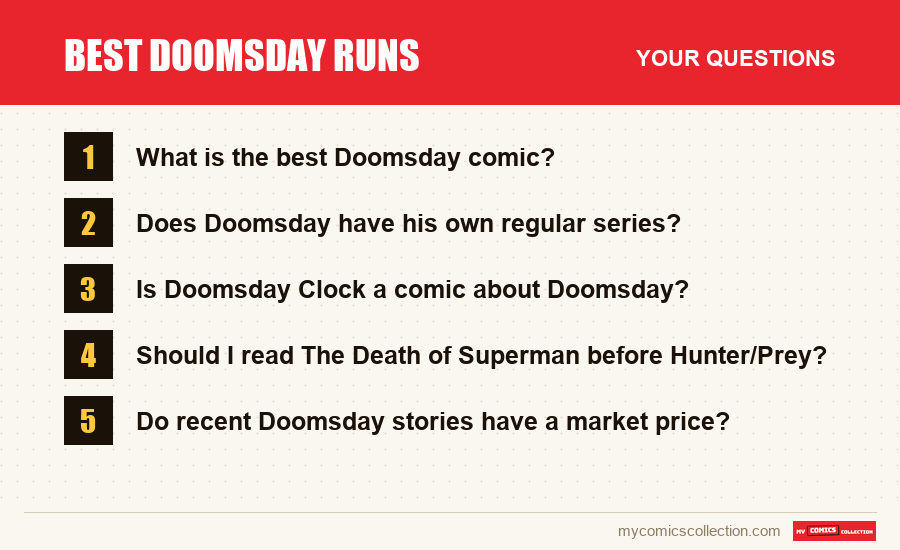
The Death of Superman, published in the fall of 1992 across four Superman series, remains the benchmark: it requires no prior reading and contains the final duel of Superman #75. Hunter/Prey, the miniseries by Dan Jurgens and Brett Breeding from 1994, is the second read to make in order to understand the creature's origin.
No, the monster has never carried a long-running series. His best showcases are prestige-format miniseries, Hunter/Prey in 1994 and The Doomsday Wars in 1998, along with the big Superman crossovers. That is why this ranking talks about reading blocks rather than runs in the classic sense of the term.
No. This title by Geoff Johns and Gary Frank extends the Watchmen universe and borrows its name from the apocalypse clock. The Kryptonian creature is not its subject. To find him, read The Death of Superman, Hunter/Prey or the 2014 Superman: Doomed crossover.
Yes, that is preferable. Hunter/Prey answers a riddle that the 1992 story deliberately leaves open, and the effect of the reveal is lost if you learn the creature's origin without having seen what he does to Superman. Both read quickly, in collected form or single issues.
Not yet settled. Superman: Doomed (2014) and Path of Doom (2016) are modern issues, produced in quantity. Only a lasting resurgence of interest in the monster, a confirmed adaptation or ratio-variant covers would move their price; better to read them in collected form than to buy them to speculate.
Do you own a copy of Superman #75 or one of the issues from the 1992 saga? Measure its real standing before you shelve it or resell it.
Estimate my comic