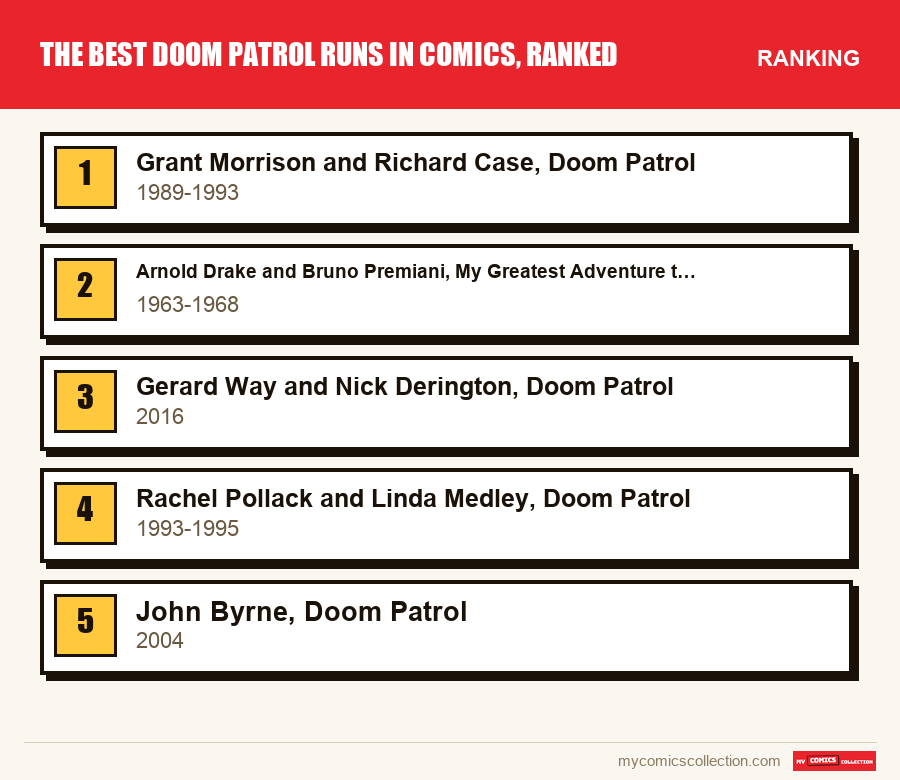
The best Doom Patrol run is the one by Grant Morrison and Richard Case, from issue 19 to issue 63 (1989-1993), ahead of the creation by Arnold Drake and Bruno Premiani (1963-1968) and the relaunch by Gerard Way and Nick Derington (2016). Five sets are ranked here. For each, we give the starting issues, the intended audience and the format to favor, original issues or collected editions.
Few comics teams are collected for their writers more than for their characters. The Doom Patrol is the clearest example: Cliff Steele, Rita Farr and Larry Trainor draw nobody on their own, but a handful of writers have turned this group of survivors into a laboratory where the genre gets turned inside out. Ranking its runs therefore means ranking points of view.
As always in this guide, only verified information (creators, issue numbers, dates) is stated as fact; the analysis is our own, with no reproduction of protected art or dialogue.
How we ranked these runs
For this team, a ranking by sales or by longevity would make no sense: the longest-lasting series are not the most memorable. We weighed the scale of the change each writer imposed on the concept, how well the whole reads without knowing its predecessors, and its trace in the relaunches that followed. A run that left nothing behind, even a well-written one, slides down the list.
A little historical framing is enough. It all begins in My Greatest Adventure #80, cover-dated June 1963, well before the team received a title of its own. The later releases are spread over several successive series, hence overlapping numbering: a "number 19" here means the one from 1989, not another. Keep that in mind when reading the references.
Top 1: Grant Morrison and Richard Case, Doom Patrol (1989-1993)
Morrison takes over the series with issue 19, dated February 1989, and writes it through issue 63. Richard Case draws most of the period. The starting point is bold: if the team is made up of broken people, the story can be broken too. Crazy Jane, a woman with many personalities, each holding a power, arrives as early as issue 19. The Brotherhood of Dada appears in issue 26, and Danny the Street, a living street, in issue 35.
This run dominates because it changes what a mainstream comic can say: dissociation, grief, identity, under a layer of openly embraced surrealism. It became the matrix for every later reading of the title, including the television series that draws its source from it. Later on, the title joined the Vertigo imprint.
It is aimed at the reader ready to be disoriented, and it is more approachable than people say: the story can be followed with no prior reading of the 1960s. For collecting, issue 19 is the natural milestone; for reading, an omnibus devoted to the run exists, and separate collected editions gather the arcs in order. As always, note the range of issues covered before buying.
Top 2: Arnold Drake and Bruno Premiani, My Greatest Adventure then Doom Patrol (1963-1968)
The creation of the team, by Arnold Drake and the artist Bruno Premiani, with Bob Haney on the first issues. My Greatest Adventure #80 introduces Robotman, Elasti-Girl and Negative Man around the Chief, Niles Caulder. The title becomes Doom Patrol from issue 86, in 1964, and continues through issue 121, in 1968. Beast Boy makes his debut in issue 99, in November 1965.
Why this spot: the idea of heroes who are first of all victims, whose powers are mutilations, was new for the era, and it sets the tone that later writers pick up or overturn. The stories are simpler than Morrison's: colorful adversaries, openly embraced shifts in tone, an underlying melancholy. Premiani's line gives the whole an immediate identity.
This run interests the Silver Age reader and the collector of first appearances. For reading, archive volumes and black-and-white collections of the period exist; to own the single issues, count on variable condition and demand concentrated on the launch issues.
Top 3: Gerard Way and Nick Derington, Doom Patrol (2016)
The series opens DC's Young Animal imprint, in 2016, under the direction of Gerard Way, already known as the creator of The Umbrella Academy. Nick Derington draws. Way embraces Morrison's legacy but moves it to a more pop, more colorful register, with panels that play with layout as much as with meaning.
This run counts because it proves that the 1989 approach can be extended without being a pastiche. It is also one of the rare cases of a relaunch praised for its stance rather than for its fidelity to continuity. It suits the reader who already knows Morrison, or who likes the imprint's aesthetic. Way returns to the team's themes, the damaged body, memory, identity, but handles them with an energy that owes as much to rock and independent comics as to the superhero, which explains why the series divided as much as it charmed.
For collecting, this is a 2010s release: the market value is not settled, and we offer no ratio and no print run. What will move it comes down to how long attention to the imprint lasts, possible future adaptations and the real scarcity of the first issues. The collected edition is the prudent choice.
Top 4: Rachel Pollack and Linda Medley, Doom Patrol (1993-1995)
Rachel Pollack succeeds Morrison with issue 64 and writes the series through issue 87, in 1995. The art is shared among several hands, including Linda Medley's. Pollack extends the strangeness without copying the method, with a marked taste for mysticism and tarot, and introduces Coagula, a transgender character rare in the comics of the day.
This run deserves its place for what it attempts: continuing work as striking as Morrison's without imitating it. It is uneven, and that is the reason for its rank. It is aimed at the reader who has exhausted Morrison and wants to see how the team survived that model.
In collecting, these single issues are cited less often than the 1989 ones and remain affordable one at a time. For reading, check whether the period has been collected in your language, since the supply is thinner than for the previous cycle. Tracking issue by issue avoids duplicates, which are common when you buy in lots.
Do you collect this series?
Track what you own, what you're missing and what your collection is worth. 7-day trial.
Start my trial →
Top 5: John Byrne, Doom Patrol (2004)
John Byrne writes and draws the 2004 launch, his version of the team. Rather than extending the surrealist vein, he takes up the setup of the early days, turning back toward more classic superheroics. The choice is debated, and that is why the run closes our ranking: it is readable, but it did not have the echo of the earlier ones. Byrne works alone on both writing and art, as is his habit, which gives the whole a visual unity that the cycles with multiple artists lack.
Its interest is mostly documentary, since it lets you gauge the force of the turn taken fifteen years earlier: seeing what the Doom Patrol becomes when the 1989 turn is refused. It is aimed at admirers of Byrne and at collectors who want a complete panorama of the series.
On the collecting side, the print run of a mid-2000s series remains modest in the market's memory, and there is little pressure there. If you can only buy one lot, leave this one for last.
And the 2026 relaunch?
The first issue of The Doom Patrol, with Darcy Van Poelgeest on script and Niko Henrichon on art, came out on September 2, 2026. It is too early to rank it: no public market data covers it, and the number of planned issues has not been announced. Our article on key issues details what is established and what is not.
Which one to start with, depending on your profile
To discover the Doom Patrol with no baggage, start with the 1989 issue 19: the series can be followed without knowing the 1960s, and it is the best preview of what the team can do. If you prefer chronological order, open My Greatest Adventure #80 and then the first issues of Doom Patrol, with their serial tone.
If you enjoyed the television series, read Morrison first, since the adaptation takes it as its model, then the 2016 relaunch. If you are already familiar with the writer, our Grant Morrison guide shows where to place Doom Patrol in the career, before Animal Man or The Invisibles.
For a reader in a hurry, one piece of advice: read the opening of Morrison's cycle, from the arrival of Crazy Jane to that of the Brotherhood of Dada, before deciding whether to continue. These seven or so issues give the essence of the writer's method, from black humor to tenderness for characters the world has rejected, and are enough to tell whether the rest suits you.
What these runs are worth as collectibles
The market value of the Doom Patrol concentrates on few issues: the 1963 first appearance, Beast Boy's in 1965 and the start of the 1989 run. Between those milestones, most single issues can be completed with no effort. The value of a run is therefore not read in the whole series, but in its tipping-point issues, and the rest comes down to reading pleasure.
For an older issue, the method is to compare several completed sales at the same condition, dwelling on the gaps between graded and ungraded copies. For a recent release, the market value is not settled; it will move with the length of the series and the lasting interest in its imprint. Reread our grading benchmarks before deciding to send a copy in for grading.
Finally, distinguish original issues from collected editions in your inventory: a complete collection of the 1989 series is not the same kind of thing as an omnibus of the same content. Tracking by issue, following our collection management method, avoids accidental rebuys on a title whose numbering overlaps.
Frequently asked questions
The one by Grant Morrison and Richard Case, from issue 19 to issue 63 (1989-1993). It redefined the concept and remains the reference for all the relaunches. The creation by Arnold Drake and Bruno Premiani (1963-1968) comes second, as the historical foundation.
No. The 1989 issue 19 reads on its own, and the writer recaps what is needed of the team's past. The issues of the 1960s enrich the reading, notably to measure what Morrison overturns, but they do not condition understanding.
Yes, it draws first of all on Morrison's run, while rearranging the arcs and adding humor. Our comparison details what is kept and what changes, without revealing the endings. Reading the original run gives a solid basis for understanding it.
Open the first issue of the Doom Patrol by Gerard Way and Nick Derington (2016). It reads with a little curiosity about Morrison, requiring no prior reading, and sets the tone of the imprint. Read it preferably after the 1989 run.
For reading, an omnibus or collected editions by arc are enough and can be bought in a few steps. To own the original issues, start from issue 19, then fill in the series. Always check the range of issues covered before buying.
Do you own My Greatest Adventure #80 or Doom Patrol #19? Estimate it by comparing completed sales to its condition.
Estimate my comic