
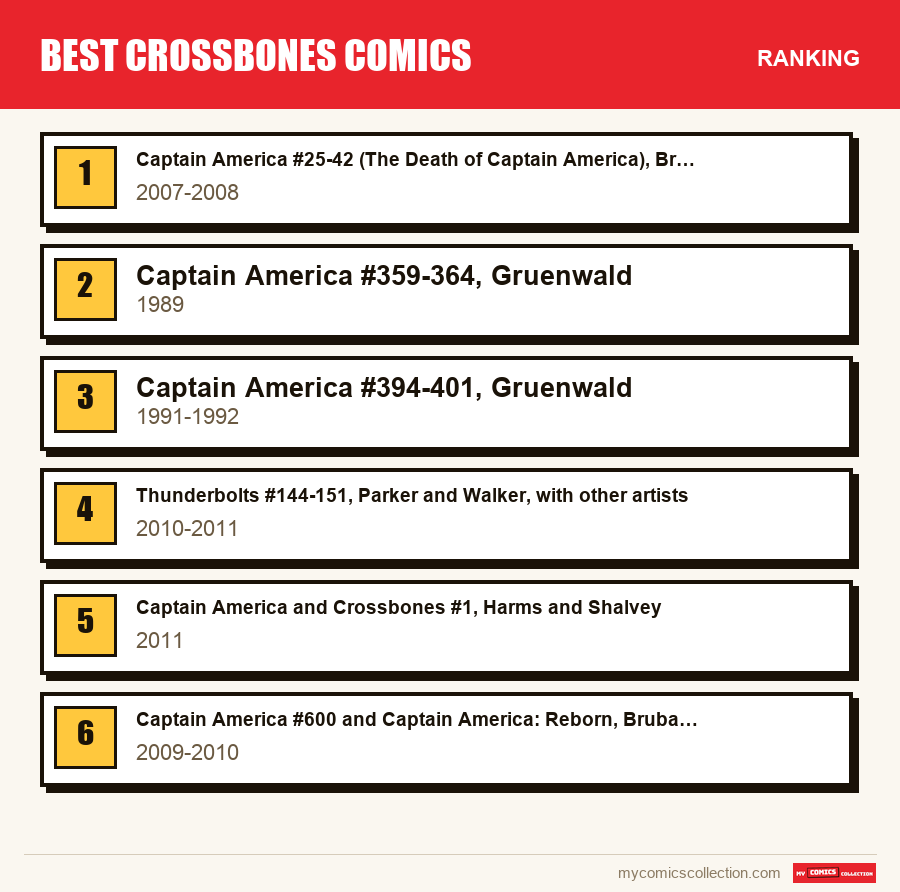
The best Crossbones comics start with the man himself: Crossbones (Brock Rumlow) is the Red Skull's right-hand enforcer, born in Captain America #359 and #360 (1989), written by Mark Gruenwald. To read him at his best, start with The Death of Captain America (Ed Brubaker, 2007-2008), then go back to Gruenwald's 1989 and 1991-1992 issues, and finish with Thunderbolts #144-151 (2010-2011), where he goes from killer to team member.
Few of Captain America's adversaries embody violence in the service of another's will as fully as this one. Crossbones is neither a strategist nor an ideologue: he is the enforcer, the one who obeys the Red Skull when the order is to strike. This ranking keeps stories where he acts in the foreground or plays a decisive part, and spells out his place each time.
As always in this guide, only verified facts (creators, issue numbers, dates) are stated as fact. The analysis is ours, with no reproduction of protected pages or dialogue.
His first appearance
Crossbones was created by writer Mark Gruenwald and artist Kieron Dwyer. He appears in silhouette in Captain America #359, cover-dated October 1989, then makes a full entrance in #360, published the same year. From that moment he is presented as a henchman of the Red Skull, not a leader: his function in the story is to execute.
His past comes into focus later. Brock Rumlow is first the leader of a Lower East Side gang in New York, the Savage Crims. He then goes through the Taskmaster's criminal academy, where he teaches under the name "Bingo Brock" (Captain America #400, May 1992). He serves the mercenary Albert Malik as Frag, then impresses the Red Skull, who gives him his war name (#383, March 1991). You see the principle: the character is rebuilt issue by issue, and publication order matters more than internal chronology.
For the collector, keep two points in mind. #359 is the cameo-appearance issue and #360 the full appearance, so the two are hunted together. Compare copies on the condition of the spine, corners and edge, then read any grade notation. To place these single issues within the long series, the Captain America reading guide serves as a map.
1: Captain America #25-42 (The Death of Captain America), Brubaker with Epting and several artists (2007-2008)
Ed Brubaker writes the arc, published from April 2007 to November 2008 in the fifth Captain America series. Steve Epting draws #25 and its cover; Mike Perkins, Butch Guice, Roberto De La Torre and Luke Ross share the arc's pages with him. Here Crossbones is not the hero but the executor: Captain America is assassinated by Crossbones and by a conditioned Sharon Carter, on the Red Skull's orders.
The rest of the arc follows the hunt for the killers. Tony Stark and the Black Widow look for those who acted, the Falcon follows his own leads, and Bucky Barnes, at first determined to kill Stark, ends up agreeing to become Captain America. What matters for anyone following Crossbones is watching him go from the small-time enforcer of the Gruenwald years to a cog in a large-scale plot, in a story whose dark tone suits the character.
The arc is available in three trade paperbacks and an omnibus, which makes it the entry point we recommend to the modern reader. To place this period, our page on Ed Brubaker: where to start details the rest of his time on the series.
2: Captain America #359-364, Gruenwald (1989)
Mark Gruenwald writes these issues, which run from October to December 1989. Brock Rumlow, sent to observe Helmut Zemo's Bloodstone quest (#359 and #360), then kidnaps Diamondback and challenges Captain America, who beats him (#361-364). This first clash sets the character's dynamic: tough, reliable, but beaten.
#367 (February 1990) shows him leading the Skeleton Crew, a team of henchmen sent in search of the vanished Red Skull. These issues interest the reader who wants to see the character in his original context, that of a monthly series from the late 1980s, with its subplots and serial pacing.
They suit the methodical collector more than the hurried reader: the story stretches out, and the best reason to read it is to understand where the character comes from before moving on to the modern arcs. When buying, look for the single issues in order and check the printed number on each.
3: Captain America #394-401, Gruenwald (1991-1992)
This run goes from November 1991 to June 1992 and is still written by Mark Gruenwald. Crossbones is fired by the Red Skull for questioning his alliance with Viper. To regain leadership of his team, he kidnaps Diamondback again; both are captured, and the Red Skull takes him back for the time being. #400, dated May 1992, details his past at the Taskmaster's academy.
It is the best read of the Gruenwald-era Crossbones, because he finally gains a psychology here: a proud man caught between loyalty and pride. The story is for the reader who enjoys superhero series of the period with their long rivalries, and for the collector of the last third of the series.
For reading, count on eight issues in a row and do not skip #400, which serves as the biographical pivot. If you like spy stories, the file on the history of the Red Skull gives you the thread of his lieutenants.
4: Thunderbolts #144-151, Parker and Walker, with other artists (2010-2011)
Jeff Parker writes the series, and Kev Walker becomes its main artist from #144 (July 2010). Crossbones joins the team there under the influence of government agents and Luke Cage, who hope his methods will pull the group toward rehabilitation. On the first mission, he is exposed to a corrupted Terrigen mist (#147, October 2010). He draws energy beams from it (#149, December 2010), then flames wrap around his head (#150, January 2011). He is dismissed from the team after killing a police officer and apparently loses his powers (#150 and #151, January and February 2011).
The interest of these issues is showing the character in an unprecedented role: a criminal on probation in a team that promises a second chance. He is one member among others there, but his arc is one of the most visible threads of the period. It is the read to recommend to anyone who likes teams of convicts and wants to see Crossbones outside the Captain America frame.
To place the series, the ranking of the best runs of Thunderbolts puts this team in the context of the whole title.
Do you collect this series?
Track what you own, what you are missing and what your collection is worth. 7-day trial.
Start my trial →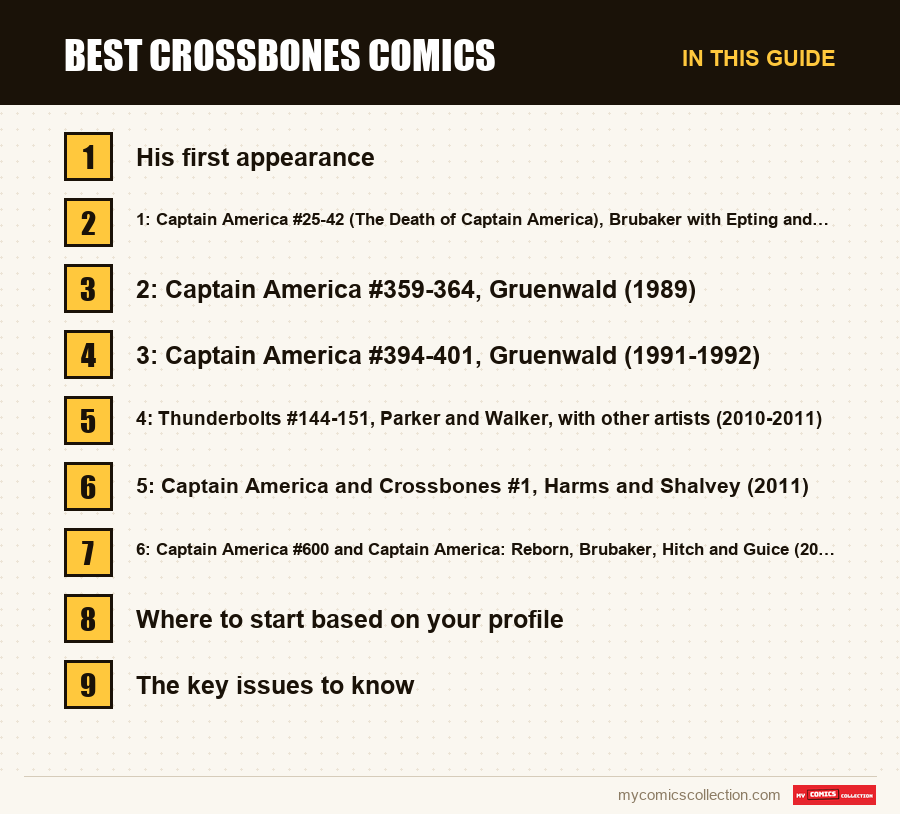
5: Captain America and Crossbones #1, Harms and Shalvey (2011)
The script of the one-shot is by William Harms and the art by Declan Shalvey. Crossbones is its central character, and Captain America barely appears despite the title. It follows the Thunderbolts issues that concern him, and so reads as an epilogue.
The strength of this single issue is its focus: one comic to follow the character alone, without Rogers as a counterpoint. It is for the reader who wants to know what becomes of Crossbones after his disgrace, and for the collector looking for a short piece to complete a set. Read it as an epilogue more than as an entry point.
Keep it for the end of your path: it makes full sense once you know the Crossbones of 1989, the one of 2007 and the one of 2010.
6: Captain America #600 and Captain America: Reborn, Brubaker, Hitch and Guice (2009-2010)
Ed Brubaker writes, Bryan Hitch draws and Butch Guice inks this six-issue miniseries, preceded by #600 (June 2009). Crossbones is not its hero: he plays the role of an enforcer, paired with Sin. In #600, they escape from a H.A.M.M.E.R. site in Colorado. Later, Osborn gives them a mission, then Sin and Crossbones find the Red Skull and take him to Latveria.
The story serves mostly as Steve Rogers's comeback, but for anyone following Crossbones, it shows where the character stands in the machinery of the opposing camp: with Sin, he is one of the Red Skull's two reliable executors. It is a companion read to the 2007 assassination, to be placed after it.
Where to start based on your profile
If you want the most accessible and most striking Crossbones, read The Death of Captain America, preferably in a trade paperback. If you prefer going back to the sources, open Captain America #359 and #360 from 1989, then #361-364, before leaping ahead to 2007.
If you are looking for a character who evolves, chain together Gruenwald's 1991 and 1992 issues, then Thunderbolts #144-151, and finish with the 2011 one-shot. If you like espionage and conspiracy machinery, read Reborn after Rogers's death. For the full panorama of the series, the ranking of Captain America runs shows what surrounds these arcs.
On the big screen, the role is played by Frank Grillo: in The Winter Soldier (2014) as the field leader of S.T.R.I.K.E., then in Civil War (2016). The comics offer an older version of the character; read them for their own sake rather than to find the screen version again.
The key issues to know
In the 1968 Captain America series, remember #359 (October 1989), Crossbones's cameo, and #360 (1989), his full appearance: Mark Gruenwald and Kieron Dwyer are the creators. #383 (March 1991) sheds light on the birth of his war name, and #400 (May 1992) on his past at the Taskmaster's academy.
More recently, #25 of the fifth series (April 2007) opens The Death of Captain America. Thunderbolts #144 (July 2010) marks his entry into the team, #147 (October 2010) his exposure to the Terrigen mist, and #150 and #151 his dismissal. Devil's Reign #2 (February 2022) shows him among Mayor Wilson Fisk's Thunderbolts.
A key issue, here, is a single issue that introduces the character or changes his course. The overview of the modern key issues of Captain America places these comics within the series, and the label of a graded copy should be read in full before any purchase.
Frequently asked questions
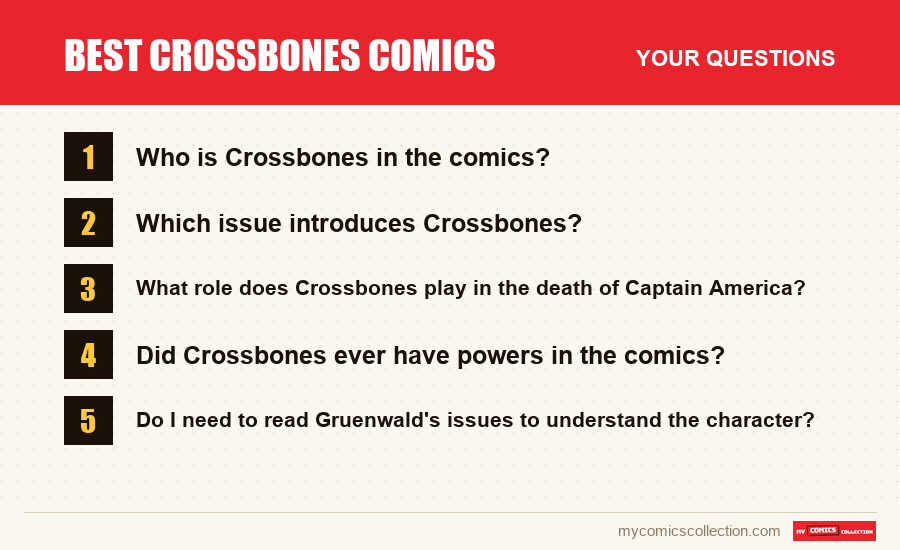
Crossbones is Brock Rumlow, a mercenary in the service of the Red Skull, an adversary of Captain America. Created by Mark Gruenwald and Kieron Dwyer, he appears in 1989 in the Captain America series. He has no powers originally and stands out for his violence and loyalty.
He appears in silhouette in Captain America #359, dated October 1989, then fully in #360, the same year. The writer is Mark Gruenwald, and artist Kieron Dwyer is among the creators. The two comics are hunted together, since one sets up the other.
In The Death of Captain America (2007), Steve Rogers is assassinated by Crossbones and by a conditioned Sharon Carter, on the Red Skull's orders. Ed Brubaker is the writer. Crossbones is the executor there, not the hero of the story.
Yes, briefly. In Thunderbolts, exposure to a corrupted Terrigen mist (#147, 2010) gives him energy beams (#149). After his dismissal from the team (#150 and #151, 2011), he apparently loses his powers. Outside that parenthesis, he fights without them.
Not to follow the modern stories, which stand alone. But the 1989 to 1992 issues give his origins and psychology, notably #400 on his past. They mainly interest the collector or the reader who wants to understand what the recent arcs add.
Do you own Captain America issues from 1989 or the early 1990s? Have them estimated before you sell them or send them in for grading.
Estimate my comic